Poses in European royal portraits: profile, three-quarter view, full length and on horseback
Why European rulers were painted in profile, turned three-quarters, standing full length or on horseback, and what each pose told the people who saw it.
By Purrealism. Part of European royal portraits: how Europe's courts painted their rulers.
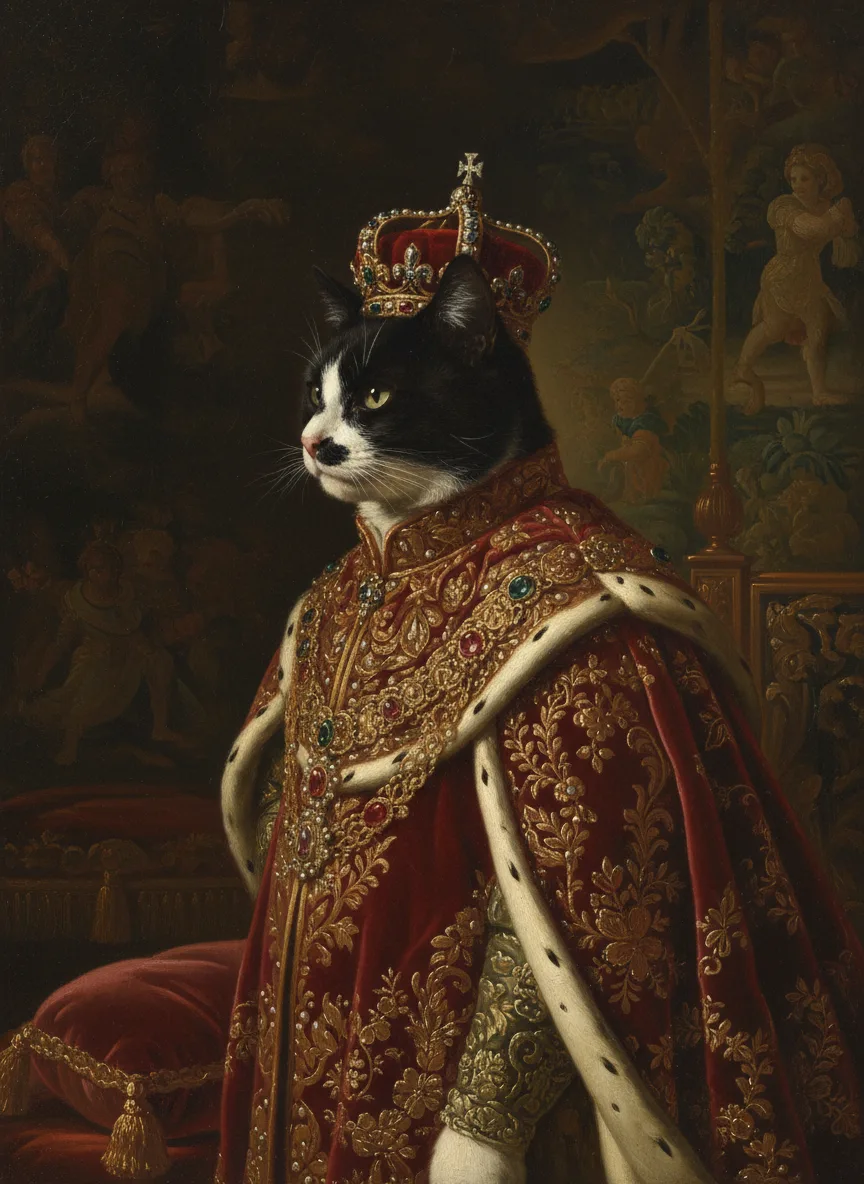
This page is about the body in a royal portrait: which way the ruler faces, how much of the body the painter shows, and whether the ruler stands, sits or rides. Each of these choices had a meaning at a European court. A side view recalled Roman emperors. A face turned toward us felt closer and more alive. A full-length figure near life size covered a wall in a palace hall, and a king on horseback looked like a commander. Knowing the poses helps you read any royal portrait, and it helps you picture which pose suits your own dog or cat. For the objects placed around the ruler, see the companion page on symbols of royal power, and for the whole subject, start at the main guide to European royal portraits.
Why the pose mattered
A court portrait had a job. It told everyone who saw it that this person ruled. The person being painted is called the sitter.
Where the ruler looks is one of the first things to read. The National Gallery in London describes Giovanni Bellini's portrait of Leonardo Loredan, the doge (elected ruler) of Venice from 1501 to 1521. Loredan knows he is being looked at, but he does not meet our eyes. The gallery explains that returning the gaze would treat the viewer as an equal, and nobody looking at the picture was his equal.
The profile: the oldest court pose
The profile, a strict side view of the head, is the earliest pose covered in this guide.
The Louvre in Paris holds a small portrait of John II of France, known as Jean le Bon, which the museum dates to 1355 to 1360. It is painted in tempera, a paint made with egg, on a gold background, and measures 60 by 45 centimetres. The king's head is shown in pure side view, and the words "Jehan roy de France" (John, king of France) run across the gold above him. His profile, his long hair and the inscription identify him.
The National Gallery explains where this pose came from. It says the profile was adopted from the heads of emperors on Roman coins and medals, so it became a symbol of power and social rank. Florentine painters kept using it until 1470, by the gallery's approximate dating. The gallery's example is Alesso Baldovinetti's Portrait of a Lady, probably painted for a marriage, in which the side view gives the family's coat of arms on her sleeve as much space as her face.
The profile stayed the normal pose for rulers. The National Gallery says portraits of the doges of Venice had followed the normal convention for portraits of rulers, which was the strict profile, until Bellini changed it.
The three-quarter view
In a three-quarter view, the head is turned partly toward the viewer, so you see one side of the face fully and the other side in part. Both eyes are visible, and the face looks rounder and more alive.
The National Gallery says the three-quarter pose, the dark background and the strong light were innovations from Northern Europe. Its key example is Jan van Eyck's portrait of a man from 1433, painted in Flanders. Antonello da Messina brought the formula to Venice. The gallery dates his Portrait of a Man to 1475 or 1476 and says only 12 of his portraits survive, all men, all shown head and shoulders against a dark background. Other painters in Venice quickly copied him.
Bellini then used the same view for the doge. The National Gallery says he used "the more contemporary three-quarter view", popularised in Venice by artists such as Antonello from the 1470s, to explore Loredan's character. A ruler's portrait could now show a thinking person as well as an office.
Pairs of portraits followed their own rule. The National Gallery says that in a pair of panels, the convention was to turn each sitter three-quarters toward the other. In Lucas Cranach's 1509 double portrait of two future electors of Saxony, a father and son, the painter broke this rule and turned the six-year-old son toward the viewer instead, to give the boy more presence.
How much of the body to show
Painters also chose how much of the body to include.
- Bust or head and shoulders. The National Gallery says Antonello's sitters are cropped at the shoulders, so they look like a carved portrait bust.
- Half length. Bellini painted Loredan to the chest, with the arms hidden, behind a stone ledge. The gallery says this recalls ancient marble busts of emperors, which stood on plinths.
- Three-quarter length. Raphael's Pope Julius II shows the pope seated, from the head to below the knees. The National Gallery says it was probably painted soon after 27 June 1511, and it became the model for portraits of churchmen for the next 200 years. It names Titian, El Greco and Velázquez among the painters who followed it.
- Full length. The whole figure, from head to feet.
The full-length state portrait
A state portrait is the official picture of a ruler. It is usually full length, and it often shows the ruler standing near life size.
Size signalled rank. The National Gallery says that visitors to Gerrit van Honthorst's 1642 portrait of Elizabeth Stuart, Queen of Bohemia, would have judged her status and nobility from its near life-size scale and her lace and silks, even before an inscription naming her was added.
The Spanish court used the standing pose for its king. The National Gallery's Philip IV of Spain in Brown and Silver, painted by Diego Velázquez in 1631 or 1632, shows the king full length beside a table covered in red velvet. The gallery says the head was painted from life and then served as the pattern for other half-length and full-length portraits by Velázquez and his workshop.
The Palace of Versailles calls Hyacinthe Rigaud's Louis XIV of 1701 an emblem of absolute monarchy across Europe. The Louvre gives its size as 2.77 by 1.94 metres. The king stands in his coronation mantle beside a throne, with his right leg forward, and the crown and the hand of justice, a sceptre topped with a small hand, rest on a cushion beside him. The Louvre says the king admired the picture so much that he kept it, and had Rigaud paint a second version for his grandson, Philip V of Spain. The Louvre says Rigaud probably borrowed this pose from a statue of the king by Martin Desjardins, put up in Paris in 1686, and that the leg recalls the king's early passion for dance. The museum adds that courtiers copied the pose. The marquis de Dangeau, for one, ordered a half-length portrait from Rigaud in 1702 in the same attitude as the king.
Official portraits were copied again and again. The Wallace Collection in London says Allan Ramsay began his full-length portrait of George III in coronation robes in December 1761, and that over 100 replica versions appear to have been made, many by Ramsay himself. In France, the same museum says, a workshop of copyists at Versailles called the Cabinet du Roi was set up to reproduce official portraits, and copies of Louis-Michel van Loo's Louis XV were sent as diplomatic gifts and hung in embassies and public buildings.
Seated and enthroned
A ruler could also be shown sitting on a throne. Westminster Abbey holds a wooden panel painting of Richard II from the 1390s, which it calls the earliest known portrait of an English monarch. The king sits in the Coronation Chair in his coronation robes, holding the orb and sceptre. The panel is 213.5 centimetres high.
The same seated pose appeared on royal seals. The National Archives in London explains that every English sovereign since Edward the Confessor has used a double-sided great seal, nearly always showing the ruler enthroned "in majesty" on one side and on horseback on the other. The medieval page of this guide, on medieval royal portraits, looks at those seals in more detail.
A seat could also send a quieter message. In Juan Bautista Martínez del Mazo's portrait of Queen Mariana of Spain from 1666, the widowed queen sits on a throne-like chair in the royal palace in Madrid. The National Gallery says her pose suggests she is sitting only for a moment, perhaps because her rule as regent for her young son was temporary.
On horseback
The National Gallery says equestrian portraits, pictures of a person on horseback, were a popular way of displaying power for centuries. It names the ancient bronze statue of Emperor Marcus Aurelius on horseback in Rome as a famous early example.
Anthony van Dyck's Equestrian Portrait of Charles I, which the gallery dates to 1638 to 1639, is over 3.5 metres high, the largest of his portraits of the king. The gallery says a portrait of the Emperor Charles V on horseback by Titian probably inspired it. The king holds the reins of a powerful horse, a sign of his control over his state. The gallery adds that he lost that control in civil war and was executed in January 1649. The horse's legs are placed in a step from dressage, the fashionable sport of training a horse to move in set patterns.
Generals were painted this way too. The National Gallery says Francisco de Goya painted a large portrait of the Duke of Wellington on horseback in Madrid in 1812, now at Apsley House in London. For uniforms, medals and battle scenes, see the page on military portraits.
Gestures: the hand on the hip and the speaking hand
Smaller gestures carried meaning too. The National Gallery says Pompeo Batoni's portrait of Richard Milles, painted in Rome during Milles's Grand Tour in the late 1750s, uses a swaggering pose with one hand on the hip. The gallery says Titian and Van Dyck had used the same pose to show a sitter's commanding presence.
In Hyacinthe Rigaud's portrait of the royal treasurer Antoine Pâris, probably from 1724, the sitter raises his right hand. The National Gallery says this is the gesture that Quintilian, a Roman writer on public speaking, described as the most fitting for eloquent speech.
Choosing a pose for a pet portrait
The same choices apply to a portrait of your dog or cat. A photo taken from the side gives you the clean outline of a profile. A photo with your pet's head turned partly toward you gives the livelier three-quarter view that Antonello and Bellini used. A photo taken straight on works for a formal, frontal look.
The portrait studio takes one photo of up to 5 MB. The gallery shows example portraits in the Renaissance Royal, Baroque Aristocrat, Regency Era, Victorian Noble and Military General styles, so you can see how different head angles look. For twelve famous paintings of the period and where to see them, read famous Renaissance paintings. The style finder on this page asks a few questions about your pet and suggests one of the six European styles.
Try it
European style finder
Answer four questions about your pet. The finder suggests one of the European styles and shows a portrait painted in it.
Answer all four questions to see your suggestion.
Questions and answers
What is a state portrait?
A state portrait is the official picture of a ruler, usually standing full length in coronation robes with the crown and other royal objects nearby. The Wallace Collection says Allan Ramsay's state portrait of George III, begun in December 1761, was so wanted that over 100 replica versions appear to have been made. Copies went to embassies, public buildings and loyal friends.
What is a 3/4 portrait?
A 3/4 portrait can mean two things. In a three-quarter view, the face is turned partly toward the viewer, between a side view and a front view. In a three-quarter length portrait, the painting shows the person from the head to below the waist. The National Gallery says Raphael's three-quarter length Pope Julius II, probably painted in the summer of 1511, became the model for portraits of churchmen for 200 years.
Why were early portraits of rulers painted in profile?
Early portraits of rulers were painted in profile because the side view copied the heads of emperors on ancient Roman coins and medals. The National Gallery in London says this link made the profile a symbol of power and social rank, and that Florentine painters kept the format until 1470, by the gallery's approximate dating. A profile also shows the nose, chin and hairline clearly, which makes the sitter easy to recognise.
Who brought the three-quarter view to Italian portraits?
Antonello da Messina helped bring the three-quarter view to Venetian portraits in the 1470s. The National Gallery in London says his three-quarter pose, dark background and strong light were ideas from Northern Europe, and that other painters quickly copied his formula. The gallery names Jan van Eyck's portrait of a man from 1433 as a key example of the Flemish type he followed.
Why does the doge in Bellini's portrait not look at the viewer?
The doge in Giovanni Bellini's portrait does not meet our eyes because he outranks everyone looking at him. The National Gallery in London explains that returning the gaze would treat the viewer as an equal, and Leonardo Loredan was the elected ruler of Venice from 1501 to 1521. Bellini painted him half length behind a stone ledge, like a marble bust of an emperor.
Who painted Louis XIV portrait?
Hyacinthe Rigaud painted the best-known portrait of Louis XIV in 1701. The Louvre, which holds the signed first version, gives its size as 2.77 by 1.94 metres. The king stands in his coronation mantle beside a throne, with the crown and the hand of justice on a cushion. The Louvre says courtiers copied the pose, and that Rigaud painted a second version for the king's grandson, Philip V of Spain.
Why is Louis XIV showing his legs in the Rigaud portrait?
Louis XIV shows his legs in Hyacinthe Rigaud's 1701 portrait because the pose recalls his love of dance and a statue of him. The Louvre says Rigaud probably borrowed the forward right leg from Martin Desjardins's statue of the king, put up in Paris in 1686. The Louvre adds that the pose seems to recall the king's early passion for dancing.
What are equestrian portraits?
Equestrian portraits show a person on horseback. The National Gallery in London says they were a popular way to display power for centuries, and names the ancient bronze statue of Emperor Marcus Aurelius in Rome as a famous early example. Anthony van Dyck's Equestrian Portrait of Charles I, which the gallery dates to 1638 to 1639, is over 3.5 metres high.
What does holding the reins mean in a royal portrait?
Holding the reins in a royal portrait stands for the ruler's control over his state. The National Gallery in London explains that in Van Dyck's Equestrian Portrait of Charles I the king calmly grasps the reins of a powerful horse, showing his strength and his power to command. The gallery adds that Charles lost that control in civil war and was executed in January 1649.
Why were royal portraits copied so many times?
Royal portraits were copied many times because courts, embassies and loyal subjects all wanted an image of the ruler. The Wallace Collection says a studio of copyists at Versailles, the Cabinet du Roi, was set up to reproduce official portraits, and that copies of Louis-Michel van Loo's Louis XV served as diplomatic gifts. The same museum says over 100 replicas of Ramsay's George III appear to exist.
What does a hand on the hip mean in a portrait?
A hand placed firmly on the hip shows confidence and command in a European portrait. The National Gallery in London says Pompeo Batoni's portrait of Richard Milles, painted in Rome during Milles's Grand Tour in the late 1750s, uses this swaggering pose, and that earlier painters such as Titian and Van Dyck used it to establish a sitter's commanding presence and self-assurance.
Sources
- Alesso Baldovinetti, Portrait of a Lady, National Gallery, London. Accessed September 29, 2026.
- Jean II le Bon (1319-1364), Musée du Louvre. Accessed September 29, 2026.
- Giovanni Bellini, Doge Leonardo Loredan, National Gallery, London. Accessed September 29, 2026.
- Antonello da Messina, Portrait of a Man, National Gallery, London. Accessed September 29, 2026.
- Lucas Cranach the Elder, Diptych: Two Electors of Saxony, National Gallery, London. Accessed September 29, 2026.
- Raphael, Pope Julius II, National Gallery, London. Accessed September 29, 2026.
- Diego Velázquez, Philip IV of Spain in Brown and Silver, National Gallery, London. Accessed September 29, 2026.
- Gerrit van Honthorst, Elizabeth Stuart, Queen of Bohemia, National Gallery, London. Accessed September 29, 2026.
- Louis XIV (1638-1715), roi de France, Musée du Louvre. Accessed September 29, 2026.
- George III, The Wallace Collection. Accessed September 29, 2026.
- Louis XV, The Wallace Collection. Accessed September 29, 2026.
- Richard II and Anne of Bohemia, Westminster Abbey. Accessed September 29, 2026.
- Juan Bautista Martínez del Mazo, Queen Mariana of Spain in Mourning, National Gallery, London. Accessed September 29, 2026.
- Seals, The National Archives. Accessed September 29, 2026.
- Anthony van Dyck, Equestrian Portrait of Charles I, National Gallery, London. Accessed September 29, 2026.
- Francisco de Goya, The Duke of Wellington, National Gallery, London. Accessed September 29, 2026.
- Pompeo Girolamo Batoni, Portrait of Richard Milles, National Gallery, London. Accessed September 29, 2026.
- Hyacinthe Rigaud, Antoine Pâris, National Gallery, London. Accessed September 29, 2026.
- Louis XIV en grand costume royal, par Hyacinthe Rigaud, Château de Versailles. Accessed September 29, 2026.
Short reads on this topic
Articles from Purrspectives that answer one question each.
What was the Victorian era? Dates, fashion and portraits of 1837 to 1901
The Victorian era is Queen Victoria's reign, 1837 to 1901. Her life, what Victorians wore, and how they had portraits painted and photographed.
Military dog portraits: the real dogs who served, and your dog as a general
Real war dogs such as Stubby and Gander earned medals and a rank. Here is their story, and how to make a dog general portrait of your own dog.
Dogs in medieval paintings and manuscripts: hunting hounds, lapdogs and faithful friends
Medieval dog paintings show hunting hounds, lapdogs and loyal dogs in painted books, on church brasses and in the Bayeux Tapestry. Where to find each one.