Medieval royal portraits: how kings were shown on seals, tombs and panels
Before the painted portrait, medieval kings appeared on seals, tomb effigies and altarpieces. How to read them, from Richard II to the Wilton Diptych.
By Purrealism. Part of European royal portraits: how Europe's courts painted their rulers.
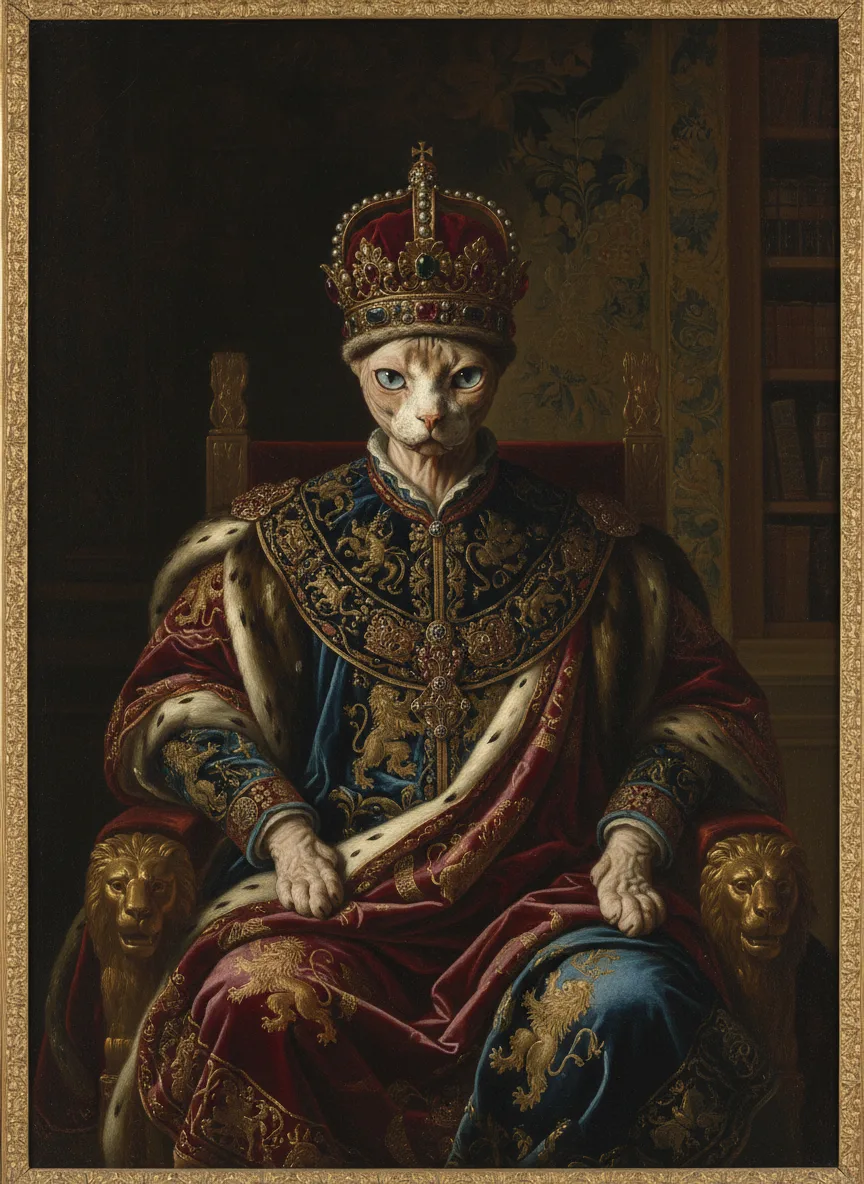
Medieval kings and queens were pictured long before anyone painted a portrait to hang on a wall. They appeared on wax seals, on the lids of their tombs, in the pages of books and on small painted altarpieces. Many of these images show a crowned figure on a throne or a knight on a horse, with a name or a coat of arms to say who it is. This page explains each kind of image, how to read it, and how the first true likenesses of European rulers appeared in the 1300s and 1400s. It covers the period before the Renaissance, which has its own page on Renaissance and Tudor portraits, and it is part of the guide to European royal portraits.
Seals: the king in two poses
A seal is a design pressed into wax from a carved metal stamp. The National Archives in London explains that seals often carried their owner's portrait or coat of arms and were used to approve documents such as charters and letters, in much the same way we use signatures today. The Archives holds over a quarter of a million seals, from the 11th to the 20th century.
The most important seal was the great seal. The National Archives says every sovereign of England since Edward the Confessor has used a large, double-sided great seal. It nearly always shows the ruler on one side enthroned, "in majesty", usually holding a sceptre, a sword or an orb, and on the other side on horseback, in the pose the Archives calls equestrian. The Archives lists a great seal of Richard I from 1189 among its holdings.
King's College, Cambridge, which keeps seals in its own archive, describes the same two faces. On one side the king rides with a drawn sword and a shield bearing the royal arms. On the other he sits on the throne with the crown and sceptre.
A seal also told you whose it was in words. The National Archives says the name and title of the owner ran around the edge, usually beginning with sigillum, Latin for "seal of", much like the words on a coin. These two designs, the ruler on the throne and the ruler on a horse, came back again and again in later painted portraits. The page on royal portrait poses follows them into the 1600s and 1700s.
Books for the coronation
Coronations produced their own images. Westminster Abbey says crowns have appeared in coronations for over 1,000 years and are shown in manuscripts from the 10th century onwards. It says the Liber Regalis, a Latin book that brought together the order of the English coronation service, was produced in 1390, by the Abbey's approximate dating. The Abbey adds that the book is said to have been written for the coronation of Anne of Bohemia, Richard II's first queen, and that it contains three pictures of coronation scenes, the king alone, the queen alone and the two together, and one of a royal funeral.
Tomb effigies
An effigy is a full-size figure of a dead person that lies on top of the tomb. The Church Monuments Society says the most prestigious type of medieval tomb had an effigy cast in gilded copper alloy, and that such effigies were made across Europe, from Denmark to Portugal. Most of those made in England were destroyed in later religious and civil conflicts, but a handful survive.
One of them belongs to Edward, the Black Prince, eldest son of Edward III, in Canterbury Cathedral. The society says the prince set out the form of his monument in his will. He is shown as an adult crown prince in armour, lying with his head on his helmet, his hands in prayer and his feet on a leopard. Over his armour he wears a tight coat showing his coat of arms.
Westminster Abbey holds the double tomb of Richard II and his first wife, Anne of Bohemia, made between 1396 and 1399. The Abbey says it was the first double royal tomb, and that it cost £933, 6 shillings and 8 pence. The gilt bronze effigies were stamped all over with royal badges. Richard asked for the two figures to hold hands, though the hands have since broken off. The Abbey says both effigies "are undoubtedly portraits": the king has the same short, wispy beard as in his painted portrait.
The first painted likenesses
Painted portraits of single rulers appear in the 1300s. The Louvre in Paris holds a small portrait of King John II of France, called Jean le Bon, by an unknown Parisian painter. The museum dates it to 1355 to 1360. It is painted in tempera, a paint made with egg, on a gold background, and measures 60 by 45 centimetres. The king is shown in strict side view with long hair and no crown. Above his head, the words "Jehan roy de France" (John, king of France) run across the gold.
In England, the earliest known portrait of a monarch is at Westminster Abbey. The Abbey dates this wooden panel of Richard II to the 1390s and gives its size as 213.5 by 110 centimetres. The king sits in the Coronation Chair wearing coronation robes and holding the orb and sceptre. The Abbey says the court painter André Beauneveu has been suggested as the artist. The panel first hung beside the choir stalls, and the Abbey says it was placed there to represent the king.
The panel has changed over time. The Abbey says that during a restoration in 1866, the patterned gilt background and the raised decoration on the crown, orb and sceptre were removed, and only a few patches survive.
The Wilton Diptych: a king among saints
A detailed painted image of a medieval English king survives in the Wilton Diptych in the National Gallery in London. A diptych is a painting on two hinged panels that fold shut like a book. The gallery dates this one to 1395 to 1399, says it was made for Richard II's private prayers, and calls it one of a handful of English panel paintings to survive from the Middle Ages.
On the inside, the young king kneels, shown in profile, while three saints present him to the Virgin Mary and the Christ Child. Two of the saints, Edmund and Edward the Confessor, were English kings, and the gallery says they were central to Richard's idea of sacred kingship. An angel holds a white banner with a red cross, and on top of its pole sits a tiny orb showing an island with trees and a white tower, which stands for England.
The picture is full of personal signs. Richard wears a jewel in the shape of a white hart, a white stag, which was his own badge, and a collar of gold broomcods, the seed pods of the broom plant. The gallery explains that broom is planta genista in Latin, a play on his family name, Plantagenet. The angels wear white hart badges too, to show they are his supporters. On the outside, the English royal arms are joined with those of Edward the Confessor.
The gallery also points out a puzzle. Richard appears as a beardless youth, although the diptych dates from the years when he was a grown man. Technical analysis shows that his head was painted in late. The gallery asks whether he is shown as he looked when he was crowned at the age of ten.
Coats of arms: identity before likeness
The Heraldry Society says people have long wanted to identify themselves by a personal sign, and that these signs first appeared as impressions on seals, then moved to battle shields and from there to the cloth coats worn over armour, which may be where the phrase "coat of arms" comes from. It says the first formal appearance of heraldry as we know it came in 1128, when Henry I of England gave a shield to Geoffrey of Anjou at his knighting. The Third Crusade of 1189 spread the practice across Europe, and in 1484 Richard III founded the College of Arms to regulate it.
What a medieval knight wore over his armour, and how the surcoat carried his arms, is explained in what a medieval knight wore. For the crown, orb and sceptre in later portraits, see symbols of royal power.
Fur and cloth at the medieval court
The fur in these images reflects real spending at court. A history of the English fur trade, published by the London Record Society, says 1,634 ermine skins were bought for Richard II between 1392 and 1394, along with an average of over 100,000 squirrel skins a year. The ermine lining of Richard's robe in the Westminster portrait was a real luxury of his court.
Toward the modern portrait
By the 1430s, painters in Flanders were making portraits of individual people with great precision. The National Gallery's Portrait of a Man by Jan van Eyck is signed and dated 10 October 1432. The unknown sitter holds a scroll and wears a green headdress called a chaperon and a red robe trimmed with brown fur. Carved into a stone ledge in front of him are the French words "Léal Souvenir", meaning loyal remembrance. The gallery says this might mean the picture is a good likeness or a keepsake.
The Medieval Knight style
Purrealism's Medieval Knight style is one of its six European styles. You can choose it in the portrait studio with one photo of your pet of up to 5 MB. The gallery shows finished examples in five of the European styles, which helps you compare the look of each before you decide.
Questions and answers
Are medieval portraits accurate?
Medieval portraits mix real likeness with ideal images. Westminster Abbey says the gilt bronze effigies of Richard II and Anne of Bohemia are undoubtedly portraits, and that the king has the same short, wispy beard as in his painted portrait. The National Gallery in London says the Wilton Diptych shows Richard as a beardless youth, although it is dated to the late 1390s, when he was a grown man.
Why do medieval portraits look the same?
Many medieval images of rulers look alike because they followed set designs. The National Archives in London says English great seals nearly always showed the sovereign enthroned on one side and on horseback on the other. The owner's name and title ran around the edge in words usually beginning with sigillum, Latin for seal of.
What is the earliest known portrait of an English king?
The earliest known portrait of an English king is a wooden panel painting of Richard II at Westminster Abbey, dating from the 1390s. The Abbey says it shows the king seated in the Coronation Chair, wearing coronation robes and holding the orb and sceptre. The panel measures 213.5 by 110 centimetres, and the Abbey says the court painter André Beauneveu has been suggested as the artist.
What was the great seal of England?
The great seal of England was the monarch's official stamp, pressed into wax to approve documents in the way a signature does today. The National Archives in London says every sovereign since Edward the Confessor has used a double-sided great seal, nearly always showing the ruler enthroned on one side and on horseback on the other. The Archives holds over a quarter of a million seals.
What does in majesty mean on a royal seal?
In majesty on a royal seal means the sovereign is shown seated on a throne, usually holding a sceptre, a sword or an orb. The National Archives in London uses the term for one of the two sides of the great seal of England. The other side, which it calls equestrian, shows the ruler on horseback, usually in armour.
What is the Wilton Diptych?
The Wilton Diptych is a small folding altarpiece of two painted panels made for Richard II of England, which the National Gallery in London dates to 1395 to 1399. It shows the kneeling king presented to the Virgin Mary and the Christ Child by three saints. The gallery says it is one of a handful of English panel paintings to survive from the Middle Ages.
Why is Richard II shown as a boy in the Wilton Diptych?
Nobody knows for certain why Richard II appears as a beardless boy in the Wilton Diptych. The National Gallery in London says technical analysis shows his head was painted in at a late stage, and asks whether he is shown as he looked when crowned at the age of ten. The gallery adds that he was fascinated by crowns and coronations.
What is a tomb effigy?
A tomb effigy is a life-size figure of the dead person carved or cast to lie on top of a tomb. The Church Monuments Society says gilt copper-alloy effigies were among the most prestigious medieval tombs. Its example, the Black Prince in Canterbury Cathedral, lies in armour with his head on his helmet, his hands in prayer and his feet on a leopard.
What was the Liber Regalis?
The Liber Regalis is an illuminated manuscript that set out the order of the English coronation service. Westminster Abbey dates it to 1390, as an approximate date, and says it brought together the elements of the ceremony, and that it is said to have been written for the coronation of Anne of Bohemia. It has three pictures of coronation scenes and one of a royal funeral.
Who received the first recorded coat of arms?
Geoffrey of Anjou received the shield that the Heraldry Society calls the first formal appearance of heraldry as we know it. The society says Henry I of England presented him with a shield in 1128, at the ceremony where Geoffrey was knighted. It adds that the Third Crusade of 1189 spread heraldry across Europe, and that Richard III founded the College of Arms in 1484.
What is the portrait of John the Good in the Louvre?
The portrait of John the Good in the Louvre is a small painting of King John II of France by an unknown Parisian artist, which the museum dates to 1355 to 1360. It is painted in tempera on a gold background and measures 60 by 45 centimetres. The king appears in strict profile, and the words Jehan roy de France run across the gold above his head.
Sources
- Seals, The National Archives. Accessed September 29, 2026.
- Seals: Stamps of Authority, King's College, Cambridge. Accessed September 29, 2026.
- A guide to coronations, Westminster Abbey. Accessed September 29, 2026.
- Richard II and Anne of Bohemia, Westminster Abbey. Accessed September 29, 2026.
- Edward, the Black Prince, d. 1376, Canterbury Cathedral, Kent, Church Monuments Society. Accessed September 29, 2026.
- Jean II le Bon (1319-1364), Musée du Louvre. Accessed September 29, 2026.
- The Wilton Diptych, National Gallery, London. Accessed September 29, 2026.
- Heraldry: The beginnings, The Heraldry Society. Accessed September 29, 2026.
- Jan van Eyck, Portrait of a Man ('Léal Souvenir'), National Gallery, London. Accessed September 29, 2026.
- VII. Fashions in Fur, British History Online (London Record Society). Accessed September 29, 2026.
Short reads on this topic
Articles from Purrspectives that answer one question each.
What was the Victorian era? Dates, fashion and portraits of 1837 to 1901
The Victorian era is Queen Victoria's reign, 1837 to 1901. Her life, what Victorians wore, and how they had portraits painted and photographed.

Military dog portraits: the real dogs who served, and your dog as a general
Real war dogs such as Stubby and Gander earned medals and a rank. Here is their story, and how to make a dog general portrait of your own dog.
Dogs in medieval paintings and manuscripts: hunting hounds, lapdogs and faithful friends
Medieval dog paintings show hunting hounds, lapdogs and loyal dogs in painted books, on church brasses and in the Bayeux Tapestry. Where to find each one.