Military portraits in European art: armour, uniforms, batons and medals
How European kings, generals and officers were painted as soldiers, from tournament armour to red coats and rows of medals, and how to read each sign.
By Purrealism. Part of European royal portraits: how Europe's courts painted their rulers.
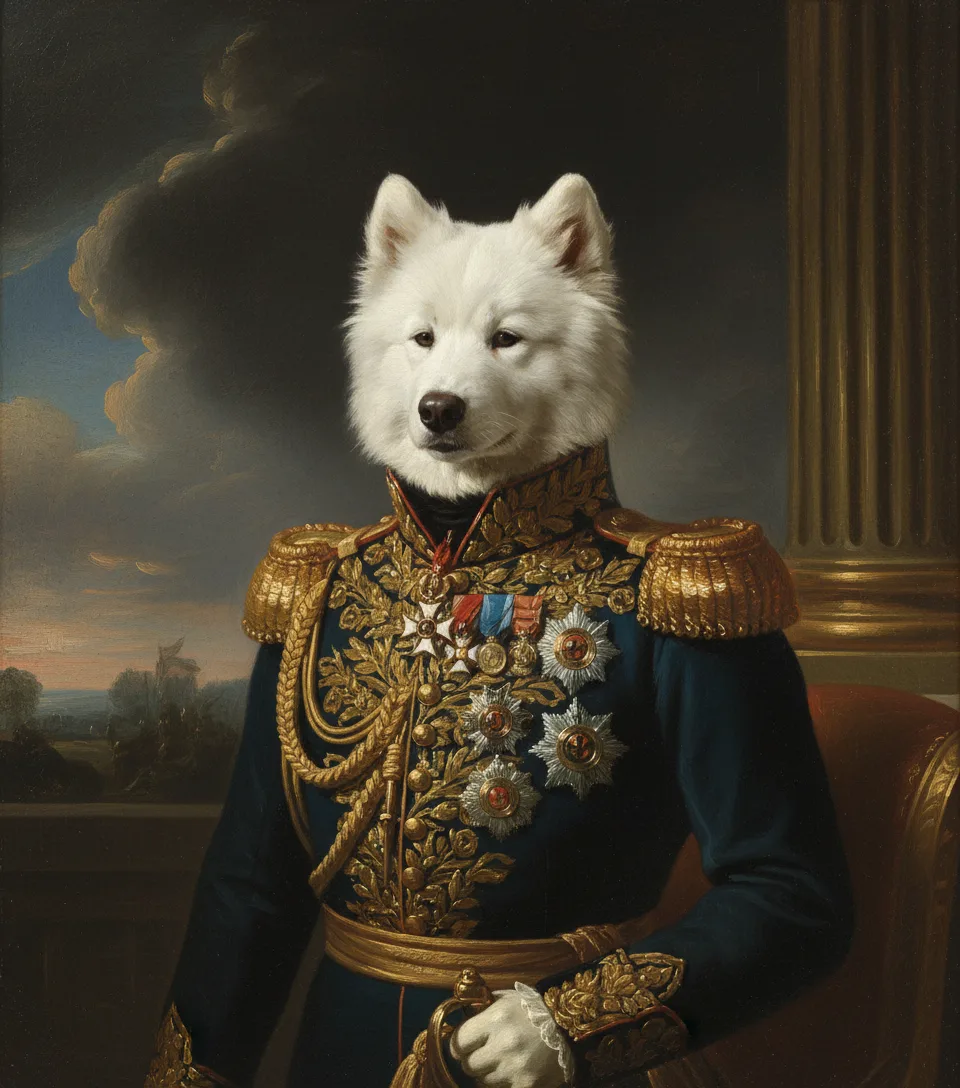
Kings, princes and generals were often painted as soldiers. A ruler in shining armour, a colonel in a red coat on a smoky battlefield, a duke with a chest full of stars: each of these pictures says "this person commands". This page explains how military portraits were composed in Europe from the 1500s to the 1800s, and how to read their signs: armour, the baton of command, the uniform, and the medals and orders pinned to the coat. For the royal regalia that sit beside them, see symbols of royal power, and for the wider story, the guide to European royal portraits.
Armour as a sign of rank
The Wallace Collection in London holds a late 15th century South German armour for both a man and his horse. The museum says only three full equestrian armours made before the 16th century survive in the world, and that its own is the only one kept complete as first made. It has served for 150 years as a standard image of the medieval European knight.
Armour could also appear as a statement of character. The National Gallery in London holds Giovanni Battista Moroni's A Knight with his Jousting Helmet, painted in the 1550s. The sitter, thought to be Count Faustino Avogadro of Brescia, wears a padded leather jacket called an arming doublet, with mail laced to it to cover the gaps in the plate. His plumed helmet and his rapier, a sword inlaid with gold and silver, were made for tournaments. Pieces of his armour lie scattered on the floor, which the gallery says is unusual and has never been explained. It suggests the ruined setting may point to the lasting virtues of the sitter.
Kings kept wearing armour in their portraits. The National Gallery says Anthony van Dyck shows Charles I in fine armour on horseback, his long hair and pearl earring about to be hidden by the helmet his servant is passing him: glamorous, but also ready for battle. Rubens painted the Earl of Arundel twice as a man of action, in armour and looking straight at the viewer. In the 1700s armour could be a studio prop. The gallery says the same suit appears in three portraits by the French painter Jean-Marc Nattier, including its own Portrait of a Man in Armour, whose sitter wears the medal of a knight of the military Order of Saint Louis.
What a medieval knight actually wore into battle is explained in what a medieval knight wore. The Purrspectives article on military dog portraits tells the stories of real dogs who served in war.
The baton of command
A baton is a short, decorated rod carried by a commander. The National Gallery says the baton in Van Dyck's portrait of Charles I signals the king's senior military rank. In Britain, the highest rank is field marshal. The National Army Museum says the Duke of Wellington earned a field marshal's baton for destroying the French army at Vittoria in 1813, and that a field marshal's rank badge shows two crossed batons in a wreath beneath a crown. A general's badge shows a crossed baton and sabre beneath a star and crown.
Where to look for rank on a uniform is also set by custom. The National Army Museum explains that every soldier's rank is shown by a title and a set of badges. Officers usually wear their badges on the shoulders or the chest, and other soldiers wear theirs on the sleeves. So in a portrait, the shoulders of the coat are one of the first places to check. The gold fringed pads on the shoulders of the Samoyed's coat on the cover of this page sit where an officer's rank would be shown.
Red coats and the painted battlefield
In the 1700s, British officers were painted in uniform against scenes of battle. The National Gallery's Captain Robert Orme by Joshua Reynolds shows an officer of the Coldstream Guards in his campaign uniform: a scarlet coat with blue lapels and cuffs, a grey waistcoat trimmed with gold lace, buff breeches and black gaiters. Orme was aide-de-camp, a personal assistant officer, to General Edward Braddock, whose force was defeated in North America on 9 July 1755. Reynolds shows Orme about to leap onto his horse with a dispatch, against a break in the storm clouds and smoke of battle. The gallery says Reynolds took the poses of the man and horse from a fresco he had drawn in Florence in 1752.
This portrait was an advertisement. The National Gallery says Reynolds painted it on speculation, without a commission, and kept heroic full-length portraits on display in his studio so that sitters might order something grander than a head-and-shoulders likeness. Orme never owned it.
Reynolds's Colonel Tarleton, shown at the Royal Academy in 1782, is a second example. The gallery says Banastre Tarleton, commander of the British Legion cavalry in the American War of Independence, is shown dismounted on a battlefield, one leg on a cannon, fixing his sword to his belt while troopers hold horses behind. His pose combines a Rembrandt drawing, a detail from a Tintoretto painting in Venice and an ancient sculpture of the god Hermes. Tarleton had nine sittings.
Some portraits included an object that explained the event. In Reynolds's Lord Heathfield of Gibraltar, the general holds a giant key, the "key of Gibraltar", which he refused to give up during a siege by Spain and France that ended on 13 September 1782. Red-hot shot from the cannon on the rock sets the enemy ships alight behind him. The National Gallery says the portrait was commissioned by John Boydell, an alderman of the City of London, for a gallery of paintings of "great and glorious actions" in the Guildhall, and that it was engraved soon after to profit from Heathfield's fame.
How the poses in these pictures developed is explained on the page about royal portrait poses.
Medals, stars and sashes
By 1800 a general's medals recorded his career. The badge of an order of knighthood was worn on a sash or as a star on the coat. In Heathfield's portrait, the National Gallery says, the star on his breast is the Order of the Bath, which he received for defending Gibraltar.
Francisco de Goya's Duke of Wellington in the National Gallery shows how honours were added over time. Wellington sat for Goya in Madrid in 1812, after entering the city in August. As he received new honours, Goya changed the portrait. The gallery lists the badges of the Order of the Bath, the Portuguese Tower and Sword and the Spanish San Fernando on his chest, the blue and pink sashes across his shoulder, and the Golden Fleece at his neck. The Military Gold Cross was only introduced in October 1813, well after the sitting, and it shows three clasps for the battles he had fought by the summer of 1812. The gallery says the face is gaunt and exhausted, in contrast with the bright crimson uniform.
The ribbons themselves have meanings. The National Army Museum says medal ribbon colours come from heraldry: purple for royalty, blue for personal strength, black for loyalty, green for love, and red for military strength and courage. It adds that red and blue appear often in British ribbons for gallantry, and that each service has its colour: red for the British Army, dark blue for the Royal Navy and pale blue for the Royal Air Force. It says the first medal known to have been worn from a neck ribbon was the Cumberland Society Medal, created in 1746 for officers who fought at Culloden, with a crimson and green ribbon approved by King George II.
Emperors wore the orders they founded. The National Gallery says Horace Vernet's portrait of Napoleon, one of three he painted in 1815 and 1816 for the Scottish collector Lord Kinnaird, shows the emperor with the cross and star of the Légion d'honneur and the cross of the Order of the Iron Crown, both orders that Napoleon had founded. The gallery says Vernet's image emphasises the man over imperial glory.
From paint to photograph
The conventions of the painted military portrait passed into photography. The National Army Museum says photography inherited many of them, presenting celebrated commanders in heroic or carefully staged poses. Its example is a photograph of Prince George, Duke of Cambridge, from the early 1860s, in an elaborate uniform and a leaning stance long used to convey relaxed authority. The museum adds that early photographs also showed rank: an officer's elaborate uniform next to the plainer dress of an ordinary soldier. A portrait could also serve a later war. The museum says the image of Field Marshal Lord Kitchener, already famous when a studio portrait of him was taken in 1901, was spread widely across the British Empire during the First World War, mainly to encourage men to join the army. The page on Victorian royal portraits covers the royal family's own photographs.
The Military General style
Purrealism's Military General style puts a dog or cat in this tradition. The Samoyed on the cover of this page, from the gallery, wears a dark blue uniform with gold braid, a row of medals and silver stars, beside a tall column. The gallery also shows the style on a Siamese cat. You can choose it in the portrait studio with one photo of your pet of up to 5 MB.
Questions and answers
What does a baton mean in a military portrait?
A baton in a military portrait shows that the sitter holds high command. The National Gallery in London says the baton in Van Dyck's Equestrian Portrait of Charles I signals the king's senior military rank. The National Army Museum says the Duke of Wellington earned a field marshal's baton for his victory at Vittoria in 1813, and that a field marshal's rank badge shows two crossed batons.
Why is Lord Heathfield holding a key in his portrait?
Lord Heathfield holds a large key in Joshua Reynolds's portrait because it stands for the key of Gibraltar, which he refused to give up. The National Gallery in London says he defended the British territory against a Spanish and French siege that ended on 13 September 1782. The star on his chest is the Order of the Bath, which he received for that defence.
Why did Goya change his portrait of the Duke of Wellington?
Francisco de Goya changed his portrait of the Duke of Wellington to add medals and orders as the duke received them. The National Gallery in London says Goya painted him in Madrid in 1812 and later moved the medals and buttons to fit new honours. The Military Gold Cross on the portrait was only introduced in October 1813, well after the sitting.
What do the colours of military medal ribbons mean?
The colours of military medal ribbons carry meanings taken from heraldry. The National Army Museum in London says purple represents royalty, blue personal strength, black loyalty, green love, and red military strength and courage. It says red and blue appear often in British ribbons for gallantry, and that the British Army's own colour is red, the Royal Navy's dark blue and the Royal Air Force's pale blue.
What was the first medal worn on a neck ribbon?
The first medal known to have been worn hanging from a neck ribbon is the Cumberland Society Medal. The National Army Museum in London says it was created in 1746 for selected officers who served under the Duke of Cumberland at the Battle of Culloden. Its ribbon of crimson and green stripes was approved by Cumberland's father, King George II, and one example keeps its original ribbon.
Why did Reynolds paint Captain Robert Orme?
Joshua Reynolds painted Captain Robert Orme on speculation, hoping to sell the portrait or use it to win more work. The National Gallery in London says Reynolds kept heroic full-length portraits on display in his studio to persuade sitters to order something grander than a head-and-shoulders likeness. Orme, painted in his Coldstream Guards uniform after a battle of 1755, never owned the picture.
Where did Reynolds get the pose for Colonel Tarleton?
Joshua Reynolds based Colonel Tarleton's pose on earlier works of art. The National Gallery in London says it combines a drawing by Rembrandt, a detail from a painting by Tintoretto in Venice and an ancient sculpture of the god Hermes. Tarleton, commander of the British Legion cavalry in the American War of Independence, props one leg on a cannon, and he had nine sittings for the portrait.
What orders is Napoleon wearing in Vernet's portrait?
Napoleon wears the cross and star of the Légion d'honneur and the cross of the Order of the Iron Crown in Horace Vernet's portrait. The National Gallery in London says Napoleon had founded both orders himself. Vernet painted three portraits of the emperor in 1815 and 1816 for the Scottish collector Lord Kinnaird, and the gallery says this one emphasises the man over imperial glory.
Why is the armour scattered on the floor in Moroni's knight portrait?
Nobody knows why the armour is scattered on the floor in Giovanni Battista Moroni's A Knight with his Jousting Helmet. The National Gallery in London says this is unusual and has never been explained, and suggests the ruined setting may highlight the lasting virtues of the sitter, probably Count Faustino Avogadro of Brescia. The gallery says his plumed helmet and rapier were made for tournaments.
What is an equestrian armour?
An equestrian armour is a full suit of armour for both a rider and his horse. The Wallace Collection in London holds a late 15th century South German example, and says only three full equestrian armours made before the 16th century survive in the world, with its own the only one kept complete as first made. It has long been a standard image of the medieval knight.
How did Victorian photographs of generals copy paintings?
Victorian photographs of generals copied the poses and settings of painted military portraits. The National Army Museum in London says photography inherited many conventions of painted portraiture, presenting commanders in heroic or carefully staged poses. It gives the example of Prince George, Duke of Cambridge, photographed in the early 1860s in an elaborate uniform with the leaning stance long used to convey relaxed authority.
Sources
- Giovanni Battista Moroni, A Knight with his Jousting Helmet, National Gallery, London. Accessed September 29, 2026.
- Equestrian Armour Display, The Wallace Collection. Accessed September 29, 2026.
- Anthony van Dyck, Equestrian Portrait of Charles I, National Gallery, London. Accessed September 29, 2026.
- Peter Paul Rubens, Portrait of Thomas Howard, 2nd Earl of Arundel, National Gallery, London. Accessed September 29, 2026.
- Jean-Marc Nattier, Portrait of a Man in Armour, National Gallery, London. Accessed September 29, 2026.
- Sir Joshua Reynolds, Captain Robert Orme, National Gallery, London. Accessed September 29, 2026.
- Sir Joshua Reynolds, Colonel Tarleton, National Gallery, London. Accessed September 29, 2026.
- Sir Joshua Reynolds, Lord Heathfield of Gibraltar, National Gallery, London. Accessed September 29, 2026.
- Francisco de Goya, The Duke of Wellington, National Gallery, London. Accessed September 29, 2026.
- Emile-Jean-Horace Vernet, The Emperor Napoleon I, National Gallery, London. Accessed September 29, 2026.
- Wellington: The Iron Duke, National Army Museum. Accessed September 29, 2026.
- British Army ranks, National Army Museum. Accessed September 29, 2026.
- Medal ribbons, National Army Museum. Accessed September 29, 2026.
- Faces of the Victorian Army, National Army Museum. Accessed September 29, 2026.
Short reads on this topic
Articles from Purrspectives that answer one question each.
What was the Victorian era? Dates, fashion and portraits of 1837 to 1901
The Victorian era is Queen Victoria's reign, 1837 to 1901. Her life, what Victorians wore, and how they had portraits painted and photographed.
Military dog portraits: the real dogs who served, and your dog as a general
Real war dogs such as Stubby and Gander earned medals and a rank. Here is their story, and how to make a dog general portrait of your own dog.
Dogs in medieval paintings and manuscripts: hunting hounds, lapdogs and faithful friends
Medieval dog paintings show hunting hounds, lapdogs and loyal dogs in painted books, on church brasses and in the Bayeux Tapestry. Where to find each one.