Georgian and Regency portraits: Ramsay, Reynolds, Gainsborough and Lawrence
How British kings, queens and nobles were painted from 1714 to 1830: coronation portraits and their copies, the grand manner, conversation pieces and more.
By Purrealism. Part of European royal portraits: how Europe's courts painted their rulers.
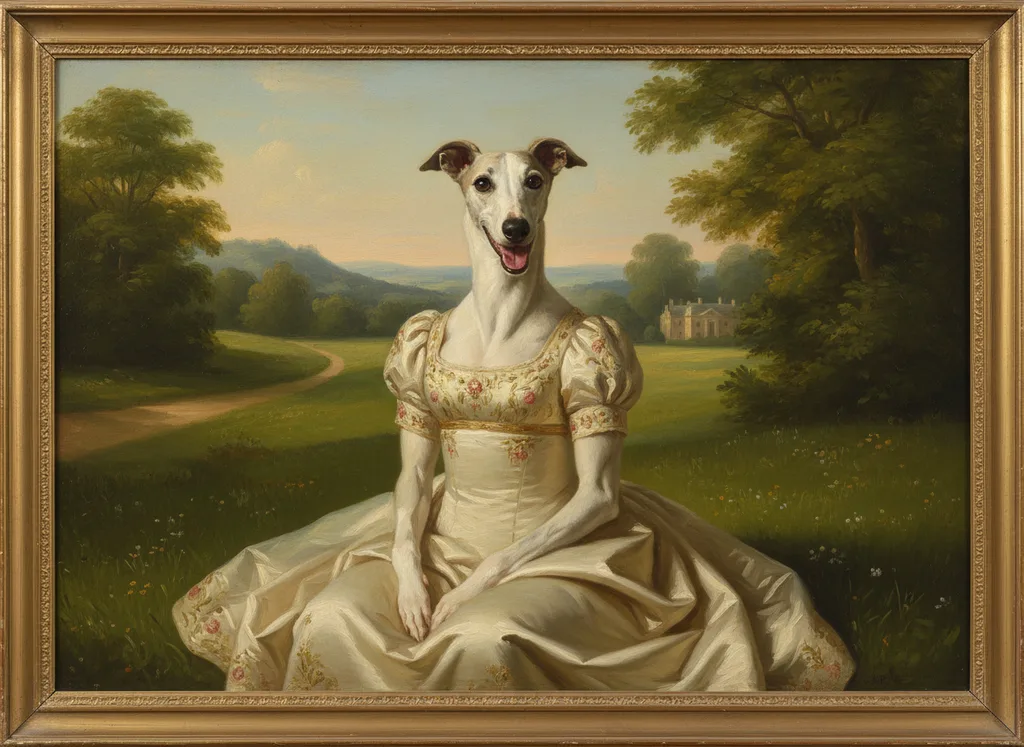
Between 1714 and 1830, Britain was ruled by four kings named George. This page is about how that court and its nobility were painted: the official coronation portrait and the workshop that copied it, the idealised "grand manner" of Joshua Reynolds, the relaxed family groups called conversation pieces, the portraits brought home from the Grand Tour, and the royal pictures of Thomas Lawrence. The years of the Regency itself, with their dates, fashions and history, are explained in what the Regency era was. The main guide to European royal portraits places this period among the others.
What "Georgian" means
Tate uses Georgian for the style of the reigns of the four King Georges in Britain, from 1714 to 1830. It says the word usually describes architecture, furniture and silver more than painting, and that the period's unifying feature, if it has one, is a certain classical restraint and harmony. The Regency, the years when the future George IV ruled for his ill father, falls at the end of it.
The coronation portrait and its copies
The official image of a Georgian king began with the coronation. The Wallace Collection in London says George III came to the throne in 1760 and was crowned with Queen Charlotte on 22 September 1761. By December that year the Scottish painter Allan Ramsay was working on a new full-length portrait of the king in his coronation robes. The principal version is in the Royal Collection.
The portrait was in high demand. The Wallace Collection says that, as an official state portrait, the picture was highly desirable, and over 100 replica versions appear to have been produced, many by Ramsay's own hand. To meet the demand, Ramsay employed several studio assistants, who went on producing replicas after he retired in 1773 following an injury to his arm. The Wallace Collection's own version is a studio copy reduced to bust length. Ramsay had first painted George as Prince of Wales in 1758, and was made Principal Painter in Ordinary to the King in 1767.
How a full-length state portrait was posed, and why so many copies were needed, is explained on the page about royal portrait poses.
Reynolds and the grand manner
The Wallace Collection says Joshua Reynolds is known today for his portraits of the wealthiest and most influential people in 18th century Britain. He was born in Plympton, Devon, in 1723, trained with the portrait painter Thomas Hudson, and travelled to Italy in 1749 to study the old masters and ancient sculpture.
His big idea was the grand manner. Tate explains that the term described what academic theory considered the highest style of art, based on an idealised, classical approach, and that Reynolds gave it currency in fifteen lectures to Royal Academy students between 1769 and 1790. He argued that painters should seek a general, ideal form. The grand manner was meant for history painting, pictures of scenes from history, myth and religion, but Tate says Reynolds adapted it with great success to portraits, inventing the "high art portrait". In practice, Tate says, it meant drawing on ancient Greek and Roman art and on Italian Renaissance masters such as Raphael. The page on royal portrait costume explains why Reynolds distrusted fashionable dress.
Reynolds also shaped the institutions of British art. The Wallace Collection says he led the group of artists who founded the Royal Academy of Arts in 1768, became its first President that year, and was knighted in 1769. Between 1769 and 1790 he exhibited 244 paintings at the Academy, and only 32 were not portraits.
His studio was run like a business. The Wallace Collection says he relied on pupils, assistants, copyists and specialist drapery painters. In the 1750s he charged 48 guineas for a full-length portrait. When he moved to Leicester Square in 1760, he built an octagonal painting room at the back of the house where sitters rested in a leather armchair.
The Wallace Collection describes the paperwork behind a portrait. In a memorandum book he kept in the early 1760s, Reynolds recorded the colour and style of each sitter's clothes, any inscription wanted on the portrait and the type of frame. The clothes themselves were often shipped out with the portrait to the drapery painter. Reynolds also dealt with engravers, who turned his most famous portraits into prints for sale, and with a long list of tradesmen, from pigment suppliers and frame makers to the wagon drivers who delivered finished paintings. A Georgian portrait was often the work of a team.
The king's painter
Three painters held the post of principal painter to the king in turn. The Wallace Collection says that in 1784 Reynolds was appointed principal painter to George III, although the king was not particularly fond of his work, replacing Allan Ramsay. The National Gallery says that when Reynolds died in 1792, Thomas Lawrence was appointed Principal Painter to the King.
Lawrence and Queen Charlotte
Lawrence's portrait of Queen Charlotte, painted at Windsor Castle in 1789 when he was only 20, shows how a royal sitting could go wrong. The National Gallery tells the story. The queen was troubled by her husband's long mental illness and by events in France, and was in no mood to sit. The sitting on 28 September was probably the only one she gave. She arrived in a bonnet, and when Lawrence objected, she sat bare-headed. X-ray images show that he repainted her face several times to bring it to life.
The jewels carried a message. The queen refused a second sitting, so the Assistant Keeper of her Wardrobe modelled the jewellery for Lawrence. The gallery says the pearl bracelets, set with the king's portrait and monogram, were especially important to Charlotte, and that Lawrence gave them a significant role, as if to show her loyalty to her husband. Neither the king nor the queen liked the result. The portrait never entered the Royal Collection and stayed with Lawrence until his death, though it was praised at the Royal Academy.
Conversation pieces: the family at ease
Not every Georgian portrait was grand. Tate describes the conversation piece as an informal group portrait, popular in the 18th century, small in scale and showing families or friends at home or in a garden. The sitters talk to each other, take tea, play games or play with pets. Tate says the type was probably introduced to Britain in the 1720s by Philip Mercier, made popular by William Hogarth and Arthur Devis, and became highly fashionable with Johan Zoffany. It met demand from the new middle classes but also gained aristocratic and royal patrons. The National Gallery adds that Gainsborough painted conversation pieces too.
Gainsborough could also paint a couple full length in the open air. The National Gallery's Mr and Mrs William Hallett, known as The Morning Walk, shows a young couple arm in arm shortly before their wedding on 30 July 1785. The gallery says the groom commissioned it and paid Gainsborough £126 on 4 March 1786, and that its style draws on the earlier painters Watteau and Van Dyck. Tate says Gainsborough's female portraits show the influence of the French Rococo in Britain, which is covered on the page about Rococo court portraits.
Portraits from the Grand Tour
Young British noblemen often came home with a portrait painted in Italy. The National Gallery explains that the Grand Tour was a journey around the main cities and monuments of Europe, made by young men of the British upper class in the 18th century to complete their education, and that many had their portraits painted abroad by artists such as Pompeo Batoni. Its portrait of Richard Milles, painted in Rome in the late 1750s, shows him with classical columns, a map and a bust of the Roman emperor Marcus Aurelius, props that the gallery says establish him as a learned, cultivated gentleman.
A coronation to end the period
The Georgian age ended with a coronation of great expense. Westminster Abbey says George IV, who had ruled as Prince Regent from 1811, was crowned on 19 July 1821 in a ceremony that cost £230,000, with a new crown containing over 12,000 diamonds. His estranged wife, Caroline of Brunswick, tried every door of the Abbey to get in and be crowned, but the king had ordered the guards to refuse her. He died on 26 June 1830. The reign of Queen Victoria that followed is covered on the page about Victorian royal portraits.
The Regency Era style
Purrealism's Regency Era style takes its look from the end of this period. The gallery shows it on a whippet, a Bernese mountain dog, a pug, a golden retriever and a tabby cat, so you can see how it suits different coats. You can choose it in the portrait studio with one photo of your pet of up to 5 MB.
Questions and answers
What does Georgian mean in art?
Georgian in art refers to the style of the reigns of the four King Georges in Britain, from 1714 to 1830. Tate says the term usually describes architecture, furniture and silver more than painting, and that its unifying feature, if it has one, is a certain classical restraint and harmony. The last part of the period includes the Regency, when the future George IV ruled for his father.
What is grand manner portraiture?
Grand manner portraiture is a style that presents the sitter in an ideal, dignified way drawn from ancient Greek and Roman art and the Italian Renaissance. Tate says Joshua Reynolds gave the term currency in his lectures to Royal Academy students between 1769 and 1790. Grand manner was meant for history painting, but Tate says Reynolds adapted it with great success to portraits.
What is a conversation piece?
A conversation piece is a small, informal group portrait of a family or friends in a home or garden. Tate says the sitters are shown talking, taking tea, playing games or with pets, and that the type was probably introduced to Britain in the 1720s by Philip Mercier, then made popular by William Hogarth and Arthur Devis. It became highly fashionable with the painter Johan Zoffany.
Who painted George III's coronation portrait?
Allan Ramsay painted George III's coronation portrait. The Wallace Collection in London says the king was crowned with Queen Charlotte on 22 September 1761, and that by December that year Ramsay was working on a new full-length portrait of him in his coronation robes. The principal version is in the Royal Collection, and Ramsay was appointed Principal Painter in Ordinary to the King in 1767.
Why did Allan Ramsay need studio assistants?
Allan Ramsay needed studio assistants to meet the demand for copies of his official portrait of George III. The Wallace Collection in London says over 100 replicas appear to have been produced, many by Ramsay himself. It says his assistants kept making replica portraits after he retired in 1773 following an injury to his arm, including reduced bust-length copies.
Who was principal painter to George III?
George III had three principal painters in turn. The Wallace Collection in London says Allan Ramsay was appointed Principal Painter in Ordinary to the King in 1767, and that Joshua Reynolds replaced him in 1784, although the king was not fond of Reynolds's work. The National Gallery says Thomas Lawrence was appointed Principal Painter to the King after Reynolds died in 1792.
What did Queen Charlotte think of Lawrence's portrait of her?
Queen Charlotte considered Thomas Lawrence's 1789 portrait of her a failure. The National Gallery in London says it pleased neither the king nor the queen and never entered the Royal Collection. The queen gave the 20-year-old painter probably only one sitting, at Windsor Castle on 28 September, and refused a second, so an assistant keeper of her wardrobe modelled the jewels for him.
Why is Queen Charlotte wearing bracelets in Lawrence's portrait?
Queen Charlotte wears pearl bracelets in Thomas Lawrence's 1789 portrait because they carried the king's portrait and monogram. The National Gallery in London says the bracelets were especially important to her, and that Lawrence gave them a significant role, as if to show her unwavering loyalty to George III during his long mental illness. Several of her jewels were wedding presents from the king.
What was a Grand Tour portrait?
A Grand Tour portrait was a painting made for a young British gentleman during his educational journey around Europe, usually in Rome. The National Gallery in London says many travellers had their portraits painted abroad by artists such as Pompeo Batoni. Batoni's portrait of Richard Milles, from the late 1750s, uses classical columns and a bust of Emperor Marcus Aurelius to show him as a learned gentleman.
Who founded the Royal Academy of Arts?
The Royal Academy of Arts was founded in 1768 by a group of artists led by Joshua Reynolds. The Wallace Collection in London says Reynolds played a leading part in its foundation, became its first President the same year and was knighted in 1769. Between 1769 and 1790 he showed 244 paintings at its exhibitions, and only 32 of them were not portraits.
How much did George IV's coronation cost?
George IV's coronation cost £230,000. Westminster Abbey says the ceremony took place on 19 July 1821 and was a superbly extravagant pageant, and that the king had a new crown made containing over 12,000 diamonds. His estranged wife, Caroline of Brunswick, tried every door of the Abbey to get in and be crowned, but the king had ordered the guards to refuse her.
Sources
- Georgian, Tate. Accessed September 29, 2026.
- Grand manner, Tate. Accessed September 29, 2026.
- Conversation piece, Tate. Accessed September 29, 2026.
- Rococo, Tate. Accessed September 29, 2026.
- George III, The Wallace Collection. Accessed September 29, 2026.
- Reynolds, The Wallace Collection. Accessed September 29, 2026.
- Reynolds's Studio, The Wallace Collection. Accessed September 29, 2026.
- Sir Thomas Lawrence, Queen Charlotte, National Gallery, London. Accessed September 29, 2026.
- Thomas Gainsborough, Mr and Mrs William Hallett ('The Morning Walk'), National Gallery, London. Accessed September 29, 2026.
- Conversation pieces, National Gallery, London. Accessed September 29, 2026.
- Grand Tour, National Gallery, London. Accessed September 29, 2026.
- Pompeo Girolamo Batoni, Portrait of Richard Milles, National Gallery, London. Accessed September 29, 2026.
- George IV, Westminster Abbey. Accessed September 29, 2026.
Short reads on this topic
Articles from Purrspectives that answer one question each.
What was the Victorian era? Dates, fashion and portraits of 1837 to 1901
The Victorian era is Queen Victoria's reign, 1837 to 1901. Her life, what Victorians wore, and how they had portraits painted and photographed.
Military dog portraits: the real dogs who served, and your dog as a general
Real war dogs such as Stubby and Gander earned medals and a rank. Here is their story, and how to make a dog general portrait of your own dog.
Dogs in medieval paintings and manuscripts: hunting hounds, lapdogs and faithful friends
Medieval dog paintings show hunting hounds, lapdogs and loyal dogs in painted books, on church brasses and in the Bayeux Tapestry. Where to find each one.