Rococo court portraits: Louis XV, Madame de Pompadour and Marie-Antoinette
How the French court of the 1700s was painted in the light, curving Rococo style, from Boucher's Madame de Pompadour to Vigée Le Brun's Marie-Antoinette.
By Purrealism. Part of European royal portraits: how Europe's courts painted their rulers.
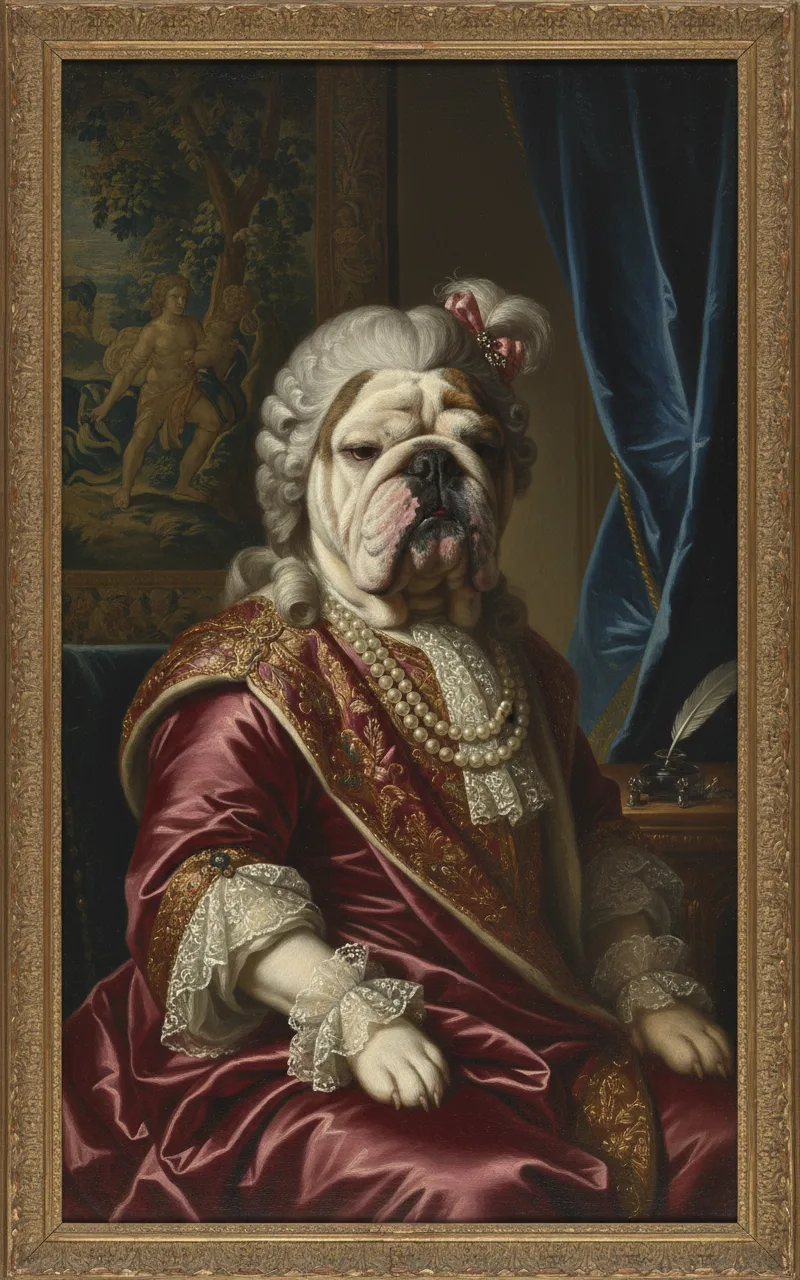
After the death of Louis XIV in 1715, a lighter style of pale colours, curving lines and graceful poses developed in France. Tate says it grew in reaction to the Baroque grandeur of Versailles, and later critics named it Rococo. This page looks at how that style shaped portraits of the French court: the king, Louis XV, his influential companion Madame de Pompadour, and Queen Marie-Antoinette and her painter, Élisabeth Vigée Le Brun. It also shows how busy portrait studios repeated their successful designs. For the Baroque courts that came before, see Baroque court portraits, and for the whole subject, the guide to European royal portraits.
What Rococo means
The National Gallery in London uses Rococo as a label for the painting, interior decoration and architecture popular in France during the reign of Louis XV, from 1715 to 1774. It says the style is based on the study of natural forms and is dominated by asymmetry, curved forms and light, bright colours. The word may come from the French rocaille, the decoration of rocks and shells in grottoes and fountains, and it was first used as an insult by Neoclassical critics later in the century.
Tate describes Rococo as a light, highly decorative French style that developed after the death of Louis XIV, in reaction to the Baroque grandeur of Versailles. It names François Boucher, Jean-Honoré Fragonard and Antoine Watteau as its leading painters. The Victoria and Albert Museum (V&A) adds that the style first appeared in France in the 1720s and 1730s among craftspeople and designers, which is why so much of it is found in furniture, silver and porcelain. Its curves often take the shape of the letters S and C, and one half of a design does not match the other.
The king in robes and as a god
Louis XV was still painted in the full dress of kingship. The Château de Versailles says Louis-Michel van Loo, formerly the official painter of King Philip V of Spain, painted Louis XV full length in his coronation robes and presented a powerful, confident king, a portrait that works as an allegory of the kingdom of France. The Wallace Collection in London says Van Loo's design refers back to Rigaud's famous portrait of Louis XIV of 1701. What the king holds and wears in it is explained on the page about symbols of royal power.
The Rococo also found lighter ways to flatter a king. The Wallace Collection describes two designs by Boucher for tapestries, The Rising of the Sun and The Setting of the Sun, from 1753 and 1752, made for Madame de Pompadour. Louis XV appears in them with the youthful body of the god Apollo, recognised by his lyre. A sea nymph modelled on Madame de Pompadour welcomes him home at dusk. The museum calls the pair among her most prized pieces of personal propaganda.
Madame de Pompadour and her portraits
Madame de Pompadour used portraits to protect her place at court. The Wallace Collection says she joined the court of Louis XV in 1745, the first royal mistress to come from the newly rich Parisian middle class, and that the king made her Marquise de Pompadour. At the start of the 1750s, as the romance faded, she turned increasingly to the arts.
Her favourite painter was Boucher. The Wallace Collection says he finished his first portrait of her by March 1750, and that she valued his ability to show her in an attractive light over strict realism, so she went on to commission eleven more. Aware that her position at court was fragile, she wanted her portraits to project confidence and loyalty and to show her continuing role as the king's confidante. The museum's own portrait of her by Boucher, from 1759, the last he painted of her, shows her leaning against a statue of Friendship, with orange blossom and roses for love and her pet spaniel for faithfulness.
Later she chose plainer portraits. The Wallace Collection says that as war and public disfavour damaged her reputation, she turned to Carle van Loo and François-Hubert Drouais for more modest images. The National Gallery's Madame de Pompadour at her Tambour Frame by Drouais, begun in April 1763 and finished in May 1764, a month after her death, shows her at work on embroidery in her rooms at Versailles. The gallery says it avoids the rigid formality and mythological trappings of much court portraiture, and presents her as a respectable lady of arts and letters, perhaps to play down her part in France's defeat in the Seven Years War.
The gallery also explains how the picture was made. It is two canvases: a smaller one with her head, shoulders and right forearm, painted from life, set into a larger full-length canvas. It says painters of important sitters often worked on the face from life and finished the rest in the studio, with a model wearing the sitter's clothes.
Studios that repeated their designs
Court portraiture was a business, and successful designs were reused. The National Gallery says Jean-Marc Nattier's portrait of Manon Balletti, signed and dated 1757, closely resembles several of his other portraits of women, with the same direct gaze, striped muslin veil and pearls. The gallery says repetition allowed him to produce portraits more quickly and more cheaply than inventing new compositions.
The same was true of men. The gallery's Portrait of a Man in Armour by Nattier, painted near the middle of the 1700s, shows an unknown young officer wearing the medal of a knight of the military Order of Saint Louis. The same armour appears in two other Nattier portraits of 1745 and 1746, so the gallery says it was presumably a studio prop. The turning pose goes back to Nattier's 1717 portrait of Tsar Peter the Great and was used again for his later portraits of military men. The page on military portraits follows this kind of picture into the age of uniforms.
Marie-Antoinette and Vigée Le Brun
The last queen of the old French court had her own favourite painter. The National Gallery says Élisabeth Louise Vigée Le Brun, born in Paris in 1755 and largely self-taught, enjoyed great success at the Versailles court in the years before the Revolution of 1789. She was one of only four women admitted to the French Royal Academy of painting and sculpture in the 18th century. She became Marie-Antoinette's preferred painter and made over 30 portraits of the queen and her family.
One of them caused a scandal. The gallery says a portrait of Marie-Antoinette in a simple white cotton dress, holding a rose, shocked visitors to the official Paris exhibition, the Salon, in 1783, because it looked too informal for a queen. The same taste appears in Vigée Le Brun's own Self Portrait in a Straw Hat of 1782. The gallery says she wears her own unpowdered hair, although a wig would have been expected in a formal portrait, and a straw hat with flowers that recalls the shepherdess costumes Marie-Antoinette liked. After the royal family was arrested in October 1789, Vigée Le Brun fled Paris and did not return until 1802. The clothes of these portraits are covered on the page about royal portrait costume.
Boucher, painter to the king's circle
Boucher's career shows how a court painter rose. The Wallace Collection says he was born in Paris in 1703 into a family of artisans, won the Rome Prize, a scholarship for art students, in 1723, and became a full member of the Royal Academy in 1734. His work was favoured by Louis XV, he painted decorations for the royal châteaux of Versailles, Fontainebleau and Choisy, and he taught Madame de Pompadour drawing and engraving as her private tutor. The museum gives an approximate count of 1,500 known prints after his designs, which carried his images far beyond the court.
Rococo in Britain
The style crossed the Channel. Tate says Rococo was brought to Britain by the French painter Philip Mercier, who became principal painter to the Prince and Princess of Wales, and that its influence in Britain shows best in the female portraits of Thomas Gainsborough. The V&A says Rococo flourished in English design between 1740 and 1770. British portraits of this time are covered on the page about Georgian and Regency portraits.
The end of the Rococo
The style lost favour before the old court fell. The Wallace Collection says the critic Denis Diderot condemned Boucher's repeated compositions and light subjects as frivolous in the 1750s and 1760s. By the 1780s, it says, the curves and candy colours of the Rococo were being rejected for the clean lines and primary colours of Neoclassicism, which the National Gallery describes as a conscious revival of the art of ancient Greece and Rome. The revolutionaries of 1789, the Wallace Collection adds, condemned the luxury the style stood for.
A Rococo look for a pet portrait
The closest Purrealism style to the Rococo is the Baroque Aristocrat style, which shares its powdered wigs, pearls and lace, as the English bulldog on the cover of this page shows. Pale silks and soft colours suit a dog or cat with a dark coat, which stands out against them. To compare all six European styles and the nine Indian ones, read how to choose a royal portrait style, then pick your style in the portrait studio.
Questions and answers
What is rococo painting?
Rococo painting is the light, decorative style of French art during the reign of Louis XV, from 1715 to 1774. The National Gallery in London says Rococo art is based on the study of natural forms and is dominated by asymmetry, curved forms and light, bright colours. Tate names François Boucher, Jean-Honoré Fragonard and Antoine Watteau as its leading painters.
What does the word rococo mean?
The word rococo probably comes from the French rocaille, the decoration of rocks and shells used in grottoes and fountains. The National Gallery in London says the label was first used as an insult by Neoclassical critics of the late 1700s. The Victoria and Albert Museum adds that shells, fish and other sea forms often appear in Rococo designs, with curves shaped like the letters S and C.
Who was the court painter of Marie Antoinette?
Élisabeth Louise Vigée Le Brun was the favourite painter of Queen Marie-Antoinette of France. The National Gallery in London says she became the queen's preferred painter and made over 30 portraits of the queen and her family. She was one of only four women admitted to the French Royal Academy of painting and sculpture in the 18th century, and she fled Paris in 1789.
Why did Vigée Le Brun's portrait of Marie-Antoinette cause a scandal?
Élisabeth Vigée Le Brun's portrait of Marie-Antoinette caused a scandal in 1783 because it showed the queen in a simple white cotton dress, too informal for a queen. The National Gallery in London says the portrait, in which the queen holds a rose, was shown at the official Paris exhibition, the Salon, that year. Vigée Le Brun painted over 30 portraits of the queen and her family.
Who painted Madame de Pompadour?
Madame de Pompadour was painted by several leading French artists, above all François Boucher. The Wallace Collection in London says Boucher finished his first portrait of her by March 1750, and that she went on to commission eleven more from him. The National Gallery says François-Hubert Drouais painted her last great portrait, finished in May 1764, a month after her death.
Why did Madame de Pompadour commission so many portraits?
Madame de Pompadour commissioned many portraits to protect her place at the court of Louis XV. The Wallace Collection in London says that after her romance with the king ended, she wanted to project an image of confidence and loyalty, showing her continuing role as his trusted friend. Her portraits by Boucher stressed friendship, loyalty, intelligence and beauty over strict likeness.
How did Drouais paint Madame de Pompadour at her tambour frame?
François-Hubert Drouais painted Madame de Pompadour on two canvases joined together. The National Gallery in London says a smaller canvas with her head, shoulders and right forearm, painted from life, was set into the larger full-length picture. The gallery explains that painters often worked from important sitters in person for the face and finished the rest in the studio, with a model wearing the sitter's clothes.
Why do Nattier's portraits look alike?
Many of Jean-Marc Nattier's portraits look alike because he reused successful designs. The National Gallery in London says repetition let him produce portraits more quickly and cheaply than inventing new compositions. The gallery adds that the armour in his Portrait of a Man in Armour, painted near the middle of the 1700s, also appears in two earlier portraits, so it was presumably a studio prop.
How was Louis XV shown in Rococo art?
Louis XV appeared in Rococo art both as a crowned king and as a figure from myth. The Wallace Collection in London says François Boucher's designs for the tapestries The Rising and The Setting of the Sun show the king with the body of the god Apollo, recognised by his lyre. For state portraits, he was painted in coronation robes by Louis-Michel van Loo.
Why did Rococo go out of fashion?
Rococo went out of fashion because critics and then revolutionaries came to see it as frivolous and decadent. The Wallace Collection in London says the critic Denis Diderot attacked Boucher's lightness in the 1750s and 1760s, and that by the 1780s the curving style was rejected for the clean lines of Neoclassicism. The French revolutionaries of 1789 condemned the luxury the style stood for.
What is a Rococo tambour frame in a portrait?
A tambour frame is a frame that holds cloth tight for embroidery, and in a Rococo portrait it showed the sitter as a virtuous, hard-working woman. The National Gallery in London says Madame de Pompadour is painted at one in 1763 to 1764, and that embroidery was regarded as a virtuous activity for women. The word tambour is French for drum, after the usual round shape.
Sources
- Rococo, National Gallery, London. Accessed September 29, 2026.
- Rococo, Tate. Accessed September 29, 2026.
- The Rococo style: an introduction, Victoria and Albert Museum. Accessed September 29, 2026.
- Madame de Pompadour, The Wallace Collection. Accessed September 29, 2026.
- Boucher the Artist, The Wallace Collection. Accessed September 29, 2026.
- Reviewing Rococo, The Wallace Collection. Accessed September 29, 2026.
- François-Hubert Drouais, Madame de Pompadour at her Tambour Frame, National Gallery, London. Accessed September 29, 2026.
- Jean-Marc Nattier, Portrait of a Man in Armour, National Gallery, London. Accessed September 29, 2026.
- Jean-Marc Nattier, Manon Balletti, National Gallery, London. Accessed September 29, 2026.
- Elisabeth Louise Vigée Le Brun, Self Portrait in a Straw Hat, National Gallery, London. Accessed September 29, 2026.
- Louis XV, le sacre, Château de Versailles. Accessed September 29, 2026.
- Louis XV, The Wallace Collection. Accessed September 29, 2026.
- Neoclassical, National Gallery, London. Accessed September 29, 2026.
Short reads on this topic
Articles from Purrspectives that answer one question each.
What was the Victorian era? Dates, fashion and portraits of 1837 to 1901
The Victorian era is Queen Victoria's reign, 1837 to 1901. Her life, what Victorians wore, and how they had portraits painted and photographed.
Military dog portraits: the real dogs who served, and your dog as a general
Real war dogs such as Stubby and Gander earned medals and a rank. Here is their story, and how to make a dog general portrait of your own dog.
Dogs in medieval paintings and manuscripts: hunting hounds, lapdogs and faithful friends
Medieval dog paintings show hunting hounds, lapdogs and loyal dogs in painted books, on church brasses and in the Bayeux Tapestry. Where to find each one.