Baroque court portraits: how the kings and queens of the 1600s were painted
How Van Dyck, Velázquez, Rubens and Rigaud painted the rulers of the 1600s, and how palaces, copies and grand scale turned a portrait into power.
By Purrealism. Part of European royal portraits: how Europe's courts painted their rulers.
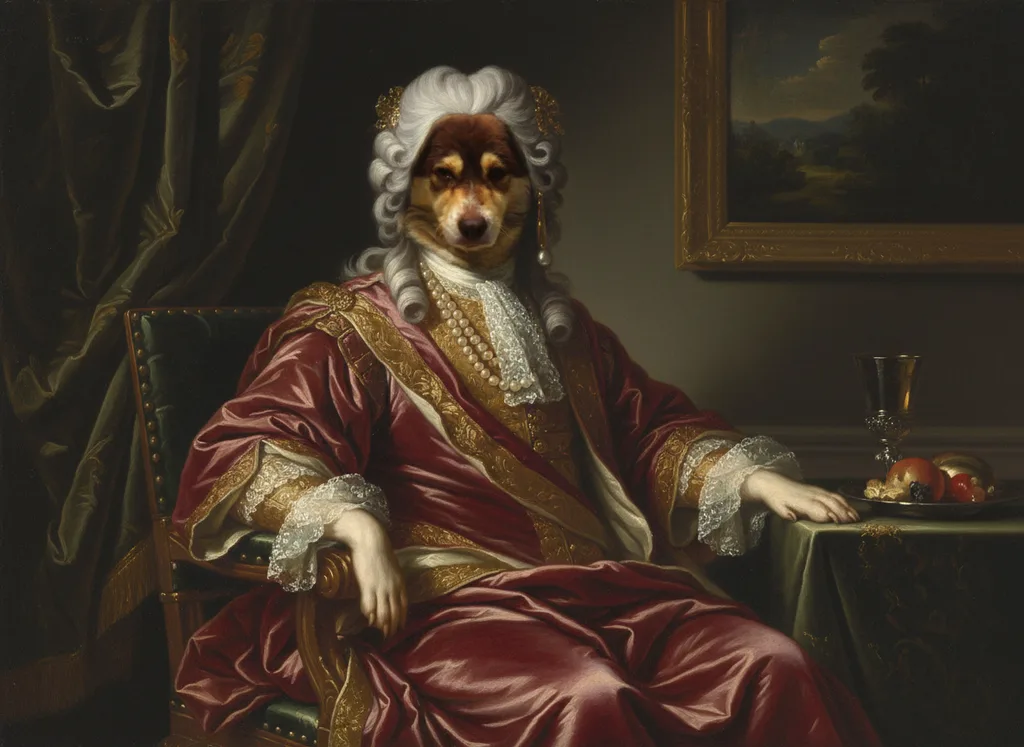
In the 1600s, kings in Spain, England and France employed favourite painters and used their portraits to decorate palaces and to send abroad as gifts. This page looks at how the Baroque courts portrayed their rulers: the painters who served them, the queens and regents they painted, and the palaces the portraits were made for. The art style of the century, with its strong light and movement, is explained in what Baroque art is. Here the subject is the ruler in the picture. For the full story across the centuries, start at the guide to European royal portraits.
The palace and its rooms
A Baroque royal portrait was made to hang in a palace, and the palace itself was built to show power. The Victoria and Albert Museum (V&A) in London says the buildings and gardens of Versailles, near Paris, were planned to glorify King Louis XIV, who reigned from 1643 to 1715, and to hold the pomp and ceremony that revolved around him. Rulers across Europe copied it.
The rooms of a palace were arranged by rank. The V&A explains that every palace was divided into apartments, suites of rooms in a line, from a guards' hall to a state bedchamber. A visitor's rank was shown by how far through the rooms he was allowed to go. At Versailles, the museum says, a bust of the king stood at the centre of the great Ambassadors' Staircase, just as he stood at the centre of court life, and the whole court gathered in the Hall of Mirrors every day to watch him pass to the chapel.
Portraits did the same job on canvas. Tate, writing about the Baroque in Britain, says a portrait in this style showed that the sitter was a person of wealth and importance. It says commissioning a portrait acted as a seal of one's power and a record of one's success, and that the more elaborate the painting, the greater the illusion of power.
Van Dyck and the court of Charles I
The National Gallery in London says Charles I was crowned King of England in 1625 and beheaded outside the Banqueting Hall in Whitehall in 1649, and that he was an important patron of the arts and a notable collector. Tate says he built one of the greatest royal art collections and appointed the Flemish painter Anthony van Dyck "Principalle Paynter in ordinary to their majesties", his principal painter.
Charles brought other painters too. The National Gallery says he invited Gerrit van Honthorst to England in 1628, and that Honthorst painted several royal portraits there before returning to The Hague.
Van Dyck's best-known image of the king shows him on horseback. The National Gallery dates this Equestrian Portrait of Charles I to 1638 to 1639 and says it is over 3.5 metres high, the largest of Van Dyck's portraits of the king. The pose, and what the horse and reins meant, is explained on the page about royal portrait poses. The chain and badge that mark the king's rank are explained on the page about symbols of royal power.
Velázquez and Philip IV
In Spain, one painter recorded a king across most of his reign. The National Gallery says Diego Velázquez served Philip IV as court artist from 1623, and painted the king and his family over four decades.
The portraits built a picture of a dynasty. The National Gallery says Philip IV of Spain in Brown and Silver, from 1631 or 1632, was recorded in the mid-1600s in the library of the Escorial, the royal monastery near Madrid. There it formed a group of four portraits with the king's predecessors, Charles V, Philip II and Philip III, placing Philip in the line of the Habsburg family.
The gallery's late portrait of the king, painted in the mid-1650s, shows a different man. Philip, who came to the throne at 16 and reigned from 1621 to 1665, looks tired and middle-aged, with sagging flesh and puffy eyes. He wears his usual black, with the gold chain of the Order of the Golden Fleece. The gallery says Philip seems to have approved of the picture. Velázquez's pupils made many copies of it, which were given as gifts to members of the court and to visiting dignitaries, and it was engraved for a book about the Escorial in 1657. A year later, in 1658, Velázquez was made a Knight of Santiago, an honour the gallery says he had always wanted.
Queens, widows and regents
Two portraits in the National Gallery show royal widows. When Philip IV died in 1665, his son Charles was too young to rule, so his widow Mariana ruled as regent until 1677. The National Gallery's portrait of her by Juan Bautista Martínez del Mazo, from 1666, shows her in the widow's black habit and white wimple, seated on a throne-like chair in the royal palace in Madrid. She holds a petition, which the gallery says points to her official duties. Mazo was Velázquez's son-in-law and principal assistant, and he became court painter after Velázquez died in 1660.
In the Dutch Republic, Honthorst painted another royal widow. Elizabeth Stuart, the daughter of James I of England, had been crowned Queen of Bohemia with her husband Frederick V in 1619, but they were deposed in the winter of 1620 and went into exile in The Hague. She became known as the Winter Queen. The National Gallery says Honthorst's portrait of 1642 is near life size and was the first time she was painted in the open air. Viewers of the time, it says, would have judged her status from the picture's size and from her lace and silks.
Tate points out that portraits were one of the few ways in which women of the court could exercise power. It names Peter Lely, a Dutch painter who spent his career in England, as a painter commissioned by women of the royal court.
Rubens and the nobleman
The great painters also portrayed the nobles around the king. The National Gallery says Peter Paul Rubens met Thomas Howard, 2nd Earl of Arundel, in England in 1629 and 1630. Arundel was Earl Marshal of England from 1621 and built up a collection of drawings and ancient sculpture. Rubens painted him three times. In two portraits Arundel is a man of action, in armour, looking straight at the viewer. In the third, in the National Gallery, he sits looking away with a focused expression, and the gallery says his status is underlined by the Lesser George, a badge of the Order of the Garter, on a blue ribbon at his neck.
Restoration England
Tate says the Baroque period in Britain began with the restoration of Charles II to the throne in 1660, and that artists were commissioned to sell the idea that the crown was secure and order had returned. In Antonio Verrio's Sea Triumph of Charles II, painted in the 1670s, the king rides into the centre of the picture, above everyone else and just below the angels celebrating his return. Tate says the monarch was seen as appointed by God, and that the painting re-establishes Charles as the rightful ruler.
The V&A holds a marble bust of Charles II made in 1684 by the sculptor Honoré Pelle. The museum says his head is turned to one side and an elaborate wig falls over his lace cravat and billowing drapery. It adds that such grand Baroque images of monarchs were more common in France than in England, but Charles had spent much of his youth in mainland Europe and favoured European artists.
Louis XIV and the portrait of 1701
The century ended with Hyacinthe Rigaud's portrait of Louis XIV, painted in 1701. The Château de Versailles says it became an emblem of absolute monarchy by divine right across Europe, and that it still influences the official portraits of French presidents today. The National Gallery calls Rigaud the most prestigious portraitist in France in his time.
The Louvre tells the story of the picture. After the king's grandson became King Philip V of Spain in 1700, Louis ordered a portrait of him from Rigaud, and the young king asked for a portrait of his grandfather by the same hand. When it was finished, Louis and his whole court admired it so much that he kept it and ordered a second version for Madrid. The first version hung over the fireplace in the Salon d'Apollon, the throne room at Versailles. It was seized during the French Revolution and moved to the Louvre in 1814. The Louvre says Pierre Drevet engraved it between 1714 and 1716, and that Rigaud's records list a great many reduced copies.
The Baroque Aristocrat style
Purrealism's Baroque Aristocrat style takes its look from these courts. The gallery shows it on a Siamese cat, two English bulldogs and an Australian shepherd, so you can see the wigs, lace and silks before you choose. You can pick the style in the portrait studio. The century that followed, with its lighter colours and softer poses, is covered on the page about Rococo court portraits.
Questions and answers
Who was court painter to King Philip IV?
Diego Velázquez was court painter to King Philip IV of Spain from 1623. The National Gallery in London says he painted the king and his family over four decades, and that his last painted image of Philip, from the mid-1650s, shows a tired, middle-aged king in black. Many copies of that portrait were made by his pupils and given to courtiers and visiting dignitaries.
Which artist was the court painter to Louis XIV?
Hyacinthe Rigaud painted the best-known state portrait of Louis XIV, and the Palace of Versailles calls him the king's portraitist, and the National Gallery in London calls him the most prestigious portraitist in France. His full-length portrait of Louis XIV, signed in 1701 and now in the Louvre, became an emblem of absolute monarchy across Europe.
Who was Anthony van Dyck?
Anthony van Dyck was a Flemish painter who became principal painter to King Charles I of England. Tate says Charles appointed him Principal Painter in Ordinary to their Majesties. The National Gallery in London says Van Dyck painted several portraits of Charles, including the Equestrian Portrait of Charles I, over 3.5 metres high, which the gallery dates to 1638 to 1639.
Who became Spanish court painter after Velázquez?
Juan Bautista Martínez del Mazo became Spanish court painter after Velázquez died in 1660. The National Gallery in London says Mazo was Velázquez's son-in-law and principal assistant. His 1666 portrait of Queen Mariana of Spain in mourning, in the National Gallery, carries his signature and title as court painter on a petition in the queen's hand, a device Velázquez had also used.
Why is Queen Mariana of Spain dressed in black in her portrait?
Queen Mariana of Spain is dressed in black because she was in mourning for her husband, Philip IV, who died in 1665. The National Gallery in London says Juan Bautista Martínez del Mazo painted her in 1666 in a white wimple and a widow's black habit. She ruled as regent for her young son Charles until 1677, and she holds a petition to show her official duties.
Who was the Winter Queen?
The Winter Queen was Elizabeth Stuart, daughter of James I of England, who was crowned Queen of Bohemia in 1619 with her husband Frederick V. The National Gallery in London says they were deposed in the winter of 1620 and went into exile in The Hague. Gerrit van Honthorst painted her near life size in 1642, the first time she was shown outdoors.
Why did Baroque nobles have grand portraits painted?
Baroque nobles had grand portraits painted to show and record their power. Tate says that in Britain a Baroque-style portrait showed that the sitter was a person of wealth and importance, and that the more elaborate the painting, the greater the illusion of power. Tate adds that portraits were one of the few ways in which women at court could exercise power.
How did Baroque palaces show a visitor's rank?
Baroque palaces showed a visitor's rank by how far through the ruler's rooms that visitor was allowed to go. The Victoria and Albert Museum says palace apartments were suites of rooms in a line, beginning with a guards' hall and ending with a state bedchamber. The state apartment, where most daily court ceremonies took place, followed a strict system of etiquette.
Where did Louis XIV hang his portrait by Rigaud?
Louis XIV hung his 1701 portrait by Hyacinthe Rigaud over the fireplace in the Salon d'Apollon, the throne room at Versailles. The Louvre says the painting was first meant for his grandson Philip V of Spain, but the king and his court admired it so much that he kept it and ordered a second version for Madrid. It moved to the Louvre in 1814.
How many times did Rubens paint the Earl of Arundel?
Peter Paul Rubens painted Thomas Howard, 2nd Earl of Arundel, three times. The National Gallery in London says two of the portraits show Arundel as a man of action in armour, looking straight at the viewer. The third, in the National Gallery and dated to 1629 or 1630, shows a quieter, thinking man looking away, with the Lesser George of the Order of the Garter on a blue ribbon.
What was the Sea Triumph of Charles II?
The Sea Triumph of Charles II is a painting by Antonio Verrio from the 1670s that celebrates the restored English king. Tate says Charles rides into the centre of the picture, placed higher than everyone else and just below the angels who celebrate his return. It says the painting presents Charles as the rightful ruler, appointed by God, after the monarchy was restored in 1660.
Sources
- Inside the Baroque palace, Victoria and Albert Museum. Accessed September 29, 2026.
- The Baroque style, Victoria and Albert Museum. Accessed September 29, 2026.
- Court, Tate. Accessed September 29, 2026.
- Illusions of Power in British Baroque, Tate. Accessed September 29, 2026.
- Charles I, King of Great Britain, National Gallery, London. Accessed September 29, 2026.
- Anthony van Dyck, Equestrian Portrait of Charles I, National Gallery, London. Accessed September 29, 2026.
- Diego Velázquez, Philip IV of Spain, National Gallery, London. Accessed September 29, 2026.
- Diego Velázquez, Philip IV of Spain in Brown and Silver, National Gallery, London. Accessed September 29, 2026.
- Juan Bautista Martínez del Mazo, Queen Mariana of Spain in Mourning, National Gallery, London. Accessed September 29, 2026.
- Gerrit van Honthorst, Elizabeth Stuart, Queen of Bohemia, National Gallery, London. Accessed September 29, 2026.
- Peter Paul Rubens, Portrait of Thomas Howard, 2nd Earl of Arundel, National Gallery, London. Accessed September 29, 2026.
- Hyacinthe Rigaud, Antoine Pâris, National Gallery, London. Accessed September 29, 2026.
- Louis XIV (1638-1715), roi de France, Musée du Louvre. Accessed September 29, 2026.
- Louis XIV en grand costume royal, par Hyacinthe Rigaud, Château de Versailles. Accessed September 29, 2026.
Short reads on this topic
Articles from Purrspectives that answer one question each.
What was the Victorian era? Dates, fashion and portraits of 1837 to 1901
The Victorian era is Queen Victoria's reign, 1837 to 1901. Her life, what Victorians wore, and how they had portraits painted and photographed.
Military dog portraits: the real dogs who served, and your dog as a general
Real war dogs such as Stubby and Gander earned medals and a rank. Here is their story, and how to make a dog general portrait of your own dog.
Dogs in medieval paintings and manuscripts: hunting hounds, lapdogs and faithful friends
Medieval dog paintings show hunting hounds, lapdogs and loyal dogs in painted books, on church brasses and in the Bayeux Tapestry. Where to find each one.