Updated
Edwin Landseer's dogs: the Victorian painter who gave animals human feelings
How Edwin Landseer learned dog anatomy as a boy, why his dogs look as if they think and feel, and where to see his dog paintings in London today.
By Purrealism. Part of Dogs in art: the painters and paintings behind a royal dog portrait.
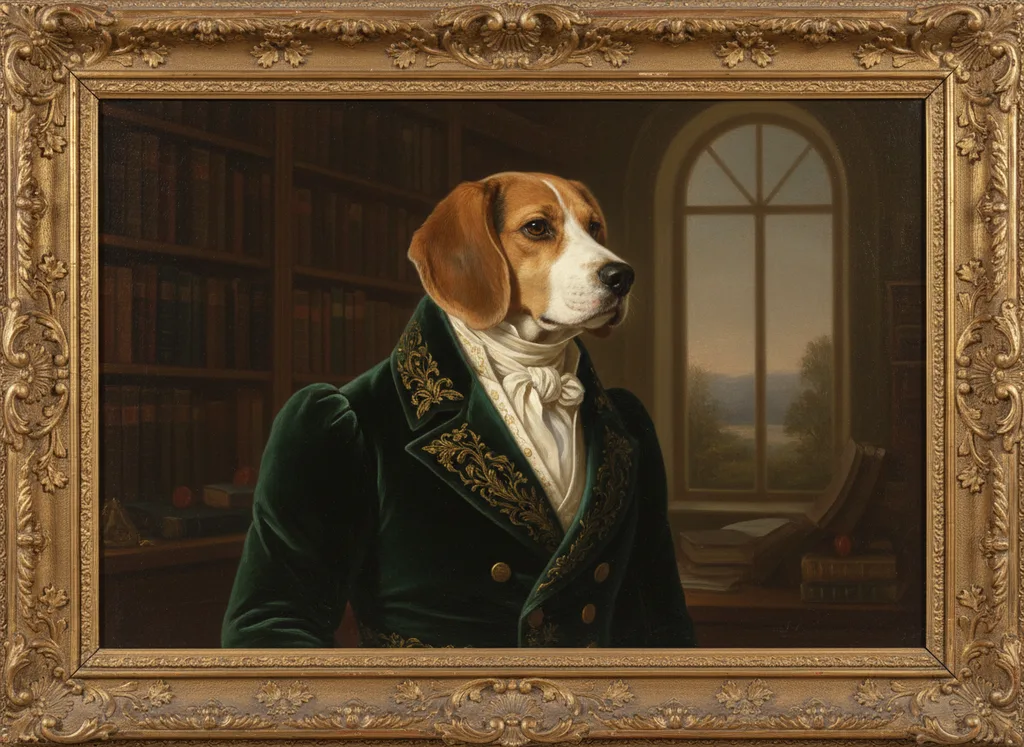
Edwin Landseer (1802 to 1873) was, in the words of the Victoria and Albert Museum, one of the most famous and successful painters of his century, and dogs were among his favourite subjects. This page follows his dog paintings from the anatomy drawings he made as a boy to the Newfoundland that gave its name to a type of the breed. It uses the records of the V&A in London, which holds many of his dog pictures, and the articles on Landseer in the Victorian Web, a website about 19th-century Britain. For how dogs were painted before him, start with the dogs in art guide.
A boy who drew animals
Landseer was born in London on 7 March 1802. His father, John Landseer, was an engraver, a craftsman who cuts pictures into metal plates for printing. An article on the Victorian Web by the writer Geri Walton says the father sent his sons into the fields to draw sheep, goats and donkeys, and made Edwin correct his mistakes on the spot.
The training worked early. In 1815, at the age of 13, Landseer had two works in the Royal Academy exhibition in London: a portrait of a mule and portraits of a pointer and her puppy. The Victorian Web says he entered the Royal Academy Schools, the Academy's art school, in 1816. He was elected an associate of the Academy in 1826, at 24, and a full member in 1831. The V&A adds that over his career he showed 179 works at the Royal Academy and 94 at the British Institution, another London exhibition society.
Learning the dog from the inside
A painter who wants a dog to look solid has to know what is under the fur. Landseer learned this by drawing animals that had been skinned. Artists call such a drawing an écorché, a French word for "flayed".
The V&A holds eight of his anatomical studies of dogs and cats, made between 1817 and 1821, when he was still a teenager. One shows the leg of a dog in black, red and white chalk, signed and dated 1821. The museum explains that the history painter Benjamin Robert Haydon encouraged him. Haydon later claimed that Landseer had "dissected animals under my eye". Landseer also went to anatomy classes run by the surgeon Sir Charles Bell in Soho, London, and visited a menagerie, a travelling collection of wild animals, at the Exeter Exchange to sketch lions and tigers.
His older brother Thomas took the same classes. The V&A holds three écorché dog drawings attributed to Thomas, made around 1816. It explains that human bodies were hard to obtain for study at the time, so students often dissected animals instead. Thomas became an engraver, and his prints of Edwin's paintings later brought them into many homes.
Dogs that think and feel
Landseer's early dog paintings already show the idea that made him famous: a dog can seem to have thoughts and moods of its own.
The Twa Dogs, 1822. "Twa" is the Scottish word for "two". The painting shows a Newfoundland and a collie beside a loch. The V&A says it refers to Robert Burns's poem The Twa Dogs, in which two dogs named Caesar and Luath talk critically about people and their manners. Landseer was only 19 and had not yet been to Scotland, so he imagined the scenery. The V&A calls it the earliest example of his habit of giving animals human emotions and intelligence. Critics later compared his skill to that of the Flemish animal painter Jan Fyt.
The Dog and the Shadow, 1822. In this small oil on wood panel, a dog stands at the edge of a stream with a red handkerchief in its mouth and stares at its own reflection in the water. Landseer signed it with his monogram, EL, and the year.
A quote collected in the Walton article sums up the aim. Landseer said he wanted to show human feeling and human thought, such as endurance, impudence, pain and joy, through animal life.
Portraits for owners
Landseer also painted real, named dogs for the people who owned them. This part of his work is closest to a modern pet portrait.
Lion: A Newfoundland Dog, 1824. The owner, W. H. de Merle, commissioned it. The canvas is 149.8 cm high and 195.6 cm wide. The V&A calls the Newfoundland a large Canadian working dog, strong enough to pull a sledge and known for its intelligence, gentle nature and swimming. Landseer based the mountains behind Lion on scenery he had seen in Scotland. Mrs Ann de Merle left the painting to the museum in 1894.
Lady Blessington's Dog: The Barrier, 1832. This one is small, 29.2 by 38.1 cm. A dog lies across a round rug at the foot of a staircase with its front paws crossed. In front of it a cat with a red collar arches its back, and a kitten lies on a step behind, beside a bundle of string.
Young roebuck and rough hounds, around 1840. Here the portrait is part of a hunting scene. The V&A cites an 1876 catalogue of Landseer's work by Algernon Graves, which says the roebuck was shot by Lord Cosmo Russell. Russell also owned the two upper dogs, Melody and Toddy. The museum calls it a good example of Landseer placing a patron's favourite dogs, the dogs of the man who paid for the picture, in an imagined scene.
A Newfoundland that gave its name to a type of the breed
One of Landseer's dog paintings gave its name to a type of Newfoundland: A Distinguished Member of the Humane Society, shown in 1838 and now owned by Tate in London. The dog in it is a Newfoundland with a mainly white coat and a black head.
An article on the Victorian Web by Jacqueline Banerjee, which draws on the historians Michael Worboys, Julie-Marie Strange and Neil Pemberton, gives the story. The dog was called Paul Pry. It stood in for Bob, a well-known dog on the River Thames in London, who was said to have saved 23 people from drowning in 14 years. Bob had received a medal from the Royal Humane Society, a charity that rewards people who save lives, and this explains the painting's title.
The same article says the white and black coat was normal for a Newfoundland in the 1830s. By 1870 breeders preferred an all-black dog, and the white and black type became known as the "Landseer Newfoundland". For a list of other famous dog paintings and where to see them, read our guide to famous paintings of dogs.
Mood, drama and a joke
By the 1830s Landseer was using dogs to tell small stories.
Suspense, around 1834. A bloodhound waits at a closed door, as if ready to spring. On the table lie a pair of armoured gloves, and a knight's plume lies on the floor. The V&A says the story is left unclear on purpose, but the objects suggest an absent master. The picture was admired, though one critic objected to "the absurd air of sentimentality" that Landseer gave his dogs.
A Highland Breakfast, around 1834. A young mother feeds her baby in a Scottish cottage while terriers and hounds eat from a tub nearby. The V&A quotes the magazine The Athenaeum, which praised the truth and nature of the dogs when the painting was shown at the Royal Academy in 1834. One of the dogs is feeding her own puppies.
Comical Dogs, 1836. Two wire-haired terriers sit up in human clothes. One wears a Scottish bonnet and has a ram's horn snuff box; the other wears a lady's white cap and holds a clay pipe in its mouth. The V&A label says they are dressed as an old Scottish married couple. Landseer made a similar joke with a bloodhound and a terrier in Dignity and Impudence, and our guide to funny pet portrait ideas covers that painting.
Suspense shows a dog waiting for an absent master. In The Old Shepherd's Chief Mourner of 1837, also at the V&A, a dog rests its head on its dead master's coffin. Our page on what dogs mean in paintings follows that idea back to the Renaissance.
Fame, royal patrons and illness
The Victorian Web says Landseer's paintings were bought by both the aristocracy and the new middle class from the 1830s. Engravings by his brother Thomas spread them further. From 1836 he painted for the royal family, and he was knighted in 1850. His pictures of Queen Victoria's own dogs are covered in our guide to Queen Victoria and her dogs. In the 1860s he modelled the four bronze lions at the foot of Nelson's Column in Trafalgar Square, which were unveiled in 1867.
His later life was hard. The Victorian Web says he had a breakdown in 1840 and struggled with depression and ill health afterwards. In 1866 he declined the presidency of the Royal Academy. In July 1872, at his family's request, he was declared legally insane. He died on 1 October 1873 and was buried in St Paul's Cathedral.
Where to see Landseer's dogs
| Painting | Date | Museum |
|---|---|---|
| The Twa Dogs | 1822 | V&A, London |
| The Dog and the Shadow | 1822 | V&A, London |
| Lion: A Newfoundland Dog | 1824 | V&A, London |
| Lady Blessington's Dog: The Barrier | 1832 | V&A, London |
| Suspense | around 1834 | V&A, London |
| A Highland Breakfast | around 1834 | V&A, London |
| Comical Dogs | 1836 | V&A, London |
| A Distinguished Member of the Humane Society | exhibited 1838 | Tate, London |
| Young roebuck and rough hounds | around 1840 | V&A, London |
Most of the V&A paintings came from John Sheepshanks, a collector of British art who gave them to the museum in 1857. The V&A says the two biggest collections of Landseer's work are in the Royal Collection and at the V&A itself. Check each museum's online record before a visit, because works move between display and storage.
Landseer and your own dog's portrait
Landseer's dogs have their own faces. Lion is a particular Newfoundland, and Melody and Toddy are two particular hounds. That is the same starting point as a portrait of your pet today. A clear photo in daylight, taken at your dog's eye level, shows the markings that make your dog recognisable. The trade in dog portraits that grew up after Landseer, with dog shows, breed painters and printed portfolios, is covered on our page about Victorian dog painters.
If you like the look of the Victorian period, Purrealism's Victorian Noble style dresses a dog or cat as a well-born Victorian. The cover of this page shows a Beagle-Harrier from the studio examples in that style. You can see other finished portraits in the gallery, or start your own in the portrait studio.
Questions and answers
What does Landseer mean when people talk about Newfoundland dogs?
Landseer is the name for the white Newfoundland dog with a black head, named after the painter Edwin Landseer. The Victorian Web explains that this colouring was normal for the breed in the 1830s, when Landseer painted one in A Distinguished Member of the Humane Society. By 1870 breeders preferred an all-black coat, and the white and black type became known as the Landseer Newfoundland.
How did Edwin Landseer die?
Edwin Landseer died on 1 October 1873 after many years of mental illness. The Victorian Web says he had a breakdown in 1840 and suffered from depression and ill health for the rest of his life. At his family's request he was declared legally insane in July 1872. He was buried in St Paul's Cathedral in London, near Joshua Reynolds and J. M. W. Turner.
How old was Edwin Landseer when he first showed at the Royal Academy?
Edwin Landseer was 13 when his work first hung in the Royal Academy exhibition in London, in 1815. According to an article on the Victorian Web that quotes his early biographer F. G. Stephens, the two works were a portrait of a mule and portraits of a pointer and her puppy. He entered the Royal Academy Schools in 1816 and became a full member of the Academy in 1831.
Why did Edwin Landseer draw skinned dogs?
Edwin Landseer drew skinned dogs to learn how muscle and bone sit under the fur. The Victoria and Albert Museum holds eight of his anatomical studies of dogs and cats, made between 1817 and 1821 when he was a teenager. The painter Benjamin Robert Haydon encouraged this work, and Landseer attended anatomy classes run by the surgeon Sir Charles Bell in Soho, London.
What is Landseer's painting The Twa Dogs about?
Landseer's The Twa Dogs, painted in 1822, shows a Newfoundland and a collie in a Scottish landscape. The Victoria and Albert Museum says it refers to Robert Burns's poem The Twa Dogs, in which two dogs called Caesar and Luath talk about people and their manners. Landseer had not yet visited Scotland, so he imagined the loch and mountains behind them.
Who owned Lion, the Newfoundland dog painted by Landseer?
Lion, the Newfoundland in Landseer's painting of 1824, belonged to W. H. de Merle, who commissioned the portrait. The Victoria and Albert Museum describes the Newfoundland as a large Canadian working dog, known for its intelligence, gentle nature and strength in the water. The canvas is 149.8 cm high and 195.6 cm wide, and Mrs Ann de Merle left it to the museum in 1894.
Which dog is shown in A Distinguished Member of the Humane Society?
A Distinguished Member of the Humane Society, exhibited by Landseer in 1838, shows a Newfoundland called Paul Pry. According to the Victorian Web, which cites the historians Michael Worboys, Julie-Marie Strange and Neil Pemberton, Paul Pry stood in for Bob, a dog on the Thames said to have saved 23 people from drowning in 14 years. Tate in London owns the painting.
Why did some critics dislike Landseer's dog paintings?
Some critics felt that Edwin Landseer made his dogs too human and too sad. The Victoria and Albert Museum quotes one critic who objected to 'the absurd air of sentimentality' that Landseer gave his dogs, writing about his bloodhound painting Suspense of around 1834. The same museum records that the picture was much admired all the same.
Where can I see Edwin Landseer's dog paintings in London?
The Victoria and Albert Museum in London holds many of Edwin Landseer's dog paintings. Most came from the collector John Sheepshanks, who gave them in 1857, including The Twa Dogs, The Dog and the Shadow, Comical Dogs and Suspense. Tate owns A Distinguished Member of the Humane Society. Check each museum's online record first, because not every painting is on display.
Did Edwin Landseer paint dogs dressed in clothes?
Edwin Landseer painted two terriers in human clothes in Comical Dogs, dated 1836. The Victoria and Albert Museum describes one wearing a Scottish bonnet with a ram's horn snuff box, and the other in a lady's cap with a clay pipe in its mouth. The museum's label says the pair are dressed as an old Scottish married couple, a joke about Highland characters.
Sources
- The Twa Dogs, Edwin Henry Landseer, Victoria and Albert Museum. Accessed September 29, 2026.
- The Dog and the Shadow, Edwin Henry Landseer, Victoria and Albert Museum. Accessed September 29, 2026.
- Lion: A Newfoundland Dog, Edwin Henry Landseer, Victoria and Albert Museum. Accessed September 29, 2026.
- Lady Blessington's Dog: The Barrier, Edwin Henry Landseer, Victoria and Albert Museum. Accessed September 29, 2026.
- Suspense, Edwin Henry Landseer, Victoria and Albert Museum. Accessed September 29, 2026.
- A Highland Breakfast, Edwin Henry Landseer, Victoria and Albert Museum. Accessed September 29, 2026.
- Comical Dogs, Edwin Henry Landseer, Victoria and Albert Museum. Accessed September 29, 2026.
- Young roebuck and rough hounds, Edwin Henry Landseer, Victoria and Albert Museum. Accessed September 29, 2026.
- Ecorche drawing of a dog's leg, Edwin Henry Landseer, Victoria and Albert Museum. Accessed September 29, 2026.
- Ecorche drawing of a dog, Thomas Landseer, Victoria and Albert Museum. Accessed September 29, 2026.
- The Old Shepherd's Chief Mourner, Edwin Henry Landseer, Victoria and Albert Museum. Accessed September 29, 2026.
- Sir Edwin Henry Landseer, RA 1802-73, The Victorian Web. Accessed September 29, 2026.
- Edwin Landseer: British Painter of Animals, The Victorian Web. Accessed September 29, 2026.
- A Distinguished Member of the Humane Society, by Sir Edwin Landseer, R.A., The Victorian Web. Accessed September 29, 2026.
- A Distinguished Member of the Humane Society, Sir Edwin Henry Landseer, exhibited 1838, Tate. Accessed September 29, 2026.
Short reads on this topic
Articles from Purrspectives that answer one question each.
Dog years to human years: the chart by size, and the DNA formula
A 1-year-old dog is closer to 15 or 30 in human years than to 7. The AKC chart by size, the 2020 DNA formula, and a dog's life stages, explained simply.
Pug history: from Chinese emperors to the House of Orange
Pugs began as companions of Chinese emperors, reached Holland on Dutch trading ships and became the dog of the House of Orange. Their history, art and health.
Persian cat history: where the breed came from, its first cat show, coat and care
Persian cat history from a cat brought to Italy in 1626 to the 1871 Crystal Palace show, plus face types, coat colours, grooming and how to photograph one.