Funny pet portraits: why a dog on a throne makes us smile, and 10 ideas to try
Funny pet portraits put a dog or cat in a serious human role. How Landseer and Wegman used the joke, and 10 royal portrait ideas matched to your pet's habits.
By Purrealism
Funny pet portraits make people laugh for one simple reason: a dog or a cat sits in a serious human role and has no idea it is funny. Painters and photographers have used this joke since at least 1839. This guide looks at how they did it, what the American Kennel Club (AKC) says about dogs and humour, and 10 ideas for a funny royal portrait of your own pet, matched to the way it behaves at home.
Why an animal in a serious role makes people laugh
In 1839 Edwin Landseer painted Dignity and Impudence, which Tate in London now holds. It shows two dogs: a bloodhound called Grafton and a West Highland terrier called Scratch. Both belonged to Jacob Bell, who paid for the painting. Tate says the picture makes fun of a Dutch portrait habit, in which the sitter is framed by a window with an arm or hand over the edge. Here it is the bloodhound's paw that hangs over the edge of the kennel.
The joke is in the faces. Tate describes the soulful look and gentle dignity of the bloodhound next to the mischievous expression of the small terrier. It calls the picture a new kind of subject for Landseer, because it treats the two dogs' relationship as comedy.
Cats have been given human roles too. Bethlem Museum of the Mind says Louis Wain's cats played cricket, rode bicycles and made pompous after-dinner speeches, and were popular from the 1880s until the First World War. The guide to famous paintings of cats covers his work.
The American artist William Wegman, born in Massachusetts in 1943, used the idea in photography. The Museum of Modern Art (MoMA) in New York says his Weimaraners have played an important part in his photographs since 1973. In 1993 MoMA showed 17 photographs from his Cinderella, in which every character is played by one of his dogs, in costumes and sets he designed. MoMA quoted praise for his "deadpan wit", which means humour told with a serious face.
The Metropolitan Museum of Art says his Weimaraner Man Ray, named after the Surrealist artist, often worked with him, and that Wegman gave the museum 174 of his videos. Doug Eklund, the Met curator behind a 2018 show of that early work, said the humour centres on "the dog's total cluelessness regarding what's going on." A royal pet portrait uses the same idea. Your dog has no idea it is a Maharaja, and that is why it is funny.
Do dogs have a sense of humour?
An AKC article says dogs make a sound during play that can be understood as laughter: a breathy breath out through the mouth. In a study led by the researcher Patricia Simonet, a recording of this sound was played to dogs at a shelter in Spokane. The researchers concluded it could reduce signs of stress. The same article quotes Charles Darwin, who wrote in The Descent of Man (1871) that dogs show "a sense of humor, as distinct from mere play."
The AKC also says dogs learn fast that making us laugh keeps us playing with them, so they repeat whatever got a laugh. That habit is a good place to start a funny portrait.
10 funny royal portrait ideas for your dog or cat
Purrealism has 15 royal portrait styles. The ideas below use the seven styles that have finished portraits in the gallery, so you can see each one before you choose. The joke works best when the role fits your pet's habit, or when it is the exact opposite.
- The sofa guard as a Rajput Warrior. If your dog barks at every delivery from its place on the sofa, give it a real post to guard. The Rajput Warrior portrait shows a dog in armour with a fort at sunset behind it.
- The cat who ignores everyone as a Mughal Emperor. Some cats walk past guests without a look. The Mughal Emperor portrait shows a grey cat in a jewelled crown and pearls, and an emperor does not have to greet anyone.
- The dog who takes the best chair as the Maharaja. The Maharaja portrait seats a golden retriever in a red jewelled turban on a gold throne. For a dog that takes your chair the moment you stand up, a throne is only a larger chair.
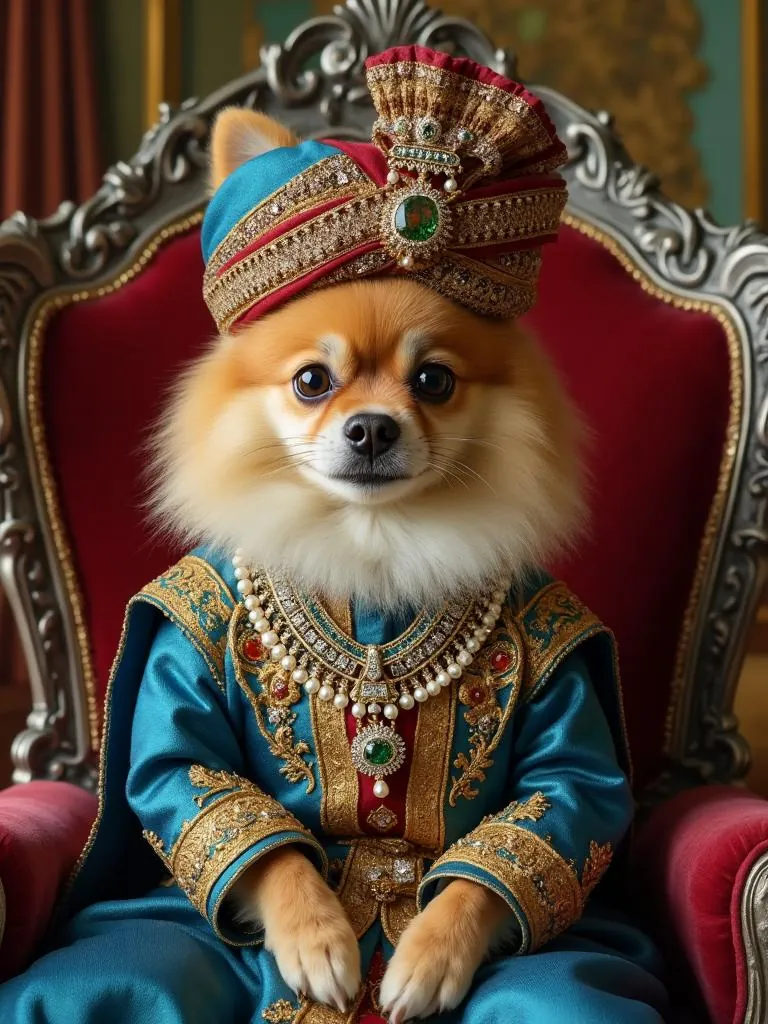
- The small dog with a loud bark as Patiala Royalty. The gallery shows a Pomeranian in a blue coat and a jewelled turban on a red throne. A tiny dog on a large throne gives the same contrast of size that Landseer used for Scratch and Grafton. The real Maharajas of Patiala have their own guide.
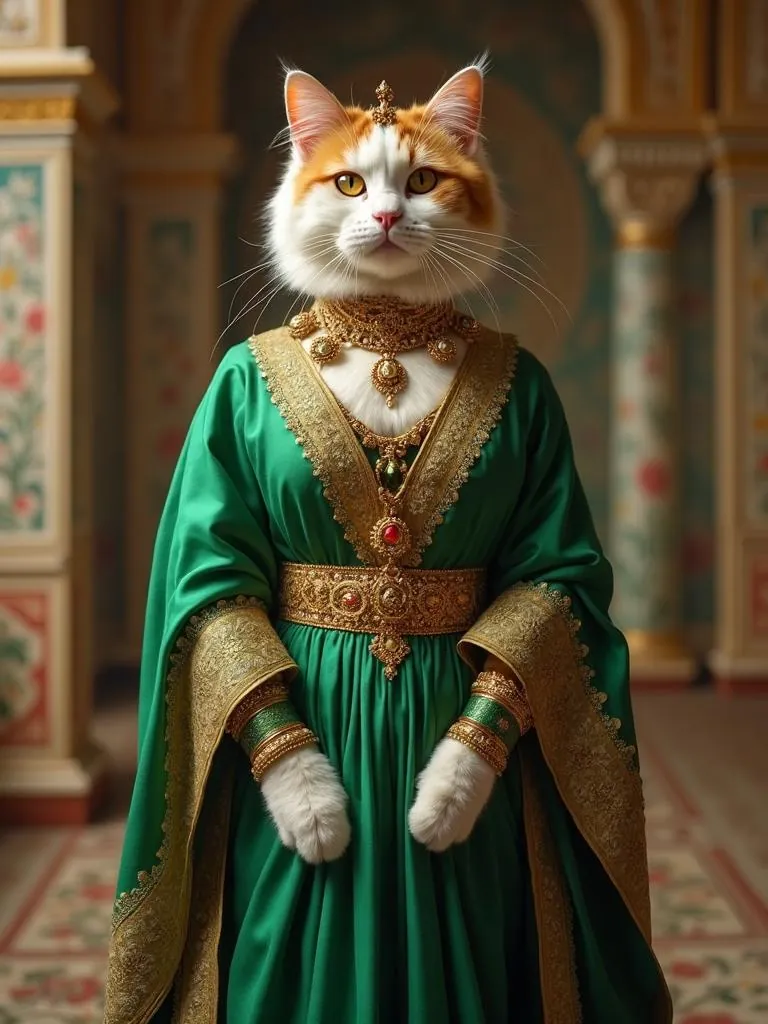
- The cat who gives the orders as the Maharani. If your cat decides when breakfast starts and where everyone sits, the Maharani style fits. The gallery shows a white and ginger cat in a green and gold gown.
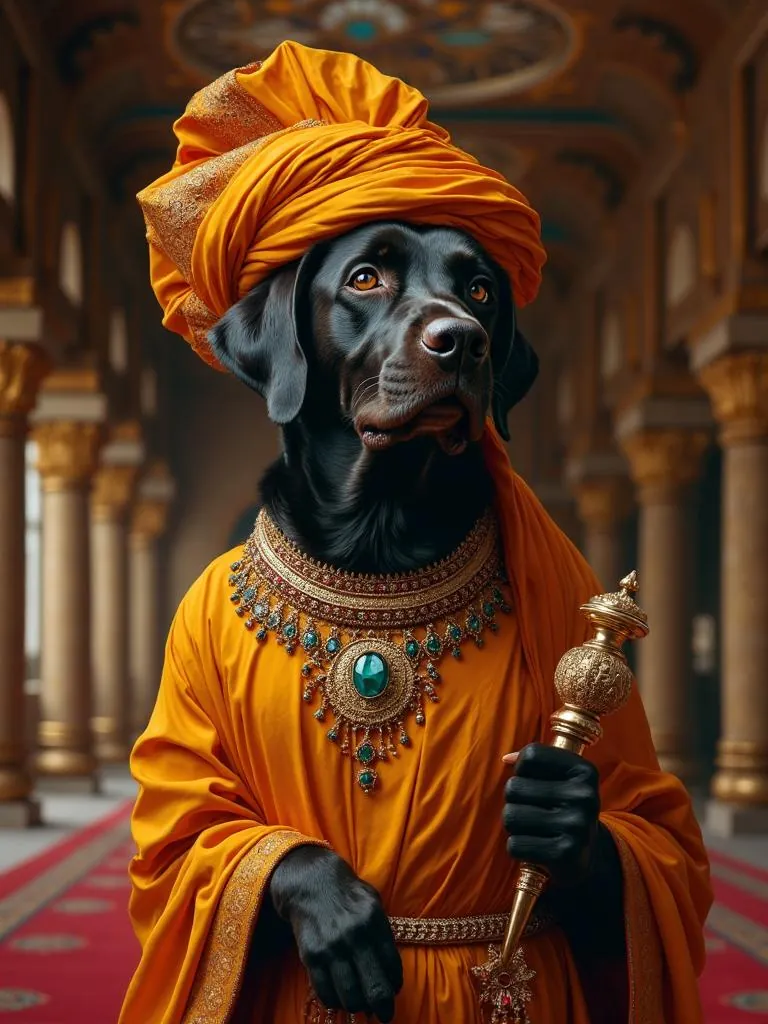
- The sock thief as the Mysore Royal. The Mysore Royal portrait gives a black labrador a saffron turban and a gold sceptre to hold. A dog that carries off socks and shoes looks funny holding something of real value for once.
- The all-day sleeper as Indian Royalty. The Regal Feline in the gallery is a ginger cat in a red and gold royal robe. A robe suits a cat that sleeps all day in the warmest spot in the house.
- The happy, clumsy dog in a crown. The Noble Hound, also in the Indian Royalty style, shows a golden retriever in a royal crown and red robe. A crown on a dog that trips over its own feet is a gentle joke the whole family will understand.
- Two pets, two portraits, one wall. If you have a big dog and a small one, or a calm cat and a wild one, make one portrait of each and hang them side by side, the way Landseer set a bloodhound beside a terrier. Pick two styles that differ, such as the Maharaja next to Patiala Royalty.
- The brave warrior who hides from the vacuum. The joke can also come from the opposite role. A Rajput Warrior portrait of a dog that hides under the bed when the vacuum cleaner starts is a joke every visitor who knows your dog will laugh at.
Eight more styles, from the Chola Warrior to the Regency Era, are in the portrait studio.
How to get a funny expression in your pet's photo
A royal portrait starts from one photo of your pet. These tips come from the AKC and from Cats Protection, a UK cat charity.
- Use what your pet loves. The AKC suggests showing a dog's quirky personality with familiar games or favourite tricks, and watching for happy expressions. It also says not to push a dog to perform. Stop if you see pinned back ears, a droopy tail, lip licking or shaking.
- Ask a question your dog knows. An AKC article says a dog with its head tilted to one side makes us smile. Animal behaviourist Jill Goldman told the AKC she believes the tilt is often followed by something good, such as "Do you want a cookie?", and she thinks that reward is why the tilt repeats. Have the camera ready before you ask. The same article says that if a head tilt lasts and seems unrelated to anything, you should take your dog to a veterinarian.
- Take photos when your dog is not looking at you. Beci Markijohn Beasley, a breeder and photographer quoted by the AKC, suggests shots of your dog looking past you or at something that has its attention, and says these unplanned shots can be some of the best. She also suggests asking a friend or two to pick their favourite before you say which one you like.
- Get a helper for a cat. Cats Protection suggests asking someone to dangle a toy out of view of the camera.
However funny the pose, keep the face clear, with both eyes sharp. The studio takes one image file of up to 5 MB. The guide on how to photograph your pet for a portrait has 10 tips on light, angle and background.
Where a funny portrait works best
Hang a funny portrait where people see it every day. Art prints come in 8 × 10, 12 × 16, 18 × 24 and 24 × 36 inches, on matte or glossy paper. An 8 × 10 print fits a desk or a shelf, and a 24 × 36 inch print lets visitors see the joke from across the room. The digital pack, a high-resolution file with no watermark, works as a phone wallpaper or a picture to send to family.
As a gift, pick the idea above that matches the story the owner tells most often about their pet.
Questions and answers
What makes a pet portrait funny?
A pet portrait is funny when an animal plays a serious human role with no sign that it knows the joke. Tate says Edwin Landseer's Dignity and Impudence, from 1839, sets the gentle dignity of a bloodhound beside the mischievous expression of a small terrier. A curator at The Metropolitan Museum of Art said William Wegman's dog videos centre on the dog's total cluelessness about what is going on. The animal takes the role seriously, and the viewer laughs.
Can dogs be funny?
Dogs can be funny, and Charles Darwin thought so too. According to the American Kennel Club, Darwin wrote in The Descent of Man, published in 1871, that dogs show a sense of humour separate from ordinary play. He described a dog that carries a stick a short way, lies down with it, and waits for its owner to come close to take it. Then the dog grabs the stick and rushes away, again and again.
Do dogs try to be funny?
Dogs often repeat what makes their owners laugh. The American Kennel Club says even young puppies learn fast that making us laugh keeps us playing with them. For most dogs that are close to their owners, a laugh works as a reward, and a behaviour that gets a reward is more likely to happen again. So a dog may repeat a trick because it earned a laugh the first time.
Why are dogs so funny?
Dogs seem funny because they have big personalities and spend their days close to us. The American Kennel Club says that the closer you and your dog are, the more private jokes you are likely to share: habits your dog repeats that you find funny. The AKC also says dogs make a breathy sound during play, a breath out through the mouth, that can be understood as laughter.
What are funny dog breeds?
No official study has ranked the funniest dog breeds, according to the American Kennel Club. The AKC points to breed standards instead, the written description of each breed's ideal temperament. The Coton de Tulear's standard, for example, calls the breed naturally clownish. The AKC adds that every dog is an individual, so a dog of any breed can make its family laugh.
Can dogs find stuff funny?
Dogs have a sound that can be understood as laughter, according to the American Kennel Club, though no one can ask a dog what it finds funny. The AKC describes a study led by the researcher Patricia Simonet at a shelter in Spokane. The researchers played a recording of this play sound to shelter dogs and concluded that it could reduce signs of stress and help dogs start friendly contact.
What does a funny dog look like?
A funny dog often has a cheeky, mischievous face, especially next to a calm or serious one. In Edwin Landseer's Dignity and Impudence, painted in 1839 and held by Tate in London, a small West Highland terrier called Scratch appears beside a large bloodhound called Grafton. Tate describes the terrier's mischievous expression against the bloodhound's soulful look and gentle dignity.
Who painted Dignity and Impudence?
Edwin Landseer painted Dignity and Impudence in 1839, in oil paint on canvas, and Tate in London holds it. According to Tate, the two dogs, a bloodhound called Grafton and a West Highland terrier called Scratch, belonged to Jacob Bell, who paid for the picture. Tate says it makes fun of Dutch portraits in which the sitter's hand hangs over a window ledge, because the bloodhound's paw hangs over the edge of a kennel.
Why did William Wegman dress his dogs in costumes?
William Wegman dressed his Weimaraner dogs in costumes so they could play the characters in stories he photographed. The Museum of Modern Art in New York showed 17 photographs from his Cinderella in 1993, in which every character is played by one of his dogs, in costumes and sets he designed. MoMA says his Weimaraners have played an important part in his photographs since 1973, and it quotes praise for his deadpan wit.
What is a funny royal portrait idea for a cat?
A funny royal portrait idea for a cat is to match the role to the cat's habits. A cat that ignores guests suits the Mughal Emperor style, which in the Purrealism gallery shows a grey cat in a jewelled crown and pearls. A cat that decides when breakfast starts suits the Maharani, shown as a white and ginger cat in a green and gold gown.
Sources
- 'Dignity and Impudence', Sir Edwin Henry Landseer, 1839, Tate
- Louis Wain, Bethlem Museum of the Mind
- William Wegman's Cinderella, The Museum of Modern Art
- No Dogs Allowed: How William Wegman Broke the Rules of Conceptual Art, The Metropolitan Museum of Art
- Do Dogs Have a Sense of Humor?, American Kennel Club
- Why Do Dogs Tilt Their Heads?, American Kennel Club
- Tips for Taking Great Photos of Your Dog, American Kennel Club
- Say Cheese! Take the Best Photos of Your Dogs, American Kennel Club
- Pet photography: How to take amazing photos of your cat, Cats Protection
Go deeper
The full guides on this topic, each a set of pages with sources: