Updated
What dogs mean in paintings: loyalty, saints, hunts, grief and politics
How to read a dog in an old painting: the faithful pet, the dogs of Saint Roch and Saint Dominic, hunting saints, Diana's hounds, a mourner and a political dog.
By Purrealism. Part of Dogs in art: the painters and paintings behind a royal dog portrait.
A dog in an old painting can carry a message. It can say that a couple is faithful, identify a saint, belong to a goddess, mourn the dead, or even stand for a political enemy. This page explains the main meanings, using paintings in the National Gallery in London and the Rijksmuseum in Amsterdam and the explanations their curators give. It ends with a short method for reading any dog you meet in a museum. For the history of dogs in art, painter by painter, start with the dogs in art guide.
Meaning depends on the picture
The National Gallery's glossary entry on dogs sums up the range. Dogs in its collection go from "the scrawny mongrel" in Hogarth's Marriage A-la-Mode to "the precisely defined pet" in van Eyck's Arnolfini Portrait, "which may be intended to symbolise the fidelity of the couple". Beyond homes, it says, "dogs can also accompany religious and mythological figures".
So the first rule is simple: the same animal can mean different things in different paintings. The sections below take the meanings one at a time.
The faithful dog
The first meaning is fidelity, or faithfulness. It appears in pictures of couples and of women. The National Gallery suggests it for the small dog between the Arnolfini couple in 1434. Our page on the Arnolfini Portrait dog explains why the Gallery's own catalogue is more careful and calls the dog clearly a household pet.
The meaning lasted for centuries. The Wallace Collection in London says that in Thomas Gainsborough's full-length portrait of the actress Mary Robinson, painted in 1781 and 1782, "her canine companion alludes to her fidelity". The prince, her former lover, had commissioned it, and the museum says Robinson probably meant it as a public statement about her relationship with him. Our page on Gainsborough's dogs tells that story.
A dog can also reveal disloyalty. In Hogarth's satire, a dog pulls a woman's cap from a husband's pocket and exposes his night out. That scene is on our page about Hogarth and his pug.
The travelling companion: Tobias and his dog
The story of Tobias comes from the Book of Tobit, which the National Gallery says Jews and Protestants regard as apocryphal, meaning outside their Bible. Tobit, a blind old merchant, sends his son Tobias on a long journey to collect a debt. God sends the Archangel Raphael to go with him, and the Gallery's glossary says Tobias was accompanied by "his guardian, the archangel Raphael, whom he thought was a mortal, and his dog". On the way Tobias catches a fish whose organs later cure his father's blindness.
The National Gallery owns a Tobias and the Angel painted in the workshop of Andrea del Verrocchio around 1470 to 1475. Tobias, Raphael and the dog cross a wide landscape. The Gallery says the story was popular in the late 1400s, when religious brotherhoods promoted devotion to Raphael, the patron saint of healers and travellers. It adds that Verrocchio's pupil Leonardo da Vinci may have painted the fish and the dog. Both seem to have been added at the last minute: "if you look closely you can see how the grass and shrubs behind show through the fur and scales."
Here the dog is a companion on the road. The Gallery says the story's moral message could be presented through the appealing image of "a young man, an angel and a dog crossing a vast landscape".
Dogs that identify saints
In religious art, an object or animal that identifies a saint is called an attribute. Several saints have a dog as theirs.
Saint Roch and the dog that brought bread
The National Gallery's glossary says Roch was born in Montpellier in the 14th century. He travelled to northern Italy, cared for victims of the Black Death, and caught the plague himself. According to legend, "he was looked after by a dog in the forest who brought him bread and licked the sore on his thigh." When he returned home, illness had changed him so much that he was not recognised and was thrown into prison as an impostor, "still accompanied by his dog". He became one of the saints people prayed to against the plague. Paintings show him as a pilgrim with a scallop-shell badge and a staff, his hose drawn back to show the plague scar on his thigh.
Saint Dominic and the dogs of the Lord
Dominic founded an order of preaching friars, the Dominicans, in 1215, and the Pope approved it in 1216. The National Gallery says the Dominicans "are sometimes symbolised by a dog: the domini canis (dog of the lord), which is usually black and white like their monastic habits". The symbol is a pun: the Latin words sound like the name of the order.
Saint Eustace, Saint Hubert and the hunt
Two saints share a legend of a hunter who meets a stag with a crucifix between its antlers and becomes a Christian. The National Gallery tells it for Saint Eustace, a Roman soldier named Placidus, and says the same legend is also told of Saint Hubert, who became the patron of hunters in the Ardennes.
In Pisanello's The Vision of Saint Eustace, painted around 1438 to 1442, the saint appears as an elegant Italian prince in a blue hat, hunting with his hounds. The Gallery says the painting is full of dogs, some apparently taken from the illustrated hunting books that were popular in the 1400s, and that Pisanello was famous for his animals. It explains that for the knightly class, hunting was seen as a picture of the soul's search for God and as training for war. The dogs here mark the saint as a nobleman and a hunter.
The hunter goddess and her hounds
In ancient myth, dogs belong above all to Diana, goddess of the hunt. The National Gallery's glossary lists her attributes: "a bow, quiver, spear, dogs and a stag, as well as a shield and a chariot", with a crescent moon for her link to the moon goddess Luna.
Diana's dogs can also be dangerous. In the myth of Actaeon, she turns a hunter into a stag and his own hounds kill him. The paintings Titian made of this story, including a scene in which Diana's lapdog barks at Actaeon's hound, are on our page about Titian's dogs.
The mourning dog
A dog that stays by a dead master is one of the most moving images in art. An example from the 1490s in the National Gallery is Piero di Cosimo's A Satyr mourning over a Nymph, painted around 1495.
A young woman lies dead on the grass, with wounds on her throat and hand. A satyr, half man and half goat, kneels beside her. The Gallery says: "A dog sits at her feet, balancing the stooping figure of the satyr and seemingly mourning as well." More dogs stand by a lake in the background. The painting may show Procris, whom her husband Cephalus killed by accident while hunting, a story from Ovid's poem the Metamorphoses.
The Gallery adds that Piero's biographer Vasari praised his skill with animals, and that "underdrawing revealed through technical examination shows that Piero carefully adjusted the animal's position". The long, low panel, 65.4 by 184.2 cm, probably formed the back of a bench or chest, or part of the wall panelling in a Florentine palace.
The mourning dog returned in later centuries. The V&A owns Edwin Landseer's The Old Shepherd's Chief Mourner of 1837, in which a dog rests its head on its master's coffin. Another example is Maud Earl's painting of King Edward VII's terrier, Caesar, covered on our page about Victorian dog painters. Medieval tomb brasses also placed dogs at the feet of the dead; our guide to medieval paintings of dogs looks at those.
The dog as enemy: The Threatened Swan
Sometimes the dog is the villain. Jan Asselijn's The Threatened Swan, painted around 1650, is a large canvas, 144 by 171 cm. The Rijksmuseum describes it simply: "A swan fiercely defends its nest against a dog."
Later viewers gave it a political meaning. The museum says the white swan came to be read as the Dutch statesman Johan de Witt, murdered in 1672, protecting the country from its enemies. Words on the canvas make the point: "de Raad-Pensionaris" (the chief minister) under the swan, "Holland" on the egg, and "de viand van de staat" (the enemy of the state) above the dog. With that meaning, it became the first acquisition of the Nationale Kunstgalerij, the forerunner of the Rijksmuseum, in 1800.
Dog meanings at a glance
| Meaning | Example | Source |
|---|---|---|
| Fidelity in marriage or love | The Arnolfini Portrait, 1434 | National Gallery, London |
| Company on a journey | Tobias and the Angel, around 1470 to 1475 | National Gallery, London |
| Care in sickness | Saint Roch and his dog | National Gallery glossary |
| The Dominican order | A black and white dog with Saint Dominic | National Gallery glossary |
| A hunting saint | The Vision of Saint Eustace, around 1438 to 1442 | National Gallery, London |
| The goddess of the hunt | Diana with her dogs | National Gallery glossary |
| Grief | A Satyr mourning over a Nymph, around 1495 | National Gallery, London |
| An enemy | The Threatened Swan, around 1650 | Rijksmuseum, Amsterdam |
How to read a dog in a painting
When you meet a dog in a museum, four questions usually lead to its meaning:
- Who is the dog with? A couple or a woman suggests fidelity. A pilgrim with a sore on his thigh means Saint Roch. A goddess with a bow is Diana.
- What is the dog doing? Hunting, guarding, begging, mourning or barking each tells a different story.
- What kind of dog is it? A small lapdog usually belongs to the home, and a hound to the hunt.
- Are there words? Titles, labels and inscriptions, like the ones on The Threatened Swan, can fix a meaning that later viewers wanted the painting to carry.
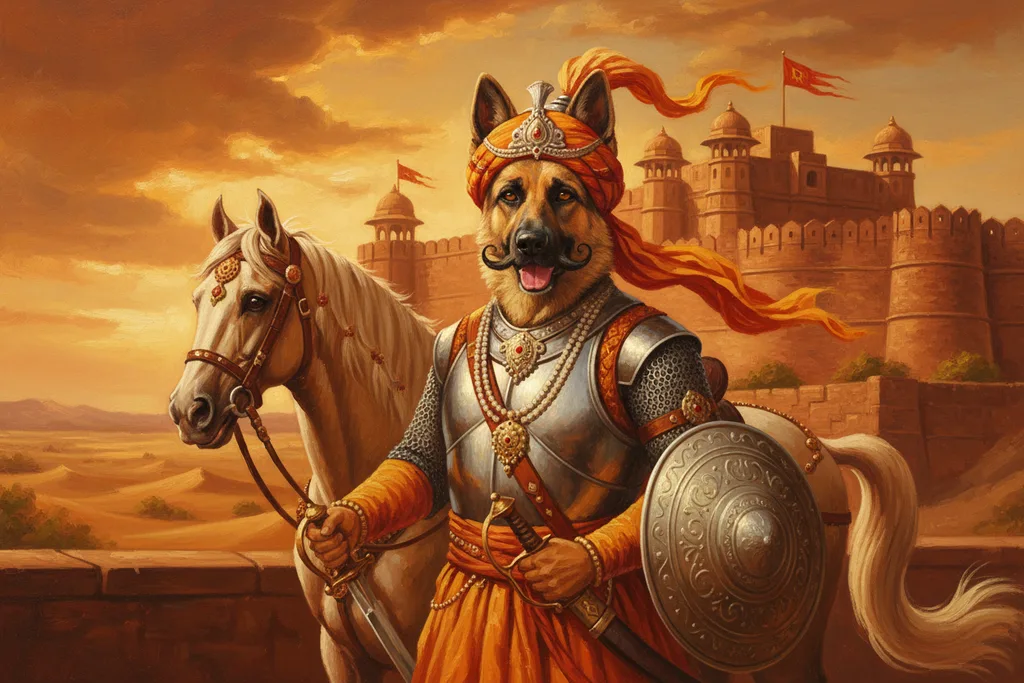
The same questions help when you choose a style for your own dog's portrait. A loyal guardian of the house might suit a warrior's armour, and a calm lapdog might suit a seated ruler. The cover of this page shows a German Shepherd from the studio examples in Purrealism's Rajput Warrior style. Our guide on how to choose a royal portrait style gives more ideas, and the gallery shows finished portraits.
Questions and answers
What are dogs a symbol of in art?
Dogs in European art often stand for faithfulness, and they carry other meanings too. The National Gallery in London says a dog may symbolise a couple's fidelity, as in van Eyck's Arnolfini Portrait. Dogs also accompany saints and figures from myth: the hunter Saint Eustace is surrounded by hounds, and dogs are among the signs of Diana, goddess of the hunt.
Do dogs symbolize loyalty in paintings?
Dogs often symbolize loyalty in paintings, especially in portraits of couples and women. The National Gallery in London says the dog in Jan van Eyck's Arnolfini Portrait of 1434 may stand for the couple's fidelity. The Wallace Collection says the dog beside Mary Robinson in Gainsborough's portrait of 1781 to 1782 alludes to her fidelity. The meaning depends on the painting.
Do dogs symbolize death in paintings?
Dogs in paintings can keep company with the dead, as mourners. In Piero di Cosimo's A Satyr mourning over a Nymph, painted around 1495, a dog sits at the dead nymph's feet and seems to mourn her, according to the National Gallery in London. Technical study shows Piero adjusted the dog's position with care while he painted.
Why is there a dog in Tobias and the Angel?
There is a dog in Tobias and the Angel because the Book of Tobit says the young Tobias travelled with his dog. The National Gallery in London owns a version painted in Andrea del Verrocchio's workshop around 1470 to 1475. It says the dog and the fish may have been painted by Verrocchio's pupil Leonardo da Vinci, and seem to have been added at the last minute.
Why does Saint Roch have a dog?
Saint Roch has a dog because, according to his legend, a dog looked after him in the forest when he caught the plague. The National Gallery in London says the dog brought him bread and licked the sore on his thigh. Roch, born in Montpellier in the 14th century, became one of the saints people prayed to for protection against the plague.
Why is Saint Dominic shown with a dog?
Saint Dominic is shown with a dog because his friars, the Dominicans, were sometimes symbolised as dogs of the Lord. The National Gallery in London explains the Latin play on words, domini canis, meaning dog of the Lord. The dog is usually black and white, like the Dominicans' robes. Dominic founded his order in 1215, and the Pope approved it in 1216.
Which saint is painted with hunting dogs and a stag?
Saint Eustace and Saint Hubert are both painted with hunting dogs and a stag. The National Gallery in London says both saints share the legend of a hunter converted by the sight of a stag with a crucifix between its antlers. In Pisanello's The Vision of Saint Eustace, painted around 1438 to 1442, the saint rides with his hounds.
Why is the goddess Diana painted with dogs?
The goddess Diana is painted with dogs because she is the goddess of the hunt, and hunting dogs are among her attributes, the objects that identify her in art. The National Gallery in London lists her attributes as a bow, a quiver, a spear, dogs and a stag, together with a crescent moon, a shield and a chariot.
What does the dog stand for in The Threatened Swan?
The dog in Jan Asselijn's The Threatened Swan, painted around 1650, came to stand for the enemies of the Dutch Republic. The Rijksmuseum in Amsterdam says a swan defends its nest from a dog, and later viewers read the swan as the statesman Johan de Witt. Words on the painting label the dog de viand van de staat, the enemy of the state.
How can I tell what a dog means in an old painting?
You can tell what a dog means in an old painting by looking at who it belongs to and what it is doing. A small dog beside a couple or a woman often points to fidelity, as the National Gallery in London says of the Arnolfini Portrait. Hounds usually mean a hunt or a hunting saint. A dog beside a pilgrim with a sore thigh is Saint Roch's.
Sources
- Dogs, The National Gallery, London. Accessed September 29, 2026.
- Tobias and the Angel, Workshop of Andrea del Verrocchio, The National Gallery, London. Accessed September 29, 2026.
- Tobias, The National Gallery, London. Accessed September 29, 2026.
- St Roch, The National Gallery, London. Accessed September 29, 2026.
- St Dominic, The National Gallery, London. Accessed September 29, 2026.
- The Vision of Saint Eustace, Pisanello, The National Gallery, London. Accessed September 29, 2026.
- St Hubert, The National Gallery, London. Accessed September 29, 2026.
- Diana, The National Gallery, London. Accessed September 29, 2026.
- A Satyr mourning over a Nymph, Piero di Cosimo, The National Gallery, London. Accessed September 29, 2026.
- The Old Shepherd's Chief Mourner, Edwin Henry Landseer, Victoria and Albert Museum. Accessed September 29, 2026.
- The Threatened Swan, Jan Asselijn, Rijksmuseum. Accessed September 29, 2026.
- Mrs Mary Robinson and her Portraits, The Wallace Collection. Accessed September 29, 2026.
Short reads on this topic
Articles from Purrspectives that answer one question each.
Dog years to human years: the chart by size, and the DNA formula
A 1-year-old dog is closer to 15 or 30 in human years than to 7. The AKC chart by size, the 2020 DNA formula, and a dog's life stages, explained simply.

Pug history: from Chinese emperors to the House of Orange
Pugs began as companions of Chinese emperors, reached Holland on Dutch trading ships and became the dog of the House of Orange. Their history, art and health.
Persian cat history: where the breed came from, its first cat show, coat and care
Persian cat history from a cat brought to Italy in 1626 to the 1871 Crystal Palace show, plus face types, coat colours, grooming and how to photograph one.