Updated
Thomas Gainsborough's dogs: gun dogs, lapdogs and a dog he never finished
Why Thomas Gainsborough put dogs beside the people he painted, from the gun dog in Mr and Mrs Andrews to Mary Robinson's companion, and what each dog tells you.
By Purrealism. Part of Dogs in art: the painters and paintings behind a royal dog portrait.
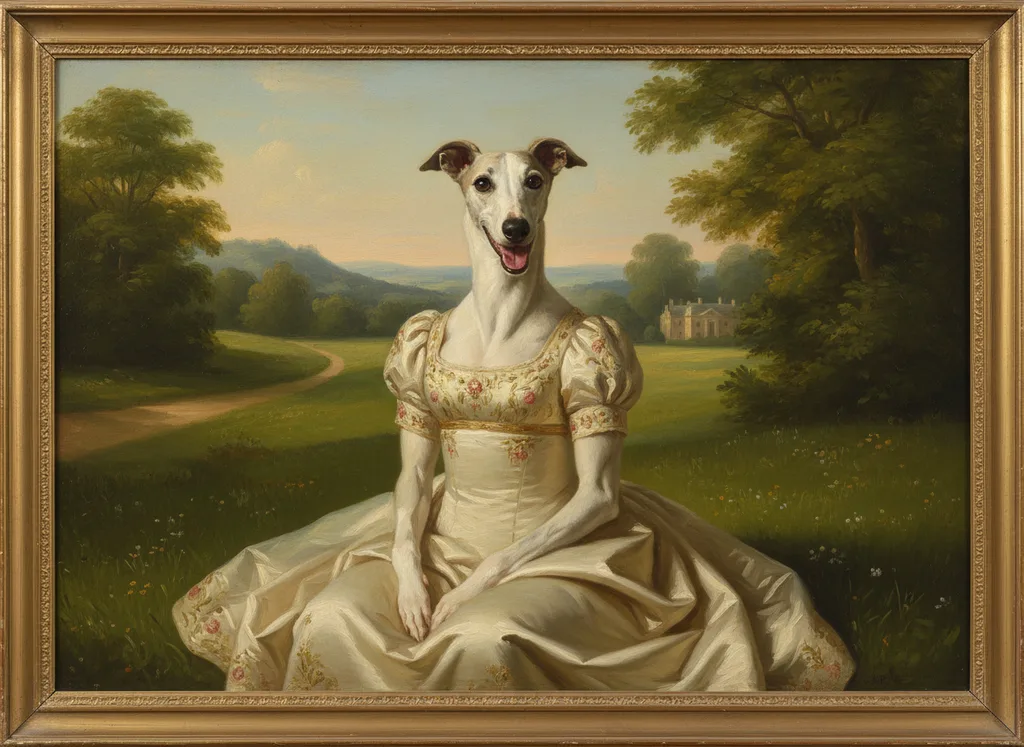
Thomas Gainsborough (1727 to 1788) painted dogs into his pictures from around 1750 until 1786, two years before he died. This page looks at the dogs in five of his pictures, what each dog says about the person beside it, and where you can see them in London. It draws on the National Gallery in London, the Wallace Collection and a biography of the painter by Max Rothschild, free to read on Project Gutenberg. For the wider story of dogs in paintings, from van Eyck to the Victorians, start with the dogs in art guide.
Who was Gainsborough?
The National Gallery says Gainsborough was born in Sudbury, Suffolk, the son of a wool manufacturer. He trained in London and set up as a painter in Ipswich around 1752. In 1759 he moved to Bath, a fashionable spa town where wealthy visitors wanted their portraits painted. He settled in London in 1774.
The Gallery calls him, with his rival Joshua Reynolds, the leading portrait painter in England in the later 18th century. He was a founding member of the Royal Academy and became a favourite painter of George III and his family. His own taste ran to landscapes and country scenes, and his letters show his impatience with clients who only wanted portraits. His dogs join these two interests: an animal from the countryside, placed beside a paying sitter.
The conversation piece and the gun dog
Gainsborough painted conversation pieces, according to the National Gallery's glossary, which defines these as small group portraits of family or friends, painted in an informal way, at home or in the countryside. It says they were a favourite in 18th-century England.
Mr and Mrs Andrews, around 1750
The National Gallery calls this the finest work of Gainsborough's early career, and it has a dog in it. Robert Andrews stands on the left beside his seated wife, Frances, under an oak tree. Behind them, fields and pasture run east across the valley of the River Stour. The National Gallery says much of the land in the picture belonged to Andrews.
Andrews wears a loose shooting jacket, with bags of powder and shot hanging from his pocket and a long-barrelled shotgun under his arm. At his feet stands his gun dog, brown and white, looking up at him. The Gallery's audio description says the dog looks up "faithfully". The Gallery also says Andrews is suited to the landscape he stands in, with his shotgun under his arm and his attentive gun dog at his feet. It calls the painting a triple portrait: of Robert Andrews, his wife and his land.
Gainsborough and Robert Andrews had been pupils together at Sudbury Grammar School. The canvas is small, 69.8 by 119.4 cm, and hangs in Room 34.
John Plampin, around 1752
In this portrait John Plampin, a young landowner from Shimpling in Suffolk, sits on a bank in a blue coat with gold braid, one hand tucked into his waistcoat. His legs are spread in a relaxed pose. Beside him is a small gun dog, which the National Gallery describes as probably a pointer cross.
The Gallery adds a detail that shows how a portrait painter worked: Gainsborough reused the dog's pose in other Suffolk portraits of the 1750s. The same page explains that the landscape is there to reinforce Plampin's authority and privilege as a member of the landed gentry, the families who owned land and lived from it.
The painting measures 50.2 by 60.3 cm. The collector Percy Moore Turner left it to the National Gallery in 1951. It was listed as not on display when this page was written.
A dog for loyalty: Mary Robinson, 1781 to 1782
In the 1780s Gainsborough painted some of the best-known people in London. The Wallace Collection owns his full-length portrait of Mary Robinson, an actress and poet. The high point of her stage career came on 3 December 1779, when she played Perdita, a princess disguised as a shepherdess, in David Garrick's version of Shakespeare's The Winter's Tale. The 17-year-old Prince of Wales, later George IV, watched from the royal box. He was captivated, and in the spring of 1780 they began an affair that became public. By the end of 1780 it was over.
The prince commissioned the portrait from Gainsborough while Robinson was negotiating a settlement with him. Gainsborough painted her outdoors, as Perdita left behind by her royal lover, holding a miniature portrait that was probably the one the prince had sent her. A dog is at her side. The Wallace Collection says the dog alludes to her fidelity and looks as natural as the landscape around it.
Here the dog does a different job from the gun dog. It carries a message about the character of the sitter, the person being painted. The museum adds that Gainsborough withdrew the painting from the Royal Academy exhibition of 1782, perhaps to avoid embarrassing the prince. The idea of the faithful dog is older than Gainsborough; our page on what dogs mean in paintings follows it back to the 1400s.
The Morning Walk, 1785
The National Gallery says Gainsborough's late style used light, feathery brushwork, and The Morning Walk comes from these years. William Hallett and Elizabeth Stephen walk arm in arm with their dog, shortly before their wedding on 30 July 1785. Our guide to famous paintings of dogs covers the scene itself, so here are the facts behind it.
The National Gallery says the groom commissioned the painting and paid Gainsborough 126 pounds for it on 4 March 1786. The canvas is large, 236.2 by 179.1 cm. Hallett later lost his fortune through gambling and two bad property deals. After Elizabeth died, he remarried and sent the portrait to a sale room, where it did not sell, and in his will he left it to his daughter Lettice.
Max Rothschild, who wrote a short book on Gainsborough for the Masterpieces in Colour series, called The Morning Walk perhaps the painter's most perfect work. He wrote that it then belonged to Lord Rothschild and showed the couple "with a white Pomeranian dog". The National Gallery now owns it, and it hangs in Room 34.
The Newfoundland that was never finished
Rothschild's book also tells a story about a dog portrait that went wrong. Rothschild calls Philip Thicknesse the painter's earliest patron, and says it was Thicknesse who persuaded him to move to Bath. Mrs Thicknesse owned a fine viol da gamba, a stringed instrument made in 1612, which Gainsborough loved and had often offered to buy. One evening after supper she gave it to him, asking only for a portrait of her husband in return, to hang beside her own portrait.
According to Thicknesse's account, quoted by Rothschild, Gainsborough began the next day. He finished the head, "put in a Newfoundland dog at the sitter's feet", and sketched in the rest. Then he stopped and never touched it again. In a temper he sent the instrument back, and soon afterwards the unfinished picture too. Thicknesse was deeply offended, and their long friendship ended. Rothschild also gives a second version, from the writer Allan Cunningham, in which Gainsborough had paid for the instrument, and he judges Thicknesse's account the more likely one.
In Thicknesse's account, the dog went into the picture on the first day, together with the face.
Dogs in the countryside: The Market Cart, 1786
Gainsborough's own favourite subjects were country scenes, and dogs appear in those too. In The Market Cart, a horse pulls a cart full of vegetables along a woodland path. Two boys and their dog walk beside the cart's large wheel. By the road, two tired travellers rest with their baskets, bundles and another dog.
The National Gallery says Gainsborough painted it at the end of 1786. He died in 1788. The canvas is 184 by 153 cm, as large as some of his full-length portraits. Here the dogs are ordinary working animals, part of daily life on the road to market.
The five dogs side by side
| Painting | Date | What the dog does | Museum |
|---|---|---|---|
| Mr and Mrs Andrews | around 1750 | A gun dog looks up at its master | National Gallery, Room 34 |
| John Plampin | around 1752 | A small gun dog, probably a pointer cross, beside a landowner | National Gallery |
| Mrs Mary Robinson ('Perdita') | 1781 to 1782 | A companion that alludes to fidelity | Wallace Collection |
| The Morning Walk | 1785 | Walks with a couple before their wedding | National Gallery, Room 34 |
| The Market Cart | 1786 | Walks beside a cart on the way to market | National Gallery, Room 34 |
What a Gainsborough dog can teach a portrait today
Each of these dogs has a reason to be in the picture. The gun dogs go with landowners who shoot. The dog beside Mary Robinson stands for loyalty. The dogs on the road belong to country life.
When your own dog is the sitter, the dog is the centre of the picture. A photo that shows how your dog stands and looks, taken in daylight at its eye level, gives a portrait the same sense of a real animal that Gainsborough's gun dogs have. The cover of this page shows a whippet from the studio examples in Purrealism's Regency Era style. For the court portraits of the same century in France, read about Oudry and Desportes. For English satire in the decades just before, see Hogarth and his pug, Trump. To see more finished portraits, visit the gallery.
Questions and answers
What dog is in Gainsborough's Mr and Mrs Andrews?
Gainsborough's Mr and Mrs Andrews, painted around 1750, shows a brown and white gun dog at Robert Andrews's feet. The National Gallery in London describes the dog looking up at its master, who carries a long-barrelled shotgun and bags of powder and shot. The Gallery calls the work a triple portrait of Andrews, his wife and his land.
What kind of dog does John Plampin have in Gainsborough's portrait?
John Plampin has a small gun dog, probably a pointer cross, in the portrait Gainsborough painted of him around 1752. The National Gallery in London, which owns the painting, says Gainsborough reused the dog's pose in other portraits he painted in Suffolk in the 1750s. Plampin sits on a bank with his legs spread, in a relaxed pose for a portrait of that time.
Why is there a dog in Gainsborough's portrait of Mary Robinson?
The dog in Gainsborough's portrait of the actress Mary Robinson stands for loyalty. The Wallace Collection in London, which owns the painting of 1781 to 1782, says her companion alludes to her fidelity. The Prince of Wales commissioned the portrait after their affair ended, and Robinson holds a miniature portrait that was probably the one the prince had sent her.
How much did Gainsborough charge for The Morning Walk?
William Hallett paid Thomas Gainsborough 126 pounds for The Morning Walk on 4 March 1786, according to the National Gallery in London. The painting shows Hallett and Elizabeth Stephen shortly before their wedding on 30 July 1785, walking arm in arm with their dog. It is a large canvas, 236.2 cm high and 179.1 cm wide, and hangs in Room 34.
Did Gainsborough ever leave a dog portrait unfinished?
Thomas Gainsborough left a portrait of Philip Thicknesse unfinished after painting a Newfoundland dog at the sitter's feet. Max Rothschild's book Gainsborough retells Thicknesse's own account: Gainsborough finished the head and added the dog in one day, sketched the rest and never touched it again. The painter later sent the canvas back, and the two men quarrelled over it.
What is a conversation piece in painting?
A conversation piece is a small, informal group portrait of family members or friends, set at home or in the countryside. The National Gallery in London says these paintings were a favourite in England in the 18th century, and names Gainsborough among the artists who painted them. Mr and Mrs Andrews is one, with the couple, their gun dog and their land.
Are there dogs in Gainsborough's landscapes?
Dogs appear in several of Thomas Gainsborough's country scenes. In The Market Cart of 1786, which the National Gallery in London owns, two boys and their dog walk beside the cart's large wheel on the way to market. Two tired travellers rest by the road with their baskets, bundles and a second dog. Gainsborough painted it at the end of 1786, less than two years before his death in 1788.
Where can I see Gainsborough's paintings with dogs in London?
The National Gallery in London shows Mr and Mrs Andrews, The Morning Walk and The Market Cart, all listed in Room 34 in September 2026. John Plampin, also owned by the National Gallery, was listed as not on display. The Wallace Collection in Manchester Square owns the full-length portrait of Mary Robinson with her dog. Check each museum's page before visiting.
Where was Thomas Gainsborough from?
Thomas Gainsborough was born in Sudbury, Suffolk, in 1727, the son of a wool manufacturer, according to the National Gallery in London. He trained in London, worked in Ipswich from around 1752, moved to the spa town of Bath in 1759 and settled in London in 1774. Several of his early portraits with dogs, such as Mr and Mrs Andrews, show Suffolk farmland.
Why do Gainsborough's Suffolk portraits include gun dogs?
Gainsborough's Suffolk portraits include gun dogs because his sitters were landowners who hunted on their own land. The National Gallery in London says the landscape in John Plampin, painted around 1752, reinforces Plampin's authority as a member of the landed gentry. In Mr and Mrs Andrews, Robert Andrews carries a shotgun and his gun dog stands at his feet.
Sources
- Mr and Mrs Andrews, Thomas Gainsborough, The National Gallery, London. Accessed September 29, 2026.
- John Plampin, Thomas Gainsborough, The National Gallery, London. Accessed September 29, 2026.
- Mr and Mrs William Hallett ('The Morning Walk'), Thomas Gainsborough, The National Gallery, London. Accessed September 29, 2026.
- The Market Cart, Thomas Gainsborough, The National Gallery, London. Accessed September 29, 2026.
- Thomas Gainsborough (1727 - 1788), The National Gallery, London. Accessed September 29, 2026.
- Conversation pieces, The National Gallery, London. Accessed September 29, 2026.
- Mrs Mary Robinson and her Portraits, The Wallace Collection. Accessed September 29, 2026.
- Gainsborough, by Max Rothschild, Project Gutenberg. Accessed September 29, 2026.
Short reads on this topic
Articles from Purrspectives that answer one question each.
Dog years to human years: the chart by size, and the DNA formula
A 1-year-old dog is closer to 15 or 30 in human years than to 7. The AKC chart by size, the 2020 DNA formula, and a dog's life stages, explained simply.
Pug history: from Chinese emperors to the House of Orange
Pugs began as companions of Chinese emperors, reached Holland on Dutch trading ships and became the dog of the House of Orange. Their history, art and health.
Persian cat history: where the breed came from, its first cat show, coat and care
Persian cat history from a cat brought to Italy in 1626 to the 1871 Crystal Palace show, plus face types, coat colours, grooming and how to photograph one.