Updated
The dog in the Arnolfini Portrait: van Eyck's small pet up close
What the National Gallery's research says about the small dog in van Eyck's Arnolfini Portrait of 1434: its breed, its colours, and whether it is a symbol.
By Purrealism. Part of Dogs in art: the painters and paintings behind a royal dog portrait.
The small dog standing between the couple in Jan van Eyck's Arnolfini Portrait, dated 1434, stands close to the viewer and looks straight out of the picture. This page looks closely at that one animal: what kind of dog it is, how van Eyck painted its fur, whether it was meant as a symbol, and what happened to the painting over six centuries. It draws on the National Gallery in London, which owns the portrait, and above all on the Gallery's detailed catalogue entry by the curator Lorne Campbell, published in 1998 and updated in 2021. For the wider history of dogs in art, start with the dogs in art guide.
The painting in brief
The Arnolfini Portrait is an oil painting on an oak panel, 84.5 cm high and 62.5 cm wide, made of three boards. A richly dressed man and woman stand in a room in Bruges, in present-day Belgium. Oranges lie by the window, a brass chandelier hangs above them, and a round mirror on the back wall reflects the room and two more figures in the doorway. Above the mirror van Eyck painted his signature: "Johannes de eyck fuit hic 1434", Latin for "Jan van Eyck has been here, 1434".
The man is believed to be a member of the Arnolfini family, Italian merchants from Lucca who lived in Bruges. Campbell's catalogue lists five members of the family in Bruges at the time, and the painter's patron, the person who paid for the portrait, could have been any of them. The small dog stands on the floor between the couple, close to the viewer.
What kind of dog is it?
The catalogue says the dog "is clearly a household pet". It adds that the dog "has been recognised as one of a canine family from which the Brussels griffon has been bred", citing an article in Country Life magazine from 1955. The catalogue also compares it with other dogs in paintings of the time. It looks different from the dogs in paintings and miniatures of the Burgundian court, the court of the dukes who ruled Bruges. It also differs from the small whitish dogs with long hair and long, drooping ears that appear in paintings by Rogier van der Weyden, Hans Memling and their followers. In other words, van Eyck painted a particular kind of dog.
How van Eyck painted the fur
Campbell's catalogue describes the dog's colours in detail. Its hair is grey-brown, mixed from four pigments: black, vermilion, yellow and white. Vermilion is a bright red pigment. Some single strands of hair are painted in almost pure vermilion. The dog's eyes are brown, with small secondary lights in vermilion.
The National Gallery's own page on the painting adds that, for all its precision, the portrait was painted quickly and freely. Van Eyck bounced the brush off the panel for small touches of colour and used his fingers and the handle of the brush as well as its tip. The catalogue explains one result: to soften the edge where the shadow of the dog's back leg meets the floor, he smudged the paint with a finger or thumb and left a print. Our guide to what makes a Renaissance painting covers that thumbprint and the oil technique behind it.
Was the dog part of the first plan?
Before he painted, van Eyck drew the design on the prepared panel. This first drawing is called the underdrawing. Infrared light can show it through the paint today.
The catalogue reports that no underdrawing can be found for the dog. The same is true of the oranges, the beads, the two pairs of pattens (wooden overshoes worn outdoors) and the chandelier. These details were painted without a drawn plan beneath them. The figures, by contrast, were underdrawn and then changed during painting: the man's hat, his eyes and his nose all moved. Campbell reads these many changes as a sign of close contact between the painter and the couple, who "must surely have approved every departure from the first design".
Symbol or pet?
The National Gallery's glossary entry on dogs says the "precisely defined pet" in the foreground of the Arnolfini Portrait "may be intended to symbolise the fidelity of the couple". Fidelity means faithfulness. This reading has a long history in art writing about dogs.
The catalogue is more cautious. The art historian Erwin Panofsky argued that the painting was a "pictorial marriage certificate", a record of a secret wedding, and that many objects in the room were disguised symbols. Campbell takes the argument apart point by point:
- Panofsky called the man's raised hand a marriage gesture with a Latin name, but, the catalogue says, "in fact he had invented the term".
- Panofsky called the single candle a marriage candle, but produced no evidence that candles were burned at weddings.
- Panofsky described the room as a bedroom. The catalogue calls it a reception room, and says the bed was an essential part of such a room's furniture.
Campbell then makes a point that bears directly on the dog. "Most of the objects which, according to Panofsky and his followers, have symbolic significance, turn out not to have been underdrawn: the candle, the carving of Saint Margaret, the oranges, the discarded pattens, the dog." Campbell uses this as evidence against reading them as a planned set of hidden symbols.
So there are two readings. The glossary says the dog may stand for fidelity. The catalogue says it is clearly a pet and warns against reading every object as a hidden sign. Both come from the same museum, and both are worth knowing. Our page on what dogs mean in paintings looks at how the idea of the faithful dog developed in other works.
Six centuries of owners
The catalogue traces the painting's journey, and the dog travelled with it.
| Date | Owner or place | What the record says |
|---|---|---|
| Before 1516 | Don Diego de Guevara | A Spanish nobleman raised at the Burgundian court; his coat of arms was painted on the shutters |
| 1516 | Margaret of Austria, at Mechelen | First item in her inventory of paintings, as "Hernoul le Fin with his wife in a chamber" |
| 1700 | Royal palace, Madrid | Listed in the inventory after the death of King Charles II of Spain |
| 1794 | Royal palace, Madrid | Described as one vara high, a Spanish yard of 84 cm |
| After 1813 | James Hay | A Scottish soldier who fought at the Battle of Vitoria in the Peninsular War |
| 1842 | The National Gallery, London | Bought for 600 guineas |
The National Gallery's page adds that it bought the portrait "for 'the moderate price' of 600 Guineas" and that it was the Gallery's first Netherlandish painting. The panel once had two painted shutters that closed over it like doors; the catalogue says they are lost.
Condition of the dog today
The catalogue says the painting, cleaned in 1942 and 1943, is well preserved. It lists small losses along a zig-zag scratch across the mirror and "a slight damage in the ribcage of the dog". Thin strips of the original oak frame remain attached to the top and bottom edges of the panel. The largest fragment begins just below the dog's left front paw.
Other dogs linked to the Arnolfini Portrait
The dog appears in later works too. The catalogue lists several:
- A copy in a manuscript. The Bruges illuminator Willem Vrelant painted a scene of the martyrdom of Saint Margaret in a copy of Vincent de Beauvais's Miroir historial, and "the London painting's dog appears in the foreground".
- A lost van Eyck. Two copies survive of a lost van Eyck painting of a nude woman with a clothed attendant. The copies show a room with a bed, a mirror, discarded pattens "and a small dog".
- A grey dog with a patron. A manuscript made in Paris in 1454 for Giovanni di Arrigo Arnolfini, one of the five Arnolfini in Bruges, opens with a painting of a kneeling man presenting a book to the young Charles the Bold. The catalogue says the pair are no doubt Arnolfini and Charles, though they are not recognisable portraits, and that the kneeling man "is accompanied by a grey dog".
The catalogue also warns against seeing van Eyck's influence everywhere. As it says, it is tempting to imagine that any work of art showing a couple with a dog must come from this painting.
What the Arnolfini dog means for a portrait of your own pet
Van Eyck gave a small pet the same care he gave a merchant's fur-lined robe: single hairs, a warm red glint, light in the eyes. The detail is what makes the dog feel real. If you want a portrait with that kind of detail, start with a sharp photo in which your dog's coat and eyes are clear, taken in good daylight at your dog's eye level.
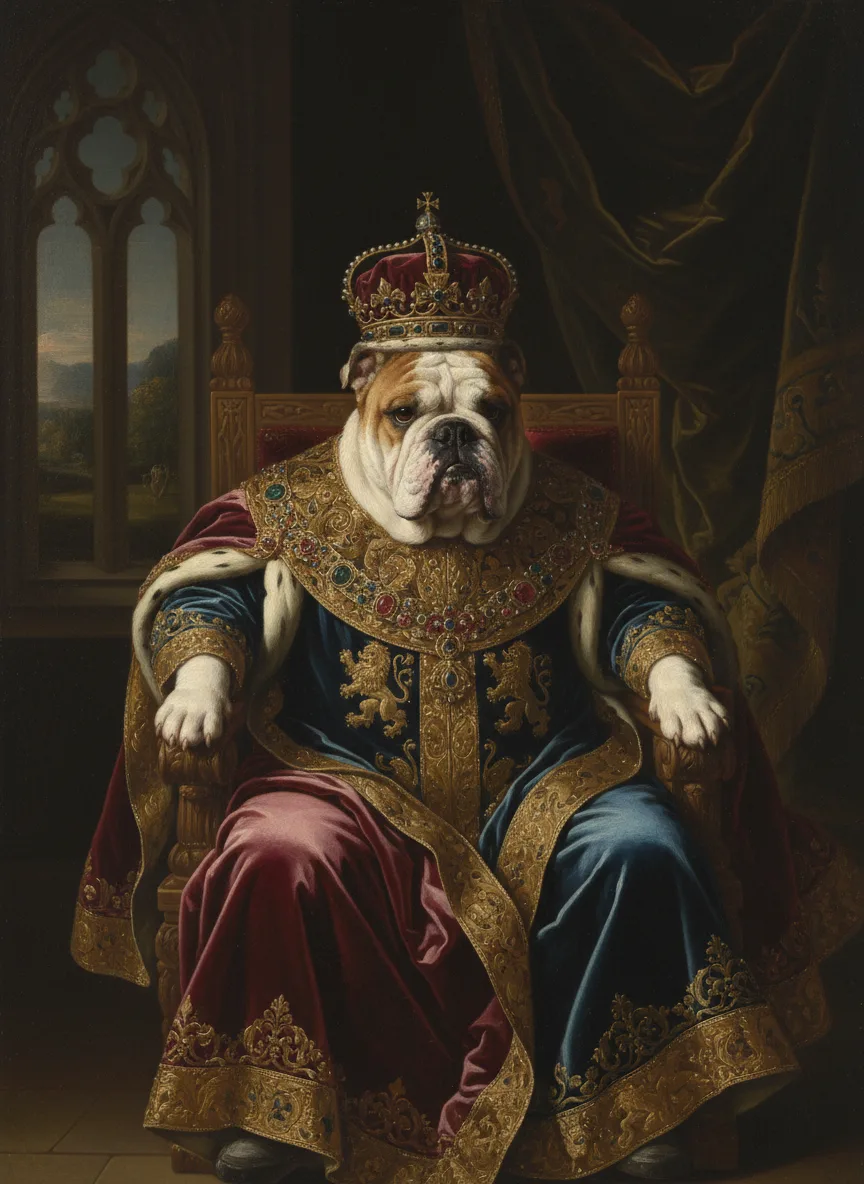
Purrealism's Renaissance Royal style draws on the European portraits of this period; the cover of this page shows an English Bulldog from the studio examples in that style. Painters after van Eyck gave their dogs other roles: in Italy, Titian's dogs hunt with gods and sit with noble children, and two centuries later Dutch painters put dogs into family portraits and everyday scenes. When you are ready, choose a photo and start in the portrait studio.
Questions and answers
What breed is the dog in the Arnolfini Portrait?
The dog in Jan van Eyck's Arnolfini Portrait of 1434 belongs to the family of small dogs from which the Brussels griffon was later bred. The National Gallery in London gives this identification in its catalogue by Lorne Campbell, citing an article in Country Life magazine from 1955. The catalogue adds that the dog looks different from the dogs in paintings of the Burgundian court.
What colours did van Eyck use for the Arnolfini dog?
Jan van Eyck mixed the Arnolfini dog's grey-brown fur from black, vermilion, yellow and white paint, according to the National Gallery's catalogue. Some single hairs are painted in almost pure vermilion, a bright red pigment. The dog's eyes are brown, with small touches of vermilion to catch the light. The painting is oil on an oak panel, 84.5 by 62.5 cm.
Does the dog in the Arnolfini Portrait stand for faithfulness?
The dog in the Arnolfini Portrait may stand for the couple's faithfulness, according to the National Gallery's glossary, but its catalogue is more careful. Lorne Campbell's catalogue calls the dog clearly a household pet. It also records that the dog, like the oranges, the candle and the discarded shoes, was not in van Eyck's underdrawing, which Campbell uses as evidence against the idea of planned hidden symbols.
Did van Eyck plan the Arnolfini dog from the start?
Jan van Eyck did not draw the Arnolfini dog in his first design on the panel. The National Gallery's catalogue reports that infrared study found no underdrawing for the dog, the oranges, the beads, the two pairs of wooden overshoes or the chandelier. The figures, by contrast, were underdrawn and then changed during painting, which suggests the couple approved each change.
What does Johannes de eyck fuit hic mean?
Johannes de eyck fuit hic is Latin for Jan van Eyck has been here, and it is the signature on the wall of the Arnolfini Portrait, dated 1434. The National Gallery's catalogue by Lorne Campbell reads it as a claim of the painter's skill at making an imagined room look real. It also suggests van Eyck was on friendly terms with the couple.
Is the Arnolfini Portrait a wedding picture?
The Arnolfini Portrait is a double portrait of a couple, and the National Gallery's catalogue questions the older idea that it records a wedding. The art historian Erwin Panofsky called it a pictorial marriage certificate. Lorne Campbell's catalogue shows that Panofsky invented a Latin term for the man's gesture, and it describes the room as a reception room, where a bed was normal furniture.
Who owned the Arnolfini Portrait before the National Gallery?
The first recorded owner of the Arnolfini Portrait was Don Diego de Guevara, a Spanish nobleman who died in 1520. The National Gallery's catalogue says he gave it to Margaret of Austria, who listed it in 1516. It later passed to the Spanish royal collection and then to James Hay, a Scottish soldier in the Peninsular War. The National Gallery bought it in 1842.
How much did the National Gallery pay for the Arnolfini Portrait?
The National Gallery in London paid 600 guineas for Jan van Eyck's Arnolfini Portrait in 1842, according to the museum's own page, which calls it a moderate price. It was the first Netherlandish painting in the Gallery's collection. The previous owner, James Hay, was a Scottish soldier who had brought the panel back from Spain after the Peninsular War.
Did other artists copy the dog from the Arnolfini Portrait?
Later artists did copy the dog from the Arnolfini Portrait. The National Gallery's catalogue says that in a manuscript painted by Willem Vrelant, a Bruges illuminator, the London painting's dog appears in the foreground of a scene of the martyrdom of Saint Margaret. Another illuminator, Loyset Liédet, based several miniatures on the painting in books he made for Charles the Bold.
Is the dog in the Arnolfini Portrait damaged?
The dog in the Arnolfini Portrait is well preserved apart from slight damage to its ribcage, according to the National Gallery's catalogue. The painting was cleaned in 1942 and 1943. The catalogue also records that the largest surviving fragment of the original oak frame starts just below the dog's left front paw.
Sources
- The Arnolfini Portrait, Jan van Eyck, The National Gallery, London. Accessed September 29, 2026.
- The Arnolfini Portrait (catalogue entry by Lorne Campbell, 1998, updated 2021), The National Gallery, London. Accessed September 29, 2026.
- Dogs, The National Gallery, London. Accessed September 29, 2026.
Short reads on this topic
Articles from Purrspectives that answer one question each.
Dog years to human years: the chart by size, and the DNA formula
A 1-year-old dog is closer to 15 or 30 in human years than to 7. The AKC chart by size, the 2020 DNA formula, and a dog's life stages, explained simply.

Pug history: from Chinese emperors to the House of Orange
Pugs began as companions of Chinese emperors, reached Holland on Dutch trading ships and became the dog of the House of Orange. Their history, art and health.
Persian cat history: where the breed came from, its first cat show, coat and care
Persian cat history from a cat brought to Italy in 1626 to the 1871 Crystal Palace show, plus face types, coat colours, grooming and how to photograph one.