Updated
Titian's dogs: hounds, lapdogs and a spaniel in a Venetian family portrait
The dogs in Titian's paintings at the National Gallery: Actaeon's hounds, Diana's lapdog, Adonis's hunting dogs and a boy's spaniel, with where to see them.
By Purrealism. Part of Dogs in art: the painters and paintings behind a royal dog portrait.
Titian, the leading painter of 16th-century Venice, put dogs into portraits of noble families and into the ancient myths he painted for kings. This page looks at the dogs in five of his paintings owned by the National Gallery in London: a spaniel in a boy's arms, a lapdog on a riverbank, the hunting hounds of Adonis and Actaeon, and a dog's head in a puzzle picture about time. It explains what each dog is doing and why it is there, using the Gallery's own descriptions. For dogs in art from van Eyck to the Victorians, start with the dogs in art guide.
Who was Titian?
The National Gallery says Titian, whose Italian name was Tiziano Vecellio, was born in Pieve di Cadore, a small town at the foot of the Dolomite mountains on the Venetian side of the Alps. No document gives his exact birth date, but contemporary sources suggest he was born around 1490. He came to Venice as a boy, trained in the workshops of the Bellini brothers, and worked beside the painter Giorgione. He died in 1576.
The Gallery calls him the greatest painter of 16th-century Venice and the first painter to work mainly for clients abroad. After he met the Holy Roman Emperor Charles V in Bologna in 1530, he became the main painter of the imperial court, and later the official painter of the emperor's son, Philip II of Spain. Our guide to famous paintings of dogs covers his best-known portrait with a dog, so this page turns to other Titian dogs.
A spaniel in a family portrait
The Vendramin Family, painted around 1540 to 1545, is Titian's largest group portrait. It measures 206.1 cm high and 288.5 cm wide. The Vendramin were a rich Venetian family who made and sold soap. The Gallery identifies the two older men as probably the brothers Andrea and Gabriel Vendramin. They kneel with Andrea's seven sons before a reliquary of gilded silver and rock crystal, a container for a holy relic said to hold splinters of the cross of Christ.
The youngest boy, Federigo, holds a spaniel. The National Gallery says Federigo, born in 1535, "seems to have been painted from life" and can be no older than five, which dates that part of the painting to around 1541. The rest of the canvas may have been finished later. The Gallery adds that Andrea's six daughters are not in the picture, perhaps because only men could belong to the religious brotherhood that owned the relic.
The painting was recorded in the family palace in Venice in March 1569. The Gallery adds that it was later owned by the Flemish painter Anthony van Dyck, who saw himself as Titian's artistic heir.
The poesie: myths painted for a king
From around 1551 Titian painted a series of large pictures of ancient myths for Prince Philip, who became King of Spain in 1556. The National Gallery says Titian called them poesie, Italian for "poems", because he wanted his paintings to equal poetry. Most of their stories come from the Metamorphoses, a long poem by the Roman writer Ovid about people and gods who change shape. Hunting is part of several of these stories, and so are hunting dogs.
Venus and Adonis
Adonis is a young hunter, and Venus, the goddess of love, has fallen in love with him. In Titian's version, she throws her arms around him to stop him leaving for the hunt. The National Gallery owns a version painted in Titian's workshop around 1554, following the design of the most famous version, which Titian sent to Philip that year and which is now in the Prado in Madrid.
The dogs tell the story. The Gallery says Adonis has wound the leads of his three hounds around his upper arm, and "his large hound seems to catch the scent of a boar". In Ovid's poem, a boar kills Adonis on that hunt. The Gallery explains that Titian combined past, present and future in one image, and the hound catching the scent is the part that points to the future.
Diana and Actaeon, 1556 to 1559
Actaeon is a young hunter who, after a day's hunting, stumbles on the goddess Diana bathing with her nymphs. Diana is the goddess of the hunt, and the National Gallery's glossary lists dogs among her attributes, the objects that identify her in art.
In Titian's painting, Actaeon rushes into the scene and several nymphs hurry to cover themselves. The Gallery points out that Titian lightens the tragic story with amusing details. One of them involves two dogs: "Diana's lapdog yaps at Actaeon's hound from the safety of the far bank." The goddess's small pet barks at the hunter's large working dog, with the stream between them.
The painting was sent to Spain in 1559. It is now owned jointly by the National Gallery and the National Galleries of Scotland, and it moves between London and Edinburgh every few years.
The Death of Actaeon
The next part of the story is dark. Diana turns Actaeon into a stag, and his own hounds hunt him down. The National Gallery says a letter Titian wrote to Philip in June 1559 mentions a painting he hoped to finish of "Actaeon torn apart by his hounds". Titian began it in his seventies, worked on it into his mid-eighties, and it was still in his studio when he died in 1576. It never went to Spain.
The Gallery's audio description of the painting describes the dogs closely. Diana strides in from the left with her bow. On the right, Actaeon stumbles back, with a stag's antlers on his head and brown fur on his legs. "His lean bodied hounds of brown, black and white are attacking him, two leaping up at his torso, a third snapping at his knees. A fourth races to join them."
The Gallery says scenes of Actaeon's death were rare in Italian art, and Titian may never have seen another painting of it. Experts still debate whether the work is finished: the brushwork is loose, the paint is thin in places and the string of Diana's bow was never painted.
A dog's head in a puzzle picture
An Allegory of Prudence, painted around 1550, is a small canvas, 75.5 by 68.4 cm. An allegory is a picture in which figures stand for ideas. It shows three male heads at different ages above three animal heads: an old bearded man with a wolf, a middle-aged man with a lion, and a young man with a dog. A Latin inscription above them translates as: "Learning from Yesterday, Today acts prudently lest by his action he spoil Tomorrow."
The National Gallery says the meaning has been much debated. A book of symbols published in Venice in 1556, Valeriano's Hieroglyphica, proposed a serpent with the three heads of a dog, a wolf and a lion as an emblem of Prudence, meaning careful judgement. The Gallery adds that the animal heads were added late in the painting and are painted in a quick, summary way. Our page on what dogs mean in paintings looks at other symbolic dogs.
Faithful dogs in Titian's portraits of women
Titian also used a small dog as a sign of faithfulness in marriage. In his Venus of Urbino, painted in 1538, a dog sleeps at the foot of the bed. The Uffizi Galleries in Florence, which own it, say it is the same dog that appears in Titian's portrait of Eleonora Gonzaga, Duchess of Urbino, and that it is a reference to fidelity in marriage. Our guide to what makes a Renaissance painting looks at both paintings. The idea goes back to earlier paintings such as the Arnolfini Portrait, where the National Gallery's glossary suggests the dog may stand for fidelity.
Titian's dogs at the National Gallery
| Painting | Date | The dog | Location in September 2026 |
|---|---|---|---|
| The Vendramin Family | around 1540 to 1545 | A spaniel held by the youngest boy | Room 10 |
| An Allegory of Prudence | around 1550 | A dog's head paired with a young man | Room 14 |
| Venus and Adonis (workshop of Titian) | around 1554 | Three hounds on leads, one catching a scent | Not on display |
| Diana and Actaeon | 1556 to 1559 | Diana's lapdog barks at Actaeon's hound | On loan to Edinburgh, 2026 to 2030 |
| The Death of Actaeon | around 1559 to 1575 | Four hounds attack their master | Room 14 |
What Titian's dogs suggest for a portrait of your pet
Titian's dogs each have a clear action: holding still in a child's arms, barking across a stream, lifting a nose to catch a scent. An action like this makes a dog in a picture feel alive. When you choose a photo for a portrait, look for one where your dog is doing something typical of it, such as looking up alert or sitting calmly, with its eyes open and in focus.
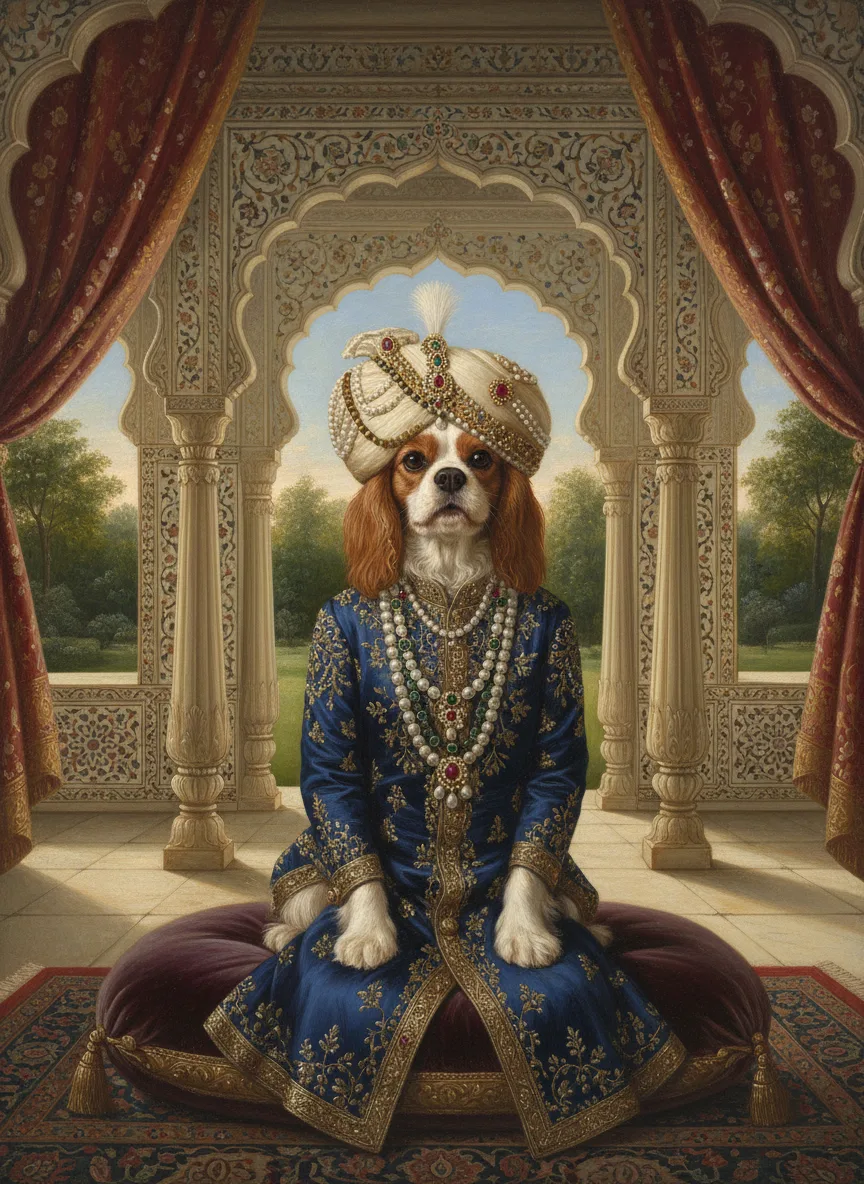
The cover of this page shows a Cavalier King Charles Spaniel from the studio examples, a small spaniel like the one Federigo Vendramin holds, painted in Purrealism's Indian Royalty style. For how court painters in France showed royal hounds two centuries later, read about Oudry and Desportes. To see more finished portraits, visit the gallery.
Questions and answers
What dog is in Titian's The Vendramin Family?
The dog in Titian's The Vendramin Family is a spaniel, held by the youngest boy, Federigo Vendramin. The National Gallery in London says Federigo, born in 1535, seems to have been painted from life when he was five or younger, which dates that part of the painting to around 1541. It is Titian's largest group portrait, 206.1 cm high and 288.5 cm wide.
What happens to the hounds in Titian's The Death of Actaeon?
In Titian's The Death of Actaeon, the hunter Actaeon's own hounds attack him after the goddess Diana turns him into a stag. The National Gallery in London describes lean hounds of brown, black and white: two leap at his body, a third snaps at his knees and a fourth races to join them. Actaeon already has a stag's head and fur on his legs.
Why did Actaeon's dogs kill him?
Actaeon's dogs killed him because the goddess Diana had turned him into a stag. In the Roman poet Ovid's Metamorphoses, the hunter Actaeon sees Diana bathing, and she punishes him. The National Gallery in London explains that Actaeon finds he cannot speak, and his own hounds chase him down and tear him to death. Titian painted this ending in The Death of Actaeon.
Is Titian's The Death of Actaeon finished?
Titian's The Death of Actaeon may not be finished, and experts have long debated it, according to the National Gallery in London. Titian started it when he was in his seventies and was still working on it in his mid-eighties. The brushwork is loose, the paint is thin in places and the string of Diana's bow was never painted. It stayed in his studio.
What is the dog doing in Titian's Diana and Actaeon?
In Titian's Diana and Actaeon, painted from 1556 to 1559, Diana's small lapdog yaps at Actaeon's hunting hound from the safety of the far bank of the stream. The National Gallery in London calls it one of several amusing details that lighten the story. The painting belongs jointly to the National Gallery and the National Galleries of Scotland.
Why does Adonis have hounds in Titian's Venus and Adonis?
Adonis has hounds in Titian's Venus and Adonis because he is leaving to hunt, against Venus's wishes. The National Gallery in London says he has wound the leads of his three hounds around his arm, and the large hound seems to catch the scent of a boar. In Ovid's story the boar kills Adonis, so the dog points to his death.
What are Titian's poesie?
Titian's poesie are six large paintings of stories from ancient myth that he made for Prince Philip, later King Philip II of Spain, between around 1551 and 1562. The National Gallery in London says Titian called them poesie, Italian for poems, because he wanted them to equal poetry. Dogs appear in several, including Venus and Adonis and Diana and Actaeon.
What do the three animal heads in Titian's Allegory of Prudence mean?
The three animal heads in Titian's An Allegory of Prudence, a wolf, a lion and a dog, are paired with three men of different ages. The National Gallery in London links them to an emblem of Prudence published in Venice in 1556, a serpent with the heads of a dog, a wolf and a lion. The young man is paired with the dog.
Where can I see Titian's dogs in London?
The National Gallery in London holds Titian's paintings with dogs. In September 2026 its pages listed The Vendramin Family in Room 10 and The Death of Actaeon and An Allegory of Prudence in Room 14. The workshop version of Venus and Adonis was not on display, and Diana and Actaeon was on loan to Edinburgh as part of a shared rotation from 2026 to 2030.
Who owned Titian's Vendramin Family portrait?
Titian's The Vendramin Family was recorded in the Vendramin palace in Venice in March 1569. The National Gallery in London says it was later owned by the Flemish painter Anthony van Dyck, who saw himself as Titian's artistic heir. The portrait shows two brothers of the Vendramin family and seven boys kneeling before a holy relic, with the youngest holding a spaniel.
Sources
- The Vendramin Family, Titian, The National Gallery, London. Accessed September 29, 2026.
- The Death of Actaeon, Titian, The National Gallery, London. Accessed September 29, 2026.
- Diana and Actaeon, Titian, The National Gallery, London. Accessed September 29, 2026.
- Venus and Adonis, Workshop of Titian, The National Gallery, London. Accessed September 29, 2026.
- An Allegory of Prudence, Titian, The National Gallery, London. Accessed September 29, 2026.
- Titian (active about 1506, died 1576), The National Gallery, London. Accessed September 29, 2026.
- Venus of Urbino, Titian, Uffizi Galleries. Accessed September 29, 2026.
- Diana, The National Gallery, London. Accessed September 29, 2026.
Short reads on this topic
Articles from Purrspectives that answer one question each.
Dog years to human years: the chart by size, and the DNA formula
A 1-year-old dog is closer to 15 or 30 in human years than to 7. The AKC chart by size, the 2020 DNA formula, and a dog's life stages, explained simply.

Pug history: from Chinese emperors to the House of Orange
Pugs began as companions of Chinese emperors, reached Holland on Dutch trading ships and became the dog of the House of Orange. Their history, art and health.
Persian cat history: where the breed came from, its first cat show, coat and care
Persian cat history from a cat brought to Italy in 1626 to the 1871 Crystal Palace show, plus face types, coat colours, grooming and how to photograph one.