Indian royal dog breeds: the Mudhol hound, Rajapalayam, Rampur hound and more
The Mudhol hound, Rajapalayam, Chippiparai and Rampur hound: India's hunting dogs linked to its old princely states, and the three breeds registered in 2020.
By Purrealism. Part of Royal pets in history: the real dogs and cats of kings, queens and emperors.
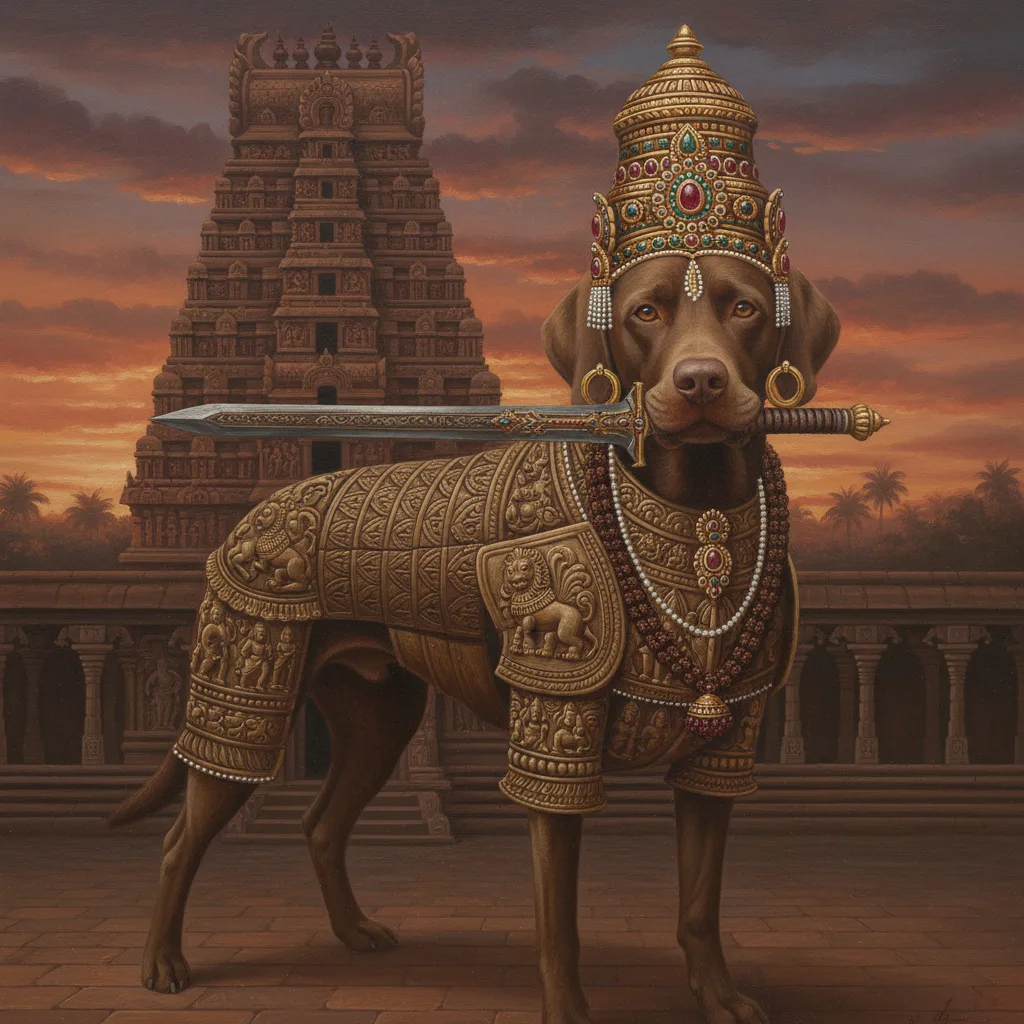
India's princely states had their own hunting dogs, and some of those dogs are still known by the names of the places where rulers kept them. This page follows four of them: the Mudhol hound of the Ghorpade rulers of Mudhol, the Rampur hound of the Nawabs' state of Rampur, and the Rajapalayam and Chippiparai of southern Tamil Nadu. It also covers the Kombai and Kanni, and how India registered its first native dog breeds in 2020. It is part of our guide to royal pets in history.
Hunting dogs at the Indian courts
In the 1600s the Mughal emperor Jahangir recorded his greyhounds, and the dogs that other rulers sent him as gifts, in his memoirs; our page on Jahangir and his animals tells that story.
Most of the written history of the breeds on this page is recent, and much of what is said about them online has no source at all. For this page we used only university research, government records, peer-reviewed studies and dog books printed in 1907 and 1915. Where a story about a breed rests on belief or report, we say so.
The Mudhol hound and the rulers of Mudhol
A Maratha state
Mudhol is a town in Bagalkot district of Karnataka. It was once the capital of Mudhol State. A history of the state, written as a doctoral thesis at Shivaji University in Kolhapur in 2004 by M. S. Ghorpade, calls it one of the leading and oldest Maratha states of the Southern Maratha Country. The state came into being in 1551 and lasted until 1948. Its rulers belonged to the Ghorpade family.
The thesis follows the reign of Raja Malojirao Ghorpade. His father died on 19 July 1900, when Malojirao was still a minor, and British officers ran the state until he came of age. On 25 January 1904 the British political agent handed the government to him. The thesis says that in his time "the breed of dog known as Mudhol hound or Maratha hounds was famous."
Many modern websites tell further stories about the Mudhol hound and the British royal family. We found no museum, university or government record for them, so they are left out here.
A university centre for the breed
Today the breed has its own research centre. The Karnataka Veterinary, Animal and Fisheries Sciences University runs the Canine Research and Information Centre at Timmapur, 16 km from Mudhol. The university says the centre was opened on 24 September 2009 by the Chief Minister of Karnataka, on 40 acres of land given free by the state government. Its work to conserve and develop the Mudhol hound began in 2010 to 2011.
The centre's tasks include research on the breed's feeding, behaviour, training, health and breeding. It has sent Mudhol hound puppies to government agencies, among them the SSB in Rajasthan, the CRPF in Bangalore, the CISF at Sriharikota, the BSF at Tekanpur, the Bandipur Forest Department, the Air Force at Yelahanka, and the SPG in New Delhi. It received a Breed Saviour Award in 2015 and a Breed Conservation Award for 2022 from the National Bureau of Animal Genetic Resources, presented on 17 February 2023.
A 2022 study from the same university, in the Indian Journal of Animal Research, describes the Mudhol hound's long association with wars, hunting and guarding, and with the Indian Army's sniffer dog squad. It adds that postage stamps were issued for the breed.
From the hunt to the security forces
On 30 August 2020 India's Prime Minister spoke about Indian dog breeds in his monthly radio address, Mann Ki Baat. He named the Mudhol hound and the Himachali hound, and the Rajapalayam, Kanni, Chippiparai and Kombai. He said the Mudhol hound had been trained and taken into the dog squads of the Army, the CISF and the NSG, and that the CRPF had taken Kombai dogs.
The Border Security Force, or BSF, trains Indian breeds too. A Press Information Bureau paper on the national unity day parade of 31 October 2025 describes a marching squad of BSF Rampur hounds and Mudhol hounds planned for that parade, to be led by a Mudhol hound named Riya, who had come first in the All India Police Dog Competition. All India Radio reported that 150 Indian breed dogs were serving on the borders, trained at the BSF Academy at Tekanpur.
The Rampur hound
Rampur is a town in northern India. It was the capital of a state ruled by princes with the title Nawab. India's Ministry of Culture says Nawab Faizullah Khan founded the Rampur Raza Library there in 1774, and that the Nawabs were great patrons of scholars, poets, painters and musicians. After independence, the state joined the Union of India.
The hound that carries the town's name was described in England in 1907. Robert Leighton's New Book of the Dog says it comes "from Rampur in North-West India". He calls it a large greyhound of powerful, coarse build, fast, and used mainly to hunt jackal and to run down wounded big game. He lists these points:
- a long, flat head and bright yellow eyes
- a short coat like a newly clipped horse, mouse-grey or black, with black dogs the rarest and considered the best
- a height of 29 to 30 inches and an average weight of 75 lb
- feet that stand hard ground, where an English greyhound's feet would not
Leighton adds that Rampur hounds had been brought to England and shown at Dublin. In 1915 Walter Esplin Mason's Dogs of All Nations gave the "Rampur Greyhound" the same mouse-grey colour, a height of 30 inches and a weight of 75 lb.
Many modern breed pages name one particular Nawab as the creator of the Rampur hound. We found no museum, university or government record that confirms it, so this page names none.
The dogs of Tamil Nadu
Rajapalayam
The Rajapalayam comes from Rajapalayam taluk, an area around the town of Rajapalayam in Virudhunagar district of southern Tamil Nadu. In 2017 scientists of the National Bureau of Animal Genetic Resources and the Tamil Nadu Veterinary and Animal Sciences University published a study of the breed in the Indian Journal of Animal Sciences. They measured 88 adult dogs and 21 puppies.
On history, the study is careful. It says it "was believed" that the Nayak dynasty of Tamil Nadu bred these dogs, and that it "was reported" they were used in the Carnatic war against the British army. It records the local name Vellai Moonji Naai, meaning white faced dog.
The dogs they measured were medium-sized, with a white coat, pink skin, pink nostrils, pink eyelids and, in most cases, golden eyes. Adult males averaged 24.69 kg and 63.1 cm at the shoulder, and females 21.42 kg and 58.9 cm. Some dogs had silver eyes, and the authors report that dogs with silver eyes were said to be deaf. The study puts the breed among mid-size hounds.
Today, the authors say, farmers near Rajapalayam keep the dogs to guard farms and farm houses, and the Indian Army has used them as guard dogs on the international borders. They took the ages of some dogs from pedigree records on registration certificates issued by the Kennel Club of India. They also studied the Dog Breeding Unit of Tamil Nadu's Department of Animal Husbandry in Chennai.
Chippiparai
The Chippiparai comes from Tirunelveli district of southern Tamil Nadu. A 2014 study from Madras Veterinary College calls it a medium-sized sighthound, a dog that hunts by sight and speed. Its marks are a fawn coat, black nostrils, black eyes, a broad chest and a tucked-up belly. Scientists of the National Bureau of Animal Genetic Resources write that the Rajapalayam and the Chippiparai are both kept to guard farms, and that Chippiparai dogs are even given to brides at their weddings.
Kombai, Kanni and the Poligar hound
The 2017 Rajapalayam study says four of the seven Indian breeds known outside India come from Tamil Nadu: the Rajapalayam, the Kanni, the Chippiparai and the Combai, also spelled Kombai. It calls the Kanni an indigenous hound of southern Tamil Nadu. The Kombai is the breed the CRPF took into service, according to the Prime Minister's address of 2020.
Leighton's book of 1907 recorded a southern hunting dog with a royal link in its name. He called it the Poligar hound, "a native of the districts round Madras", and said it bore the name of the military chieftains of the Southern Carnatic, who were "evidently the original breeders or owners". He wrote that it hunted foxes, deer and jackal, and that three of them would tackle a boar. Leighton names no modern breed, so the Poligar hound cannot be matched to any breed on this page with certainty.
Official recognition in 2020
India's National Bureau of Animal Genetic Resources, part of the Indian Council of Agricultural Research (ICAR), keeps the national register of livestock breeds. The bureau says that until 2020 no Indian dog had been recognized as a native breed, although some native dogs already worked as sniffer dogs with the Army and other security forces.
After the Prime Minister's address of 30 August 2020, the ICAR gave the bureau the authority to register dogs. On 16 September 2020 it registered the country's first three native dog breeds: the Mudhol hound, the Rajapalayam and the Chippiparai. The Government of India listed all three in the Official Gazette on 13 November 2020. By the bureau's count, it has registered 202 breeds of livestock and poultry and 3 breeds of dog.
| Breed | Home area | Link to rulers or old records | Official record |
|---|---|---|---|
| Mudhol hound | Mudhol, Bagalkot district, Karnataka | Famous under Raja Malojirao Ghorpade of Mudhol State | Registered in 2020; Gazette of India, 2020 |
| Rajapalayam | Rajapalayam, Virudhunagar district, Tamil Nadu | Believed to have been bred by the Nayak dynasty | Registered in 2020; Kennel Club of India certificates |
| Chippiparai | Tirunelveli district, Tamil Nadu | Given to brides at weddings | Registered in 2020 |
| Rampur hound | Rampur, northern India, a state of the Nawabs | Described by Leighton in 1907 and Mason in 1915 | Serves with the BSF |
| Kombai | Tamil Nadu | Named by the Prime Minister in 2020 | Serves with the CRPF |
| Kanni | Southern Tamil Nadu | Named by the Prime Minister in 2020 | Outside the three registered breeds |
Other rulers in other lands kept their own hunting dogs. Our page on the borzoi and the tsars follows the Russian imperial hunts.
A royal portrait for an Indian breed
The Mudhol hound's history gives it a natural match on this site. The thesis on Mudhol State calls the breed the Maratha hound, and Maratha King is one of Purrealism's 15 portrait styles. Our article on Shivaji and the Maratha kings explains the kingdom behind that style.
For a dog from Tamil Nadu, the Chola Warrior style takes its name from the Tamil kings described in our article on the Chola dynasty. The cover of this page is a studio example: a Vizsla and Labrador mix in the Chola Warrior style. For a portrait with a turban and throne, the Maharaja style is one more choice, and our article on what Maharaja means explains the title.
See finished portraits in the gallery, then upload one clear photo of up to 5 MB in the portrait studio. Prints come in 8 × 10, 12 × 16, 18 × 24 and 24 × 36 inches, on matte or glossy paper, or you can choose a digital download.
Questions and answers
What is Mudhol hound?
The Mudhol hound is an Indian hunting dog named after Mudhol, a town in Bagalkot district of Karnataka that was once the capital of a princely state. A 2004 history of Mudhol State, a doctoral thesis at Shivaji University in Kolhapur, says the breed, also called the Maratha hound, was famous in the reign of Raja Malojirao Ghorpade. India's National Bureau of Animal Genetic Resources registered it as a breed in 2020.
Is Mudhol hound Indian?
The Mudhol hound is an Indian breed from Karnataka. On 16 September 2020 India's National Bureau of Animal Genetic Resources, part of the Indian Council of Agricultural Research, registered it as one of the country's first three native dog breeds. The Government of India then listed all three in the Official Gazette on 13 November 2020, according to the bureau.
Which Indian forces use Mudhol hounds?
Mudhol hounds have been trained for the dog squads of the Indian Army, the CISF and the NSG, India's Prime Minister said in his Mann Ki Baat radio address of 30 August 2020. The university centre that breeds them in Karnataka has also sent puppies to the SSB, the CRPF, the BSF, the Air Force and the SPG. In 2025 a BSF squad of Mudhol and Rampur hounds was chosen for the national unity day parade.
What is Rajapalayam dog?
The Rajapalayam is a white dog breed from Rajapalayam taluk in Virudhunagar district of southern Tamil Nadu. A 2017 study in the Indian Journal of Animal Sciences says it was believed to have been bred by the Nayak dynasty of Tamil Nadu, and that farmers keep it mainly to guard farms and farm houses. Its local name, Vellai Moonji Naai, means white faced dog.
How to identify Rajapalayam dog?
A Rajapalayam dog can be identified by its white coat, pink skin, pink nostrils, pink eyelids and golden eyes, according to a 2017 study of 88 adult dogs in the Indian Journal of Animal Sciences. The study found drooping ears, a semi-curved tail and a straight back. Adult males averaged 24.69 kg and 63.1 cm at the shoulder, and females 21.42 kg and 58.9 cm.
Is Rajapalayam dog a hound?
The Rajapalayam dog is a mid-size hound, according to a 2017 study by scientists of India's National Bureau of Animal Genetic Resources and the Tamil Nadu veterinary university. The study places it in the group of hounds between 51 and 70 cm tall at the shoulder and between 20 and 40 kg. Its owners near Rajapalayam use it mostly to guard farms, and the Indian Army has used it as a border guard dog.
Is Rajapalayam and Chippiparai same?
The Rajapalayam and the Chippiparai are two separate breeds, and India registered them separately in 2020. A 2017 study describes the Rajapalayam as a white dog with pink skin from Virudhunagar district of Tamil Nadu. A 2014 study describes the Chippiparai as a medium-sized sighthound, a dog that hunts by sight, from Tirunelveli district, with a fawn coat, black nostrils and black eyes.
What is Chippiparai dog?
The Chippiparai is a medium-sized sighthound, a dog that hunts by sight, from Tirunelveli district of southern Tamil Nadu. A 2014 study from Madras Veterinary College lists its fawn coat, black nostrils, black eyes, broad chest and tucked-up belly. Scientists of India's National Bureau of Animal Genetic Resources write that Chippiparai dogs are even given to brides at their weddings.
What dogs are native to India?
India's native dogs include the Caravan hound, Combai, Chippiparai, Rajapalayam, Rampur hound, Kanni, Mudhol hound, Indian mastiff or Bulli, Himalayan sheep dog, Bhutia dog and Bhakarwal dog. That list comes from a 2024 article by scientists of the National Bureau of Animal Genetic Resources. Of these, the bureau has registered three as official breeds: the Mudhol hound, the Rajapalayam and the Chippiparai.
Where does the Rampur hound come from?
The Rampur hound comes from Rampur in northern India, the capital of a state once ruled by Nawabs. Robert Leighton's New Book of the Dog, published in 1907, called it a large greyhound of powerful build, used to hunt jackal and to run down wounded big game. He recorded mouse-grey or black coats, with black dogs the rarest, a height of 29 to 30 inches and a weight of 75 lb.
What did Mann Ki Baat say about Indian dog breeds?
India's Prime Minister praised Indian dog breeds in his Mann Ki Baat radio address of 30 August 2020. He named the Mudhol hound and the Himachali hound, and the Rajapalayam, Kanni, Chippiparai and Kombai, and said they cost less to raise and suit Indian conditions. He asked listeners to consider an Indian breed the next time they raised a pet dog, and said the ICAR was doing research on them.
Sources
- History of Mudhol State (PhD thesis, Shivaji University, Kolhapur, 2004), by M. S. Ghorpade, Internet Archive. Accessed September 28, 2026.
- Canine Research and Information Center (Mudhol Hound), Thimmapur, Bagalkot, Karnataka Veterinary, Animal and Fisheries Sciences University. Accessed September 28, 2026.
- Canine Research and Information Center (Mudhol Hound): Research, Karnataka Veterinary, Animal and Fisheries Sciences University. Accessed September 28, 2026.
- Salient Achievements, ICAR-National Bureau of Animal Genetic Resources. Accessed September 28, 2026.
- Characterization, registration and gazette notification: New initiatives for recognizing native dog breeds (Indian Journal of Animal Genetics and Breeding, 2024), The Indian Journal of Animal Genetics and Breeding. Accessed September 28, 2026.
- English rendering of PM's address in the 15th Episode of 'Mann Ki Baat 2.0' on 30.08.2020, Press Information Bureau, Government of India. Accessed September 28, 2026.
- Rashtriya Ekta Diwas: A Pillar of National Cohesion (30 October 2025), Press Information Bureau, Government of India. Accessed September 28, 2026.
- BSF's Indian bred canine squad to showcase skills at Ekta Diwas celebration, All India Radio News (Prasar Bharati). Accessed September 28, 2026.
- Microsatellite DNA Polymorphism Studies in Mudhol Hound Dog Native of India (Indian Journal of Animal Research, 2022), Indian Journal of Animal Research (Agricultural Research Communication Centre). Accessed September 28, 2026.
- Phenotypic characterization of Rajapalayam dog of Southern India (Indian Journal of Animal Sciences 87 (4), 2017), Krishikosh, Indian Council of Agricultural Research. Accessed September 28, 2026.
- Chippiparai Breed of Dogs in Tamil Nadu: An Assessment of Physical and Performance Characteristics, Indian Journal of Veterinary Sciences and Biotechnology. Accessed September 28, 2026.
- The New Book of the Dog, by Robert Leighton (Cassell, 1907), Internet Archive. Accessed September 28, 2026.
- Dogs of All Nations, by Walter Esplin Mason (1915), Project Gutenberg. Accessed September 28, 2026.
- Rampur Raza Library, Rampur, Ministry of Culture, Government of India. Accessed September 28, 2026.
Short reads on this topic
Articles from Purrspectives that answer one question each.
Dog years to human years: the chart by size, and the DNA formula
A 1-year-old dog is closer to 15 or 30 in human years than to 7. The AKC chart by size, the 2020 DNA formula, and a dog's life stages, explained simply.

Pug history: from Chinese emperors to the House of Orange
Pugs began as companions of Chinese emperors, reached Holland on Dutch trading ships and became the dog of the House of Orange. Their history, art and health.
Persian cat history: where the breed came from, its first cat show, coat and care
Persian cat history from a cat brought to Italy in 1626 to the 1871 Crystal Palace show, plus face types, coat colours, grooming and how to photograph one.