Borzoi and the tsars: Russia's wolfhounds, noble hunts and Perchino
The borzoi was the hunting hound of Russia's nobles and the imperial family. How the great hunts worked, what Perchino was, and how the breed survived 1917.
By Purrealism. Part of Royal pets in history: the real dogs and cats of kings, queens and emperors.
The borzoi, once called the Russian wolfhound, was the hunting dog of Russia's nobles and of the imperial family. This page looks at the dogs' real working lives: what the name means, how the great hunts were run, the imperial kennels at Gatchina, the famous kennel of Grand Duke Nicholas Nikolaevich at Perchino, what happened to the dogs after 1917, and how kennel clubs came to recognize the breed. For other royal animals, start at the royal pets in history page.
What the name means
The Borzoi Club of America, the breed's national club in the United States, explains the name. The Russian word borzoi, or more correctly borzaya when it describes a dog, is an adjective meaning "swift". In English it means sighthound, a dog that hunts by sight and speed. The breed's full Russian name is russkaya psovaya borzaya, "Russian longhaired sighthound". The American Kennel Club (AKC) gives the root as the Russian borzyi, "swift".
In English the breed had another name for a long time. The AKC says the dog was known as the Russian Wolfhound in the English-speaking world. In America the name changed to Borzoi in 1936, after a long debate among breeders. The Royal Kennel Club in Britain still calls it "the wolfhound of the Imperial Russian aristocracy".
A long history in Russia
The records do not agree on where the story starts, so each source is given here in its own words. The Fédération Cynologique Internationale (FCI), the world federation of kennel clubs, dates the breed's history to the 15th century and the Mongol invasion. Its standard says the Tatars used a sighthound of Arab origin, and that Russian hunters used strong dogs able to catch a deer or an elk. Crosses between the two became the first borzoi. The FCI says dogs of this kind appear in the prayer book of Grand Prince Vasily III, father of Ivan the Terrible.
The Borzoi Club of America points further back, to a 12th century fresco, a painting on a wet plaster wall, in St Sophia Cathedral in Kyiv that shows a hunt with "swift dogs". It says Mongol invaders in the 13th century brought Saluki-type dogs, which were crossed with the local dogs, and that Tsar Vasily III was a great lover of the breed. The Royal Kennel Club says only that the breed was well established in Russia by the 16th century.
Over the next centuries other hounds were added. The Borzoi Club of America lists the Courland sighthound from the Baltic, the Polish sighthound, the English greyhound, and mountain and Crimean sighthounds. Each cross changed the dog's coat, speed or stamina. The club says the greyhound brought the brindle pattern, a coat with dark stripes.
The great hunts
For the nobles, the hunt was a show as well as a sport. The AKC says that under the Romanovs, wolf hunting was a consuming passion of the Russian aristocracy. Nobles held hunts on their estates with guests, horses and hounds brought in by special trains. A hundred borzoi and as many servants could take part, and the hunt ended with a feast at the manor house. The Royal Kennel Club says the hounds were followed on horseback, dogs and horses often wore brightly coloured hunting silks, and a good day ended with a feast in tents.
The estates kept dogs in large numbers. The Borzoi Club of America says some kennels held as many as 400 borzoi at a time. The FCI says the hunts of the 1700s and 1800s used packs of up to several hundred dogs, with special horses.
The work itself followed set rules. Joseph B. Thomas, an American breeder who hunted in Russia, described it in his book Observations on Borzoi, published in 1912. Hunters on horseback surrounded a small wood, each holding a leash of borzoi. For wolves the team was two male dogs and a female, matched in colour and build. At a signal on the horn, a pack of foxhounds, hounds that hunt by scent, was sent into the wood to drive the game out. When a wolf ran into the open, the nearest hunter let his dogs go. The borzoi caught the wolf and held it down by the neck. The hunter jumped from his horse onto the wolf. Thomas wrote that a knife was used in earlier times, but that it had become better form to take the wolf alive: the wolf bit on a short stick, and the hunter tied it in place with a leather thong behind the neck.
Training took care. Thomas said few borzoi were good at catching wolves, and that young dogs learned by running with older ones at muzzled live wolves kept at the kennels. In winter, he wrote, the borzoi were sometimes taken to the hunt on a low sled behind a blanket screen, which was pulled aside when the wolf appeared.
A Russian novelist described hunts like these. The AKC calls Leo Tolstoy a devoted borzoi fan who described one of these hunts in War and Peace. In Book Seven, set in 1810 and 1811, the Rostov family rides out with 54 hounds, six hunt servants, eight borzoi kennelmen and more than 40 borzois. An old borzoi called Karay catches a she wolf.
The tsar's kennels at Gatchina
The imperial family had its own kennels at Gatchina, near St Petersburg. Thomas visited them in August 1903 and was disappointed. Out of 80 grown dogs, he saw only two he would have liked to own. He found no single type: some dogs had good coats and others did not, and some looked more like greyhounds. He wrote that the Gatchina dogs were full of greyhound blood, with short tails and, in some cases, short coats. Because more dogs had gone to England and America from the Imperial Kennels than from anywhere else, he thought this explained the mixed quality of the breed outside Russia.
Perchino: the Grand Duke's kennel
The best-known kennel belonged to Grand Duke Nicholas Nikolaevich, whom the Borzoi Club of America calls the tsar's uncle. The AKC says he bought the estate of Perchino in the late 1880s, when many nobles were moving from their estates to the cities. He sent his kennel manager to the far corners of Russia to find dogs of the "ancient type" and build the breed back up. The Borzoi Club of America says he bred for both hunting ability and looks, including the "brossok", a sudden burst of speed at the start of a chase.
Thomas reached Perchino in 1903 by train from Moscow to Tula and then by a three-horse carriage. He called the kennel the finest collection of dogs of any one breed he had ever seen. He hunted there in 1904.
| Perchino in the sources | What they record |
|---|---|
| Borzoi | 130 adult borzoi and 60 puppies at its peak (AKC); 300 borzoi when Thomas hunted there in 1904 |
| Other dogs | 15 English greyhounds and 100 other dogs, including foxhounds and harriers (AKC); 100 couples of foxhounds (Thomas) |
| Horses | 87, all of a similar strawberry roan shade (AKC); all roans (Thomas) |
| People | 78 employees (AKC) |
| Kennels | Eight kennels sorted by coat colour, plus the Grand Duke's own pack (AKC) |
| Hunt dress | The Grand Duke's green uniform for the borzoi hunters, red tunics for the foxhound huntsmen (AKC) |
The AKC adds that white and light-marked borzoi were favoured at Perchino because they looked more aristocratic and matched the white leashes and gloves of the huntsmen. The Grand Duke's personal pack held at least three dogs of each colour, so matched teams could be leashed together.
Rules for the breed
The nobles also wrote the breed down. The AKC says the freeing of the serfs in 1861 ended the cheap labour that ran the great estates, and many kennels were emptied. The Borzoi Club of America says many lines of borzoi were lost at that time. After a dog show held in 1874, breeders agreed to close the borzoi studbook, the register of pedigrees, to bring back a more uniform dog. The FCI standard says the first congress of borzoi lovers met in 1874, and that in 1888 the Moscow Hunting Society adopted the first borzoi standard, written by N. P. Yermolov. The Borzoi Club of America adds that Yermolov's family had bred borzoi for more than 200 years.
After 1917
The revolution ended the old hunts. The AKC says Grand Duke Nicholas disbanded Perchino in the face of the Bolshevik Revolution. At other estates, borzoi that could not leave with their owners were given to rural hunters, killed by revolutionaries, or shot by their fleeing owners. In a short time the breed almost disappeared in Russia.
The dogs already abroad kept the breed alive. The Borzoi Club of America estimates that 200 borzoi were exported to Europe, Britain and the United States in the two decades before the revolution and just after it. Russian nobles in exile helped write the early standards in the West and judged at shows. The AKC says American dogs were later sent back to Russia to help rebuild the breed there.
Borzoi abroad and kennel club recognition
Some of the first borzoi in the West came from the imperial kennels. Thomas lists, among the best early show dogs in Britain, the Prince of Wales's Moeldewitz, from Gatchina. He also quotes a writer in the British dog paper the Stock-Keeper, who said that some borzoi shown in Britain descended from dogs of the Imperial Russian Stud given to Lord Cowley.
In the United States, the AKC says the first borzoi was brought from England in 1889 by William Wade of Hulton, Pennsylvania. Thomas brought back a white and brindle male, Bistri, from Perchino in 1903, and more dogs in 1904.
| Year | Event | Source |
|---|---|---|
| 1861 | Serfs freed; many large kennels broken up | Borzoi Club of America; AKC |
| 1874 | First congress of borzoi lovers | FCI |
| 1888 | First borzoi standard adopted, written by N. P. Yermolov | FCI; Borzoi Club of America |
| 1891 | Recognized by the American Kennel Club | AKC |
| 1903 | Russian Wolfhound Club of America founded on 12 November | Borzoi Club of America |
| 1917 | Revolution; Perchino disbanded | AKC |
| 1936 | American name changed from Russian Wolfhound to Borzoi | AKC |
The FCI places the borzoi in Group 10, the sighthounds, with Russia as its country of origin. Its standard gives a height at the shoulder of 75 to 85 cm for males and 68 to 78 cm for females. The AKC puts it in the Hound Group.
The tsars' own pets
Borzoi packs lived in kennels. Some rulers also kept dogs in the palace, and a few of those animals survive.
Peter the Great, Tsar Peter I, had two dogs and a horse that were stuffed after they died. The Saint Petersburg branch of the Russian Academy of Sciences says the three stand at the entrance of the Zoological Museum in Saint Petersburg, and that they are thought to be the oldest surviving examples of taxidermy made in Russia, the craft of preserving an animal's skin over a frame. The large dog, Tiran, was a Danzig Bullenbeisser, a hunting breed that the academy calls an ancestor of the boxer. He joined the tsar in 1705 and went with him on military campaigns, and Peter sent written messages to his officers in Tiran's collar. The small dog, Lisetta, was a gift from Peter's close ally Alexander Menshikov. The museum's head of exhibitions, Anton Rezvy, tells a story that the tsaritsa once tied a petition to Lisetta's collar, written as if by the dog, asking Peter to free a prisoner, and that Peter laughed and agreed. Specialists from the Zoological Institute and the Leningrad Zoo X-rayed all three animals for the first time, and found that the small dog was made in a different way from the other two.
Catherine II, known as Catherine the Great, kept small Italian greyhounds, the same type of dog as Frederick the Great's greyhounds. The Tsarskoe Selo State Museum says three of her favourites, Tom Anderson, Zemira and Duchesse, were buried behind the Pyramid, a garden building in the Catherine Park that was built in 1770 to 1772 and rebuilt in 1782 to 1783 by Charles Cameron. Their white marble gravestones with carved epitaphs were lost, and the museum rebuilt them during a restoration in 2024 to 2026, one with an epitaph in French.
A white coat in uniform
India's royal hunting dogs have their own page, on maharajas' dogs and Indian breeds.
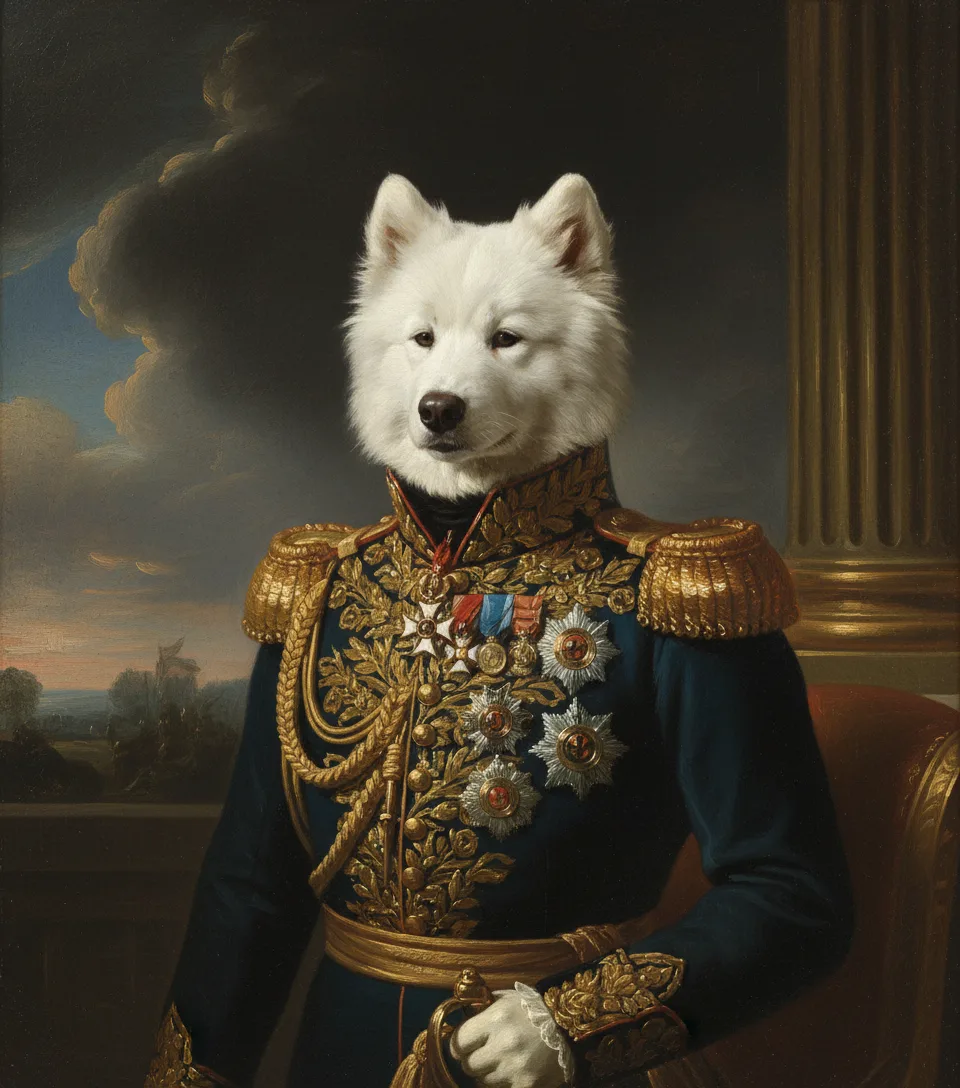
The cover of this page shows a white Samoyed from the studio examples, painted in the Military General style, in a dark blue uniform with gold braid, epaulettes and medals. The military dog portraits article explains that style, and the European royal portraits guide covers the portraits of rulers in uniform. To see other finished portraits, visit the gallery. To start one of your own dog, the portrait studio takes one clear photo of up to 5 MB.
Questions and answers
What does the word borzoi mean?
The word borzoi comes from a Russian adjective meaning swift. The Borzoi Club of America says that borzaya, the correct form for a dog, means sighthound in English, a dog that hunts by sight and speed. The breed's full Russian name, russkaya psovaya borzaya, means Russian longhaired sighthound. The American Kennel Club gives the root as the Russian borzyi, swift.
Is a borzoi a Russian wolfhound?
A borzoi and a Russian wolfhound are the same dog under two names. The American Kennel Club says the breed was called the Russian Wolfhound in the English-speaking world, and that the name changed in America in 1936, after a long debate among breeders. The first American breed club, founded in 1903, was named the Russian Wolfhound Club of America, according to the Borzoi Club of America.
Why were borzoi dogs bred?
Borzoi dogs were bred to chase and catch game for Russian nobles. The American Kennel Club says they chased fox, boar, hare and wolf. The Royal Kennel Club says borzoi hunted in pairs and held the wolf down until the hunters arrived. The FCI breed standard says the modern borzoi hunts mostly hare and fox, less often wolf, and is also used for racing and coursing.
Can a borzoi kill a wolf?
A borzoi was trained to catch and hold a wolf, and the hunter then took the wolf, often alive. Joseph B. Thomas, who hunted at Perchino in 1904, wrote in 1912 that the dogs held the wolf down by the neck. The hunter then jumped from his horse, let the wolf bite on a short stick, and tied it behind the wolf's neck with a thong. He added that young borzoi were trained on muzzled live wolves.
What was the Perchino hunt?
The Perchino hunt was the borzoi kennel and hunt of Grand Duke Nicholas Nikolaevich on his estate near Tula. The American Kennel Club says that at its peak Perchino held 130 adult borzoi, 60 puppies, 87 horses of a similar strawberry roan colour and 78 employees. The FCI breed standard says the Pershino hunt was famous for the beauty of its dogs and for their speed.
Did the Russian tsars keep borzoi?
The Russian tsars kept borzoi at the Imperial Kennels at Gatchina, near St Petersburg. Joseph B. Thomas, an American breeder, visited them in 1903 and wrote in 1912 that he saw only two out of 80 grown dogs he wanted to own. He said the Gatchina dogs showed greyhound blood, with short tails and short coats. Several early borzoi in Britain and America came from these kennels.
What happened to borzoi after the Russian Revolution?
After the Russian Revolution of 1917 most borzoi kennels in Russia were broken up. The American Kennel Club says Grand Duke Nicholas disbanded Perchino, and that dogs left behind were given to rural hunters, killed by revolutionaries or shot by their fleeing owners. The Borzoi Club of America estimates that 200 borzoi were sent abroad before and just after the revolution, and these kept the breed alive.
When were borzois first bred?
Borzois were first bred in Russia many centuries ago, and the FCI breed standard dates their history to the 15th century and the Mongol invasion. It says hunting dogs of the Tatars were crossed with strong Russian dogs, and that such dogs appear in the prayer book of Grand Prince Vasily III. The Borzoi Club of America points to a 12th century wall painting in St Sophia Cathedral in Kyiv as the first picture of a hunt with swift dogs.
When did the American Kennel Club recognize the borzoi?
The American Kennel Club recognized the borzoi in 1891, under the name Russian Wolfhound. The AKC says the name changed to Borzoi in 1936. The breed's national club in America was founded at a meeting at the Brooklyn Bench Show on 12 November 1903, according to the club now called the Borzoi Club of America.
How did the borzoi come to Britain?
Borzoi reached Britain in the 1800s, some of them from the Russian imperial kennels. Joseph B. Thomas, writing in 1912, lists among the early show dogs the Prince of Wales's Moeldewitz, from the Imperial Kennels at Gatchina. He quotes a British dog paper saying that some borzoi shown in Britain descended from dogs of the Imperial Russian Stud given to Lord Cowley. The American Kennel Club says British and American imports saved the breed after 1917.
How tall is a borzoi?
A male borzoi stands 75 to 85 cm at the shoulder and a female 68 to 78 cm, according to the FCI breed standard. The American Kennel Club says a grown male stands at least 28 inches and weighs 75 to 105 pounds, with females smaller. The AKC adds that a borzoi running at full speed reaches 35 to 40 miles per hour.
Did Tolstoy write about borzoi?
Leo Tolstoy wrote about borzoi in War and Peace, and the American Kennel Club calls him a devoted fan of the breed. In Book Seven of the novel, the Rostov family sets out on a wolf hunt with 54 hounds, more than 40 borzois and eight borzoi kennelmen. A young borzoi and an old one called Karay chase down a she wolf. The novel is set in 1810 and 1811.
What dogs did Peter the Great have?
Peter the Great had a large dog called Tiran and a small dog called Lisetta, and both now stand stuffed in the Zoological Museum in Saint Petersburg. The Saint Petersburg branch of the Russian Academy of Sciences says Tiran was a Danzig Bullenbeisser, an ancestor of the boxer, who joined the tsar in 1705 and carried written messages in his collar. Lisetta was a gift from Peter's ally Alexander Menshikov.
Where are Catherine the Great's dogs buried?
Catherine the Great's dogs are buried behind the Pyramid, a garden building in the Catherine Park at Tsarskoe Selo, near Saint Petersburg. The Tsarskoe Selo State Museum says three of her favourite Italian greyhounds lie there: Tom Anderson, Zemira and Duchesse. Their original white marble gravestones did not survive, and the museum rebuilt them during a restoration in 2024 to 2026, one with a French epitaph.
Sources
- Borzoi Dog Breed Information, American Kennel Club. Accessed September 28, 2026.
- Borzoi History: Behind the Breed's Hunting Heritage, American Kennel Club. Accessed September 28, 2026.
- Borzoi Club of America History of the Breed, Borzoi Club of America. Accessed September 28, 2026.
- Borzoi Club of America History, Borzoi Club of America. Accessed September 28, 2026.
- Borzoi, The Royal Kennel Club. Accessed September 28, 2026.
- FCI-Standard N° 193: Russkaya Psovaya Borzaya (Borzoi, Russian Hunting Sighthound), Fédération Cynologique Internationale. Accessed September 28, 2026.
- Observations on Borzoi, called in America Russian Wolfhounds (Joseph B. Thomas, 1912), Internet Archive (Library of Congress copy). Accessed September 28, 2026.
- War and Peace by graf Leo Tolstoy (translated by Louise and Aylmer Maude), Project Gutenberg. Accessed September 28, 2026.
- Учёные впервые увидели нутро друзей Петра I: рентген раскрыл тайны чучел питомцев (Scientists see inside the friends of Peter I for the first time), Saint Petersburg Branch of the Russian Academy of Sciences. Accessed September 28, 2026.
- Pyramid, Tsarskoe Selo State Museum and Heritage Site. Accessed September 28, 2026.
Short reads on this topic
Articles from Purrspectives that answer one question each.
Dog years to human years: the chart by size, and the DNA formula
A 1-year-old dog is closer to 15 or 30 in human years than to 7. The AKC chart by size, the 2020 DNA formula, and a dog's life stages, explained simply.

Pug history: from Chinese emperors to the House of Orange
Pugs began as companions of Chinese emperors, reached Holland on Dutch trading ships and became the dog of the House of Orange. Their history, art and health.
Persian cat history: where the breed came from, its first cat show, coat and care
Persian cat history from a cat brought to Italy in 1626 to the 1871 Crystal Palace show, plus face types, coat colours, grooming and how to photograph one.