Frederick the Great's greyhounds: Biche, Alcmène and the dogs of Sanssouci
Frederick II of Prussia kept small greyhounds all his life. Letters from his court name Biche, Alcmène, Diane and Thisbé, and tell how they lived and died.
By Purrealism. Part of Royal pets in history: the real dogs and cats of kings, queens and emperors.
Frederick II, king of Prussia from 1740 to 1786, kept small greyhounds for most of his life. This page follows those dogs through the letters of his court: what he called them, how they lived in his rooms, the battle that took one of them away, the letters he wrote in a dog's voice, and the graves on the terrace at Sanssouci. Most of the letters come from the University of Trier's digital edition of his collected works, edited by Johann Preuss. The wider story of royal dogs is on the royal pets in history page.
A small greyhound in the king's rooms
The Deutsches Tierärzteblatt, the journal of Germany's federal chamber of veterinarians, published an article on Frederick and animals in 2013. It says his favourite dogs were Italian Windspiele, a small form of the greyhound. They went with him everywhere: on rides, on army exercises and even to war. They were free to go into every room of the palace. At dinner he laid pieces of meat on the tablecloth to cool, then fed the dogs from his hand. A favourite dog sometimes slept in his bed. If bad weather caught him on a walk in the park, he held one of the delicate dogs against his chest.
Franz Kugler's history of Frederick, illustrated by Adolph Menzel, adds more detail. The university's copy is the 1856 edition. Kugler says three or four dogs were always with the king. One was the favourite, and the others kept it company. The favourite lay beside him on its own chair, covered with cushions in winter. The dogs could choose the most costly sofas, and they had leather balls to play with. They followed him to the picture gallery at Sanssouci and into the gardens. When he went to Berlin for the carnival, they travelled in a coach pulled by six horses, with a servant to look after them.
The Tierärzteblatt says the king spoke to his dogs with "Sie", the polite German word for "you". Kugler gives the habit to the servant. In his version, the greyhounds took the front seat of the coach, the servant took the rear seat, and he spoke to them politely: "Biche, sein Sie doch artig! Alcmene, bellen Sie nicht so!" ("Biche, do behave! Alcmène, don't bark like that!").
The Prussian Palaces and Gardens Foundation, which cares for Sanssouci today, says the palace was the place where Frederick most liked to retreat in the company of his dogs.
What Frederick called his dogs
Today the breed is called the Italian greyhound. Frederick used a different name. In a letter to his brother William, Prince of Prussia, in April 1752, he called Biche "ma levrette anglaise", my English greyhound. The French texts of his works call these dogs levrettes, and Preuss's German comments call the same dogs Windspiele.
Small greyhounds also came to him from England as gifts. On 18 April 1747 he told his envoy in London to thank Lord Bolingbroke for "two little English greyhounds". In 1748 Villiers, a British diplomat who had served in Saxony and was leaving his post, sent two more. On 24 May 1748 Frederick thanked him for "two greyhounds that seemed to have escaped from the hunt of Diana". Frederick gave dogs away too. On 28 November 1749 Count Algarotti wrote to him that Schmidt, who was making the plates for a book, already pictured in his room the greyhound the king was giving him, and was getting ready to draw and engrave it.
The modern breed has a long written history. The Fédération Cynologique Internationale (FCI), the world federation of kennel clubs, calls it the Piccolo Levriero Italiano and gives Italy as its country of origin. Its standard says the breed descends from small sighthounds, dogs that hunt by sight and speed, that lived at the court of the pharaohs. The FCI says the breed reached Italy early in the 5th century BC and had its greatest growth at the courts of nobles during the Renaissance. The Royal Kennel Club in Britain says dogs of this type appear on tombs from ancient Egypt and the Roman Empire. The American Kennel Club names Anne of Denmark, Mary Beatrice d'Este of Modena, Frederick the Great, Catherine the Great and Queen Victoria among the breed's royal owners.
| The Italian greyhound today | What the source says |
|---|---|
| Name in the FCI standard | Piccolo Levriero Italiano |
| Country of origin | Italy (FCI) |
| Height at the shoulder | 32 to 38 cm (FCI) |
| Weight | 5 kg at most (FCI) |
| Colours | Black, grey or isabella, a pale yellowish beige, with white allowed only on the chest and feet (FCI) |
| Group | Sighthounds (FCI); Toy group (Royal Kennel Club) |
Biche and the Battle of Soor
The first war story comes from Frederick's own pen. On 30 September 1745, at the Battle of Soor, the king lost his baggage. Two days later, writing from the camp at Soor, he asked his former teacher Duhan to buy him new books, because he had been "pillé totalement", robbed of everything. Preuss adds that the king had lost his baggage in the battle.
Biche was part of that loss. In April 1752 Frederick used her as an example in a letter to his brother William. He told him that a vague complaint only gets a vague excuse, and that a complaint needs exact facts. Then he gave one: "Nádasdy, your partisan, took from me on 30 September 1745 my English greyhound called Biche, whom my servant Claus was leading." Put that way, he wrote, Nádasdy must either deny that he has the dog or give her back. Frederick wrote this letter in his own hand, seven years after the battle.
What happened next is less certain. Rödenbeck's chronicle of Frederick's reign says Biche went into Austrian captivity with the baggage. The wife of General Nádasdy kept her and had to be asked several times before she gave her back. When the dog returned, General Rothenburg let her quietly into the room where the king sat writing. She jumped onto the desk and put her front paws round his neck, and the king had tears in his eyes. Kugler tells a second story: that Biche once hid silently with the king under a bridge while enemy horsemen rode over it. Rödenbeck adds that the writer Büsching called both stories untrue, and that the 13th collection of anecdotes, printed by Unger in Berlin, defended them with named witnesses. They are good stories, and they remain anecdotes.
Letters in a dog's voice
In May 1748 Frederick and his sister Wilhelmine, Margravine of Bayreuth, wrote to each other in the voices of their dogs. Her dog was Folichon, and his was Biche.
Folichon wrote first. He argued that dogs have fewer vices and more virtues than people, and named loyalty, constancy, attachment and gratitude. He said he had grown thin and sad since he left Biche. He sent her a sofa and a bowl, so that she would think of him when she lay down and drink to his health.
Biche answered from Potsdam. She accepted the gifts and his paw, and she made a joke about her master. "You, my master and I are of the same species," she wrote, and only laziness, and not wanting to run on four legs, stopped her master from calling himself a greyhound. She signed it "Votre fidèle Biche", your faithful Biche.
Wilhelmine replied on 7 June 1748 that she preferred Biche's letters to all the letters of Cicero. On 15 June Frederick answered her. He wrote that animals are often useful to us for explaining our feelings more naturally and more frankly, and that La Fontaine, who wrote his fables with animals, knew this. He added that Biche had good sense, and that he saw people every day who behaved less sensibly than she did.
When the dogs died
Biche died at the end of 1751. On 29 December 1751 Frederick wrote to Wilhelmine about "a domestic grief" that had upset his whole philosophy. He had lost Biche, and her death brought back the loss of all his friends, above all the friend who had given her to him. "I was ashamed that a dog had affected my soul so much," he wrote. He explained that his quiet life and the dog's faithfulness had bound him to her, and that her suffering had moved him. Then he gave his reason: a person who can be indifferent to a faithful animal will not be more grateful to his equals, and if one must choose, it is better to feel too much than to be hard.
Preuss dates Biche's death to the end of December 1751. He dates the letter to Fredersdorf about the "ten doctors", the one covered in our article on royal dogs in history, to 1751 or 1752. The Tierärzteblatt puts that letter in the summer of 1753. In the same letter Frederick ordered that his dog Mene, whom Preuss identifies as Alcmène, should take nothing but whey, the watery part of milk.
Alcmène's turn came in 1763. On 9 October 1763 Frederick wrote to his brother Henry: "I have a domestic grief; my poor dog is going to die." He consoled himself, he said, with the thought that if death does not spare crowned heads, poor Alcmène could not expect a better fate. The Tierärzteblatt tells a stronger story: that a favourite dog called Alcmène was too ill to go with him to army exercises and died suddenly while he was away, and that he hurried back to Potsdam, had her dug up, laid out in his library, and said goodbye to her in tears. The name was used more than once. A dog called Alcmène was alive in February 1779, when Frederick, writing from Silberberg, sent his compliments to "the little Alcmène". Preuss identifies her as his greyhound.
Other names appear in the letters. On 30 November 1767 Frederick wrote a short poem in the voice of his greyhound Diane to the Princess of Prussia. Diane announced two puppies and asked the princess to be their godmother. On 9 August 1775 his sister Amélie wrote that she shared his sorrow at "the tragic death of the beautiful Thisbé". Kugler adds Arsinoe: once, while an article on the souls of animals was being read aloud, the king held Arsinoe on his lap and told her that she had a mind, whatever the writers said.
| Dog | Date in the record | What the record says |
|---|---|---|
| Biche | 1745 to 1751 | Taken on 30 September 1745; died at the end of 1751 (Frederick's letters; Preuss) |
| Folichon | 1748 | Wilhelmine's dog; sent Biche a sofa and a bowl (letters of May 1748) |
| Alcmène | 1763 | "My poor dog is going to die" (letter to Prince Henry, 9 October 1763) |
| Diane | 1767 | Had two puppies; "wrote" a poem to the Princess of Prussia (30 November 1767) |
| Thisbé | 1775 | Her "tragic death" (Princess Amélie, 9 August 1775) |
| Alcmène | 1779 | "The little Alcmène" (letter to Catt, February 1779) |
| Arsinoe | no date | A favourite held on his lap (Kugler) |
Horses with the names of statesmen
Frederick also cared about his horses. The Deutsches Tierärzteblatt says that when he became king in 1740 there were more than 4,000 horses in the royal stables, and that all of them were now given names. Kugler says Frederick named his own horses after men of his time to suit their character: Brühl, Choiseul, Kaunitz and Pitt. When Britain made a separate peace with France in 1762, which Kugler calls a breach of its alliance with Prussia, a horse called Lord Bute was sent to pull orange trees with the mules. An old roan called Caesar was allowed to walk freely in the palace garden at Potsdam.
His last riding horse was Condé, a grey gelding born in England in 1766 and ridden by the king from 1777. The Tierärzteblatt quotes the Marquis Lucchesini, who read aloud to Frederick, on how Condé trotted behind the king during conversations and sniffed his coat pockets for slices of melon and figs. After Frederick's death the horse went to the stud at Neustadt an der Dosse, and in 1790 to the new veterinary school in Berlin, where it died on 18 April 1804 at the age of 38. Its skeleton now belongs to the Institute of Veterinary Anatomy at the Free University of Berlin.
The graves on the terrace
Kugler says the favourite dogs were buried one after another beside the statue of Flora at Sanssouci, under stone plates with their names. In January 2005 the Potsdamer Neueste Nachrichten reported that the palace's sculpture workshop had lifted eleven sandstone plates to clean and conserve them. The paper read the names in two rows: Alcmene, Thisbe, Diana, Phillis, a second Thisbe and a second Alcmene, and a name read as Bigos or Gigos; then Diana, Pax, Superbe, "Hasenf", taken to mean Hasenfuß, and Amouretto. It said the first dog buried there was Biche, and that one greyhound was buried inside the king's own tomb. Rödenbeck adds that Biche received a small memorial at Sanssouci, and that Frederick kept her descendants around him until the end of his life.
Frederick's will, signed in Berlin on 8 January 1769, gives his wish: "I have lived as a philosopher, and I want to be buried as one, without display, without luxury, without pomp... let me be buried at Sans-Souci, at the top of the terraces, in a tomb that I have had prepared." The editor adds that his first draft, of 11 January 1752, already said the same. The same newspaper report says his successor, Frederick William II, judged the narrow tomb unworthy and buried him in the crypt of the Garrison Church instead. The Prussian Palaces and Gardens Foundation says his wish was granted only on 17 August 1991, when he was reburied on the top terrace.
A greyhound in a period portrait
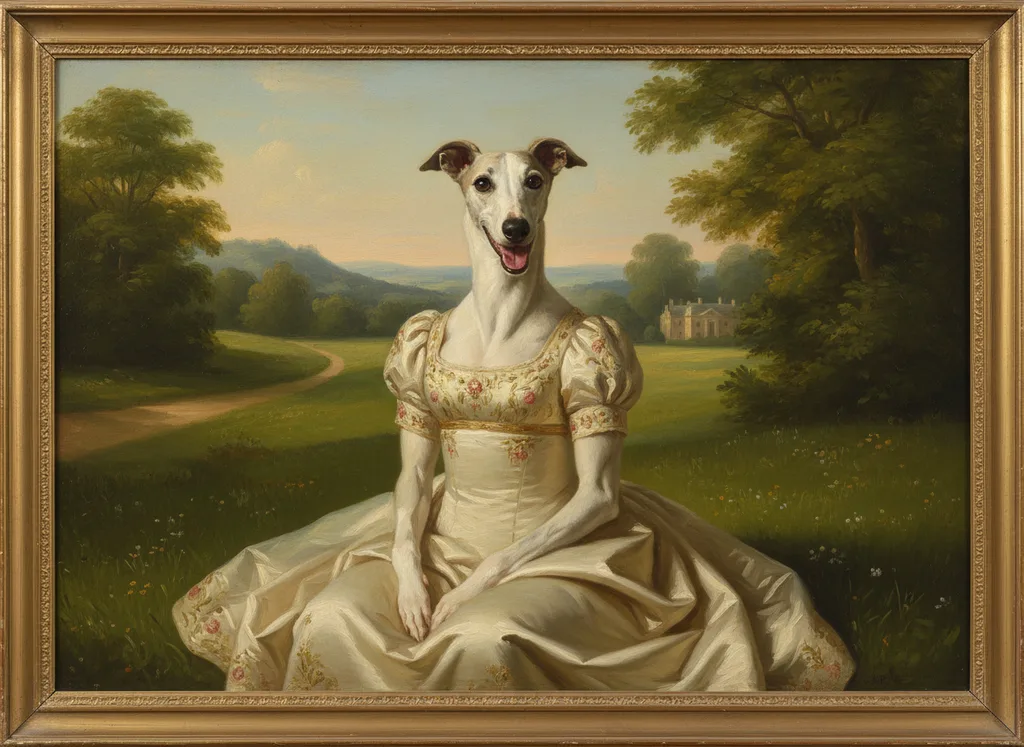
The cover of this page shows a whippet from the studio examples, painted in the Regency Era style, in a cream and gold gown in a green park. The article what was the Regency era explains the period behind that style. The military dog portraits article covers the Military General style.
For other royal dogs, read about Charles II and his spaniels or the borzoi and the Russian tsars. If your own dog is a slim greyhound, the portrait studio takes one clear photo of up to 5 MB, and you can choose any of the 15 styles. The gallery shows finished portraits.
Questions and answers
Which breed of dog did Frederick the Great keep?
Frederick the Great kept Italian greyhounds, which Germans call Windspiele. The Deutsches Tierärzteblatt, the journal of Germany's federal chamber of veterinarians, calls them a small form of the greyhound. Frederick himself used another name: in a letter to his brother in April 1752, printed in the Politische Correspondenz, he called his favourite, Biche, 'my English greyhound'. Lord Bolingbroke and the British diplomat Villiers sent him small greyhounds in 1747 and 1748.
What happened to Frederick the Great's dog Biche at the Battle of Soor?
Frederick the Great's greyhound Biche was taken from him on 30 September 1745, the day of the Battle of Soor, when the king lost his baggage. In a letter to his brother written in April 1752, Frederick said that Nádasdy took his English greyhound Biche while his servant Claus was leading her. The letter is printed in the Politische Correspondenz, which the University of Trier publishes online.
Is the story of Biche jumping onto Frederick the Great's desk true?
The story of Biche jumping onto Frederick the Great's desk is an old anecdote that writers disputed. Rödenbeck's chronicle of Frederick's reign says Biche came back from the Austrians and leapt onto the desk, putting her front paws round the king's neck. Rödenbeck adds that the writer Büsching called the story untrue, while the 13th collection of anecdotes defended it with named witnesses. Frederick's own letters do not describe her return.
What did Frederick the Great say about his dog Biche's death?
Frederick the Great wrote to his sister Wilhelmine on 29 December 1751 that he had lost Biche and that her death had upset his whole philosophy. He said he was ashamed that a dog had affected him so much. He added that a person who can be indifferent to a faithful animal will not be more grateful to other people. The University of Trier's digital edition of his works prints the letter.
What were the Biche and Folichon letters?
The Biche and Folichon letters were written in May 1748 by Frederick the Great and his sister Wilhelmine, Margravine of Bayreuth, in the voices of their dogs. Folichon, her dog, sent Biche a sofa and a bowl as gifts. Biche answered with a letter signed 'your faithful Biche'. On 15 June 1748 Frederick wrote that animals often help people express their feelings more naturally, as La Fontaine knew.
How did Frederick the Great's greyhounds live at Sanssouci?
Frederick the Great's greyhounds lived in the king's rooms and followed him everywhere. Franz Kugler's history of Frederick says three or four dogs were always with him. The favourite lay on its own chair beside him, covered with cushions in winter, and slept at night in the king's bed. The dogs chose the most costly sofas and played with leather balls, and they went with him to the picture gallery at Sanssouci and the gardens.
Did Frederick the Great take his dogs to war?
Frederick the Great took his greyhounds on rides, on army exercises and even to war, according to the Deutsches Tierärzteblatt. Biche was with his baggage at the Battle of Soor in 1745. Franz Kugler's history says that in his winter quarters at Leipzig, before the campaign of 1761, the Marquis d'Argens found the king sitting on the floor feeding his dogs a fricassee from a dish.
How many dogs are buried at Sanssouci?
Eleven sandstone plates with greyhound names lie on the top terrace of Sanssouci, according to a 2005 report in the Potsdamer Neueste Nachrichten. The paper said the plates were lifted that January to be cleaned and conserved. The names include Alcmene and Thisbe, each twice, Diana, Phillis, Pax, Superbe and Amouretto. One plate reads 'Hasenf', which is taken to mean Hasenfuß.
Did Frederick the Great want to be buried with his dogs?
Frederick the Great asked to be buried at the top of the terraces of Sanssouci, where his dogs already lay. His will, dated 8 January 1769 and printed in the University of Trier's edition of his works, says he lived as a philosopher and wants to be buried as one, without pomp, in a tomb he had prepared. The editor adds that his first draft, of 11 January 1752, already asked for this.
Why was Frederick the Great first buried in the Garrison Church?
Frederick the Great was first buried in the crypt of the Garrison Church because his successor, Frederick William II, decided the narrow tomb on the Sanssouci terrace was not worthy of him. The Potsdamer Neueste Nachrichten reported this in 2005. The paper said the burial chamber on the terrace had been built in 1744, before the palace was finished, and that the king waited 205 years to lie there.
Is the Italian greyhound a sighthound?
The Italian greyhound is a sighthound, a dog that hunts by sight and speed. The Fédération Cynologique Internationale lists it as the Piccolo Levriero Italiano in Group 10, the sighthounds, with Italy as its country of origin. Its standard gives a height of 32 to 38 cm and a weight of no more than 5 kg. The Royal Kennel Club places the breed in its Toy group.
Which royals owned Italian greyhounds?
Royal owners of Italian greyhounds include Anne of Denmark, Mary Beatrice d'Este of Modena, Frederick the Great of Prussia, Catherine the Great of Russia and Queen Victoria, according to the American Kennel Club. The Fédération Cynologique Internationale says the breed had its greatest development at the courts of nobles during the Renaissance. Letters from Frederick's court name at least four of his greyhounds: Biche, Alcmène, Diane and Thisbé.
Sources
- Der Preußenkönig Friedrich II. und die Tiere (Deutsches Tierärzteblatt 3/2013), Deutsches Tierärzteblatt (Bundestierärztekammer). Accessed September 28, 2026.
- Frédéric au prince de Prusse, avril 1752 (Politische Correspondenz, vol. 9, p. 96), Universitätsbibliothek Trier, Werke Friedrichs des Großen (digital edition). Accessed September 28, 2026.
- Frédéric à Duhan, camp de Soor, 2 octobre 1745 (Œuvres, vol. 17, p. 322), Universitätsbibliothek Trier, Werke Friedrichs des Großen (digital edition). Accessed September 28, 2026.
- Folichon (la margrave de Baireuth) à Biche (Frédéric), mai 1748 (Œuvres, vol. 27.1, p. 202), Universitätsbibliothek Trier, Werke Friedrichs des Großen (digital edition). Accessed September 28, 2026.
- Folichon à Biche, mai 1748 (Œuvres, vol. 27.1, p. 204), Universitätsbibliothek Trier, Werke Friedrichs des Großen (digital edition). Accessed September 28, 2026.
- Biche à Folichon, Potsdam, mai 1748 (Œuvres, vol. 27.1, p. 205), Universitätsbibliothek Trier, Werke Friedrichs des Großen (digital edition). Accessed September 28, 2026.
- Biche à Folichon and la margrave de Baireuth à Frédéric, 7 juin 1748 (Œuvres, vol. 27.1, p. 206), Universitätsbibliothek Trier, Werke Friedrichs des Großen (digital edition). Accessed September 28, 2026.
- Frédéric à la margrave de Baireuth, Sans-Souci, 15 juin 1748 (Œuvres, vol. 27.1, p. 207), Universitätsbibliothek Trier, Werke Friedrichs des Großen (digital edition). Accessed September 28, 2026.
- Frédéric à la margrave de Baireuth, 29 décembre 1751 (Œuvres, vol. 27.1, p. 231), Universitätsbibliothek Trier, Werke Friedrichs des Großen (digital edition). Accessed September 28, 2026.
- Friedrich an Fredersdorf, 1751 oder 1752 (Œuvres, vol. 27.3, p. 151), Universitätsbibliothek Trier, Werke Friedrichs des Großen (digital edition). Accessed September 28, 2026.
- Frédéric au prince Henri, Potsdam, 9 octobre 1763 (Œuvres, vol. 26, p. 330), Universitätsbibliothek Trier, Werke Friedrichs des Großen (digital edition). Accessed September 28, 2026.
- Vers de la levrette Diane à la Princesse de Prusse, 30 novembre 1767 (Œuvres, vol. 13, p. 17), Universitätsbibliothek Trier, Werke Friedrichs des Großen (digital edition). Accessed September 28, 2026.
- La princesse Amélie à Frédéric, 9 août 1775 (Œuvres, vol. 27.1, p. 464), Universitätsbibliothek Trier, Werke Friedrichs des Großen (digital edition). Accessed September 28, 2026.
- Frédéric à M. de Catt, Silberberg, février 1779 (Œuvres, vol. 24, p. 29), Universitätsbibliothek Trier, Werke Friedrichs des Großen (digital edition). Accessed September 28, 2026.
- Au conseiller Andrié à Londres, Potsdam, 18 avril 1747 (Politische Correspondenz, vol. 5, p. 367), Universitätsbibliothek Trier, Werke Friedrichs des Großen (digital edition). Accessed September 28, 2026.
- Au secrétaire Michell à Londres, Potsdam, 1er mars 1748 (Politische Correspondenz, vol. 6, p. 46), Universitätsbibliothek Trier, Werke Friedrichs des Großen (digital edition). Accessed September 28, 2026.
- Au sieur de Villiers à Londres, 24 mai 1748 (Politische Correspondenz, vol. 6, p. 124), Universitätsbibliothek Trier, Werke Friedrichs des Großen (digital edition). Accessed September 28, 2026.
- Le comte Algarotti à Frédéric, Berlin, 28 novembre 1749 (Œuvres, vol. 18, p. 82), Universitätsbibliothek Trier, Werke Friedrichs des Großen (digital edition). Accessed September 28, 2026.
- Testament du Roi (the king's will), Berlin, 8 janvier 1769 (Œuvres, vol. 6, p. 243), Universitätsbibliothek Trier, Werke Friedrichs des Großen (digital edition). Accessed September 28, 2026.
- Œuvres de Frédéric le Grand, vol. 6, p. 249: the editor's historical commentary on the king's will, Universitätsbibliothek Trier, Werke Friedrichs des Großen (digital edition). Accessed September 28, 2026.
- Franz Kugler, Geschichte Friedrichs des Großen, p. 192, Universitätsbibliothek Trier, Werke Friedrichs des Großen (digital edition). Accessed September 28, 2026.
- Franz Kugler, Geschichte Friedrichs des Großen, p. 393, Universitätsbibliothek Trier, Werke Friedrichs des Großen (digital edition). Accessed September 28, 2026.
- Franz Kugler, Geschichte Friedrichs des Großen, p. 394, Universitätsbibliothek Trier, Werke Friedrichs des Großen (digital edition). Accessed September 28, 2026.
- Franz Kugler, Geschichte Friedrichs des Großen, p. 493, Universitätsbibliothek Trier, Werke Friedrichs des Großen (digital edition). Accessed September 28, 2026.
- Franz Kugler, Geschichte Friedrichs des Großen, p. 494, Universitätsbibliothek Trier, Werke Friedrichs des Großen (digital edition). Accessed September 28, 2026.
- K. H. S. Rödenbeck, Tagebuch oder Geschichtskalender aus Friedrichs des Großen Regentenleben, vol. 1, p. 126, Universitätsbibliothek Trier, Werke Friedrichs des Großen (digital edition). Accessed September 28, 2026.
- K. H. S. Rödenbeck, Tagebuch oder Geschichtskalender aus Friedrichs des Großen Regentenleben, vol. 1, p. 127, Universitätsbibliothek Trier, Werke Friedrichs des Großen (digital edition). Accessed September 28, 2026.
- Landeshauptstadt: Friedrichs vierbeinige Freunde (27 January 2005), Potsdamer Neueste Nachrichten (Der Tagesspiegel). Accessed September 28, 2026.
- Sanssouci Palace: Retreat on the Vineyard, Prussian Palaces and Gardens Foundation Berlin-Brandenburg (SPSG). Accessed September 28, 2026.
- Kartoffeln am Grab. Zum Tod Friedrichs des Großen in Sanssouci am 17. August 1786, Prussian Palaces and Gardens Foundation Berlin-Brandenburg (SPSG). Accessed September 28, 2026.
- FCI-Standard N° 200: Piccolo Levriero Italiano (Italian Sighthound), Fédération Cynologique Internationale. Accessed September 28, 2026.
- Italian Greyhound, The Royal Kennel Club. Accessed September 28, 2026.
- Italian Greyhound History: Elegance and Grace With a Mysterious Beginning, American Kennel Club. Accessed September 28, 2026.
Short reads on this topic
Articles from Purrspectives that answer one question each.
Dog years to human years: the chart by size, and the DNA formula
A 1-year-old dog is closer to 15 or 30 in human years than to 7. The AKC chart by size, the 2020 DNA formula, and a dog's life stages, explained simply.
Pug history: from Chinese emperors to the House of Orange
Pugs began as companions of Chinese emperors, reached Holland on Dutch trading ships and became the dog of the House of Orange. Their history, art and health.
Persian cat history: where the breed came from, its first cat show, coat and care
Persian cat history from a cat brought to Italy in 1626 to the 1871 Crystal Palace show, plus face types, coat colours, grooming and how to photograph one.