Charles II and his spaniels: what the diaries of Pepys and Evelyn record
What Samuel Pepys, John Evelyn and a 1660 lost-dog advertisement say about Charles II's dogs, and how his toy spaniels became two modern breeds.
By Purrealism. Part of Royal pets in history: the real dogs and cats of kings, queens and emperors.
This page follows the dogs of Charles II of England through the words of people who saw them. It starts with the small lap spaniels that English writers described before he was born. It then reads what the diarists Samuel Pepys and John Evelyn wrote about his dogs, and what a newspaper printed when one of them went missing in 1660. It ends with how his spaniels, after his death, became the two breeds that carry his name today. For the other rulers and animals in this series, start at the royal pets in history guide.
Lap spaniels before Charles II
Small spaniels were at home in English houses long before the Stuart kings. In 1576 a London printer published Abraham Fleming's English translation of a Latin book on English dogs by John Caius, a doctor of medicine at the University of Cambridge. Caius gave a chapter to "the delicate, neate, and pretty kind of dogges called the Spaniel gentle, or the comforter".
Caius wrote that these dogs were small and fine, and that ladies carried them in their arms, kept them in their rooms, took them to bed and fed them at the table. He did not approve. He also recorded a belief of his time: that a small dog held against the body could ease an upset stomach with its warmth, and that the illness passed from the owner into the dog.
The Royal Kennel Club says toy spaniels can be traced back to at least the 1500s and were most likely bred down in size from sporting spaniels, the dogs that found and flushed birds for hunters. It says Queen Elizabeth I had a "spaniel gentle" as a comforter, and that a spaniel belonging to Mary, Queen of Scots was found hidden in her skirts after she was beheaded. The club says it was at the courts of Charles I and his son Charles II that toy spaniels became well established, most of all among the nobility.
A king without a country
Charles II spent his young life at war and then in exile. The official website of the Royal Family says he was eight years old when the Civil War broke out, and that he was with his father at the Battle of Edgehill before Charles I sent him to safety in France. Charles I was executed in 1649. The Scots crowned the son at Scone on 1 January 1651, but his army lost the Battle of Worcester that September. He escaped to France again and spent the next nine years in exile, until he was invited back to London and restored to his father's throne in 1660.
His return is where the first eyewitness record of his dogs begins.
The dog in the boat at Dover
Samuel Pepys, a naval official, sailed with the fleet that brought Charles home. His diary for 25 May 1660 describes the landing at Dover. The king went ashore in a barge with the two royal dukes, his brothers. Pepys followed in a second boat with a Mr. Mansell, one of the king's footmen, and "a dog that the King loved".
On the way, the dog dirtied the boat. Pepys wrote that this made them laugh, and made him think "that a King and all that belong to him are but just as others are". They reached the shore when the king did, and Pepys watched General Monk receive him on the beach. The diary does not name the dog or its breed.
The king's stolen dog, 1660
Within weeks, the king lost a dog. Henry Wheatley, who edited the Project Gutenberg edition of the diary, quotes an advertisement from the newspaper Mercurius Publicus for 28 June to 5 July 1660, which he says seems to have been written by the king himself:
"We must call upon you again for a Black Dog between a greyhound and a spaniel, no white about him, onely a streak on his brest, and his tayl a little bobbed. It is His Majesties own Dog, and doubtless was stoln, for the dog was not born nor bred in England, and would never forsake His master."
The advertisement goes on to say that the dog was better known at court than the people who stole it, and asks: "Will they never leave robbing his Majesty! Must he not keep a Dog?" It ends with a joke. The dog's place at court, it says, is the only place that nobody asks the king to be given. Wheatley adds that the king's dogs were stolen again and again, and that two more of the king's lost-dog advertisements survive in print.
The historian Stephanie Howard-Smith, writing in History Today, says an earlier offer of a reward for this dog had brought no answer, which is why the king went to the newspaper. She shows that dog theft was a trade in its own right in the 1700s. Lost-dog advertisements became common in British newspapers, and the usual reward was half a guinea.
This black dog is worth a second look. The king described a cross between a greyhound and a spaniel, born outside England. Charles loved dogs of more than one kind, and the small spaniels are only part of the record.
A dog at the council table
The best-known diary line about Charles II's dogs comes from 4 September 1667. Pepys attended the king's council at Whitehall, where it heard a complaint from Alderman Barker about the treatment of his lands by the Council of Ireland. Pepys wrote that all he noticed was "the silliness of the King, playing with his dog all the while, and not minding the business". The American Kennel Club gives the year as 1666, but the entry sits under September 1667 in the diary.
Wheatley's footnote to this entry quotes two lines from the poet Lord Rochester, printed in his poems of 1697:
"His very dog at council board Sits grave and wise as any lord."
The Pepys lines about dogs at Whitehall, and the legend of a law that lets the spaniels go anywhere, are covered in our article on royal dogs in history.
Spaniels in the royal bedchamber
John Evelyn, a second diarist of the time, wrote a long portrait of the king in his diary when Charles died in February 1685. Among the king's habits, Evelyn wrote:
"He took delight in having a number of little spaniels follow him and lie in his bedchamber, where he often suffered the bitches to puppy and give suck, which rendered it very offensive, and indeed made the whole court nasty and stinking."
In plain words: the king let his female dogs give birth and feed their puppies in his bedroom, and Evelyn thought the smell spread through the court. The official Royal Family website says Charles died after a stroke in 1685 with no legitimate children, so the crown passed to his brother James. The American Kennel Club says a group of his spaniels, as many as a dozen, were at his bedside when he died.
After Charles: the four colours
The king's spaniels changed in the centuries after him. The Royal Kennel Club says the first Duke of Marlborough developed the Blenheim spaniel, a rich red and white dog that kept its sporting instincts and could still flush game. It took its name from the duke's house, Blenheim Palace, and the word now names the chestnut and white colour. The Duke of Norfolk kept the Blenheim type too, but developed the black and tan colour. The tricolours were called the Prince Charles, and the ruby, a solid red, was the last colour to appear.
Charles's brother James, Duke of York, also kept dogs. John Evelyn wrote on 23 June 1665 that the duke told him how, during a sea battle, his dog had found the safest place on the whole ship. The American Kennel Club links the black and tan colour to James, who became James II. It repeats a story that James, caught at sea in a storm, shouted "Save the dogs and the Duke of Monmouth!", and it presents this as a report. The club also dates the first recorded ruby toy spaniel to 1875. It tells a story about the Blenheim spot, a thumb-shaped chestnut mark on top of the head: the Duchess of Marlborough, waiting for news of the Battle of Blenheim in 1704, is said to have pressed her thumb on the head of a pregnant spaniel, and every puppy was born with the mark. The club calls this folklore.
| Colour | What it looks like | Who the Royal Kennel Club links it to |
|---|---|---|
| Blenheim | Chestnut and white | The first Duke of Marlborough, at Blenheim Palace |
| Black and tan | Black with tan markings | The Duke of Norfolk |
| Tricolour | Black and white with tan markings | Called the Prince Charles |
| Ruby | Solid red | The last colour to develop |
From one royal spaniel to two breeds
The Royal Kennel Club says the toy spaniels kept the longer muzzle and flatter skull of sporting spaniels until the late 1800s. Then short faces became the fashion, as seen in the Pug and the Pekingese, and breeders chose dogs with domed skulls and short muzzles. The American Kennel Club adds that the Japanese Chin was crossed into British toy spaniels in this period.
Breeders who preferred the older, longer-nosed type brought it back in the 1920s under the name Cavalier, and the Royal Kennel Club recognised the King Charles and the Cavalier as separate breeds in 1945. The royal dogs article linked above tells that story.
| King Charles Spaniel | Cavalier King Charles Spaniel | |
|---|---|---|
| Head | Domed skull, shorter muzzle | Flatter skull, longer muzzle |
| Exercise, Royal Kennel Club guide | Up to 30 minutes a day | Up to 1 hour a day |
| Lifespan, Royal Kennel Club guide | Over 12 years | Over 12 years |
| Vulnerable native breed in the UK | Yes | No |
| Name in the United States | English Toy Spaniel | Cavalier King Charles Spaniel |
The Royal Kennel Club says the Cavalier grew popular from the 1960s, and the King Charles fell in numbers as a result. It lists the King Charles as a vulnerable native breed, which means fewer than 300 puppies are registered with the club each year. Its figures show 84 King Charles puppies registered in 2016 and 56 in 2025. For a spaniel at a later royal court, read about Dash in Queen Victoria and her dogs.
Where this fits in the royal pets series
Charles II is the earliest ruler in this series whose dogs we can follow through the diaries of people who stood beside them. In the 1700s, Frederick the Great's Italian greyhounds left a record in the king's own letters. For a royal line of dogs in the 1900s, read about Elizabeth II's corgis. The court portraits of Charles I and Charles II belong to the European royal portraits guide.
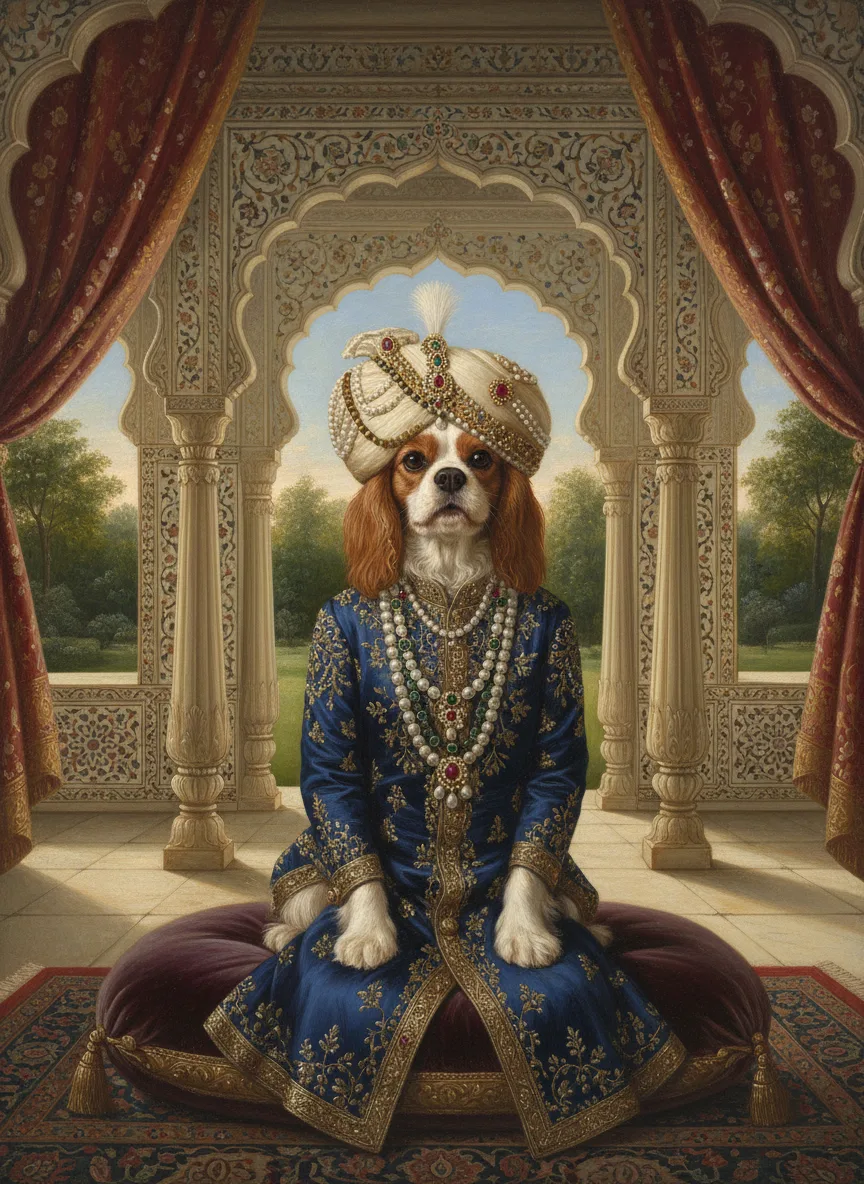
The cover of this page shows a Cavalier King Charles Spaniel from the studio examples, painted in the Indian Royalty style. You can see more finished portraits in the gallery, or start your own in the portrait studio with one clear photo of up to 5 MB and any of the 15 royal styles.
Questions and answers
Which King Charles is the dog named after?
The King Charles spaniel is named after Charles II of England, who ruled from 1660 to 1685, and his father Charles I. The Royal Kennel Club says toy spaniels became well established at the courts of both kings. Charles II is the king the eyewitnesses describe: the diarists Samuel Pepys and John Evelyn both wrote about his dogs, and Evelyn said a number of little spaniels followed him and slept in his bedchamber.
What were King Charles spaniels called before King Charles?
Before King Charles, small English lap spaniels were called the spaniel gentle, or the comforter. John Caius used both names in his book on English dogs, printed in an English translation by Abraham Fleming in 1576. He said the dogs were small and fine, carried by ladies in their laps and beds, and that people believed their warmth could ease an upset stomach.
What did Samuel Pepys write about Charles II's dog at Dover?
Samuel Pepys wrote that on 25 May 1660, the day Charles II landed at Dover to take back his throne, he rode to shore in a boat with a king's footman and a dog that the king loved. The dog dirtied the boat. Pepys wrote that this made them laugh and made him think that a king and everything that belongs to him are just like other people.
Were Charles II's dogs stolen?
Charles II's dogs were stolen more than once, according to the editor of Samuel Pepys's diary. An advertisement in the newspaper Mercurius Publicus for 28 June to 5 July 1660 asked for the return of the king's own black dog, a cross between a greyhound and a spaniel. It ended with the complaint that the dog's place at court was the only one that nobody asked the king for.
What did Pepys see Charles II do with his dog at a council meeting?
Samuel Pepys saw Charles II play with his dog through a council meeting, and wrote on 4 September 1667 that the king was not minding the business. The meeting heard a complaint from Alderman Barker about his lands in Ireland. The diary's editor, Henry Wheatley, adds lines by the poet Lord Rochester about the king's dog sitting at the council board as grave and wise as any lord.
What did John Evelyn say about Charles II's spaniels?
John Evelyn wrote that Charles II took delight in having a number of little spaniels follow him and lie in his bedchamber. In the diary entry he wrote when the king died in February 1685, Evelyn added that the king let the female dogs give birth and feed their puppies there. He complained that this made the room smell and made the whole court dirty.
How did Charles II die?
Charles II died after a stroke in February 1685, according to the official website of the Royal Family. He had no legitimate children, so his brother James became king. The American Kennel Club says a group of his spaniels, as many as a dozen, were at his bedside when he died. John Evelyn's diary records that the spaniels had long slept in his bedchamber.
What were King Charles spaniels bred for?
King Charles spaniels were bred as companion dogs, small enough to sit in a lap. The Royal Kennel Club says toy spaniels go back to at least the 1500s and were most likely bred down in size from sporting spaniels, which found birds for hunters. It adds that the Duke of Marlborough's Blenheim spaniels kept their sporting instincts and could still flush game.
Why is a red and white spaniel called Blenheim?
A red and white spaniel is called Blenheim after Blenheim Palace, the house of the first Duke of Marlborough, who bred red and white toy spaniels there. The Royal Kennel Club says the word now names the chestnut and white coat colour in both King Charles breeds. The American Kennel Club tells a story that the thumb-shaped Blenheim spot on the head began in 1704, and it calls that story folklore.
What colours do King Charles spaniels come in?
King Charles spaniels come in four standard colours: Blenheim, ruby, tricolour, and black and tan. The Royal Kennel Club says the Duke of Marlborough developed the Blenheim, the Duke of Norfolk developed the black and tan, and the tricolours were called the Prince Charles. The ruby, a solid red, was the last colour to appear, and the American Kennel Club dates the first recorded ruby toy spaniel to 1875.
Are King Charles cavaliers hunting dogs?
Cavalier King Charles spaniels are companion dogs that come from hunting stock. The Royal Kennel Club describes the Cavalier as a sporting, affectionate and fearless toy spaniel and suggests up to one hour of exercise a day. The American Kennel Club says that in earlier centuries the sturdier spaniels from a litter might still be taken out to flush woodcock, while the smaller ones stayed in ladies' laps.
Sources
- The Diary of Samuel Pepys, Complete (Mynors Bright transcription, edited by Henry B. Wheatley), Project Gutenberg. Accessed September 28, 2026.
- The Diary of John Evelyn (Volume 2 of 2), edited by William Bray, Project Gutenberg. Accessed September 28, 2026.
- De Canibus Britannicis: Of Englishe Dogges, by John Caius, translated by Abraham Fleming (1576), Project Gutenberg. Accessed September 28, 2026.
- Charles II (r. 1660-1685), The Royal Family. Accessed September 28, 2026.
- Who's Afraid of the Dog-Banditti?, History Today. Accessed September 28, 2026.
- King Charles Spaniel, The Royal Kennel Club. Accessed September 28, 2026.
- Cavalier King Charles Spaniel, The Royal Kennel Club. Accessed September 28, 2026.
- English Toy Spaniel History: Behind Great Britain's King Charles Spaniel, American Kennel Club. Accessed September 28, 2026.
- Cavalier King Charles Spaniel History: Where the Breed Originated, American Kennel Club. Accessed September 28, 2026.
- Vulnerable native breeds, The Royal Kennel Club. Accessed September 28, 2026.
Short reads on this topic
Articles from Purrspectives that answer one question each.
Dog years to human years: the chart by size, and the DNA formula
A 1-year-old dog is closer to 15 or 30 in human years than to 7. The AKC chart by size, the 2020 DNA formula, and a dog's life stages, explained simply.
Pug history: from Chinese emperors to the House of Orange
Pugs began as companions of Chinese emperors, reached Holland on Dutch trading ships and became the dog of the House of Orange. Their history, art and health.
Persian cat history: where the breed came from, its first cat show, coat and care
Persian cat history from a cat brought to Italy in 1626 to the 1871 Crystal Palace show, plus face types, coat colours, grooming and how to photograph one.