Victorian royal portraits: Winterhalter, coronation robes and the first royal photographs
How Queen Victoria was portrayed, from coronation robes and Winterhalter's court portraits to the first royal photographs sold to the public.
By Purrealism. Part of European royal portraits: how Europe's courts painted their rulers.
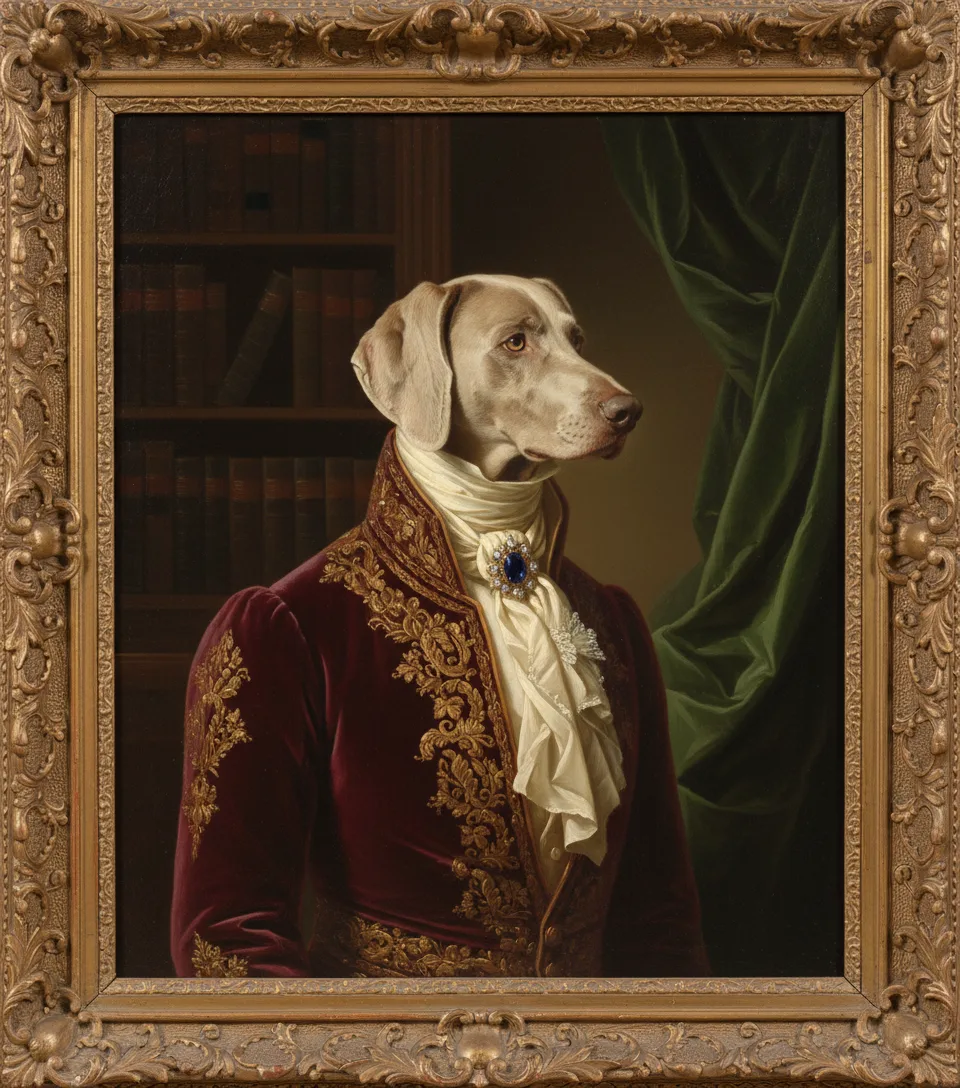
Queen Victoria reigned from 1837 to 1901. Painters still showed her in coronation robes with crown and sceptre, and a favourite court painter, Franz Xaver Winterhalter, painted her and her family again and again. At the same time, photography arrived, and ordinary people could now buy a small picture of their queen, dressed plainly and at home with her children. This page explains both sides of Victorian royal portraiture and how to read them. It is part of the guide to European royal portraits, and follows the page on Georgian and Regency portraits.
A young queen in robes of state
The traditional coronation portrait continued into the new reign. Royal Museums Greenwich says Victoria came to the throne in 1837 at the age of 18, and that her coronation was hailed as a new era of hope. In Sir George Hayter's coronation portrait, which the museum showed in a version of 1863 based on an original of 1838, her upturned gaze and a shaft of light carry that feeling. The museum says the painting is full of the traditions of royal imagery: a sceptre, the Imperial State Crown and coronation robes. The page on symbols of royal power explains what each of these objects meant.
Winterhalter, painter to the courts of Europe
The painter Victoria trusted most was Franz Xaver Winterhalter. The Palace of Versailles says he came from the Black Forest in the Grand Duchy of Baden, trained in Munich, studied in Italy from 1832 to 1834 and moved to Paris in December 1834. He became the portraitist the French royal family had been looking for. In 1839 King Louis-Philippe commissioned his official portrait from him, and then portraits of his whole family. Versailles still holds every portrait of Louis-Philippe and his family that Winterhalter painted between 1839 and 1848.
Winterhalter reached the British court through family ties. Versailles says Louis-Philippe's eldest daughter, Louise, Queen of the Belgians, introduced him to the British royal family, and he became Queen Victoria's favourite portraitist. He then spent a period with the queen every year for twenty years. Versailles also holds portraits of Victoria and Prince Albert from 1842, which were sent as gifts to the King of the French.
English Heritage, which cares for Osborne House on the Isle of Wight, the family home that Victoria and Albert bought in 1845, gives more detail. The queen wrote in her journal on 22 December 1841 that she had received from Paris a small painting by Winterhalter called La Siesta, which she had ordered. It was the first of his works she acquired. English Heritage says he went on to become her unofficial court portraitist, painting as many as a hundred works in that role.
Winterhalter worked for many crowned heads. Versailles says that after the French Revolution of 1848 he became the favourite portraitist of the Second Empire, painting Empress Eugénie of France several times, including a famous portrait of 1855 with her ladies in waiting. He also painted the King and Queen of the Belgians, Queen Isabella II of Spain, and the Austrian emperor Franz Joseph and empress Elisabeth in 1865. To meet this demand he kept a large studio, working closely with his younger brother Hermann and his friend Albert Gräfle. He died in Frankfurt in 1873.
Jewels chosen for the portrait
Victorian portraits show jewels with a story. The Victoria and Albert Museum (V&A) says Prince Albert designed a sapphire and diamond coronet for Victoria in 1840, their wedding year, and that Joseph Kitching of the firm Kitching and Abud made it. In 1842 Victoria wore the new coronet in a famous portrait by Winterhalter.
The same jewel later carried a message of grief. The V&A says that in 1866, more than 20 years after that portrait, Victoria wore the coronet in place of her crown when she felt able to open Parliament for the first time since Albert's death in 1861. The crown went with her, carried on a cushion. The coronet is now on display in the V&A's jewellery galleries.
Photography comes to court
The National Army Museum says Queen Victoria's reign coincided with the rapid development of photography. Tate says the word "photograph" was coined in 1839 by Sir John Herschel, from Greek words meaning "drawing with light". The National Portrait Gallery in Canberra says Prince Albert was keenly interested in photography from the start, and that in 1842 he sat for a daguerreotype, an early type of photograph, which is considered the first photograph ever taken of a member of the British royal family. The queen shared his enthusiasm.
Photographs of officers followed the rules of painted portraits. The National Army Museum in London says the daguerreotype was the first publicly available photographic process, prominent in the 1840s and 1850s, and that early photographs of soldiers copied the stances and poses of paintings. It says photography inherited many of the conventions of painted portraiture, from heroic poses to the leaning stance used to convey relaxed authority.
Photography also opened the family portrait to more people. The National Army Museum points out that for centuries, large painted family portraits had been linked with wealthy households and noble rank. As photographs became cheaper, families of modest means could order their own. Its collection includes a photograph from the mid-1870s of a senior soldier below officer rank standing beside his wife and five children, the whole family neatly dressed.
The Royal Album of 1860
The biggest change came in May 1860. The National Portrait Gallery in Canberra says the photographer John Jabez Edwin Mayall was invited to Buckingham Palace, where he took a series of portraits of the queen, Prince Albert and several of their children. The pictures broke with custom in two ways. The queen chose to appear in the carte de visite, a cheap and popular photographic format, and she allowed the portraits to be published and sold.
The gallery explains the format. The carte de visite was patented in 1854 by the French photographer André Adolphe Eugène Disdéri. A typical carte was nine or ten centimetres high and five or six wide, and could be printed many times from one negative, so ordinary people could afford it. The V&A holds a carte of this period showing nine small photographs in a grid, with Victoria and Albert in the centre and their nine children around them.
These photographs looked nothing like a state portrait. The Canberra gallery quotes an Australian report of the time: no crowns, orbs or thrones, with the queen "attired as plainly as any English lady could desire". Sold as the Royal Album, the photographs reportedly earned Mayall £35,000 and started a craze for collecting cartes.
A widow in black
When Prince Albert died in December 1861, the royal image changed again. The Canberra gallery says the carte de visite became the means by which Victoria fixed her image as the most noble of widows. Through the 1860s, studios in London and Europe produced prints of the queen in black crepe, some of them showing her looking at portraits of her dead husband. Within a week of Albert's death, the gallery says, 70,000 of his cartes were ordered from one London firm, Marion and Co. of Regent Street.
Painted portraits kept the old signs of rank to the end. Royal Museums Greenwich describes a late portrait of Victoria, a version by Bertha Müller after an original by Heinrich von Angeli made for the queen's own collection. It shows her near the end of her reign, wearing the blue sash of the Order of the Garter. Her youngest daughter, Princess Beatrice, read aloud to her during the sittings for the original, and the queen called it "wonderfully good". The museum says Victoria died in 1901, aged 81, after a reign of 63 years, at that time the longest of any British monarch.
Princes in uniform
Victoria's sons held military posts, some of them in foreign regiments, and were photographed in those uniforms. The National Army Museum describes the hussar uniform of Prince Arthur, Duke of Connaught, her third son, who was made colonel of a German cavalry regiment, the 3rd Zieten Hussars, in 1879, and shows a photograph of him in its uniform in Berlin in 1883. It says that like most members of the royal family he was honorary head of several regiments, and that foreign royals, such as Kaiser Wilhelm II and Tsar Nicholas II, held honorary posts in British regiments. The page on military portraits explains how such uniforms and medals are read.
The Victorian Noble style: a Victorian pet portrait
Purrealism's Victorian Noble style is a Victorian pet portrait: it dresses a pet as a well-born Victorian, the way Winterhalter painted a queen. The gallery shows it on seven animals, including a Weimaraner, a beagle-harrier, a German shepherd, a French bulldog and three cats. For the dogs the queen herself kept and had painted, read Queen Victoria and her dogs. You can choose the style in the portrait studio with one photo of your pet of up to 5 MB.
Questions and answers
Who painted Queen Victoria's portraits?
Queen Victoria's favourite portrait painter was Franz Xaver Winterhalter, a German artist based in Paris. The Palace of Versailles says he became her favourite portraitist and spent time with the queen every year for 20 years. English Heritage says he became her unofficial court portraitist and painted as many as a hundred works for her. Other painters, such as George Hayter, painted her coronation portrait.
Who was Franz Xaver Winterhalter?
Franz Xaver Winterhalter was a German court portrait painter who worked for the royal families of France, Britain and other European countries. The Palace of Versailles says he came from the Black Forest in Baden, moved to Paris in 1834 and painted the official portrait of King Louis-Philippe in 1839. He later painted Empress Eugénie of France and Empress Elisabeth of Austria, and died in Frankfurt in 1873.
What crown is Queen Victoria wearing in Winterhalter's 1842 portrait?
Queen Victoria wears her sapphire and diamond coronet in Franz Xaver Winterhalter's portrait of 1842. The Victoria and Albert Museum, which now displays the coronet, says Prince Albert designed it for her in 1840, their wedding year, and that Joseph Kitching of Kitching and Abud made it. The V&A calls it one of Victoria's most treasured jewels.
What did Queen Victoria wear to open Parliament in 1866?
Queen Victoria wore her small sapphire and diamond coronet in place of her crown to open Parliament in 1866, the first time she had done so since Prince Albert's death in 1861. The Victoria and Albert Museum says Albert had designed the coronet for her in 1840, their wedding year, and that her crown went with her to Parliament, carried on a cushion.
What does Queen Victoria's coronation portrait show?
Queen Victoria's coronation portrait by Sir George Hayter shows the young queen in her coronation robes with a sceptre and the Imperial State Crown. Royal Museums Greenwich says the version shown in its exhibition was painted in 1863, based on an original of 1838. It says her upturned gaze and a shaft of light convey the hope that greeted her reign, which began in 1837 when she was 18.
What was the Royal Album?
The Royal Album was a set of photographs of Queen Victoria, Prince Albert and their children, taken by John Jabez Edwin Mayall at Buckingham Palace in May 1860 and sold to the public. The National Portrait Gallery in Canberra says the sales reportedly earned Mayall £35,000 and started a craze for collecting small photographic portraits. The queen appeared plainly dressed, with no crown or orb.
What is a carte de visite?
A carte de visite is a small photographic portrait mounted on card, first patented in 1854 by the French photographer André Adolphe Eugène Disdéri. The National Portrait Gallery in Canberra says a typical carte was nine or ten centimetres high and five or six wide, and could be printed many times from one negative, which made it cheap. Studios offered props such as imitation columns and heavy drapes.
What was the first photograph of a British royal?
The first photograph of a member of the British royal family is a daguerreotype of Prince Albert, taken in 1842. The National Portrait Gallery in Canberra says Albert was keenly interested in photography from its beginning, three years after the process was patented, and that Queen Victoria shared his enthusiasm and collected photographs of relatives and friends. The National Army Museum calls the daguerreotype the first publicly available photographic process.
How did portraits of Queen Victoria change after Prince Albert died?
After Prince Albert died in December 1861, Queen Victoria was shown as a grieving widow in black. The National Portrait Gallery in Canberra says London and European studios produced many photographs of her in black crepe through the 1860s. It adds that within a week of Albert's death, 70,000 photographic portraits of him were ordered from one London firm, Marion and Co. of Regent Street.
What is the von Angeli portrait of Queen Victoria?
The von Angeli portrait shows Queen Victoria near the end of her reign, wearing the blue sash of the Order of the Garter. Royal Museums Greenwich says the painting it displayed was a version by Bertha Müller after an original that Heinrich von Angeli made for the queen's own collection. Princess Beatrice read aloud to her mother during the sittings, and the queen called the portrait wonderfully good.
How did Winterhalter paint so many royal portraits?
Franz Xaver Winterhalter painted so many royal portraits with the help of a large studio. The Palace of Versailles says he worked closely with his younger brother Hermann and his friend Albert Gräfle to meet the needs of his vast and demanding clientele. Versailles holds all his portraits of King Louis-Philippe and his family, painted between 1839 and 1848.
Sources
- Franz Xaver Winterhalter, Château de Versailles. Accessed September 29, 2026.
- Osborne Collection highlights, English Heritage. Accessed September 29, 2026.
- Queen Victoria's sapphire and diamond coronet, Victoria and Albert Museum. Accessed September 29, 2026.
- What do YOU see in these Royal Portraits? Tudors to Windsors, Royal Museums Greenwich. Accessed September 29, 2026.
- Queen of cartes, National Portrait Gallery, Canberra. Accessed September 29, 2026.
- Miniature Portraits of Queen Victoria and her family, Victoria and Albert Museum. Accessed September 29, 2026.
- Photography, Tate. Accessed September 29, 2026.
- Faces of the Victorian Army, National Army Museum. Accessed September 29, 2026.
- A uniform fit for a prince, National Army Museum. Accessed September 29, 2026.
- Victoria and Albert at Osborne, English Heritage. Accessed September 29, 2026.
Short reads on this topic
Articles from Purrspectives that answer one question each.
What was the Victorian era? Dates, fashion and portraits of 1837 to 1901
The Victorian era is Queen Victoria's reign, 1837 to 1901. Her life, what Victorians wore, and how they had portraits painted and photographed.
Military dog portraits: the real dogs who served, and your dog as a general
Real war dogs such as Stubby and Gander earned medals and a rank. Here is their story, and how to make a dog general portrait of your own dog.
Dogs in medieval paintings and manuscripts: hunting hounds, lapdogs and faithful friends
Medieval dog paintings show hunting hounds, lapdogs and loyal dogs in painted books, on church brasses and in the Bayeux Tapestry. Where to find each one.