Updated
Oudry and Desportes: the painters of the French kings' hunting dogs
Desportes painted Louis XIV's favourite hounds and Oudry painted Louis XV's, with each dog's name in gold. Who they were and where to see the dogs today.
By Purrealism. Part of Dogs in art: the painters and paintings behind a royal dog portrait.
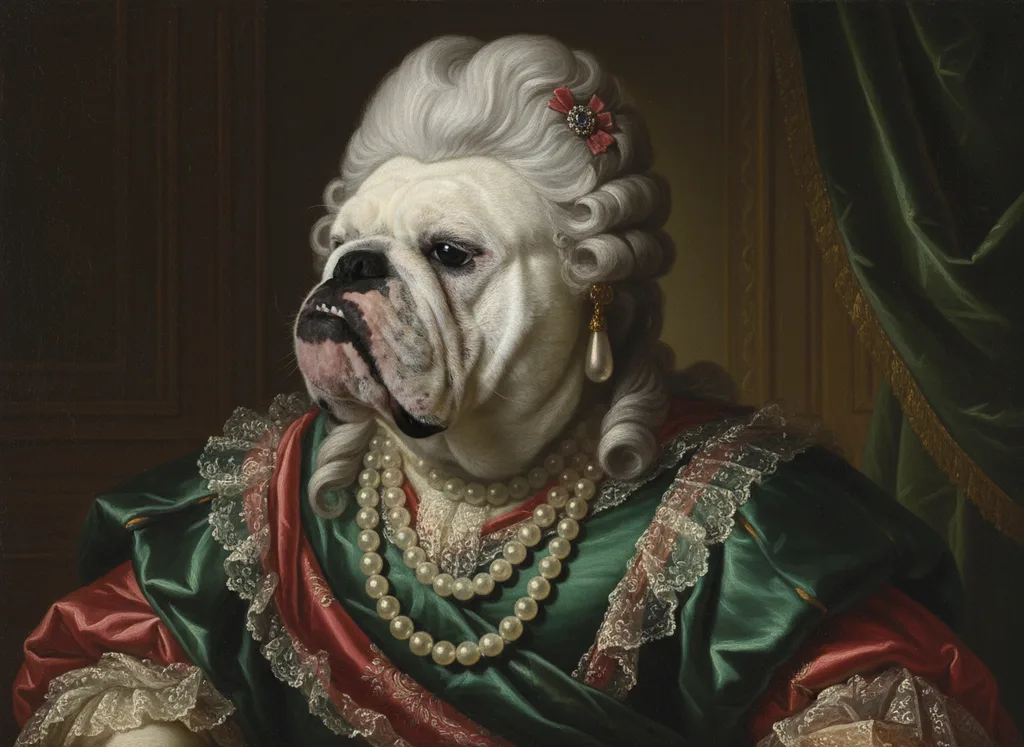
Two French painters made portraits of royal hunting dogs for two kings in a row. Alexandre-François Desportes (1661 to 1743) painted the favourite female hounds of Louis XIV, and Jean-Baptiste Oudry (1686 to 1755) painted the dogs of the next king, Louis XV. This page explains who the two painters were, how the royal commissions worked, what the dogs look like, and where the paintings hang today. It draws on the collection records of the Louvre, the château de Fontainebleau, the Wallace Collection and the Cleveland Museum of Art. For the whole story of dogs in art, from van Eyck to the Victorians, start with the dogs in art guide.
Why French kings wanted portraits of their dogs
The château de Fontainebleau, a royal palace built in a forest near Paris, calls hunting a symbol of power and royal tradition, and the royal pleasure above all others. It says French kings hunted there from the 12th century. Louis XIV and Louis XV both hunted there regularly, and the château says Louis XV's reign was the high point of the royal hunt: he hunted three times a week and increased the number of his hunting teams and packs of hounds.
The kings' hounds had names. Fontainebleau says Louis XV often mentioned his dogs in his letters and took great care of them. Portraits of these dogs hung in the kings' own rooms. The people and courts behind these commissions are covered in our guide to European royal portraits; this page is about the dogs.
Desportes and the dogs of Louis XIV
The Louvre records that Desportes was born in Champigneulle, in the Ardennes, in 1661 and died in Paris in 1743. The Wallace Collection in London says he learned his trade from a teacher named Bernaerts and followed the Flemish tradition of still-life painting, the painting of objects such as fruit and dead game, which was popular in Paris at the time.
The Marly over-doors, 1702
In 1702 Louis XIV ordered four paintings of his dogs for the antechamber of his apartment at the château de Marly, one of his royal houses. An antechamber is the waiting room outside a king's private rooms. Each painting was an over-door, a picture set into the wall above a door. The Louvre holds these three from the order:
- Diane et Blonde, signed and dated "DESPORTES 1702". Two hounds hunt a pheasant. The canvas is 1.62 metres high and 2 metres wide.
- Bonne, Nonne et Ponne, three dogs of the royal pack, also hunting.
- Folle et Mite, 1.63 metres high and 2 metres wide.
The titles call the dogs "chiennes de Louis XIV". "Chienne" is the French word for a female dog, so these were the king's favourite female hounds. The Louvre adds that the paintings were still in place at Marly in 1733.
A second order, 1714
The Louvre says the king ordered four more portraits of his favourite female dogs in 1714, also for Marly. One of them is Perle et Ponne, now at the château de Fontainebleau. The Louvre describes it: on the left, Perle turns with one paw raised toward a silver pheasant, and Ponne points at the same bird from the other side. Both dogs are white with yellow ears, and a tree trunk stands between them.
Dogs in a still life
Desportes also put dogs into large still lifes. The Wallace Collection holds his Dogs, Dead Game and Fruit, dated 1715, which measures 128.5 by 161.5 cm. The museum says it is a version of a picture dated 1712 that belonged to Louis XIV and is now in the Louvre. The Louvre's version has no dog on the right. In the Wallace painting, the museum says, the three dogs "add a narrative element", a small story, to the display of game and fruit. It also records that Desportes stayed in England in 1712 and 1713.
Oudry and the dogs of Louis XV
Jean-Baptiste Oudry trained in the studio of the famous painter Nicolas de Largillière, according to the château de Fontainebleau. The Cleveland Museum of Art says he began his career painting portraits and became known for animals and hunting scenes. Louis XV noticed these pictures, and Oudry became one of the leading decorative painters of his reign.
The king's dogs, 1725 to 1732
Fontainebleau says Oudry painted a series of Louis XV's dogs between 1725 and 1732, at the start of his service to the king. The château says Oudry continued the work of Desportes, who had painted Louis XIV's dogs for Marly. There was one difference. Oudry showed the dogs in action, chasing their prey or playing outdoors.
The château explains three features of the series:
- The dogs always stand in the foreground.
- Each dog's name is written in gold letters, to mark its rank.
- The landscape behind shows off the beauty of the setting.
The dogs' names survive with the pictures. Fontainebleau praises the noble bearing of Misse, the mischief of Gredinet, the concentration of Lise and the royal pride of Mignonne. It quotes the naturalist the comte de Buffon, who wrote of "la chaleur du sentiment", the warmth of feeling, and says Oudry gave his animals this extra quality. In 1733 the paintings went to the château de Compiègne, where they decorated a new apartment for Louis XV.
Fontainebleau says the series had 11 paintings. For its Cave Canem exhibition, which closed on 30 June 2022, it counted seven at Fontainebleau, two at the palace of Compiègne, one in a private collection and one lost. The first painting of the series, Misse et Turlu, came to Fontainebleau on loan from the Louvre in 1889.
Cadet et Hermine
In the spring of 2020 the château de Fontainebleau bought one more painting from the series, Cadet et Hermine, from the heirs of Count Robert de Moustier. It shows two spaniels pointing at a pheasant. The château praises the light on their jet black coats, the lively look in their eyes and the skill in the pheasant's feathers, and ranks it with Oudry's finest dog paintings. It adds that the canvas was cut down in width at an unknown date.
The château also says this first royal commission convinced Louis XV to give Oudry the largest project of his career. In the Cave Canem exhibition, named after the Latin for "beware of the dog", the château showed six of the dog portraits together. It said this was the first time they had been shown side by side since the French Revolution.
From dog portraits to royal hunts
The larger project was the Chasses royales, the royal hunts. Fontainebleau says Oudry painted nine large pictures between 1733 and 1746, each showing a scene from Louis XV's hunts at Compiègne, Fontainebleau and Saint-Germain-en-Laye. They were cartoons, full-size models for weavers, and the Gobelins tapestry workshop wove tapestries from them. The château says Oudry painted the coat of the stag, the colours of the horses and the excitement of the dogs. Eight of the nine cartoons now hang in the rooms known as the appartement des Chasses at Fontainebleau.
Oudry kept drawing dogs in action. The Cleveland Museum of Art holds his drawing Wild Sow and Her Young Attacked by Dogs, dated 1748. The museum links it to one of his most successful paintings, shown at the Salon of 1748, the official art exhibition in Paris, and bought by Louis XV.
Late in life he also worked on a book. Cleveland says Oudry made 276 designs for the fables of Jean de La Fontaine, short animal stories with a lesson. They were published in four large volumes between 1755 and 1759.
The two painters side by side
| Desportes | Oudry | |
|---|---|---|
| Life | 1661 to 1743 | 1686 to 1755 |
| King | Louis XIV | Louis XV |
| Dog portraits ordered | four in 1702, four in 1714 | a series painted 1725 to 1732 |
| First home of the paintings | Château de Marly | Château de Compiègne |
| How the dogs appear | pointing or hunting game birds | chasing prey or playing, names in gold |
| Where to see them now | Musée de la Chasse et de la Nature, Paris; Fontainebleau | Château de Fontainebleau; Compiègne |
The Louvre has lent Diane et Blonde, Bonne, Nonne et Ponne and Folle et Mite to the Musée de la Chasse et de la Nature, a museum of hunting and nature in Paris, since 1967.
What these royal dog portraits mean for your own dog's portrait
Desportes and Oudry painted real, named dogs. The names in gold on Oudry's canvases say that each dog was an individual with a place at court. That is the same idea behind a royal portrait of your own pet: one particular dog, shown with honour.
Both painters also caught their dogs at a moment of focus: a pointer frozen in front of a pheasant, a spaniel with its eyes on the bird. A photo of your dog alert and looking at something, with its head and ears up, gives a portrait that same energy. The cover of this page shows an English Bulldog from the studio examples in Purrealism's Baroque Aristocrat style.
For the dogs of the Spanish court in the same century, read about Goya's dogs. For the hunting hounds of Renaissance myth, see Titian's dogs. The real royal dogs of other courts, from Charles II's spaniels to Frederick the Great's greyhounds, are in our guide to royal pets in history. When you are ready, you can start a portrait in the portrait studio.
Questions and answers
Who painted the hunting dogs of Louis XIV?
Alexandre-François Desportes painted the hunting dogs of Louis XIV. The Louvre says the king ordered four portraits of his favourite female dogs from him in 1702 and four more in 1714. The first four were made to hang above the doors of the antechamber in the king's apartment at the château de Marly. Desportes lived from 1661 to 1743.
What does chiennes de Louis XIV mean?
Chiennes de Louis XIV is French for Louis XIV's female dogs, and it appears in the titles of Desportes's portraits of the king's hounds. The Louvre catalogues one of them as Diane et Blonde, chiennes de la meute de Louis XIV, meaning Diane and Blonde, female dogs of Louis XIV's pack. Desportes signed and dated it in 1702.
Who painted the dogs of Louis XV?
Jean-Baptiste Oudry painted the dogs of Louis XV. The château de Fontainebleau says he painted a series of the king's dogs between 1725 and 1732, starting his career in the king's service. In 1733 the paintings went to the château de Compiègne to decorate a new apartment for Louis XV. The king came to call Oudry his painter of dogs.
Why are the dogs' names written in gold on Oudry's paintings?
The dogs' names are written in gold on Oudry's portraits of Louis XV's dogs to mark their rank. The château de Fontainebleau, which holds most of the series, says the dogs always stand in the foreground, their names in gold letters show their status, and the landscape behind shows off the setting. Misse, Gredinet, Lise and Mignonne are among the names.
Where can I see Desportes's paintings of Louis XIV's dogs?
Desportes's portraits of Louis XIV's dogs are in Paris and at Fontainebleau. The Louvre owns them and has lent Diane et Blonde, Bonne, Nonne et Ponne and Folle et Mite to the Musée de la Chasse et de la Nature, a museum of hunting and nature in Paris, since 1967. Perle et Ponne is at the château de Fontainebleau.
What is Oudry's Cadet et Hermine?
Cadet et Hermine is a painting by Jean-Baptiste Oudry of two black spaniels of Louis XV pointing at a pheasant. The château de Fontainebleau bought it in 2020 from the heirs of Count Robert de Moustier. The château praises the light on the dogs' jet black coats and the lively look in their eyes, and ranks it among Oudry's finest dog paintings.
What were Oudry's Chasses royales?
The Chasses royales were nine large paintings of Louis XV's hunts that Jean-Baptiste Oudry made between 1733 and 1746 as models for tapestries. The Gobelins workshop wove the tapestries from them. The château de Fontainebleau says the paintings show the royal packs, the horses and the hunters at Compiègne, Fontainebleau and Saint-Germain-en-Laye, and eight of the nine hang there today.
Who taught Jean-Baptiste Oudry to paint?
Jean-Baptiste Oudry trained in the studio of the famous painter Nicolas de Largillière, according to the château de Fontainebleau. The Cleveland Museum of Art says Oudry began his career painting portraits and became known step by step for his animals and hunting scenes. Louis XV noticed those pictures, and Oudry became one of the king's main decorative painters.
What is an over-door painting?
An over-door painting is a picture made to hang in the space above a door, set into the wall panels of a room. The Louvre records that Desportes's portraits of Louis XIV's dogs, painted in 1702, were four over-doors for the antechamber of the king's apartment at Marly. Diane et Blonde, one of the four, measures 1.62 metres high and 2 metres wide.
Did Oudry illustrate La Fontaine's fables?
Jean-Baptiste Oudry made 276 designs for the fables of Jean de La Fontaine, the short animal stories with a lesson written in the late 1600s. The Cleveland Museum of Art says the designs were published in four luxurious volumes between 1755 and 1759. The museum calls it one of the most ambitious publishing projects of the artist's time.
Sources
- Diane et Blonde, chiennes de la meute de Louis XIV, chassant, Musée du Louvre. Accessed September 29, 2026.
- Bonne, Nonne et Ponne, chiennes de la meute de Louis XIV, chassant, Musée du Louvre. Accessed September 29, 2026.
- Folle et Mite, chiennes de Louis XIV, Musée du Louvre. Accessed September 29, 2026.
- Perle et Ponne, chiennes de la meute de Louis XIV, Musée du Louvre. Accessed September 29, 2026.
- Dogs, Dead Game and Fruit, Alexandre-François Desportes, The Wallace Collection. Accessed September 29, 2026.
- Cadet et Hermine peint par Jean-Baptiste Oudry rejoint les collections du château, Château de Fontainebleau. Accessed September 29, 2026.
- Exposition Cave Canem ! Jean-Baptiste Oudry et les chiens de Louis XV, Château de Fontainebleau. Accessed September 29, 2026.
- Exposition Oudry, peintre de courre. Les chasses royales de Louis XV, Château de Fontainebleau. Accessed September 29, 2026.
- Wild Sow and Her Young Attacked by Dogs, Jean-Baptiste Oudry, Cleveland Museum of Art. Accessed September 29, 2026.
- The Fables of La Fontaine: The Fox and the Turkey Hens, Jean-Baptiste Oudry, Cleveland Museum of Art. Accessed September 29, 2026.
Short reads on this topic
Articles from Purrspectives that answer one question each.
Dog years to human years: the chart by size, and the DNA formula
A 1-year-old dog is closer to 15 or 30 in human years than to 7. The AKC chart by size, the 2020 DNA formula, and a dog's life stages, explained simply.
Pug history: from Chinese emperors to the House of Orange
Pugs began as companions of Chinese emperors, reached Holland on Dutch trading ships and became the dog of the House of Orange. Their history, art and health.
Persian cat history: where the breed came from, its first cat show, coat and care
Persian cat history from a cat brought to Italy in 1626 to the 1871 Crystal Palace show, plus face types, coat colours, grooming and how to photograph one.