Golden retriever portraits: the breed's Scottish history and how to paint one as royalty
A golden retriever portrait shows the gold coat best against red, blue or green clothes. The breed's Scottish history, coat colours and photo tips.
By Purrealism
A golden retriever portrait starts with a dog that was bred in the Scottish Highlands in the 1860s. This guide covers where the breed came from, what the kennel clubs say about its coat and character, the two golden retrievers already in the Purrealism gallery, and how to photograph a gold coat so the portrait keeps its colour and detail.
A Highland estate called Guisachan
According to the American Kennel Club (AKC), Dudley Coutts Marjoribanks was born in 1820, the second son of a Scottish banker. He sat in the House of Commons and was made the first Baron Tweedmouth in 1881, so breed histories often call him Lord Tweedmouth. He kept a record of every dog he bred for half a century in a leather-bound book, which the AKC says is still kept at the Kennel Club in England.
His country home was Guisachan, in the Scottish Highlands. Historic Environment Scotland's record for Guisachan House places it in the Highland council area and says that Marjoribanks bought the house and estate in 1854 from Colonel William Fraser. The AKC describes a 15-bedroom mansion with forest and deer-stalking land around it, and says the name means "place of the firs".
In 1865, on a walk in Brighton, Marjoribanks found a wavy-coated dog named Nous. Nous had black parents but a gold coat. The AKC explains why that mattered: in the 19th century, black sporting dogs were fashionable and thought to be better hunters. Three years later he bred Nous to Belle, a Tweed Water Spaniel from his cousin. Tweed spaniels are now extinct. They were liver-coloured (a dark reddish brown) and linked to the fishermen of the River Tweed on the border between Scotland and England.
The 1868 litter included Cowslip, Crocus and Primrose, which the AKC calls the world's first golden retrievers. The Royal Kennel Club says the mating produced four yellow puppies, and that Bloodhound and Irish Setter blood were added to the line later.
How the golden retriever got its name and spread
Marjoribanks gave his gold dogs only to family and friends. The AKC says his youngest son, Archie, took a male named Sol to Texas and later brought a female named Lady to Canada. Marjoribanks wrote his last breeding entry in 1890.
According to the Royal Kennel Club, Britain's dog registry first recognized the breed in 1913 as a "yellow" or "golden" retriever. When the Golden Retriever Club was founded in 1920, the official name became Golden Retriever. The AKC recognized the breed in 1925. In September 2026, the AKC breed page ranks the golden retriever 3rd of 210 breeds for popularity.
The house at Guisachan is now a ruin. The AKC says the estate changed owners many times, and the roof of the house was taken off in 1939 to lower the tax bill. A non-profit group later put up a life-size bronze statue of a golden retriever in Tomich, the village on the road to Guisachan. The Royal Kennel Club says the estate is still sometimes used for golden retriever shows, and breed fans honour it as the home of the breed. The guide to royal dogs in history covers the breeds that lived at royal courts.
What the breed standard says about the gold coat
A breed standard is a kennel club's written description of the ideal dog of a breed. Two standards matter for the golden retriever, and both describe the coat in detail.
The AKC standard asks for a "rich, lustrous golden of various shades". It says the feathering, the longer hair on the back of the front legs, the belly, the front of the neck, the back of the thighs and under the tail, may be lighter than the rest of the coat. The main coat colour should avoid both the palest and the darkest shades, and any noticeable area of black hair is a serious fault. Grey or white hair on the face or body that comes with age is allowed.
The Royal Kennel Club standard allows "any shade of gold or cream, neither red nor mahogany". Both standards allow a few white hairs on the chest.
Both also describe two layers of coat. The AKC standard calls the coat dense and water-repellent with a good undercoat, and the Royal Kennel Club describes a flat or wavy coat with a dense, water-resisting undercoat. That fits the AKC's history: Marjoribanks wanted a hunter that could work on land and in water, for grouse, partridge and red deer.
For a portrait, these details give you a checklist. Look at your own dog's shade, from cream to deep gold, and at where the feathering is lighter. Those are the parts your photo needs to show clearly.
Choosing a royal role from the breed's character
The kennel clubs use short lists of words for the breed's character. The Royal Kennel Club standard gives the temperament as "kindly, friendly and confident", and calls the breed biddable, which means willing to do what it is asked, and intelligent. The AKC standard gives "friendly, reliable, and trustworthy", and describes a personality that is "eager, alert and self-confident".
Those words suit a calm, seated ruler, and both golden retrievers in the gallery are shown as rulers. A dog that works hard and waits for orders may suit the Military General style instead. Purrealism offers 15 styles in all, and the guide on how to choose a royal portrait style goes through them by coat colour and character.
The two golden retrievers in the gallery
Two of the eight finished portraits in the gallery show a golden retriever.
- The Maharaja: a golden retriever in a red jewelled turban, seated on a gold throne.
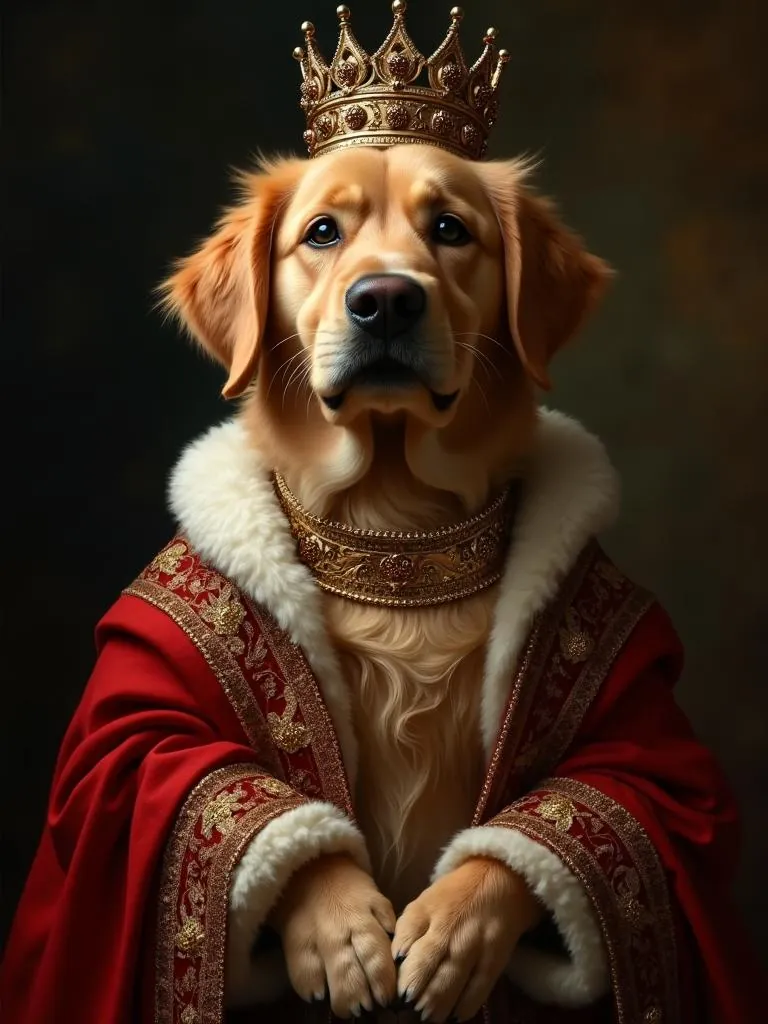
- The Noble Hound, in the Indian Royalty style: a golden retriever wearing a royal crown and a red robe.
In both, red sits next to the gold coat. The red clothes keep the gold coat separate from the costume, even though the Maharaja's throne is gold too.
Clothes in the same colour as the coat make the dog blend into its costume. For a golden or cream coat, choose clothes in green, blue or deep red. A pale cream dog also stands out against darker clothes, so a deep red or a dark blue suits it better than a light gold.
Photographing a golden coat
The photo guide has ten tips for any dog or cat. These are the ones that matter most for a gold coat.
Use soft light. The AKC suggests shade, or golden hour: the first hour after sunrise and the hour before sunset. Keep the light in front of your dog. Another AKC article warns that a dog with light shining from behind it will look shadowed.
Set the brightness on the coat. The same AKC article advises tapping the phone screen where you want the focus and exposure, to make the picture lighter or less bright. Exposure is how much light the camera lets in. If the gold coat looks too pale on your screen, tap a bright part of the coat and check the colour again.
Get down to eye level and focus on the eyes. The AKC advises shooting at your dog's eye level, which often means lying on the ground, and focusing on the dog's eye.
Check the feathering. Zoom in on the neck, legs and tail. You want to see separate hairs in the lighter feathering.
When the photo is ready, the portrait studio takes one image file of up to 5 MB. Pick the photo where both eyes are sharp and the coat shows its true shade.
Questions and answers
What is the history of the golden retriever?
The golden retriever comes from the Guisachan estate in the Scottish Highlands, where Dudley Coutts Marjoribanks, later the first Lord Tweedmouth, bred the first litter in 1868. According to the American Kennel Club, the parents were Nous, a yellow wavy-coated retriever, and Belle, a Tweed Water Spaniel. The Royal Kennel Club says Britain recognized the breed in 1913, and the name Golden Retriever became official in 1920.
How was the golden retriever created?
The golden retriever was created by crossing a retriever with a water spaniel. According to the American Kennel Club, Dudley Coutts Marjoribanks bred Nous, a yellow wavy-coated dog, to Belle, a Tweed Water Spaniel, and their 1868 litter included Cowslip, Crocus and Primrose. The Royal Kennel Club says Bloodhound and Irish Setter blood were added to the line later.
What is a golden retriever known for?
The golden retriever is known as a friendly hunting dog. The American Kennel Club calls it an exuberant Scottish gundog, a dog that helps hunters find and bring back game, and lists its work in hunting, as a guide for blind people and in search and rescue. The Royal Kennel Club's breed standard describes its temperament as kindly, friendly and confident.
Are all golden retrievers golden?
All golden retrievers are some shade of gold or cream under the breed standards. The Royal Kennel Club standard allows any shade of gold or cream, but neither red nor mahogany. The American Kennel Club standard asks for a rich golden coat of various shades, allows lighter feathering, and says the main coat colour should avoid both the palest and the darkest shades.
Can golden retrievers be black?
A black coat is outside the golden retriever breed standard. The American Kennel Club standard says any noticeable area of black or other off-colour hair is a serious fault. The Royal Kennel Club standard lists only shades of gold or cream. Both standards allow a few white hairs on the chest.
Do golden retrievers have a double coat?
The golden retriever has two layers of coat: an outer coat and a thick undercoat beneath it. The American Kennel Club standard describes a dense, water-repellent coat with a good undercoat and an outer coat that is straight or wavy. The Royal Kennel Club standard describes a flat or wavy coat with a dense, water-resisting undercoat.
Do golden retrievers like water?
The golden retriever was bred to work in water as well as on land. According to the American Kennel Club, Lord Tweedmouth crossed a retriever with a water spaniel to make a hunter able to move through both land and water. The American Kennel Club breed standard also describes the coat as water-repellent, with a good undercoat.
Do golden retrievers retrieve gold?
The golden retriever takes its name from its coat colour, and retrieve means to find and bring back. The Royal Kennel Club says gundogs were trained to find game and bring back game that had been shot. It also says the breed was first recognized in 1913 as a yellow or golden retriever, and became the Golden Retriever in 1920.
Is there a golden retriever portrait in the Purrealism gallery?
The Purrealism gallery has two golden retriever portraits. The Maharaja portrait shows a golden retriever in a red jewelled turban, seated on a gold throne. The Noble Hound, in the Indian Royalty style, shows a golden retriever wearing a royal crown and a red robe. Both put red clothes next to the gold coat, so the dog stands out from the costume.
How do I photograph a golden retriever for a portrait?
Photograph a golden retriever in shade or soft daylight, at its eye level, with the focus on its eyes. The American Kennel Club suggests shade or the hour after sunrise and before sunset. Another American Kennel Club article advises tapping the phone screen where you want the focus and brightness, which helps when a gold coat looks too pale on the screen.
Sources
- Golden Retriever History: Behind the Breed's 'Unfashionable' Past, American Kennel Club
- Official Standard for the Golden Retriever, American Kennel Club
- Golden Retriever Dog Breed Information, American Kennel Club
- Breeds by Year Recognized, American Kennel Club
- Retriever (Golden) breed standard, The Royal Kennel Club
- Retriever (Golden): Breeds A to Z, The Royal Kennel Club
- Guisachan House, Historic Environment Scotland
- Tips for Taking Great Photos of Your Dog, American Kennel Club
- Say Cheese! Take the Best Photos of Your Dogs, American Kennel Club
Go deeper
The full guides on this topic, each a set of pages with sources: