Pharaohs and their dogs: the royal hounds of ancient Egypt
The guard dog a king buried at Giza, King Intef II's dogs, Egyptian dog names, the dog catacombs of Saqqara, and what modern breeds have to do with Egypt.
By Purrealism. Part of Royal pets in history: the real dogs and cats of kings, queens and emperors.
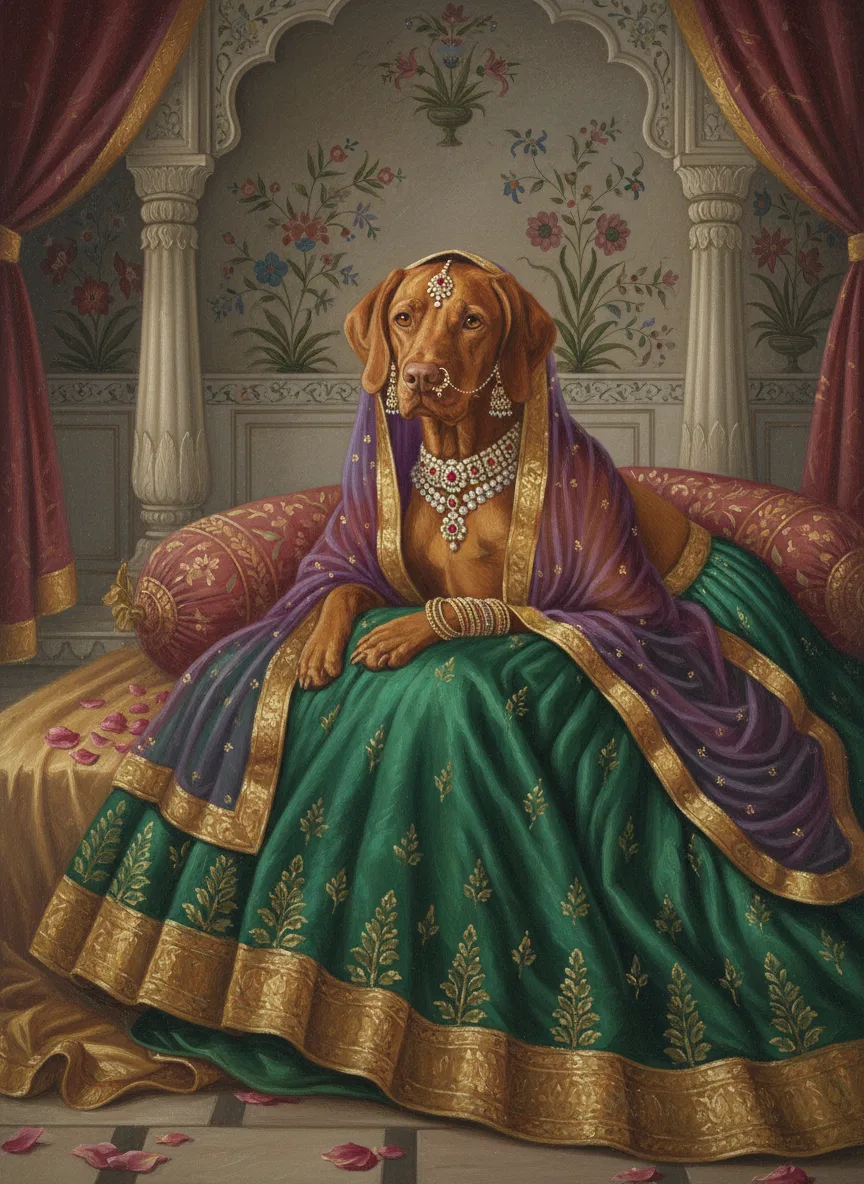
This page is about the real dogs of the Egyptian kings and their courts. It covers the guard dog a king buried at Giza, the pharaohs shown with their hounds, the names Egyptians gave their dogs, how dogs were buried, and the catacombs at Saqqara that held millions of dog mummies. The last part looks at which modern breeds kennel clubs link to Egypt, and what a genetic study says about those links. For royal animals in other times and places, start at the royal pets in history guide.
Abuwtiyuw, the guard dog a king buried
In 1935, the Harvard and Boston expedition led by the archaeologist George A. Reisner was working in the great cemetery west of the Pyramid of Cheops at Giza. In a small tomb numbered G 2188, the team found that one of the stones lining a burial chamber had been taken from an older chapel and reused. The Giza Project at Harvard University lists the block in the Cairo Museum under the number JE 67573.
Reisner published the find in the Bulletin of the Museum of Fine Arts, Boston, in December 1936. The block, of white limestone, measured 54.2 cm long, 28.2 cm high and 23.2 cm thick, with ten vertical lines of text. His translation reads:
"The dog which was the guard of His Majesty. Abuwtiyuw is his name. His Majesty ordered that he be buried (ceremonially), that he be given a coffin from the royal treasury, fine linen in great quantity, (and) incense. His Majesty (also) gave perfumed ointment, and (ordered) that a tomb be built for him by the gangs of masons. His Majesty did this for him in order that he (the dog) might be honored (before the great god, Anubis)."
The text never names the king. Reisner dated the chapel the block came from to the 5th or 6th Dynasty. He thought the dog belonged to a man who served close to the king, perhaps as a gardener, huntsman or bodyguard, and that the dog became the king's favourite. That part is Reisner's own reading of the evidence. He also wrote that his expedition had found no dog burial, and certainly none in a wooden coffin, and that finding the dog's own small tomb seemed hopeless.
Kings shown with their dogs
Other kings appear with dogs as well. Jennifer Houser Wegner, a curator in the Egyptian Section of the Penn Museum, wrote about Egyptian dogs for Glencairn Museum in 2023. She writes that a fragmentary stela, a carved stone slab, of King Intef II Wahankh shows him with three of his dogs standing before him. A gold ostrich feather fan from the tomb of Tutankhamun shows a hunting dog with the king on an ostrich hunt. An ostracon, a broken piece of stone or pottery used for drawing or writing, found near the entrance of his tomb in 1920 shows a king spearing a lion while his hunting dog helps.
Dogs went to war too. Henry G. Fischer, curator in Egyptology at The Metropolitan Museum of Art, wrote in 1977 about a battle scene in the temple of Ramesses II at Beit el-Wali, where a dog helps the king attack a Libyan enemy. The dog's name is written beside it: "Anath Is a Defender", after a goddess. Fischer adds that dogs were used in military operations in the Libyan Desert as early as the start of the Middle Kingdom.
Egyptian stories give royal dogs a place as well. Wegner retells the New Kingdom tale of the Doomed Prince. The king's only son was fated at birth to die by a crocodile, a snake or a dog, so the king kept him shut away. When the boy saw a dog from his window and asked for one, the king allowed him a puppy. Later the prince refused to have the dog killed, because he had raised it since it was small. One day the dog turned and spoke to him. The end of the papyrus is damaged, so no one knows how the story ends.
The Greek historian Diodorus Siculus gave the Egyptian view of what dogs were for. In book I of his Library of History, he wrote that the dog was useful for the hunt and for protecting people. He also wrote that dogs led the procession at the Festival of Isis.
Names written beside the dogs
Egyptians named their dogs, and the names were often written beside them in tomb scenes. Wegner counts more than 70 known dog names. Some describe the dog's looks, such as Nefer, "Beautiful", and Hebeny, "Ebony". Meniupu means "He is a shepherd", which may describe the dog's work. Seneb means "Healthy". One dog was named Adjawetet, which means something like "Useless".
Fischer's 1977 list builds on Jozef Janssen's list from 1958 and his own from 1961. Fischer found that dogs generally shared the same names as people. His count shows 42 names from before the Middle Kingdom and 13 from the New Kingdom and later, and three of those later names mention a god or the king.
| Dog | Period | Where the name is recorded | Source |
|---|---|---|---|
| Abuwtiyuw | 5th or 6th Dynasty | Limestone block reused in tomb G 2188, Giza | Reisner, 1936 |
| Heb | Middle Kingdom, 2119 to 1794 BC | Wooden coffin from Beni Hasan | Fitzwilliam Museum |
| Ta-ent-niuwt | 18th Dynasty | Gilded collar in the tomb of Maiherpri at Thebes | Reisner, 1936 |
| "Amun Is Valiant" | Early 18th Dynasty | Stela from Karnak, dog under its owner's chair | Fischer, 1977 |
| "Anath Is a Defender" | Reign of Ramesses II | Battle scene at Beit el-Wali | Fischer, 1977 |
| "Psammetichus Lives" | 26th Dynasty | Theban tomb of Ankh-Hor, under the owner's chair; the name honours the reigning king | Fischer, 1977 |
The collar in that table comes from the tomb of a huntsman. Reisner wrote that the tomb of Maiherpri, a huntsman of the 18th Dynasty buried at Thebes, held two dog collars. One was richly made, with gilded pictures of animals, and it gives the name of the female dog who wore it. Reisner thought the dogs themselves were not buried there, and that the collars show Maiherpri expected his hounds to be with him in the next world.
How Egyptians buried and mourned their dogs
Herodotus, writing in book 2 of his Histories, reported that when a dog died, everyone in the house shaved the head and the whole body. He also wrote that female dogs were buried by the people of each town in sacred coffins. Diodorus recorded the same shaving of the whole body when a dog was found dead in a house.
Some dog burials survive. The Fitzwilliam Museum in Cambridge holds a small wooden coffin, believed to be for a dog, found by John Garstang at Beni Hasan and given to the museum in 1902. It was made from 12 pieces of Lebanese cedar, of which 8 survive, and measures 70 cm long, 21 cm high and 27 cm wide. It is painted yellow, and a band of hieroglyphs around it gives the owner's name as Heb. Wegner adds that the remains of a dog were found inside. She also writes that in 1902 Flinders Petrie excavated the tomb of a priest named Hapimen at Abydos and found a finely wrapped young dog placed beside him.
The dog catacombs of Saqqara
Two underground catacombs at Saqqara held dog burials of another sort. Salima Ikram of the American University in Cairo and Paul Nicholson of Cardiff University described them in the Penn Museum's Expedition magazine in 2018. The two catacombs lie side by side on the east of the Saqqara plateau and were dedicated to Anubis, the god who oversaw embalming and protected travellers.
The authors estimate that the catacombs may once have held up to 8,000,000 animals. Over 400 to 500 years of use, that means thousands of dogs were given each year. Most were young, often newborn puppies only days or weeks old. Ikram and Nicholson think the smaller catacomb is the older one, and the larger one may date from the 5th or 4th century BC, when animal cults were growing. A temple to Anubis at Saqqara held dogs, but they think it is unlikely to have been the main breeding centre, and that puppy farms around Memphis supplied most of the animals. These dogs were gifts from pilgrims, who hoped the god would bring them good fortune in return.
Wegner writes that Anubis usually appears as a black jackal, or as a man with a jackal's head, and that the Egyptian gods with canine forms were jackal gods.
What Egyptian dogs looked like
At Hierakonpolis, a cemetery for the leading families from around 3700 to 3600 BC held dogs among its animal graves, and some were buried together with people, according to a 2014 paper in the Journal of Archaeological Science. Wegner describes an even older painted bowl, from 3900 to 3650 BC, showing a man with a bow holding four dogs on leashes.
Wegner writes that Egyptian artists showed several kinds of dog, including sighthounds, fast dogs that hunt by sight, which look like modern greyhounds or salukis, and smaller, stockier dogs with tightly curled tails. The two common words for dog were tsm and iw. Reisner linked tsm to the greyhound type and wrote that Abuwtiyuw was one. He added that the hound is usually shown with its tail curling upward, and that in Old Kingdom hunting scenes these hounds are held on a leash or pull down wild animals.
Modern breeds linked to Egypt
Three modern breeds come up when Egyptian dogs are compared with today's dogs. The Royal Kennel Club links the Pharaoh Hound and the Basenji to Egyptian tombs, and both Wegner and Reisner compare Egyptian sighthounds with the Saluki. A genetic study from 2004 checks part of those claims.
| Breed | What the kennel clubs say | What the 2004 genetic study found |
|---|---|---|
| Pharaoh Hound | Royal Kennel Club: native to Malta, where it hunted rabbits; reached the UK in the 1970s. American Kennel Club: the ancient "Blushing Dog" of Malta | Outside the ancient group; the researchers say it may be a modern re-creation, or an old line hidden by later mixing |
| Saluki | Royal Kennel Club: prized by the Bedouin, who hunted hare, fox and gazelle with it. American Kennel Club: the hunting hound of kings for thousands of years | In the ancient group |
| Basenji | Royal Kennel Club: established in England in 1936 from dogs brought from the Congo region. American Kennel Club: Africa's "Barkless Dog" | Not listed in the institute's answers |
The Royal Kennel Club says the Pharaoh Hound can be seen on ancient Egyptian tombs, and in the same entry that the breed was native to Malta. It says Phoenician sailors are thought to have taken such dogs to Egypt, which gave the breed its name. For the Basenji, the club points to tomb paintings that look like the breed.
The genetic study was published in Science in 2004. The National Human Genome Research Institute, which answered readers' questions about it, says it sorted 85 breeds into four main groups. An ancient group of breeds, closest to the grey wolf, included the Saluki and the Afghan Hound. The Pharaoh Hound and the Ibizan Hound were outside that group. The researchers answer that these breeds may be modern re-creations of old breeds, or that mixing with other breeds over thousands of years may have hidden an old line. On whether the Pharaoh Hound keeps an unbroken line to ancient Egypt, they answer that they truly do not know.
A royal portrait for your own hound
The cover of this page shows a dog in the Maharani style, one of the 15 royal portrait styles on this site. For the cats of the same courts, read cats in ancient Egypt. The hunting dogs of India's rulers are covered in Indian royal dog breeds. Finished portraits are in the gallery, and the portrait studio takes one clear photo of up to 5 MB, for a digital download or an art print.
Questions and answers
What dogs did the pharaohs have?
Pharaohs and their courts kept hunting hounds and guard dogs. Jennifer Houser Wegner of the Penn Museum says Egyptian art shows sighthounds that look like greyhounds or salukis, and smaller, stockier dogs with tightly curled tails. The archaeologist George Reisner wrote in 1936 that Abuwtiyuw, the guard dog a king buried at Giza, was a greyhound type, called tsm in Egyptian.
What were dogs called in ancient Egypt?
Dogs in ancient Egypt were called tsm or iw, the two common Egyptian words for dog, according to Jennifer Houser Wegner of the Penn Museum. She also writes that the word iwiw may have sounded like a dog's bark. The archaeologist George Reisner linked tsm to the greyhound type, and thought the name Abuwtiyuw probably imitated the barking of that type of hound.
Who was Abuwtiyuw?
Abuwtiyuw was an Egyptian guard dog honoured by a king, known from a limestone block found at Giza in 1935. The inscription calls him "the dog which was the guard of His Majesty" and says the king gave him a coffin from the royal treasury, fine linen, incense and perfumed ointment. George Reisner of the Harvard and Boston expedition published the find in 1936. The block is now in the Cairo Museum.
Which pharaoh kept dogs?
King Intef II Wahankh is one pharaoh known to have kept dogs. Jennifer Houser Wegner of the Penn Museum writes that a broken stela, a carved stone slab, shows him with three of his dogs standing before him. Other kings appear with hunting dogs too: a gold ostrich feather fan from the tomb of Tutankhamun shows a hunting dog running with the king on an ostrich hunt.
What names did ancient Egyptians give their dogs?
Ancient Egyptians gave their dogs more than 70 recorded names, according to Jennifer Houser Wegner of the Penn Museum. Examples include Nefer, meaning Beautiful, Hebeny, meaning Ebony, Seneb, meaning Healthy, and Meniupu, meaning He is a shepherd. Henry G. Fischer of The Metropolitan Museum of Art found that dogs usually shared their names with people, and that some New Kingdom dogs carried the names of gods.
How were dogs treated in ancient Egypt?
Dogs in ancient Egypt were mourned when they died, according to the Greek historian Herodotus. In book 2 of his Histories, he wrote that when a dog died, the people of the house shaved their heads and their whole bodies. He also wrote that female dogs were buried in sacred coffins in their own towns. Diodorus Siculus recorded the same custom of shaving the whole body when a dog died.
Were dogs mummified in ancient Egypt?
Some dogs in ancient Egypt were mummified and buried with care. Jennifer Houser Wegner of the Penn Museum writes that Flinders Petrie found a finely wrapped young dog in 1902, placed beside a priest named Hapimen in his tomb at Abydos. The Fitzwilliam Museum in Cambridge holds a wooden coffin from Beni Hasan, 70 cm long, made for a dog named Heb in the Middle Kingdom.
Why are there millions of dog mummies at Saqqara?
The dog mummies at Saqqara were gifts to the god Anubis, left by pilgrims in two catacombs dedicated to him. Salima Ikram and Paul Nicholson, writing in the Penn Museum's Expedition magazine in 2018, estimate the catacombs held up to 8,000,000 animals over 400 to 500 years. Most were puppies only days or weeks old, which suggests that puppy farms near Memphis bred them for this purpose.
Was Anubis a dog?
Anubis was shown as a jackal, or as a man with a jackal's head, according to Jennifer Houser Wegner of the Penn Museum. She writes that no Egyptian god took the form of the domestic dog, and that Anubis usually appears as a black jackal. The Greek historian Diodorus Siculus described Anubis with a dog's head, as the bodyguard of the gods Osiris and Isis.
Is the Pharaoh Hound from Egypt?
The Pharaoh Hound was native to Malta, where it was used for hunting rabbits, according to the Royal Kennel Club. The club links the breed to dogs on Egyptian tombs, and says it is thought that Phoenician sailors took such dogs to Egypt, where the breed got its name. The American Kennel Club calls it the ancient Blushing Dog of Malta. The breed first appeared in the United Kingdom in the 1970s.
Is the Saluki an ancient dog breed?
The Saluki was one of the breeds grouped as ancient in a 2004 genetic study of 85 dog breeds, according to the National Human Genome Research Institute. The American Kennel Club calls the Saluki the hunting hound of kings for thousands of years. The Royal Kennel Club says Bedouin sheikhs kept careful breeding records for their Salukis and hunted hare, fox and gazelle with them.
What were dogs used for in ancient Egypt?
Dogs in ancient Egypt were hunting partners, and they may also have helped shepherds, served as watchdogs and kept their owners company, according to Jennifer Houser Wegner of the Penn Museum. A painted bowl from 3900 to 3650 BC shows a man with a bow holding four dogs on leashes. Henry G. Fischer of The Metropolitan Museum of Art adds that dogs took part in military operations in the Libyan Desert as early as the start of the Middle Kingdom.
Sources
- The Dog Which was Honored by the King of Upper and Lower Egypt, by George A. Reisner (Bulletin of the Museum of Fine Arts, Boston 34, No. 206, December 1936), Giza Project at Harvard University (published by the Museum of Fine Arts, Boston). Accessed September 28, 2026.
- Abutiu (in G 2188), Giza Project at Harvard University. Accessed September 28, 2026.
- Companions and Guardians: Dogs and Jackals in Ancient Egypt, by Jennifer Houser Wegner (Glencairn Museum News, number 10, 2023), Glencairn Museum. Accessed September 28, 2026.
- Cats, Lions, and the Fabulous Felines of Ancient Egypt, by Jennifer Houser Wegner (Glencairn Museum News, number 7, 2015), Glencairn Museum. Accessed September 28, 2026.
- More Ancient Egyptian Names of Dogs and Other Animals, by Henry G. Fischer (Metropolitan Museum Journal 12, 1977), The Metropolitan Museum of Art. Accessed September 28, 2026.
- Sacred Animal Cults in Egypt, by Salima Ikram and Paul Nicholson (Expedition 60, no. 3, December 2018), Penn Museum, University of Pennsylvania. Accessed September 28, 2026.
- Wooden coffin of a dog (E.47.1902), The Fitzwilliam Museum, University of Cambridge. Accessed September 28, 2026.
- More evidence for cat taming at the Predynastic elite cemetery of Hierakonpolis (Upper Egypt), Journal of Archaeological Science 45 (2014), KU Leuven (Lirias repository). Accessed September 28, 2026.
- Herodotus, The Histories, book 2, chapter 66 (translated by A. D. Godley), Perseus Digital Library, Tufts University. Accessed September 28, 2026.
- Herodotus, The Histories, book 2, chapter 67 (translated by A. D. Godley), Perseus Digital Library, Tufts University. Accessed September 28, 2026.
- Diodorus Siculus, Library of History, book I, chapters 69 to 98 (Loeb translation by C. H. Oldfather), LacusCurtius, University of Chicago. Accessed September 28, 2026.
- Pharaoh Hound, The Royal Kennel Club. Accessed September 28, 2026.
- Saluki, The Royal Kennel Club. Accessed September 28, 2026.
- Basenji, The Royal Kennel Club. Accessed September 28, 2026.
- Pharaoh Hound Dog Breed Information, American Kennel Club. Accessed September 28, 2026.
- Saluki Dog Breed Information, American Kennel Club. Accessed September 28, 2026.
- Basenji Dog Breed Information, American Kennel Club. Accessed September 28, 2026.
- The NHGRI Dog Genome Project: frequently asked questions about Parker and others, Genetic Structure of the Purebred Domestic Dog (Science, 2004), National Human Genome Research Institute, National Institutes of Health. Accessed September 28, 2026.
Short reads on this topic
Articles from Purrspectives that answer one question each.
Dog years to human years: the chart by size, and the DNA formula
A 1-year-old dog is closer to 15 or 30 in human years than to 7. The AKC chart by size, the 2020 DNA formula, and a dog's life stages, explained simply.
Pug history: from Chinese emperors to the House of Orange
Pugs began as companions of Chinese emperors, reached Holland on Dutch trading ships and became the dog of the House of Orange. Their history, art and health.
Persian cat history: where the breed came from, its first cat show, coat and care
Persian cat history from a cat brought to Italy in 1626 to the 1871 Crystal Palace show, plus face types, coat colours, grooming and how to photograph one.