Updated
Dogs in Dutch Golden Age paintings: family portraits, forgeries and the Night Watch dog
Dogs in 17th-century Dutch paintings at the Rijksmuseum: a greyhound in a boy's portrait, family pets, a performing dog, a forgery and Rembrandt's barking dog.
By Purrealism. Part of Dogs in art: the painters and paintings behind a royal dog portrait.
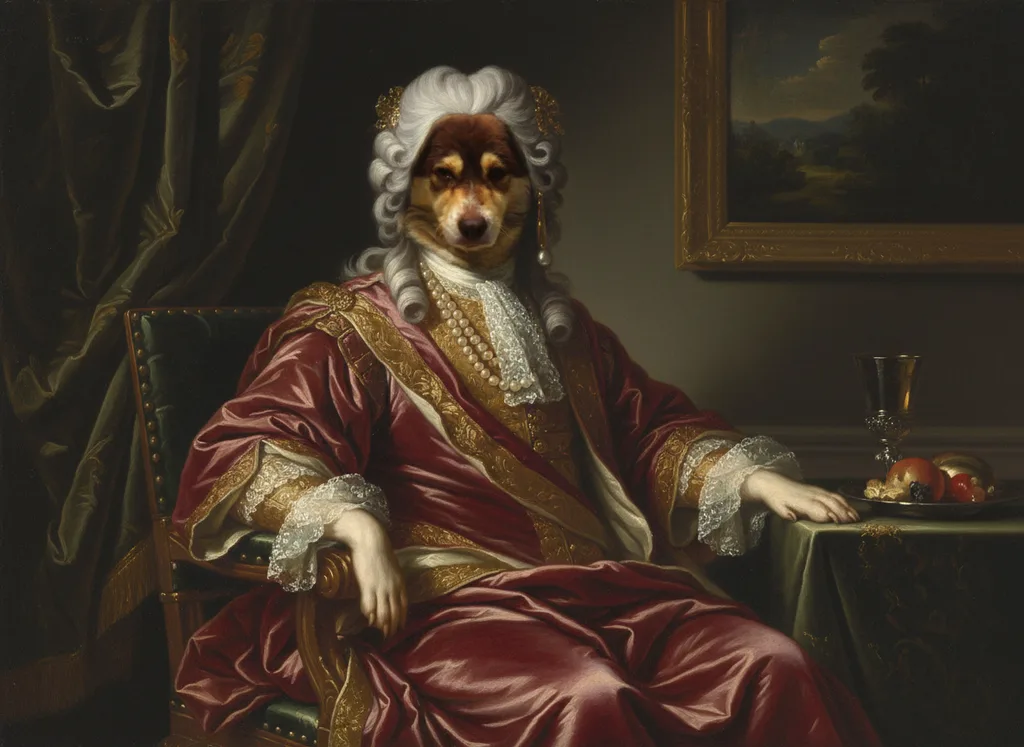
In the Dutch Republic of the 1600s, painters put dogs into portraits of rich families, into scenes of daily life and into the most famous group portrait of the age, Rembrandt's The Night Watch. This page looks at eight paintings in the Rijksmuseum in Amsterdam, the national museum of the Netherlands, and at what its curators say about each dog. The museum's online catalogue, Dutch Paintings of the Seventeenth Century in the Rijksmuseum, gives unusual detail: how the dogs were painted, what they may mean, and in one case how a dog painting was faked. For dogs in art before and after this period, start with the dogs in art guide.
The dog in The Night Watch
Rembrandt painted The Night Watch in 1642 for a hall of Amsterdam's civic guard, the city's militia and police. It is his largest canvas, 379.5 by 453.5 cm. The Rijksmuseum says Rembrandt was the first to paint the figures in a group portrait actually doing something: the captain tells his lieutenant to start the company marching while the guardsmen get into line. The museum's description lists, among the crowd, a girl with a dead chicken at her waist and, on the right, a barking dog.
Recent research changed what is known about that dog. On 17 September 2025 the Rijksmuseum announced that Rembrandt based it on a drawing by Adriaen van de Venne (1590 to 1662), an artist, poet and publisher. The drawing, made in 1619, was a design for the title page of Self-stryt, a popular book by Jacob Cats first published in 1620. It shows the biblical story of Joseph and Potiphar's wife, with a dog in the scene. It has been in the Rijksmuseum's collection for more than a hundred years.
The museum says the likeness was first noticed when the drawing was shown in an exhibition, and follow-up research confirmed it. The curator Anne Lenders published the findings in The Rijksmuseum Bulletin. The museum lists the matching features:
- The two dogs turn their heads in the same way and look upward in the same direction, with their mouths open.
- A dark line marks the position of the right eye in both.
- In both, the top of the skull is divided into two sections, and the collars closely match.
- Both dogs are placed on a slant, with the upper body close to the ground.
There are differences too. Rembrandt's dog has a flatter nose, its ears hang lower, its mouth is more open and it has a tongue. It also stands on all four legs, while Van de Venne's dog lies on its front legs.
The research also found an earlier stage of Rembrandt's dog. Using macro X-ray fluorescence scanning, which maps the chemical elements in the paint layers, the team found an underpainted sketch in which the dog's right front leg was more bent and its chest closer to the ground. In that first version the dog looked even more like the drawing. The museum says Rembrandt used prints, drawings and other sources for the poses of several militiamen too, so borrowing a dog fits his working method.
Dogs in family portraits
The Rijksmuseum owns several portraits of wealthy Dutch families with their dogs. In these portraits the dog helps say who the family are.
Martinus Alewijn as a shepherd, 1644
Dirck van Santvoort painted Martinus Alewijn, the 10-year-old son of an Amsterdam merchant, in the guise of a shepherd. He sits under a tree with a staff, a cap with three plumes and a horn at his feet, a few sheep, and a dog on a lead. The Rijksmuseum explains that this kind of pastoral child's portrait was popular for several decades after the late 1630s.
The museum's catalogue discusses the dog directly. Some writers have suggested that the dog on its lead refers to the boy's discipline, a child learning to control himself. The catalogue disagrees: "The trouble is that it is a greyhound, a classic hunting dog, and in combination with the horn it seems more likely that it should be regarded as a pastoral attribute alluding to the hunt, a pastime associated with the outdoor life enjoyed by the social elite." A matching portrait shows his sister Clara.
The technical study adds a small detail. The dog's collar and lead, like the staff and the plumed cap, were painted over the finished background.
The Bas family, around 1634 to 1635
Santvoort also painted the family of Dirck Jacobsz Bas, a burgomaster (mayor) of Amsterdam, on a wide canvas, 134.5 by 248.5 cm. Bas sits in the centre with his second wife, Margriet Snoeck, surrounded by his grown children. On the left stands his daughter Machteld with her husband, Abraham de Visscher, and their small son with a dog.
The museum's technical report shows how the dog was added. Santvoort left space for parts of the dog when he painted the room, but its tail and legs are painted over the floor and the child's dress, which were already finished.
The Hoeufft family, 1664 to 1670
Caspar Netscher painted Diederick Hoeufft, his wife Maria Witt and three of their children. The museum's description says that Diederick, a name shared by the father and the eldest son, is shown as a hunter with a dog and a dead hare in his hand, while Maria and Jacob hold flowers. A hunting dog appears here, as in the Alewijn portrait.
A couple on the beach, around 1655
An unknown painter from the northern Netherlands portrayed a married couple of the Beresteyn family standing on a beach with their daughter. The museum's description says shells lie along the waterline, the girl carries a small basket on her arm, and a dog stands in front of her. The canvas is 124 by 137 cm.
Dogs in everyday life
Dutch painters also sold small pictures of daily life, called genre paintings. Dogs appear in these too.
A Man Dancing with a Dog, around 1655 to 1665
Hendrick Bogaert painted a bearded man dancing with a dog on a small oak panel, 26.5 by 22.3 cm. The Rijksmuseum lists its subject as the training of a performing dog. The technical report says he painted the brown background first and then added the man and dog sketchily, wet paint into wet paint, with small strokes of thick white paint for the hair of the dog's coat. Tree-ring dating of the panel shows it was probably ready for use in or after 1654. The painting was once credited to another artist, François Verwilt, but the museum now rejects that attribution.
A forged boy with his dog
The Rijksmuseum owns a small panel called Boy Fleaing a Dog. A boy sits on a stool with a small dog on his lap, picking out its fleas. A book and pen lie on a table, and his hat lies on a bench.
It was bought in 1840 as a real work by Gerard ter Borch, who was born in Zwolle in 1617 and died in Deventer in 1681. In 1870 the art writer C. von Lützow showed that it was a copy of Ter Borch's original of around 1655, which is in the Alte Pinakothek in Munich. The museum's catalogue calls it a forgery, made on purpose to look older than it is. Its maker painted a network of thin brown lines and dots on the surface to imitate the cracks of old paint. Tree-ring dating shows the panel was ready for use in 1718 at the earliest. The catalogue also points out differences: the Munich original is on canvas, its boy is stockier, and Ter Borch's brushwork is looser.
A dog, a cat and the hunt
Jan Baptist Weenix painted a large hunting still life, 180 by 162 cm, between 1645 and 1660. A roebuck, a small deer from a successful hunt, hangs by one leg and has been cut open, with the knife still on the table. The Rijksmuseum says "the scene is enlivened by the dog, who springs forward in the direction of the hissing cat." The painting entered the museum in 1800, among its earliest purchases.
The eight dogs at a glance
| Painting | Painter | Date | The dog |
|---|---|---|---|
| The Bas family | Dirck van Santvoort | around 1634 to 1635 | With the family's small grandson |
| The Night Watch | Rembrandt | 1642 | Barks among the militiamen |
| Martinus Alewijn | Dirck van Santvoort | 1644 | A greyhound on a lead |
| Dog and cat with a deer | Jan Baptist Weenix | 1645 to 1660 | Springs at a hissing cat |
| The Beresteyn family | Unknown | around 1655 | Stands in front of the girl on a beach |
| A Man Dancing with a Dog | Hendrick Bogaert | around 1655 to 1665 | A performing dog in training |
| The Hoeufft family | Caspar Netscher | 1664 to 1670 | A hunting dog beside the father |
| Boy Fleaing a Dog | copy after Ter Borch | in or after 1718 | A small dog on a boy's lap |
What Dutch painters suggest for your own dog's portrait
The Dutch portraits show a family's dog as one of the family. In the Bas portrait the dog was painted over the finished floor and the child's dress. In the Alewijn portrait the dog is chosen with care: a greyhound, to say something about the family's way of life.
A portrait of your own dog can carry the same meaning. The dog is the sitter, the one being painted, and the costume and setting say something about its character. The cover of this page shows an Australian Shepherd from the studio examples, painted in Purrealism's Baroque Aristocrat style. For the French court painters who made portraits of royal hunting dogs in the decades after these works, read about Oudry and Desportes. For the meanings that dogs carried in paintings, such as loyalty and grief, see what dogs mean in paintings. To see finished portraits, visit the gallery.
Questions and answers
Is there a dog in Rembrandt's The Night Watch?
Rembrandt's The Night Watch, painted in 1642, has a barking dog on the right, among the militiamen. The Rijksmuseum in Amsterdam, which shows the painting, announced in September 2025 that Rembrandt based this dog on a drawing by Adriaen van de Venne. The dogs share the same turn of the head, the same upward look, a similar collar and a dark line marking the right eye.
Where did Rembrandt get the idea for the dog in The Night Watch?
Rembrandt based the dog in The Night Watch on a drawing made in 1619 by Adriaen van de Venne, according to research published by the Rijksmuseum curator Anne Lenders. The drawing was a design for the title page of Self-stryt, a popular book by Jacob Cats first published in 1620. It has been in the Rijksmuseum's collection for more than a hundred years.
How did Rembrandt first paint the dog in The Night Watch?
Rembrandt first painted the dog in The Night Watch with its right front leg more bent and its chest closer to the ground. The Rijksmuseum found this early version with macro X-ray fluorescence scanning, a method that maps the chemical elements in paint layers. In that first sketch the dog looked even more like the dog in Adriaen van de Venne's drawing of 1619.
Why is there a greyhound in the portrait of Martinus Alewijn?
The greyhound in Dirck van Santvoort's portrait of Martinus Alewijn, painted in 1644, points to hunting and wealth. The Rijksmuseum says some writers saw the dog on a lead as a sign that the 10-year-old boy was learning self-control. The museum finds that unlikely, because a greyhound is a classic hunting dog, and together with the horn it points to the outdoor life of the rich.
What is a pastoral portrait in Dutch painting?
A pastoral portrait in Dutch painting shows a real person, often a child, dressed as a shepherd or shepherdess in the countryside. The Rijksmuseum says the pastoral child's portrait was popular for several decades after the late 1630s. Its example is Dirck van Santvoort's portrait of Martinus Alewijn from 1644, with a staff, a plumed cap, sheep and a greyhound on a lead.
Who is holding the dog in Santvoort's portrait of the Bas family?
The dog in Dirck van Santvoort's portrait of the family of Dirck Jacobsz Bas, painted around 1634 to 1635, is with the young son of Machteld Bas and her husband, Abraham de Visscher. The Rijksmuseum says the painter left space for parts of the dog, but painted its tail and legs over the finished floor and the child's dress. The canvas is 248.5 cm wide.
Is the Rijksmuseum's Boy Fleaing a Dog by Gerard ter Borch?
The Rijksmuseum's Boy Fleaing a Dog is an 18th-century copy of a painting by Gerard ter Borch. The museum says the original, painted around 1655, is in the Alte Pinakothek in Munich. The Amsterdam panel was sold as a real Ter Borch in 1840, and its maker painted fake cracks on the surface to make it look older.
What does Hendrick Bogaert's A Man Dancing with a Dog show?
Hendrick Bogaert's A Man Dancing with a Dog, painted around 1655 to 1665, shows a bearded man dancing with a dog. The Rijksmuseum lists its subject as the training of a performing dog. It is a small oil painting on an oak panel, 26.5 by 22.3 cm. The museum says Bogaert painted the man and dog sketchily, with small strokes of white paint for the dog's hair.
Why is there a dog and a cat in Weenix's hunting still life?
Jan Baptist Weenix added a dog and a cat to his still life of a deer after the hunt to bring the scene to life. The Rijksmuseum describes a roebuck hung up by one leg and cut open, with the knife on the table. A barking dog springs toward a hissing cat. The painting was among the museum's earliest purchases, in 1800.
What does the Beresteyn family portrait at the Rijksmuseum show?
The Beresteyn family portrait at the Rijksmuseum shows a married couple and their daughter standing on a beach, painted around 1655 by an unknown artist from the northern Netherlands. The museum's description says shells lie along the waterline, the girl has a small basket on her arm, and a dog stands in front of her. The canvas measures 124 by 137 cm.
Sources
- Original drawing of the dog in The Night Watch discovered, Rijksmuseum. Accessed September 29, 2026.
- The Night Watch, Rembrandt van Rijn, Rijksmuseum. Accessed September 29, 2026.
- Portrait of Martinus Alewijn, Dirck van Santvoort, Rijksmuseum. Accessed September 29, 2026.
- Portrait of the Family of Dirck Jacobsz Bas, Dirck van Santvoort, Rijksmuseum. Accessed September 29, 2026.
- Portrait of Diederick Hoeufft and his wife Maria Witt with their children, Caspar Netscher, Rijksmuseum. Accessed September 29, 2026.
- Portrait of a Married Couple with Child, Members of the Beresteyn Family, Rijksmuseum. Accessed September 29, 2026.
- A Man Dancing with a Dog, Hendrick Bogaert, Rijksmuseum. Accessed September 29, 2026.
- Boy Fleaing a Dog, copy after Gerard ter Borch, Rijksmuseum. Accessed September 29, 2026.
- A Dog and a Cat near a partially disembowelled Deer, Jan Baptist Weenix, Rijksmuseum. Accessed September 29, 2026.
Short reads on this topic
Articles from Purrspectives that answer one question each.
Dog years to human years: the chart by size, and the DNA formula
A 1-year-old dog is closer to 15 or 30 in human years than to 7. The AKC chart by size, the 2020 DNA formula, and a dog's life stages, explained simply.
Pug history: from Chinese emperors to the House of Orange
Pugs began as companions of Chinese emperors, reached Holland on Dutch trading ships and became the dog of the House of Orange. Their history, art and health.
Persian cat history: where the breed came from, its first cat show, coat and care
Persian cat history from a cat brought to Italy in 1626 to the 1871 Crystal Palace show, plus face types, coat colours, grooming and how to photograph one.