Updated
Goya's dogs: royal hunts, tapestry designs and the dog in the Black Paintings
Goya painted dogs from 1775 to the 1820s: hunting dogs for royal tapestries, a king's dog with a named collar, a duchess's poodle and the Half-Submerged Dog.
By Purrealism. Part of Dogs in art: the painters and paintings behind a royal dog portrait.
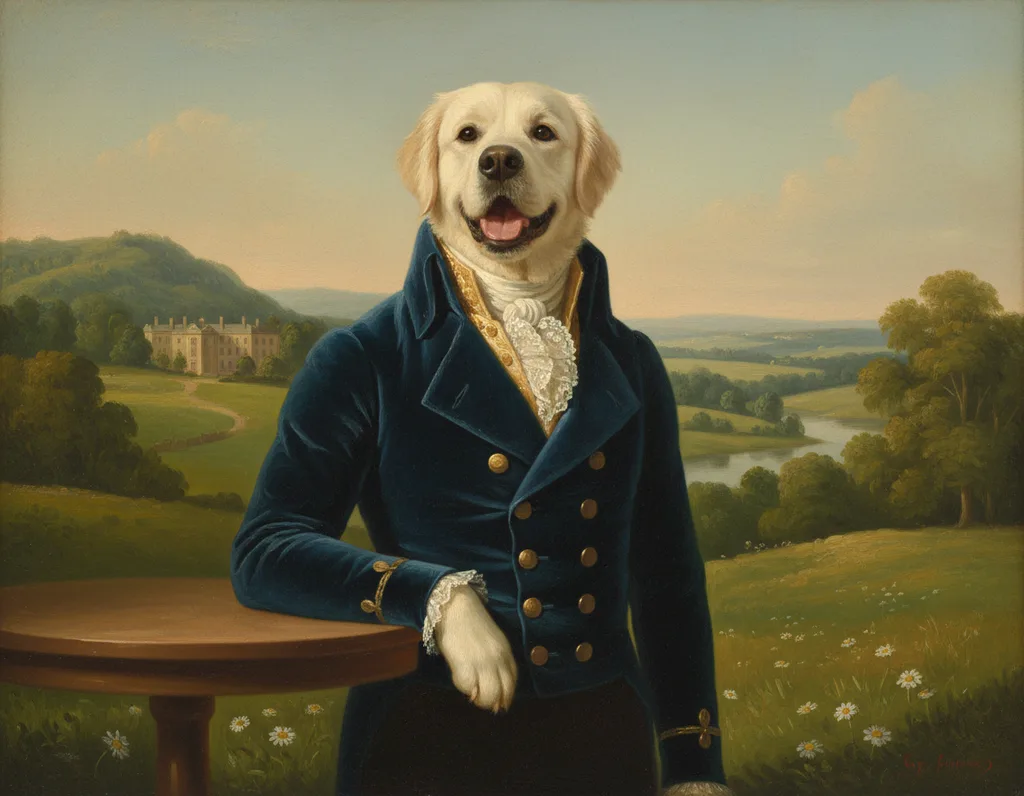
Francisco de Goya (1746 to 1828) painted and drew dogs from his first royal commission to the last years of his life. This page follows his dogs in order: the hunting dogs he designed for royal tapestries, the dogs beside kings and noblewomen in his portraits, the dog alone in one of his Black Paintings, and the strange dogs of his late drawings. It draws on the online catalogue of the Fundación Goya en Aragón, a foundation that publishes an online catalogue of his works, and on the Cleveland Museum of Art. For dogs in art before and after Goya, start with the dogs in art guide.
Dogs for the royal tapestry factory
In the 1770s and 1780s Goya designed tapestries for the Spanish court. The Royal Tapestry Factory of Santa Bárbara wove wall hangings for royal palaces such as El Pardo. A painter supplied a cartoon, a full-size painting that the weavers copied thread by thread. Several of Goya's cartoons have dogs in them.
Dogs on the Leash, 1775
This cartoon shows two chained mastiffs in a landscape, next to two shotguns and other hunting gear. The Fundación Goya en Aragón says it measures 112 by 174 cm and was designed to hang above a door or a window. It was paired with another cartoon, Hunting with a Decoy.
The foundation is frank about its quality: most experts agree that it is one of Goya's most impersonal works. Its history is eventful. In 1869 it disappeared from the Royal Palace in Madrid with six other cartoons. Raimundo de Madrazo found it in Paris, bought it and gave it to the Prado Museum in 1895.
Hunter and his Dogs, 1775
This tall, narrow cartoon, 268 by 67.5 cm, shows a hunter from behind, a shotgun over his shoulder, holding the leash of two dogs. The foundation explains a curious detail. The finished tapestry also shows a second hunter on horseback. In the painted cartoon the rider was covered over with bushes, and today only an observant viewer can find him. The foundation says nobody knows who covered him or when, though one scholar thinks Goya himself removed the rider to balance the composition.
A preparatory drawing survives for the hunter with the dogs. The foundation says this suggests Goya made studies from life and used them in his cartoons, which explains the natural look of the figure.
The Dog, 1780: a lost cartoon
Not every cartoon survives. The foundation says Goya delivered one called The Dog to the factory on 24 January 1780, and that it disappeared before an inventory taken in 1834. Its design is known from the tapestry woven from it. Goya's own invoice describes four men: two in the front playing with a dog and putting a ball in its mouth, and two talking behind. The foundation reports that the scholar Tomlinson read the ball and the dog as sexual symbols, and adds that the dog was traditionally associated with lust and sensuality.
Boys with Hunting Dogs, 1788
In this cartoon, two fashionably dressed boys stand beside two large dogs on leads. The dogs wear muzzles and have stopped so the boys can stroke them. The foundation says the muzzles show they are hunting dogs. Earlier inventories had seen only one dog and called it a mastiff. Goya painted the group from a low viewpoint because the tapestry was meant to hang above a door, so the figures look monumental from the floor. The cartoon is 112 by 145 cm and belongs to the Prado.
Dogs in Goya's portraits
In the 1780s Goya became a sought-after portrait painter. Dogs appear beside several of his sitters, the people he painted, and each has a reason to be there.
Charles III Hunting, around 1786 to 1788
King Charles III of Spain stands in hunting clothes, holding a shotgun in his left hand and suede gloves in his right. A dog lies at his feet. The Fundación Goya en Aragón records two inscriptions: "Goya lo hizo" ("By Goya") at the lower right, and "REY N. Señor" ("KING our Lord") on the dog's collar. The foundation calls the king a great lover of the hunt and says the portrait shows the influence of the hunting portraits of Velázquez. This version, 210 by 127 cm, is in a private collection, and the foundation lists it as attributed to Goya. A replica is in the Prado.
The Marchioness of Pontejos, around 1786
This full-length portrait, 210.3 by 127 cm, shows a young noblewoman in a grey dress with lace, pink ribbons and flowers, holding a rose. The foundation says Goya probably painted it in 1786, the year she married Francisco Antonio Moñino, Spain's ambassador to Portugal. A dog stands by her side. The foundation calls it "a symbol of faithfulness", painted with light brushstrokes but realist in style. It links the landscape background to French and British portrait styles of the time. The portrait is now in the National Gallery of Art in Washington.
The Duchess of Alba, 1795
Goya painted Cayetana, the 13th Duchess of Alba, several times. In this portrait she wears a long white dress with a red sash and red ribbons, and points down at an inscription on the ground dedicating the picture to her. The foundation adds a detail about the dog: "By her side we can see a white poodle, which was painted in at a later date. Its back leg is decorated with a red bow matching those worn by the Duchess." The portrait, 194 by 130 cm, belongs to the Fundación Casa de Alba in Madrid.
The Half-Submerged Dog, around 1820 to 1823
Late in life Goya painted a group of dark pictures straight onto plaster walls, now known as the Black Paintings. One of them shows only the head of a dog, above a large, empty area of colour. Our guide to famous paintings of dogs describes the painting and how the Prado reads it. The foundation's catalogue adds three facts.
- Where it hung. It was on the wall to the right of the door into the room.
- How it was moved. It was painted in oil on plaster and later transferred to canvas. It measures 131 by 79 cm and belongs to the Prado.
- What the dog is looking at. The dog looks up at something outside the picture. The foundation says the scholar Arnaiz found a photographic negative taken by the photographer Laurent before the transfer. It shows that the dog was looking at two birds flying in the sky. The birds were lost when the painting was taken off the wall.
The foundation still calls the work enigmatic, and says Goya painted the dog "with just a few brushstrokes".
Dogs in Goya's last drawings
In his final years Goya kept drawing dogs, in small albums and on tiny supports.
- Man Delousing a Little Dog, 1824 to 1825. A man in a white shirt with rolled sleeves picks fleas from a small dog, probably a poodle. Goya painted it in watercolour on ivory, 8.9 by 8.5 cm, and left the bare ivory showing for the dog's white fur. It belongs to the Kupferstich-Kabinett in Dresden.
- The Lady with the Little Dogs, around 1824 to 1828. A young woman kneels on the floor and turns to stroke her small lapdogs. The foundation reports the scholar Gassier's view that she is seeking comfort for some sorrow in the company of her pets. The drawing is in the State Hermitage Museum in Saint Petersburg.
- The Flying Dog, around 1824 to 1828. A winged creature dives toward the ground, showing its teeth. Its head, body and tail are a mastiff's, but it has the webbed feet of a water bird and large feathered wings. It wears a spiked collar, the kind sheepdogs wore to protect their necks from wolves. The foundation says no convincing meaning has been found. One scholar read it as a bad shepherd attacking his own flock, a criticism of bad priests. Another, Jonathan Brown, rejected that, reminding readers that the dog has traditionally been a symbol of fidelity.
Goya also made prints with dogs. The Cleveland Museum of Art holds two plates from his bullfighting series of 1816, They Loose Dogs on the Bull and The Dog Let Loose on the Bull.
Goya's dogs at a glance
| Work | Date | The dog | Where it is |
|---|---|---|---|
| Dogs on the Leash | 1775 | Two chained mastiffs beside guns | Prado, Madrid |
| Hunter and his Dogs | 1775 | Two dogs on a leash | Prado, Madrid |
| The Dog (lost cartoon) | 1780 | A dog with a ball in its mouth | Known from the tapestry |
| Charles III Hunting | around 1786 to 1788 | A dog with "REY N. Señor" on its collar | Private collection |
| The Marchioness of Pontejos | around 1786 | A dog as a sign of faithfulness | National Gallery of Art, Washington |
| Boys with Hunting Dogs | 1788 | Two muzzled hunting dogs | Prado, Madrid |
| The Duchess of Alba | 1795 | A white poodle with a red bow, added later | Fundación Casa de Alba, Madrid |
| Half-Submerged Dog | around 1820 to 1823 | A dog looking up at birds now lost | Prado, Madrid |
| Man Delousing a Little Dog | 1824 to 1825 | A poodle having its fleas picked | Kupferstich-Kabinett, Dresden |
| The Flying Dog | around 1824 to 1828 | A winged mastiff | Prado, Madrid |
What Goya's dogs suggest for your own dog's portrait
Two of Goya's portrait dogs carry clear signs of who they belong to. A king's hound wears a collar naming its master. A duchess's poodle wears a bow in her own colours, painted in after the rest. You can think the same way about a portrait of your own dog: which colours suit its coat, and what would it wear if it had a place at court? The cover of this page shows a Golden Retriever from the studio examples in Purrealism's Regency Era style, which draws on the fashions of Goya's time.
For the painters of French royal hunting dogs a generation earlier, read about Oudry and Desportes. For the long tradition of the dog as a sign of fidelity that Jonathan Brown mentions, see what dogs mean in paintings. When you are ready, you can choose a style and start in the portrait studio.
Questions and answers
What is the dog looking at in Goya's Half-Submerged Dog?
The dog in Goya's Half-Submerged Dog was looking up at two birds in the sky. The Fundación Goya en Aragón says the birds disappeared when the wall painting was transferred to canvas. The Goya scholar Arnaiz confirmed them from a photographic negative made by the photographer Laurent before the transfer. Goya painted the work in oil on a plaster wall between around 1820 and 1823.
What is written on the dog's collar in Goya's Charles III Hunting?
The dog's collar in Goya's Charles III Hunting reads REY N. Señor, meaning King our Lord. The Fundación Goya en Aragón records this inscription and the words Goya lo hizo, By Goya, at the lower right. The portrait dates from around 1786 to 1788 and shows the king in hunting clothes with a shotgun, and the dog lying at his feet.
What are Goya's tapestry cartoons with dogs?
Goya's tapestry cartoons with dogs are full-size paintings he made as models for weavers at the Royal Tapestry Factory of Santa Bárbara in Madrid. The Fundación Goya en Aragón lists Dogs on the Leash and Hunter and his Dogs, both of 1775, and Boys with Hunting Dogs, of 1788. All three are in the Prado in Madrid.
Why does the Marchioness of Pontejos have a dog in Goya's portrait?
The dog in Goya's portrait of the Marchioness of Pontejos is a symbol of faithfulness, according to the Fundación Goya en Aragón. Goya probably painted it around 1786, when she married Francisco Antonio Moñino, Spain's ambassador to Portugal. The foundation says the dog is painted with light brushstrokes but looks real. The portrait is in the National Gallery of Art in Washington.
When was the dog added to Goya's portrait of the Duchess of Alba?
The white poodle in Goya's portrait of the Duchess of Alba, painted in 1795, was added at a later date, according to the Fundación Goya en Aragón. The dog has a red bow on its back leg that matches the red sash and ribbons on the duchess's white dress. The portrait belongs to the Fundación Casa de Alba in Madrid.
What is Goya's Flying Dog?
Goya's Flying Dog is a late drawing, made around 1824 to 1828, of a winged creature with the head, body and tail of a mastiff. The Fundación Goya en Aragón says it also has the webbed feet of a water bird and large feathered wings. It wears a spiked collar of the kind sheepdogs wore against wolves. The drawing is in the Prado.
Why did Goya paint Boys with Hunting Dogs from a low angle?
Goya painted Boys with Hunting Dogs, of 1788, from a low viewpoint because the tapestry woven from it was meant to hang above a door. The Fundación Goya en Aragón says this makes the two boys and two muzzled dogs look monumental. The dogs have stopped so the boys can stroke them, and the muzzles mark them as hunting dogs.
Did Goya paint a dog on ivory?
Goya painted a man removing fleas from a small dog, probably a poodle, in watercolour on a piece of ivory measuring 8.9 by 8.5 cm. The Fundación Goya en Aragón dates it to 1824 or 1825. Goya left the bare ivory showing for the dog's white fur. The miniature belongs to the Kupferstich-Kabinett, a museum of prints and drawings in Dresden, Germany.
What happened to Goya's tapestry cartoon The Dog?
Goya's tapestry cartoon The Dog is lost. The Fundación Goya en Aragón says Goya delivered it to the Royal Tapestry Factory on 24 January 1780, and it disappeared before an inventory of 1834. Its design survives in the tapestry woven from it. Goya's invoice describes four men, two of them playing with a dog and putting a ball in its mouth.
Did Goya make prints with dogs?
Goya made prints with dogs, including two scenes from his bullfighting series published in 1816. The Cleveland Museum of Art holds impressions of They Loose Dogs on the Bull and The Dog Let Loose on the Bull, both engravings from Goya's plates, printed in 1876. Cleveland gives Goya's dates as 1746 to 1828.
Sources
- Dogs on the Leash (Perros en traílla), Fundación Goya en Aragón. Accessed September 29, 2026.
- Hunter and his Dogs (Cazador con sus perros), Fundación Goya en Aragón. Accessed September 29, 2026.
- The Dog (El perro), Fundación Goya en Aragón. Accessed September 29, 2026.
- Boys with Hunting Dogs (Niños con perros de presa), Fundación Goya en Aragón. Accessed September 29, 2026.
- Charles III Hunting (Carlos III cazador), Fundación Goya en Aragón. Accessed September 29, 2026.
- Mariana de Pontejos y Sandoval, Marchioness of Pontejos, Fundación Goya en Aragón. Accessed September 29, 2026.
- María del Pilar Teresa Cayetana de Silva, XIII Duchess of Alba, Fundación Goya en Aragón. Accessed September 29, 2026.
- Half-Submerged Dog (Perro semihundido), Fundación Goya en Aragón. Accessed September 29, 2026.
- Man Delousing a Little Dog (Hombre espulgando a un pequeño perro), Fundación Goya en Aragón. Accessed September 29, 2026.
- El perro volante (G.5), Fundación Goya en Aragón. Accessed September 29, 2026.
- La dama de los perritos (H.23), Fundación Goya en Aragón. Accessed September 29, 2026.
- Bullfights: They Loose Dogs on the Bull, Francisco de Goya, Cleveland Museum of Art. Accessed September 29, 2026.
- Bullfights: The Dog Let Loose on the Bull, Francisco de Goya, Cleveland Museum of Art. Accessed September 29, 2026.
Short reads on this topic
Articles from Purrspectives that answer one question each.
Dog years to human years: the chart by size, and the DNA formula
A 1-year-old dog is closer to 15 or 30 in human years than to 7. The AKC chart by size, the 2020 DNA formula, and a dog's life stages, explained simply.
Pug history: from Chinese emperors to the House of Orange
Pugs began as companions of Chinese emperors, reached Holland on Dutch trading ships and became the dog of the House of Orange. Their history, art and health.
Persian cat history: where the breed came from, its first cat show, coat and care
Persian cat history from a cat brought to Italy in 1626 to the 1871 Crystal Palace show, plus face types, coat colours, grooming and how to photograph one.