Cat wall art ideas: choosing a cat portrait for every room
Cat wall art for each room: the print size for a hall, living room, bedroom or small flat, the cat portrait that suits its colours, and where to keep it safe.
By Purrealism
To choose cat wall art, start with the room. A hall, a living room, a bedroom and a small flat each need a different print size and a different kind of picture, whether you want a large cat painting above the sofa or a small print for a desk. This guide goes room by room, then shows how to match one of the three cat portraits in the Purrealism gallery to a room's colours, and where to hang a print so that sunlight, damp and claws do not harm it.
Purrealism art prints come in four sizes: 8 × 10, 12 × 16, 18 × 24 and 24 × 36 inches, on matte or glossy paper. The guide to how big an 8 × 10 print is gives every size in centimetres, with the pixels and frames each one needs. Here the question is simpler: which size belongs in which room. For how to hang a print once you have picked the spot, see the guide to dog wall art ideas, which covers the hanging itself.
The hall: a portrait people pass every day
A hall is the first room a guest sees, and a place you walk through every day. People see the wall from close up, at arm's length, and they are usually moving. So a hall suits one clear face that a person walking past sees at once.
A 12 × 16 inch print suits a narrow hall wall. A pair of 8 × 10 inch prints, hung side by side, suits a hall with two cats, or one cat in two styles. The largest sizes need space to step back, which a narrow hall does not give.
Pick the wall with care. The Canadian Conservation Institute advises against hanging art near air vents, radiators or the outside walls of a building, because these places change temperature and humidity quickly. If your hall has a heater by the front door, choose an inside wall further along. A hall with no window has one advantage: no direct sun reaches the print.
The living room: the largest wall in the house
The living room usually has the wall people look at longest: the one they face from the sofa. This is the place for an 18 × 24 or a 24 × 36 inch print. The 24 × 36 inch print suits a wide, empty wall above a sofa. The 18 × 24 inch print suits a wall above a sideboard or a narrow chest.
A living room often has large windows, and that matters for a paper print. The Canadian Conservation Institute says visible light fades the colours on paper, and that the damage grows with the strength of the light. It calls faded colour irreversible. Choose a wall that the sun does not cross during the day. If the only good wall faces a window, choose matte paper, which shows less glare than glossy paper.
If you are still choosing a style, the guide to choosing a royal portrait style compares all 15 by coat colour and by character.
The bedroom: a calm portrait for a quiet room
A bedroom is where you rest, so the art in it can be quieter. One seated figure, with one clear face, suits the room better than a busy scene.
Above a bed or a dresser, an 18 × 24 inch print fills the space and leaves some wall clear around it. On a bedside table, an 8 × 10 inch print in a standing frame is the right size to see from the pillow.
Think about your cat here too. International Cat Care says cats often scratch after they wake up, and it suggests placing a scratching post near the cat's favourite bed. If your cat sleeps in your bedroom, that post belongs in the same room as the portrait. Hang the print well above the height the cat reaches when it stretches up to scratch.
A small flat: one clear wall and a shelf
In a small flat, a bookcase, a coat rack or a window may cover most of the walls. Here, one portrait on a clear wall is easier to see than several small ones spread around.
A 12 × 16 inch print suits the one clear wall in a studio flat. An 8 × 10 inch print can stand on a desk or lean against the wall on a shelf, and you can move it when the furniture moves.
In a small space, plan around your cat. International Cat Care says cats are natural climbers that rest and watch their home from high places, such as shelves, cupboards and wardrobes. In a small flat those high places are often the same shelves where you would lean a frame. Keep the frame on a shelf the cat does not use, or hang it on the wall instead.
If you have no free wall, the digital pack is a high-resolution file with no watermark. You can use it as a phone or computer wallpaper and print it later.
Match the portrait to the room's colours
A portrait fits a room best when it repeats one or two colours already there: a cushion, a rug, a wooden chest or the wall paint. Each of the three cat portraits in the gallery has its own main colours.
- The Maharani: a white and ginger cat in a green and gold gown. It suits a room with plants, green fabrics or light wood, such as a bedroom.
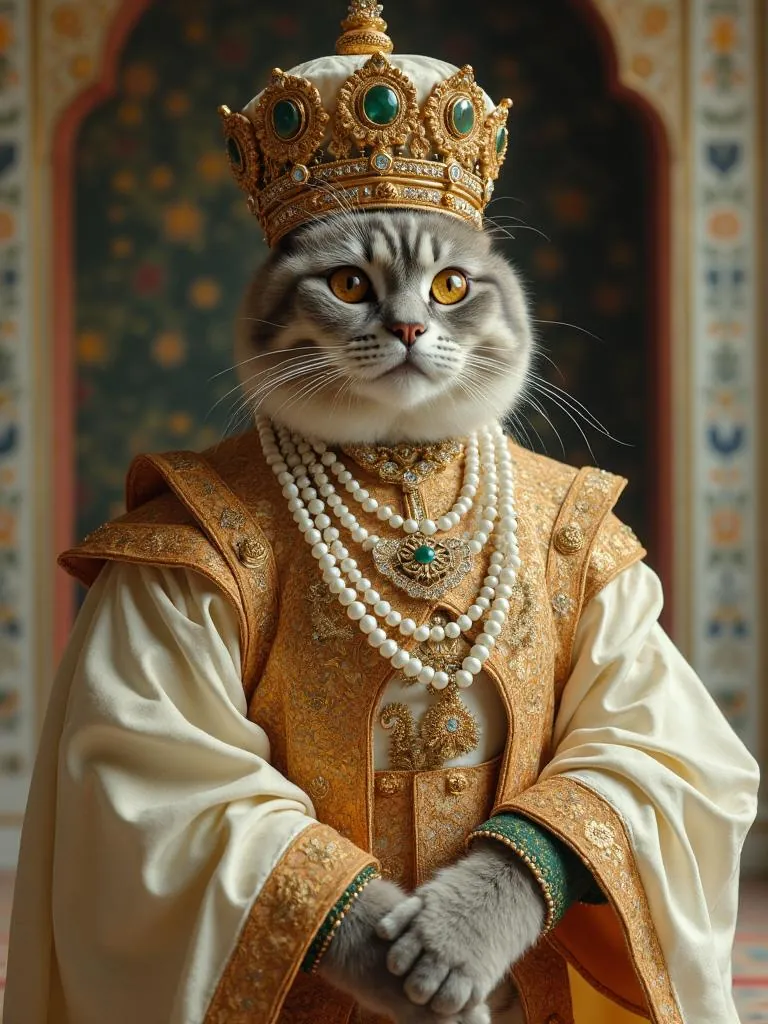
- The Mughal Emperor: a grey cat in a jewelled crown and pearls. The grey coat and the pearls suit a room with grey, white or cool blue walls, such as a modern living room.
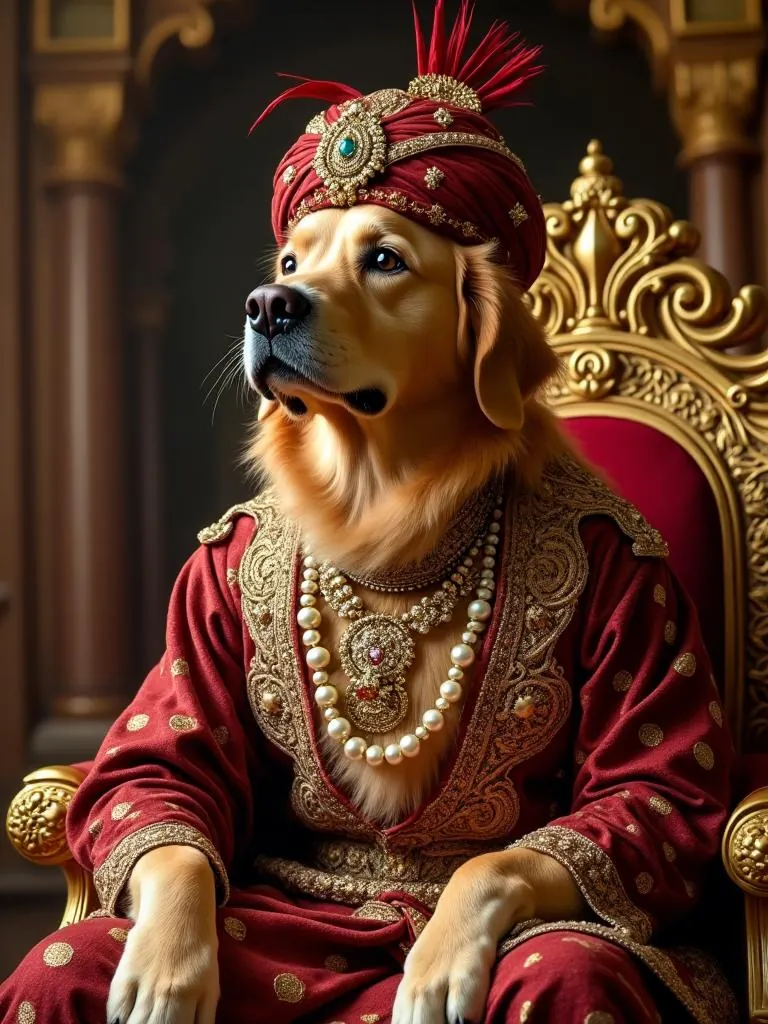
- The Regal Feline: a ginger cat in a red and gold royal robe. It suits a room with warm wood, brick or red fabrics, such as a hall with a wooden floor.
Your own cat's coat matters as much as the costume. Each style in the portrait studio can dress your cat, so you can choose the colours of the room and the colours of the clothes together.
For ideas from older art, the guide to famous paintings of cats lists ten works with cats and the museums that hold them. Renaissance cat paintings looks at cats in art from that period.
Keep the print away from sun, damp and claws
Where a print hangs decides how long it keeps its colour. In a home, watch for three things.
Sun. The Canadian Conservation Institute's guide to colour photographs says to prevent exposure to direct sunlight. Its guide to light damage says sunlight can warm a surface by 40°C or more above the air around it. Close the blinds on bright afternoons if the sun reaches the wall.
Damp. The Institute advises keeping the relative humidity around paper, which is how much water the air holds compared with the most it can hold, below 65 percent. It says mould can grow in two days at 90 percent, in 10 days at 80 percent and in 100 days at 70 percent. A bathroom fills with steam every time someone showers, so hang a paper print in a drier room. The Institute also warns that humidity can be higher against outside walls and near water pipes.
Claws. International Cat Care says cats scratch to keep their claws healthy, to stretch the muscles of the front legs and spine, and to mark their territory. Cats Protection says cats prefer to scratch objects that are sturdy or tall, and that a scratching post should be tall enough for a cat to scratch at full stretch. A frame with glass protects the print surface. A post of its own gives the cat a better choice than the wall.
Questions and answers
Do cats scratch paintings?
Cats can scratch a painting or a print that hangs within reach of their claws. According to International Cat Care, cats scratch to keep their claws healthy, to stretch the muscles of the front legs and spine, and to mark their territory. Cats Protection says cats prefer to scratch sturdy or tall objects. Hang cat wall art higher than your cat reaches at full stretch, keep it behind glass, and give the cat its own sturdy scratching post.
What kind of art should I put in my bedroom?
A bedroom suits calm art with one clear subject, such as a single seated figure. Above a bed or a dresser, an 18 × 24 inch print fills the space, and an 8 × 10 inch print fits a bedside table. In the Purrealism gallery, the Maharani portrait of a white and ginger cat in a green and gold gown suits a room with green bedding, plants or wood furniture.
Can you put art in the bathroom?
A bathroom is a poor place for a paper print, because steam from the shower makes the air damp. The Canadian Conservation Institute advises keeping the relative humidity around paper (how much water the air holds, compared with the most it can hold) below 65 percent. It says mould can grow in two days at 90 percent and in 10 days at 80 percent. Hang a paper print in a dry room instead.
Do prints fade in the sun?
Prints fade in the sun, and the Canadian Conservation Institute says that faded colour cannot be brought back. The Institute explains that visible light fades the colours on paper and that the damage grows with the strength of the light. Its guide to colour photographs says to prevent exposure to direct sunlight. Hang cat wall art on a wall the sun does not reach, or close the blinds on bright days.
How to decorate a hallway with pictures?
A hallway suits one or two pictures that people can see well from up close as they walk past. For a narrow hall, a 12 × 16 inch print or a pair of 8 × 10 inch prints fits the wall without crowding it. The Canadian Conservation Institute advises against hanging art near air vents, radiators or outside walls, so choose an inside wall of the hall, away from any heater.
How to decorate when you have cats?
Decorating when you have cats means planning for climbing and scratching. International Cat Care says cats are natural climbers that rest and watch their home from high places, such as shelves, cupboards and wardrobes. Keep framed art off the shelves and cupboard tops your cat uses. Hang it above the height your cat reaches when it stretches up to scratch, and give the cat a scratching post of its own.
Does wall art have to match?
Wall art fits a room best when it repeats one or two of the room's colours, such as the colour of a cushion, a rug or a wooden chest. In the Purrealism gallery, the grey cat painted as a Mughal emperor, in a jewelled crown and pearls, suits grey and white rooms. The ginger cat in a red and gold royal robe suits rooms with warm wood and red fabrics.
How to display small art prints?
Small art prints look best where people see them up close, such as on a desk, a bedside table or a shelf. An 8 × 10 inch print, the smallest of the four Purrealism art print sizes, can stand in a frame on a desk or lean against the wall on a shelf. If you have a cat, choose a shelf the cat does not walk along, so the frame stays in place.
Can wall art be too big?
Wall art can be too big when it crowds the wall or the furniture below it. A 24 × 36 inch print, the largest Purrealism art print size, suits a wide empty wall above a sofa or a bed, and it can crowd a narrow hall or a small bedroom. Before you choose, mark the outline of the print on the wall with removable tape and look at it from across the room.
Where should a cat portrait hang in a living room?
A cat portrait in a living room hangs best on the wall people face when they sit down, which is often the wall above the sofa. An 18 × 24 or 24 × 36 inch print fills that space. Choose a wall the sun does not reach, because the Canadian Conservation Institute says light fades colours on paper. If the wall faces a window, matte paper shows less glare than glossy paper.
Sources
- Caring for paper objects: Preventive conservation guidelines for collections, Canadian Conservation Institute, Government of Canada
- Agent of deterioration: light, ultraviolet and infrared, Canadian Conservation Institute, Government of Canada
- Care of Colour Photographic Materials, CCI Notes 16/5, Canadian Conservation Institute, Government of Canada
- Environmental Guidelines for Paintings, CCI Notes 10/4, Canadian Conservation Institute, Government of Canada
- Scratching on furniture and carpets, International Cat Care
- Making your home cat friendly, International Cat Care
- Cats and scratching, Cats Protection
Go deeper
The full guides on this topic, each a set of pages with sources: