Dog wall art ideas: how to choose and hang a portrait of your dog
Good dog wall art fits its wall: pick a print size for the furniture below, hang it with its centre at eye level, and keep it out of direct sun.
By Purrealism
A portrait of your own dog turns dog wall art into something personal. Before you choose one, look at the wall where it will hang. This guide helps you choose a print size for that wall, hang it at a comfortable height, and keep it safe from sun, heat and damp. It also covers how to match a portrait to the colours of a room, and how to hang several pet portraits as one group.
Which print size suits which wall
Purrealism art prints come in four sizes: 8 × 10, 12 × 16, 18 × 24 and 24 × 36 inches. The guide to how big an 8 × 10 print is gives every size in centimetres, with the pixels and mat sizes each one needs. This section is about the wall itself.
Start with what stands below the wall. A dog print above a sofa, a bed or a sideboard is seen together with that furniture, so its width should suit the width of that furniture. The two larger sizes, 18 × 24 and 24 × 36 inches, suit those walls. A print in a hallway, beside a door or on a shelf is seen alone and from close up, so 8 × 10 or 12 × 16 inches is often enough.
One simple test comes from Iowa State University Extension and Outreach. Trace the outline of the frame on paper, cut it out, and tape it to the wall with painter's tape, which the source says leaves no marks. Leave the template there for a day or two. You will see quickly whether a size crowds the sofa or looks too small for a large wall. Cut the template to the size of the frame, which is larger than the print when you add a mat.
How high to hang a dog portrait
Iowa State University Extension and Outreach suggests hanging a picture with its centre at eye level, which it gives as 60 inches from the floor. Here is where each print size sits when its centre is at 60 inches. The figures are for the print alone, so a mat and a frame add to every edge.
- 8 × 10 inches: from 55 to 65 inches above the floor.
- 12 × 16 inches: from 52 to 68 inches.
- 18 × 24 inches: from 48 to 72 inches.
- 24 × 36 inches: from 42 to 78 inches.
Furniture changes this. The same source suggests at least 3 to 6 inches between the top of a sofa and the bottom of the frame, and 4 to 8 inches above a table top. Measure the back of your sofa first. A 24 × 36 inch print centred at 60 inches has its lower edge at 42 inches. If the sofa back is taller than 39 inches, that leaves less than 3 inches, so raise the print or choose the 18 × 24 inch size, whose lower edge sits at 48 inches.
For the hanging itself, the Canadian Conservation Institute says in its advice on paintings that picture hooks are more reliable than nails and do less damage to walls. It also says that two hooks make it easier to hang a painting straight and keep it level. Iowa State adds that small, light frames can go on pins or adhesive strips, heavier ones may need a drywall anchor, and the heaviest should go where there is a wall stud. In plaster, drill a small hole first so the wall does not crack.
Keep your dog print out of the sun, the heat and the damp
The Canadian Conservation Institute is clear on sunlight. Its guidance on colour photographs says: "Above all, prevent exposure to direct sunlight." Its guidance on paper explains why. It lists average daylight at 30,000 lux (a measure of how bright light is), light from a window or a study lamp at 5,000 lux, and typical office lighting at 500 lux. Ultraviolet light, the part of sunlight you cannot see, makes paper turn yellow and weak.
Before you put in a hook, look at the wall in the morning, at midday and in the late afternoon. If the sun reaches it at any of those times, choose another wall.
Heat is the next problem. The Institute says heat speeds up the chemical changes that make paper yellow and brittle, and gives a general rule: the damage slows by half for every 5°C drop in temperature. In its advice on paintings, it says the space above a fireplace is not the best choice, because the wall there can become hot, dry and sooty. It also warns about spots near radiators and heating or cooling vents, where the air changes quickly. Its framing guide says not to fix a lamp to a picture frame, because the lamp creates a hot spot and adds to fading.
Damp is the third problem. High humidity lets mould grow on paper, and it makes paper cockle, which means the sheet turns wavy. A bathroom that fills with steam from a shower is a poor place for a paper print.
Match the portrait to the colours of the room
A dog portrait looks planned when it repeats one colour that is already in the room. Each finished dog portrait in the gallery has its own main colours:
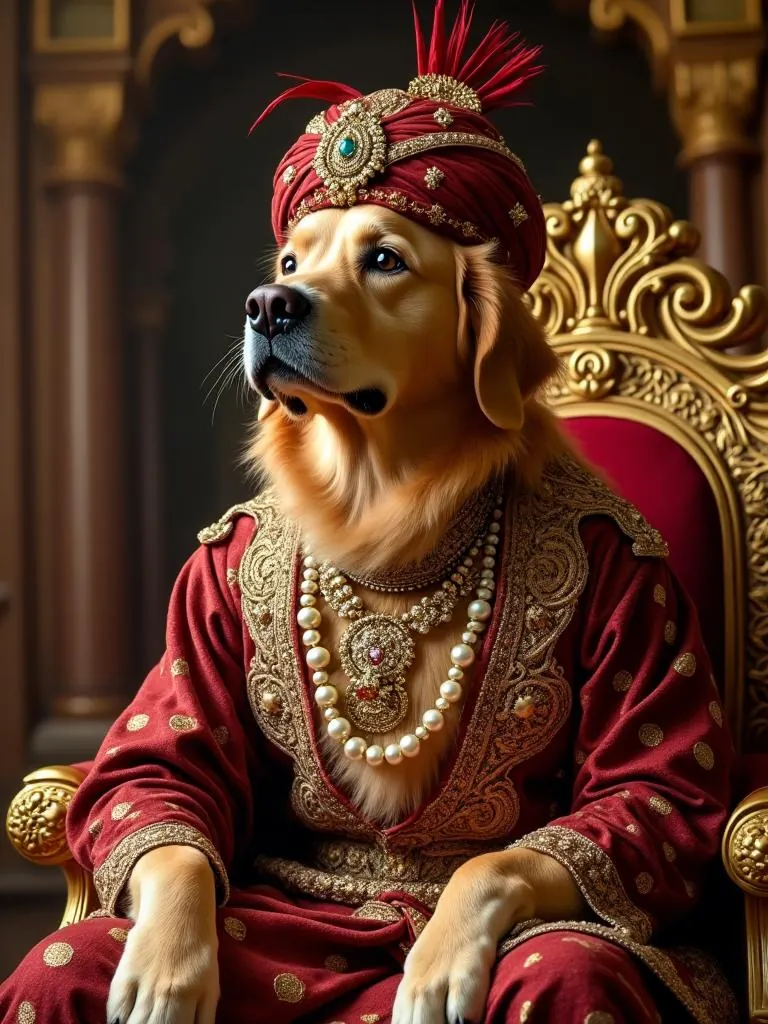
- Maharaja: a golden retriever in a red jewelled turban, on a gold throne. It suits a room with red, gold or warm wood.
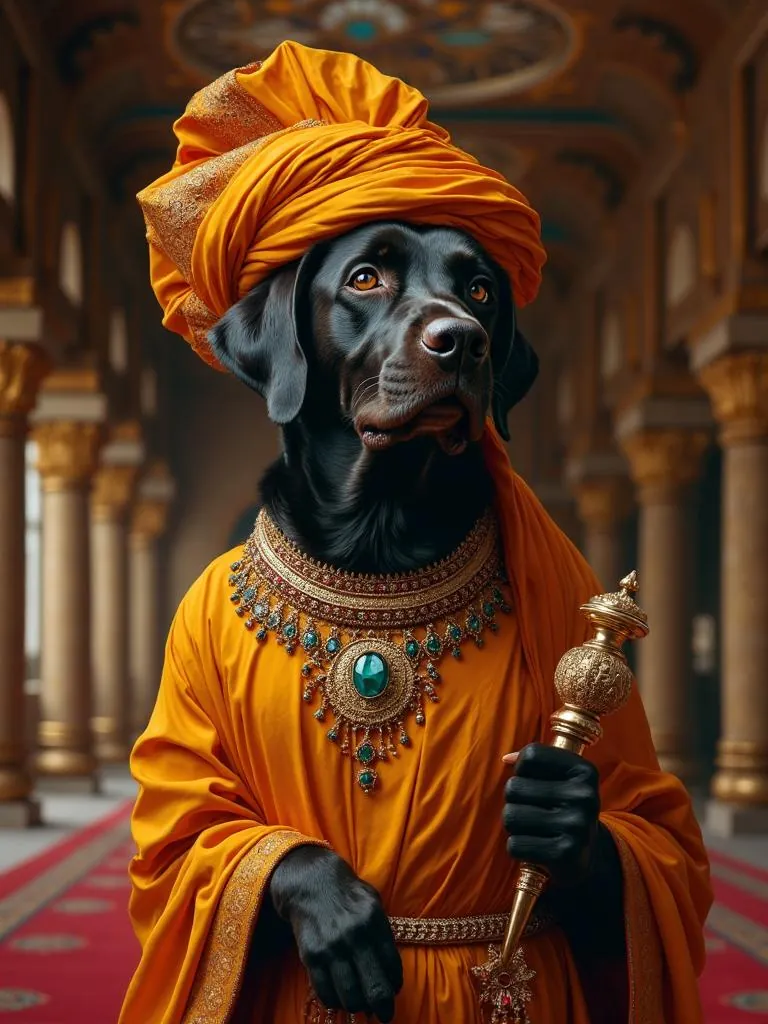
- Mysore Royal: a black labrador in a saffron turban, holding a gold sceptre. It suits a room with orange, rust or yellow.
- Patiala Royal: a Pomeranian in a blue coat and jewelled turban, on a red throne. It suits a room with blue cushions or a red rug.
- Rajput Warrior: a dog in armour, with a fort at sunset behind it. It suits a room with orange and gold, the colours of a sunset sky.
- The Noble Hound (Indian Royalty): a golden retriever in a royal crown and a red robe.
Your dog's coat matters too. The guide to choosing a royal portrait style explains how to pick clothes that stand out against a black, golden or white coat.
Purrealism also offers six European styles: Renaissance Royal, Victorian Noble, Military General, Medieval Knight, Baroque Aristocrat and Regency Era. The gallery has no finished example of them yet, so choose one in the portrait studio if a European period suits your home better.
Hang several pet portraits as one group
If you have more than one dog, or a dog and a cat, you may want a portrait of each. Iowa State University Extension and Outreach suggests treating a group of pictures as a single unit. Centre the whole group on the wall, or over the furniture below it, and put the middle of the group at eye level. Paper templates help here too, because you can move each one around until the group looks right.
Print shapes make a group easier to plan. The 12 × 16 and 18 × 24 inch prints share the same shape, 3:4. The 8 × 10 inch print is 4:5, and the 24 × 36 inch print is 2:3. Two dogs printed at the same size and hung at the same height line up at the top and bottom edges. One 18 × 24 inch print with a 12 × 16 inch print on each side gives a larger centre picture in the same shape as its neighbours.
Portraits that share a colour look like a set. The Maharaja golden retriever and the Maharani cat in the gallery both have gold in them, so they look like a pair side by side. For cat portraits, read cat wall art ideas.
Paper prints, frames and the canvas question
Some people search for a pet canvas. The Canadian Conservation Institute describes canvas as a fabric, such as linen or cotton, stretched over a frame of thin wooden bars. It says fabric takes up and loses moisture as the humidity in a room changes.
Purrealism prints on paper only, in a matte or a glossy finish, and you choose the frame. The Institute says a frame protects a paper print from handling and dust, and buffers small changes in temperature and humidity. A window mat, a sheet of card with an opening cut in it, keeps the print from touching the glass. The Institute warns that without a mat, moisture could make the print and the glass stick together.
The finish matters most on a bright wall. Florida State University's guide to light explains that a smooth surface reflects light at one definite angle, while a rough surface reflects it in all directions. A glossy print can show a bright reflection of a window or a lamp. A matte print spreads that light, so it suits a wall that faces a window.
Questions and answers
How many hooks to hang a picture?
Two picture hooks are the number the Canadian Conservation Institute suggests for a painting. In its advice on caring for paintings, it says two hooks make it easier to hang a painting straight and keep it level, and that each hook should suit the weight of the piece. The same advice works for a framed dog print: mark both hook positions with a level before you fix them to the wall.
How high should art hang?
Art should hang with its centre at eye level, which Iowa State University Extension and Outreach puts at 60 inches from the floor. Measure to the middle of the picture, then find the hook position from the distance between the hanging wire and the top of the frame. A 24 × 36 inch print centred at 60 inches runs from 42 to 78 inches above the floor, before any mat or frame is added.
What to hang pictures with?
Pictures hang best on picture hooks sized for their weight. The Canadian Conservation Institute says hooks are more reliable and do less damage to walls than nails, and that picture wire must be strong enough for the frame. It adds that hooks joined to screw eyes, small metal rings screwed into the back of the frame, are more secure. Iowa State University Extension and Outreach says small, light pieces can go on pins or adhesive strips.
Can you hang art above a fireplace?
Art can hang above a fireplace, but the Canadian Conservation Institute says that spot is not the best choice. In its advice on caring for paintings, the Institute explains that the wall at the chimney can become hot, dry and sooty when the fire is used. Its guidance on paper adds that heat speeds up the yellowing and weakening of paper, so a paper print of your dog lasts longer on a cooler wall.
Can you hang art above a radiator?
Art can hang above a radiator, but the Canadian Conservation Institute points to that spot as a problem. In its advice on paintings, it asks for a place where temperature and humidity stay steady, and it names spots in the airflow from radiators, heating vents and cooling vents as places where they change quickly. Its guidance on paper adds that heat speeds up yellowing, so hang a paper dog print away from the heat.
Should wall photos be glossy or matte?
Wall photos that face a window or a lamp suit matte paper, because a matte surface spreads reflected light and shows less glare. Florida State University's guide to light explains that a smooth surface reflects light at one definite angle, while a rough surface reflects light in all directions. Glossy paper suits a room with soft light. Purrealism art prints come on either matte or glossy paper, in all four sizes.
How high should gallery wall be?
A gallery wall should have the middle of the whole group at eye level, which Iowa State University Extension and Outreach gives as 60 inches from the floor. The same source suggests treating a group of pictures as a single unit, so measure the full height and width of the group, find its centre, and put that centre at 60 inches. Over a sofa, keep at least 3 to 6 inches between the sofa and the lowest frame.
What is pet canvas?
Pet canvas is a picture of a pet printed on canvas, a fabric that painters have used for centuries. The Canadian Conservation Institute says painters in northern Europe began to paint on fabric in the 15th century, and it describes canvas as fabric, such as linen or cotton, stretched over a frame of thin wooden bars. Purrealism prints only on paper, with a matte or glossy finish.
Do you hang pictures on studs?
You hang a heavy picture on a wall stud, one of the upright beams inside the wall, and a lighter picture can go straight into drywall. Iowa State University Extension and Outreach says a small nail or picture hanger in drywall can hold a piece that is not too heavy, and that larger or heavier pieces may need a drywall anchor. For a heavy piece, it suggests choosing a spot where there is a stud.
How to arrange gallery wall?
To arrange a gallery wall, treat the whole group of pictures as one unit and centre it on the wall or over the furniture below, as Iowa State University Extension and Outreach suggests. Cut a paper template for each frame and fix the templates to the wall with painter's tape, which the same source says leaves no marks. Move them until the group looks right, then mark the hook positions.
Sources
- Tips for Hanging Pictures Perfectly (AnswerLine), Iowa State University Extension and Outreach
- Basic care: paintings, Canadian Conservation Institute, Government of Canada
- Caring for paper objects, Canadian Conservation Institute, Government of Canada
- Caring for paintings, Canadian Conservation Institute, Government of Canada
- Care of Colour Photographic Materials, CCI Notes 16/5, Canadian Conservation Institute, Government of Canada
- Framing Works of Art on Paper, CCI Notes 11/9, Canadian Conservation Institute, Government of Canada
- Specular and Diffuse Reflection, Molecular Expressions, Florida State University
Go deeper
The full guides on this topic, each a set of pages with sources: