Writing a pet dedication: words for a memorial portrait
How to write a few lines for a pet's memorial portrait, card or plaque, using real inscriptions from Byron, Queen Victoria and old pet cemeteries as models.
By Purrealism. Part of Pet memorial portraits: remembering a dog or cat who has died.
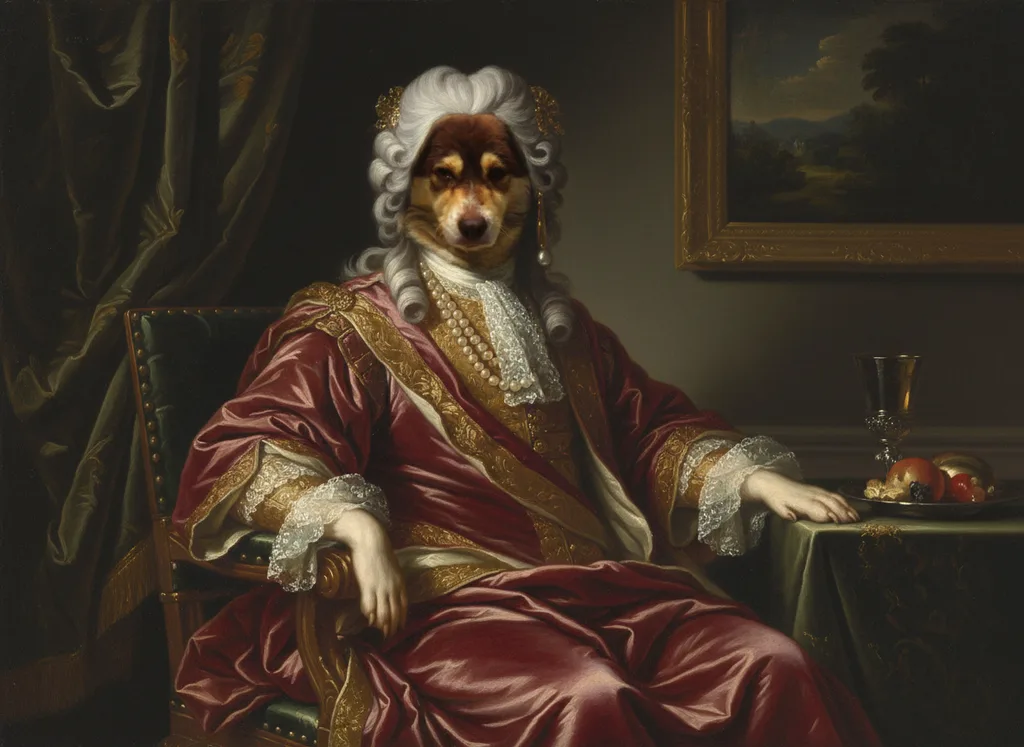
A dedication is the handful of words that goes with a memorial portrait: a name, a pair of years and a line that could only belong to one animal. This page explains where a dedication can go, what to put in it, and how to write it when grief makes words hard to find. It uses real inscriptions from the last 200 years as models, from Lord Byron's monument to his dog in 1808 to pet cemetery headstones in London and New York. For the other steps toward a memorial portrait, start with the main guide to pet memorial portraits.
Where a dedication goes
A dedication needs a place to live. With a framed art print, the usual places are a small card tucked into the back of the frame, a label on the backing board, or a small engraved plate fixed to the wall or the frame below the picture. Purrealism prints come in four sizes, from 8 × 10 to 24 × 36 inches, and the size you choose sets how much room there is around the portrait.
With a digital download, the portrait has no frame. The words can go in the message you send when you share the file with family, on the first page of a photo album, or on a printed card kept in a memory box with the collar and tags. A family spread across several cities can each keep the same image and the same line.
The place decides the length. A card inside a frame can hold a short paragraph. A plate below a picture holds one or two lines. A caption under a shared image works best as a single sentence.
Why writing helps
Writing about a pet who has died is a step that veterinary schools suggest to grieving owners. The University of Florida College of Veterinary Medicine lists several kinds of writing among its ways to memorialize a pet: poetry, a farewell letter, a list of the things you loved about the pet, a list of the things you will miss, and an obituary. It also suggests asking family and friends who knew the pet to write down something they remember.
The Colorado State University Veterinary Health System gives similar ideas. It suggests journaling, writing a letter to the pet, writing an obituary, and writing stories or poetry. If the loss was sudden, it suggests a letter telling the pet all the things you did not get the chance to say. Cornell University's College of Veterinary Medicine also suggests writing a letter to your pet, and the Ohio State University Veterinary Medical Center suggests a journal of your pet's story: how, when and where you met, its nicknames, what you love most and what you will miss most.
Those longer pieces are private. A dedication is public, and it is short. One way to write one is to write the long version first and then choose one line from it.
The three parts of a short dedication
A short dedication can carry three things.
The name
Use the name the family used. If the pet had a formal name and a house name, you can use both, with the house name in quotation marks. Newcastle University reports that when family surnames first appeared on British pet gravestones, some owners put them in brackets or quotation marks. After the Second World War, surnames on pet graves became more common. If your cat was "Pepper Singh" to your family, you can write it that way.
The years
Write the first year, the word "to", and the last year: "2011 to 2026". The word is easier to read than a dash on a small card or plate. If you adopted an older pet and do not know when it was born, use the year it came home, and say so: "Home with us 2018 to 2026".
There are older ways to do it. Byron's monument gives Boatswain's birth month and his exact date of death: born at Newfoundland in May 1803, died at Newstead Abbey on 18 November 1808. You can also give an age instead of dates, such as "aged 14 years", if the age means more to your family than the calendar.
One true detail
This is the part that makes the dedication belong to one animal. Think about a habit, a sound or a place: the dog who met every car at the gate, the cat who slept in the laundry basket. Ask each person in the family for the first thing they picture. Pick the detail that most people name.
What old inscriptions can teach
People have written words for dead animals for a long time. The table gathers real examples. Each one shows a different way to write.
| Inscription | Year and place | What it shows |
|---|---|---|
| "Beauty without Vanity, Strength without Insolence, Courage without Ferocity" | 1808, Boatswain, Newstead Abbey, England | Qualities listed in pairs |
| "His attachment was without selfishness, His playfulness without malice, His fidelity without deceit" | 1840, Dash, Queen Victoria's spaniel | The same pattern, used for a small spaniel |
| "A tribute to the affectionate fidelity of Greyfriars Bobby" | 1873, Edinburgh, Scotland | A short story told with dates |
| "Alas! Poor Zoe. As deeply mourned as ever dog was mourned" | 1892, Hyde Park, London | Rhyme and a direct cry of grief |
| "Poor dear Tappy" | 1892, Hyde Park, London | Three words |
| "You taught me how to love and be loved" | 2020, Boots, Hartsdale, New York | One sentence spoken to the pet |
Byron's words come from a prose inscription on the monument, printed in The Works of Lord Byron. Dash's epitaph, quoted by the Victorian Web, ends by speaking to anyone who passes: "READER, if you would live beloved and die regretted, profit by the example of DASH". Historic Environment Scotland records the full inscription on the Greyfriars Bobby fountain: in 1858 the dog followed the remains of his master to Greyfriars churchyard and stayed near the spot until his death in 1872.
The two Hyde Park stones come from The Royal Parks. It says Lord Petrie's dog Tappy died in 1892, and that Zoe, who belonged to the Barned family, died the same year. The Hartsdale line comes from a Voice of America report on America's oldest working pet cemetery. It was written for a cat called Boots, and the same report quotes two other stones: "A truer friend we never had" and "Our beloved queen".
The poet Matthew Arnold (1822 to 1888) wrote a whole poem, "Geist's Grave", for a dachshund buried in a garden under a stone. Its last lines picture strangers who will one day read the stone and learn the name of "The dachs-hound, Geist, their little friend." A long poem will not fit on a card, but the idea behind it works for any dedication: write for someone who never met the pet.
How pet inscriptions changed
The words people choose for a pet say something about their time. According to Newcastle University, the archaeologist Dr Eric Tourigny recorded more than 1,000 animal headstones at four British pet cemeteries, from their founding in the 1880s to the 1980s. The sites were Hyde Park in London, the People's Dispensary for Sick Animals cemetery in Ilford, and Jesmond Dene and Northumberland Park in Newcastle.
He found three patterns:
- Friend to family. Victorian stones more often called pets companions or friends. Later burials treated the animals as family members, and family words increased after the Second World War.
- Hope of meeting again. Few 19th century stones mention an afterlife, although some "hope" to see the pet again. By the middle of the 20th century, a larger share said the owners were waiting to be reunited.
- Death as sleep. Throughout the whole period, stones described death as a kind of sleep.
None of these is right or wrong for your dedication. Use the words that match what your family believes and how it spoke about the pet.
Writing it, step by step
- Gather memories. Make the two lists the University of Florida suggests: what you loved about the pet and what you will miss. Ask others to add to them.
- Choose the detail. Circle the one memory that appears most often, or the one that makes people smile.
- Write three versions. Write one line, two lines and four lines. Compare them before you choose.
- Read it aloud. A dedication that sounds right spoken is easy to read on a wall.
- Check the facts. Check the spelling of the name, the years and any place names. Engraved words are hard to change.
- Fit it to the space. Match the length to the card, the plate or the caption.
Example dedications
These examples are for pets we made up. They show the three parts at different lengths.
One line: "Biscuit, 2011 to 2026. First to the door, every time."
Two lines: "Juniper, 2014 to 2026. She kept the sunny chair warm for all of us."
With a royal touch: "Her Majesty Pepper, Queen of the Back Garden, 2010 to 2025." A playful title suits a portrait that already shows the pet in a crown or a turban, such as the Maharaja or the Maharani styles in the gallery.
Four lines, for a card: "Bruno. 2009 to 2024. He walked the river path with us for fifteen years, and he always found the stick we threw."
Writing with children
Children can take part in the words. The Ohio State University Veterinary Medical Center encourages parents to let children honour a pet in their own way, including by writing or sharing memories. A child's line can be plain and exact: "He liked cheese and the blue ball." That kind of line can go on the card beside the adult one. Our page on helping children grieve a pet covers what children understand at each age.
Putting words and picture together
The words and the portrait are made at different times. Choose the photo first, since it decides which age of the pet the portrait shows. Our page on choosing a photo for a memorial portrait explains how. Then write a dedication that matches that age. A line about a puppy's first snow sits oddly under a portrait of a grey old dog.
If you plan to give the portrait on a special day, write the words early, while you still have time to show them to family. Our page on pet loss anniversaries has ideas for those days. The portrait studio takes one photo of up to 5 MB and offers the 15 royal styles, and the dedication writer further down this page turns your pet's name, years and favourite things into short lines you can copy and change.
Try it
Dedication writer
Add your pet's name, their years and a few things you remember. The writer turns them into short lines for a card or the back of a frame.
- Biscuit.
- In loving memory of Biscuit.
- Biscuit. Always with us.
- Biscuit, forever part of our family.
- Thank you for every day, Biscuit. With love from all of us.
Nothing you type here is saved or sent anywhere. Copy the line you like and change any word you want.
Questions and answers
What is a dedication on a pet memorial portrait?
A dedication on a pet memorial portrait is a short line of words that names the pet and says why it is remembered. It can sit on a card inside the frame, on a small plate below the picture, or under a digital image shared with family. A simple dedication gives the pet's name, the years of its life and one detail that the family knew well.
What should a short pet memorial dedication include?
A short pet memorial dedication should include the pet's name, the years of its life and one true detail. The detail can be a habit, a nickname or a place, such as a favourite window or park. Grave inscriptions from the Hyde Park pet cemetery in London, which The Royal Parks describes, show how much three words can hold: one headstone from 1892 reads "Poor dear Tappy".
How do you write a pet's years on a memorial dedication?
Write a pet's years on a memorial dedication as the first year, the word "to" and the last year, for example "2011 to 2026". The word is easier to read than a dash on a small card or plate. If a rescued pet's birth year is unknown, use the year it came home. Lord Byron's monument to his dog Boatswain gives a month and a year for his birth, May 1803.
What did Lord Byron write on his dog Boatswain's monument?
Lord Byron's monument to his dog Boatswain at Newstead Abbey carries a prose inscription saying the dog possessed "Beauty without Vanity, Strength without Insolence, Courage without Ferocity, And all the Virtues of Man without his Vices." The text, printed in The Works of Lord Byron, says Boatswain was born in Newfoundland in May 1803 and died at Newstead Abbey on 18 November 1808. A poem by Byron follows it.
What does the inscription on the Greyfriars Bobby fountain say?
The inscription on the Greyfriars Bobby fountain in Edinburgh calls it a tribute to the affectionate fidelity of the dog. According to Historic Environment Scotland, it says that in 1858 Bobby followed the remains of his master to Greyfriars churchyard and lingered near the spot until his death in 1872. Its two sentences tell a whole story with a date for each event.
How did pet gravestone inscriptions change after the Victorian era?
Pet gravestone inscriptions moved from calling animals friends to calling them family. According to Newcastle University, Dr Eric Tourigny studied more than 1,000 headstones at four British pet cemeteries from the 1880s to the 1980s. Victorian stones more often called pets companions or friends. After the Second World War, family words and family surnames appeared more often on the graves.
Should a pet dedication mention seeing the pet again?
A pet dedication can mention seeing the pet again if that matches the family's beliefs. Newcastle University reports that few 19th century pet gravestones in its study referred to an afterlife, although some hoped to meet again. By the middle of the 20th century, a larger share of graves said the owners were waiting to be reunited with the animal.
What is a pet obituary?
A pet obituary is a short written account of an animal's life, like the notices newspapers print for people. The University of Florida College of Veterinary Medicine lists writing an obituary among its ways to memorialize a pet, and the Colorado State University Veterinary Health System suggests it as a personal ritual. A dedication can be one line taken from that longer piece.
Can a child write the dedication for a pet memorial portrait?
A child can write the dedication for a pet memorial portrait, or add one line to it. The Ohio State University Veterinary Medical Center encourages letting children honour a pet in their own way, including by writing or sharing memories. A line in a child's own words, such as the game they played with the dog, can sit on the card beside the adult line.
Where does a dedication go with a digital pet portrait?
A dedication for a digital pet portrait can go in the message that shares the file with family, or on a printed card kept with the collar or tags. A digital download has no frame, so the words go in the message or on a separate card. Families who live in different cities can each print the same portrait and the same line.
What are some real inscriptions from pet cemeteries?
Real inscriptions from pet cemeteries include "You taught me how to love and be loved" on a cat's grave at Hartsdale Pet Cemetery in New York, reported by Voice of America. The same report quotes "A truer friend we never had" and "Our beloved queen". In London's Hyde Park, The Royal Parks records a 1892 stone for a dog called Zoe: "Alas! Poor Zoe."
Sources
- Inscription on the Monument of a Newfoundland Dog, Wikisource, from The Works of Lord Byron, ed. E. H. Coleridge (John Murray). Accessed September 28, 2026.
- Castle Canines: Queen Victoria's Dogs, The Victorian Web (Simon Wenham, Oxford University Department for Continuing Education). Accessed September 28, 2026.
- George IV Bridge, Greyfriars Bobby Fountain (LB27899), Historic Environment Scotland. Accessed September 28, 2026.
- Hyde Park Pet Cemetery, The Royal Parks. Accessed September 28, 2026.
- Oldest Pet Burial Ground in America Is Final Resting Place for Thousands, Voice of America Learning English. Accessed September 28, 2026.
- Pet cemeteries reveal rise of belief in pet afterlife, Newcastle University Press Office. Accessed September 28, 2026.
- Geist's Grave, Wikisource, from The Poetical Works of Matthew Arnold. Accessed September 28, 2026.
- Matthew Arnold's poem Geist's Grave, Calisphere, from the Claremont Colleges Library Special Collections. Accessed September 28, 2026.
- Ways to Memorialize Your Pet, University of Florida College of Veterinary Medicine. Accessed September 28, 2026.
- Grieving the loss of a pet, Colorado State University Veterinary Health System. Accessed September 28, 2026.
- Coping with the Loss of a Pet: A Guide for Adults, Children and Surviving Animals, The Ohio State University Veterinary Medical Center. Accessed September 28, 2026.
- Helping Children Cope with the Serious Illness or Death of a Companion Animal, The Ohio State University Veterinary Medical Center. Accessed September 28, 2026.
- Pet Loss Resources and Support, Cornell University College of Veterinary Medicine. Accessed September 28, 2026.
Short reads on this topic
Articles from Purrspectives that answer one question each.
Dog birthday ideas: how to celebrate your dog's birthday, plus gift ideas
Celebrate your dog's birthday with a favourite walk, a play date, a dog-safe treat and a yearly photo. Plus dog birthday gift ideas for the dog and the family.
Cat wall art ideas: choosing a cat portrait for every room
Cat wall art for each room: the print size for a hall, living room, bedroom or small flat, the cat portrait that suits its colours, and where to keep it safe.
Funny pet portraits: why a dog on a throne makes us smile, and 10 ideas to try
Funny pet portraits put a dog or cat in a serious human role. How Landseer and Wegman used the joke, and 10 royal portrait ideas matched to your pet's habits.