Victorian pet memorials: how the Victorians remembered their animals
Graves, bronze statues, poems and glass domes: how people in Queen Victoria's time remembered dogs and cats, and what a memorial today can borrow.
By Purrealism. Part of Pet memorial portraits: remembering a dog or cat who has died.
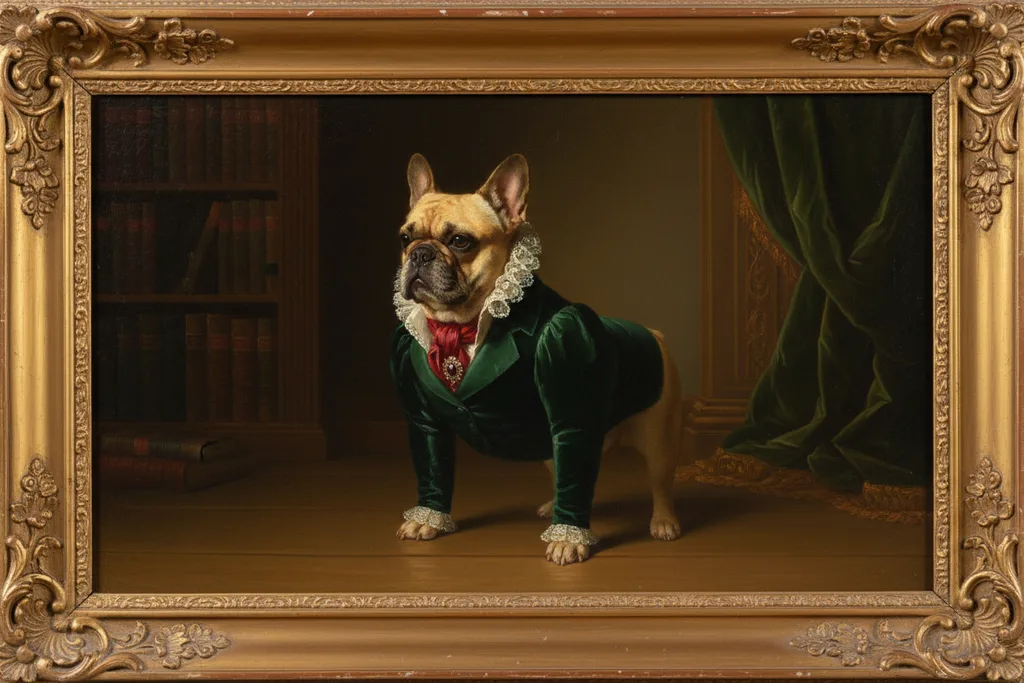
Many ways of remembering a pet that families use today were already in use in Victorian Britain: a grave in the garden, a stone with the animal's name, a poem, a likeness. This page looks at how people in Britain during Queen Victoria's reign remembered dogs and cats that died, from the Queen's own dog graves to a terrier's statue in Edinburgh and a duchess's dog kept under glass. It ends with the ideas a memorial today can borrow from them. For the other steps toward a memorial portrait, start with the main guide to pet memorial portraits.
A time of formal mourning
Queen Victoria reigned from 1837 to 1901. The official website of the Royal Family says she became queen at 18, and that after her husband, Prince Albert, died in 1861 she wore black for the rest of her reign.
Her grief affected how others mourned too. The Australian Museum says that after Albert's death, public demand grew for formal mourning clothes such as black crepe and for jewellery made of jet, a black stone. Mourners, including children and servants, were expected to follow strict mourning periods. A widow was expected to mourn for two years. Children in middle-class families wore full black for one year after a parent or a brother or sister died.
The museum describes the keepsakes families made for the people they lost. Lockets, brooches and rings often held a lock of the dead person's hair and a photograph. Photographs of the dead were common too. Families who could not afford a painted portrait could arrange a photograph quickly and cheaply after a death, and a card printed from one negative let them send copies to relatives far away.
These customs were for people. The memorials that Victorians made for animals, described below, used some of the same forms: a grave with words on it, a likeness to keep, and a keepsake.
Pets in the Victorian home
Pet keeping spread during the century. The Victorian Web, a scholarly site on the period, says the Queen's love of animals was widely shared by her subjects. It quotes historians who found that, by the middle of the century, advice books promoted dogs as suitable pets for every middle-class home, and it says pet ownership became popular across all classes. The Queen herself showed several of her dogs at Crufts in 1891, when more than 2,000 dogs were shown.
A generation earlier, one grave had already shown what a pet memorial could say. In 1808 the poet Lord Byron built a monument to his Newfoundland dog, Boatswain, at Newstead Abbey. Its prose inscription, printed in The Works of Lord Byron, praises the dog's "Beauty without Vanity, Strength without Insolence, Courage without Ferocity". Our page on writing a pet dedication looks at how inscriptions like this one can help you write your own.
The Queen's own dogs
Queen Victoria kept dogs all her life, and she marked their deaths. Our article on Queen Victoria and her dogs tells the story of their lives and their portraits. The memorials are the subject here.
The Victorian Web, drawing on the Queen's journals, gives the key facts:
- Dash, her King Charles spaniel from her teenage years, died on Christmas Eve 1840. His grave carries a long epitaph that begins "His attachment was without selfishness" and asks the reader to "profit by the example of DASH".
- Eos, Prince Albert's black greyhound, died in July 1844. A memorial statue followed.
- Sharp (1866 to 1879) and Noble (1871 to 1887), two collies, have memorials at Windsor and Balmoral. Both describe the dog as faithful and as the Queen's favourite collie.
The statue of Eos shows how far a royal memorial could go. The Victorian Web says Albert turned to the sculptor John Francis after Eos died, and that the two men made the statue together, guided by Edwin Landseer's 1841 painting of the dog. Albert modelled the dog himself under Francis's guidance, and Francis cast it in bronze in 1845. Two bronzes were made. The original stands over the dog's grave in Windsor Castle's Home Park, and the second stands on the Upper Terrace at Osborne House on the Isle of Wight.
Other royal dogs had a burial ground too. In 1894 the writer Frank Carpenter described the Windsor kennels for a children's magazine, in an account the Victorian Web quotes. He counted fifty-five dogs, said the Queen named all of them herself, and wrote that "near the kennels is a little graveyard where these pets are buried when they die."
Greyfriars Bobby
One Victorian memorial to a dog stands in a city street. Historic Environment Scotland describes the Greyfriars Bobby fountain in Edinburgh as a life-size bronze statue of a terrier, made by William Brodie in 1873. It sits on a red granite base with two basins, one low and one higher.
The inscription tells the story in two sentences. It calls the fountain a tribute to the affectionate fidelity of Greyfriars Bobby, and says that in 1858 the dog followed the remains of his master to Greyfriars churchyard and stayed near the spot until his own death in 1872. It was put up with permission by Baroness Burdett Coutts.
Historic Environment Scotland says the story became famous soon after the dog died. It lists the fountain, a memorial stone over the grave of Bobby's master, and a later memorial at the churchyard gate as places that visitors still come to see. The fountain was listed at Category A on 29 April 1977.
A poet's grave for a dachshund
Victorian writers also wrote about their pets' graves. The poet Matthew Arnold, who lived from 1822 to 1888, wrote "Geist's Grave" for a dachshund named Geist who died after only four years. The poem, printed in The Poetical Works of Matthew Arnold, describes how the family laid the dog "Between the holly and the beech", in the garden where it used to lie, and marked the place "By mounded turf, and graven stone."
The poem is full of small details that any owner will know: the dog's broad brown paws, its scuffle on the stairs, its large ears raised to ask which way the family was going. Its last lines imagine strangers who pass the grave long after the family has gone, and who learn from the stone the name of "The dachs-hound, Geist, their little friend."
Hyde Park: a garden of small graves
One group of Victorian pet graves in London lies in a garden at the edge of Hyde Park. Our page on the history of pet cemeteries tells how it began in 1881. What matters here is who used it.
The Royal Parks, the charity that cares for the site, quotes the gatekeeper, Mr Winbridge, from an 1893 article in The Strand Magazine called "A Cemetery for Dogs". He said that most of the dogs belonged to ladies. The Royal Parks explains that many of the owners came from well-to-do families in grand houses near the park, and that burying a pet in a royal park was a mark of status. One early grave belonged to Prince, the dog of the Duke of Cambridge, who was killed by a carriage in the road outside the gatehouse.
Keeping the animal: taxidermy
Some Victorians kept the animal itself. Taxidermy, the craft of preserving an animal's skin over a model of its body, was widespread in the period. The Victorian Web calls it the great age of taxidermy, and says many homes had birds under glass domes. It gives the example of the painter Dante Gabriel Rossetti, who bought a wombat in September 1869. It died that November, and he had it stuffed.
Elmbridge Museum in Surrey holds one of the clearest examples of a preserved pet. It is a Maltese terrier that belonged to Elizabeth Wellesley, the Duchess of Wellington, who lived at Burhill House in Hersham from 1887 to 1904. She bred Maltese terriers, and this one was her favourite. The museum says her coachman ran over the dog by accident while riding a bicycle. The duchess had it preserved by Queen Victoria's ornithologist, John Leadbeater, and displayed in a glass dome so that she could always remember it.
Victorian memorials at a glance
| Memorial | Example | Date | Where |
|---|---|---|---|
| Inscribed grave | Dash, Queen Victoria's spaniel | 1840 | Windsor |
| Bronze statue over a grave | Eos, Prince Albert's greyhound | 1845 | Windsor Home Park, with a second cast at Osborne House |
| Public fountain and statue | Greyfriars Bobby | 1873 | Edinburgh |
| Poem | "Geist's Grave" by Matthew Arnold | Victorian period | Printed in his collected poems |
| Garden cemetery | Hyde Park pet cemetery | From 1881 | London |
| Taxidermy under glass | The Duchess of Wellington's Maltese terrier | 1887 to 1904 | Elmbridge Museum, Surrey |
What a memorial today can borrow
The ideas behind the Victorian memorials can work at a smaller size today.
- A keepsake that holds a trace of the animal. Victorians put a lock of hair in a locket for a person. The University of Florida College of Veterinary Medicine suggests putting clippings of a pet's fur on a picture, a locket or a holiday ornament.
- A stone with words. The University of Florida also suggests decorating a headstone or memorial stone. A few words in the style of the old inscriptions can go on it.
- A likeness. Victorians who could not afford a painted portrait used photography. A portrait made from a favourite photo does the same job. Purrealism's styles include Victorian Noble, one of six European period styles, and the portrait studio takes one photo of up to 5 MB. Our page on choosing a photo for a memorial portrait explains how to pick the picture.
- Words for strangers. Arnold's poem and Dash's epitaph were written for people who never met the dog. A dedication written so that a stranger could understand who the pet was also works for the family.
Questions and answers
How did Victorians remember pets that died?
Victorians remembered pets that died with graves, carved stones, bronze statues, poems and preserved bodies under glass. Queen Victoria's dogs had statues and inscribed memorials at Windsor and Balmoral, according to the Victorian Web. Wealthy London families buried dogs in a garden behind a gatehouse in Hyde Park from 1881, and Elmbridge Museum holds a Maltese terrier that a duchess had preserved after its death.
How long did the Victorian era last?
The Victorian era lasted from 1837 to 1901, the years of Queen Victoria's reign. According to the official website of the Royal Family, Victoria became queen at the age of 18 on the death of William IV in 1837. After Prince Albert died in 1861 she wore black for the rest of her reign, which ended with her death in 1901.
What is the Greyfriars Bobby fountain?
The Greyfriars Bobby fountain is an 1873 memorial in Edinburgh to a terrier who stayed near his master's grave. Historic Environment Scotland describes it as a life-size bronze statue of the dog by William Brodie on a red granite base with two basins. It was listed as a Category A building on 29 April 1977, and its plaque records that Baroness Burdett Coutts put it up.
Who made the statue of Prince Albert's greyhound Eos?
The statue of Prince Albert's greyhound Eos was made by the sculptor John Francis working with Albert himself, in 1845. According to the Victorian Web, it was based on Edwin Landseer's 1841 painting of Eos, and Albert modelled the dog under Francis's guidance. Two bronzes were cast: one stands over the dog's grave in Windsor Home Park and one at Osborne House.
Did Queen Victoria have a pet graveyard at Windsor?
Queen Victoria had a small graveyard for her dogs near the royal kennels at Windsor. The writer Frank Carpenter described it in an 1894 children's magazine, quoted by the Victorian Web, saying the Queen named all the dogs herself and that the pets were buried nearby when they died. At that time the Windsor kennels held fifty-five dogs.
Did Victorians have their pets stuffed?
Some Victorians did have their pets stuffed by a taxidermist, a craftsperson who preserves an animal's skin over a model of its body. Elmbridge Museum in Surrey holds the Duchess of Wellington's favourite Maltese terrier, preserved in a glass dome after her coachman ran it over. The museum says Queen Victoria's ornithologist, John Leadbeater, did the work.
What is the poem Geist's Grave about?
Geist's Grave is a poem by Matthew Arnold about a dachshund named Geist who lived only four years. The poem, printed in The Poetical Works of Matthew Arnold, describes burying the dog in the garden between the holly and the beech, under turf and a carved stone. It ends by picturing future strangers who read the stone and learn the dog's name.
What was Victorian mourning jewellery?
Victorian mourning jewellery was lockets, brooches and rings kept in memory of a person who had died, usually holding a lock of their hair and a photograph. The Australian Museum describes these keepsakes and says black jet jewellery was in demand after Prince Albert's death in 1861. Today the University of Florida suggests putting a pet's fur on a locket.
Why did Victorians keep photographs of people who had died?
Victorians kept photographs of people who had died because a photograph was a cheaper and faster keepsake than a painted portrait. The Australian Museum explains that families who could not afford a painted portrait arranged a photograph instead, especially when no photograph of the person existed. Cards printed from one negative let families send copies to distant relatives.
Who buried their dogs in Hyde Park in Victorian times?
Dogs buried in Hyde Park in Victorian times mostly belonged to wealthy families who lived in grand houses at the edge of the park. The Royal Parks quotes the gatekeeper, Mr Winbridge, telling The Strand Magazine in 1893 that most of the dogs belonged to ladies. The Duke of Cambridge's dog Prince, killed by a carriage, was buried there.
What memorials did Queen Victoria give her collies Sharp and Noble?
Queen Victoria gave her collies Sharp and Noble memorials, Sharp's at Windsor and Noble's at Balmoral. According to the Victorian Web, Sharp lived from 1866 to 1879 and Noble from 1871 to 1887, and both memorials describe the dog as faithful and as the Queen's favourite collie.
Sources
- Victoria (r. 1837-1901), The Royal Family. Accessed September 28, 2026.
- Mourning: Victorian Era, Australian Museum. Accessed September 28, 2026.
- Castle Canines: Queen Victoria's Dogs, The Victorian Web (Simon Wenham, Oxford University Department for Continuing Education). Accessed September 28, 2026.
- "Eos" by John Francis with Prince Albert, The Victorian Web (Jacqueline Banerjee). Accessed September 28, 2026.
- The Victorians and Animals, I: Animals as Part of the Household, The Victorian Web (Jacqueline Banerjee). Accessed September 28, 2026.
- George IV Bridge, Greyfriars Bobby Fountain (LB27899), Historic Environment Scotland. Accessed September 28, 2026.
- Geist's Grave, Wikisource, from The Poetical Works of Matthew Arnold. Accessed September 28, 2026.
- Matthew Arnold's poem Geist's Grave, Calisphere, from the Claremont Colleges Library Special Collections. Accessed September 28, 2026.
- Hyde Park Pet Cemetery, The Royal Parks. Accessed September 28, 2026.
- The Duchess' Pet, Elmbridge Museum. Accessed September 28, 2026.
- Inscription on the Monument of a Newfoundland Dog, Wikisource, from The Works of Lord Byron, ed. E. H. Coleridge (John Murray). Accessed September 28, 2026.
- Ways to Memorialize Your Pet, University of Florida College of Veterinary Medicine. Accessed September 28, 2026.
Short reads on this topic
Articles from Purrspectives that answer one question each.
Dog birthday ideas: how to celebrate your dog's birthday, plus gift ideas
Celebrate your dog's birthday with a favourite walk, a play date, a dog-safe treat and a yearly photo. Plus dog birthday gift ideas for the dog and the family.
Cat wall art ideas: choosing a cat portrait for every room
Cat wall art for each room: the print size for a hall, living room, bedroom or small flat, the cat portrait that suits its colours, and where to keep it safe.

Funny pet portraits: why a dog on a throne makes us smile, and 10 ideas to try
Funny pet portraits put a dog or cat in a serious human role. How Landseer and Wegman used the joke, and 10 royal portrait ideas matched to your pet's habits.