How to measure a frame for a print: sight size, rabbet and outside size
A frame has three sizes: the opening you see, the inside lip that holds the print, and the outside edge. How to measure each one before you frame a portrait.
By Purrealism. Part of Framing and hanging a royal pet portrait: frames, glass, walls and light.
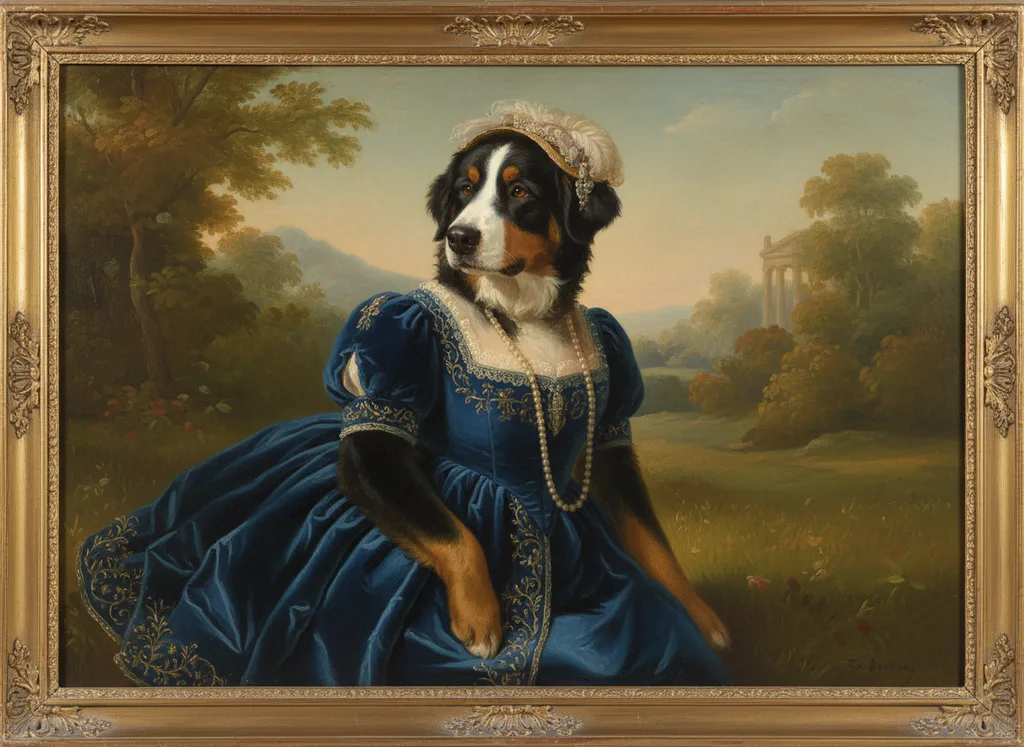
This page explains how to measure a picture frame so a royal pet portrait fits it the first time. A frame has more than one size, and most framing mistakes come from mixing them up. You will learn the three sizes every frame has, how museums record them, how to measure a frame you already own, and how to work out how much wall a framed print will cover. For a ready list of standard mat and frame sizes that fit each of the four Purrealism print sizes, read the Purrspectives article how big is an 8 × 10 print. This page goes one step further, into the frame itself. The main framing and hanging guide shows where measuring fits among the other steps.
The three sizes of a frame
Look at a frame from the front and then turn it over. You can measure it in three places.
Sight size. This is the opening you see from the front: the part of the picture, or of the mat, that shows. It is the smallest of the three.
Rabbet size. Turn the frame over. Along the inside edge of the moulding is a step, cut into the back, where the glazing, mat, print and backing board sit. This step is called the rabbet, or rebate. The rabbet size is the width and height of the opening measured at the back, from the edge of the step on one side to the edge on the other. It is larger than the sight size, because the lip at the front of the frame covers the edges of whatever sits inside.
Outside size. This is the size of the whole frame, edge to edge. It tells you how much wall the framed portrait will take up.
The rabbet also has a depth: how deep the step is, from the back of the lip to the back of the frame. Depth decides how many layers fit.
How museums record a frame
Museums measure frames with the same three ideas, and their records make a useful model. The Victoria and Albert Museum publishes several sizes for each frame in its collection.
Here are two V&A frames, with the sizes the museum gives:
| Measurement | Venetian frame, 1550 to 1600 | Tuscan frame, 1480 to 1550 |
|---|---|---|
| Outside height × width | 1190 × 1360 mm | 1290 × 790 mm |
| Depth | 100 mm | 270 mm |
| Sight size (height × width) | 650 × 746 mm | 713 × 524 mm |
| Rebate width | 15 mm to 20 mm | 9 mm |
| Rebate depth | 25 mm | 30 mm |
| Object accommodation size | 685 × 781 mm | 730 × 538 mm |
The "object accommodation size" is the size of picture the frame can hold. It is larger than the sight size and fits inside the rabbet. On the Venetian frame, the rebate width is not the same on every side: the V&A gives 15 mm at the top and left, 17 mm at the bottom and 20 mm on the right. Because the sides can differ, the museum measures each one, and you should too.
For your own frame, you need the same three numbers: the rabbet size (will the print or mat fit?), the rabbet depth (will all the layers fit?) and the outside size (will it fit the wall?).
How to measure a frame you already have
Use a metal tape measure or a ruler marked in millimetres or sixteenths of an inch. A cloth sewing tape can stretch.
- Lay the frame face down on a clean towel on a table.
- Measure the rabbet width across the back, from the inner edge of the step on the left to the inner edge on the right. Measure at the top and again at the bottom. If the two numbers differ, the frame is not square. Use the smaller number.
- Measure the rabbet height the same way, at the left and at the right.
- Measure the rabbet depth by standing a ruler upright in the step.
- Turn the frame over and measure the sight size, the visible opening.
- Measure the outside size, edge to edge.
Write the width first and the height second, and add "portrait" (taller than wide) or "landscape" (wider than tall) so there is no confusion later.
Will the layers fit? Check the depth
A framed print is a stack. The Canadian Conservation Institute's guide to framing works of art on paper says the rabbet should be deep enough to hold a mat, a backing board and a glazing material, which come to 2 cm in total (the Institute's rounded figure). It adds that these layers should fit snugly, with no pressure on them, and warns that metal clip-together frames are not always deep enough for all three.
The Institute's guide to glazing gives the thickness of the glass: picture framing glass is usually 2.0 mm or 2.5 mm thick, and it says the 2.5 mm glass may be preferable because it is more resilient, less likely to chip and easier to handle safely. For plastic glazing, it says large sheets must be 3 mm thick to avoid bowing, and that this thickness often will not fit into an average frame, which is designed for thinner glazing.
So a shallow frame limits your choices. If you plan a large acrylic sheet and a thick mat, measure the rabbet depth first.
Will the layers fit? Check the width and height
The glazing, mat and backing need a small gap around their edges. The Institute's guide to glazing says to cut the glazing 3 mm smaller than the inside rebate, so it just drops into place and has room to expand and contract. It explains why: glazing fitted too tight can snap if it is glass or bow if it is plastic, and a loose fit leaves gaps that let dust into the frame.
For paintings on canvas, the Institute's guide to framing a painting asks for a larger gap of 3 to 6 mm on all sides, to leave room for the wood to expand. The same idea applies to a paper print in a mat: never force a layer into a frame.
The mat window: smaller than the print
If the portrait sits in a mat, the mat window must be smaller than the print, so the edges of the print stay hidden behind the mat. The Canadian Conservation Institute's guide to matting works on paper says the edges of the mat should overlap the edges of the artwork by at least 2 mm to 4 mm, to hold the work down.
With an overlap of 2 mm to 4 mm on each side, the window is 4 mm to 8 mm smaller than the print in width and 4 mm to 8 mm smaller in height. That overlap hides a thin strip along every edge of the image. Before framing, look along the edges of the portrait. If an important detail, such as the tip of a crown, sits within 4 mm of an edge, tell the framer, so the mat can be planned around it. The page on mats for framed prints covers mat colours, materials and borders.
How much wall a framed print covers
To plan the wall, add up the layers. The outside size equals the print size, plus two mat borders, plus two frame face widths, in each direction.
Here are the four Purrealism print sizes with a frame that shows 1 inch of face on each side:
| Print size | No mat | 2 inch mat border | 3 inch mat border |
|---|---|---|---|
| 8 × 10 in | 10 × 12 in | 14 × 16 in | 16 × 18 in |
| 12 × 16 in | 14 × 18 in | 18 × 22 in | 20 × 24 in |
| 18 × 24 in | 20 × 26 in | 24 × 30 in | 26 × 32 in |
| 24 × 36 in | 26 × 38 in | 30 × 42 in | 32 × 44 in |
These figures are simple sums, and a real frame may differ by the width of its lip. Use them to decide which size fits the wall, then take exact numbers from the frame you buy.
The largest size needs the most planning. A 24 × 36 inch print with a 3 inch mat covers 32 × 44 inches, which is wider than many spaces between two windows. Tape a sheet of brown paper cut to the outside size onto the wall and look at it for a day before you order. The page on how high to hang a portrait shows how to set its height once the size is fixed.
Ordering a custom frame
A custom frame is built to your print. To order one, give the framer:
- the exact print size, measured on the print, width first,
- the mat border you want on each side, and whether the bottom border should be wider,
- the glazing you want (the page on glass or acrylic for a framed print helps with this choice),
- whether the print has a white border or runs to the edge.
Ask the framer to confirm the finished outside size before they cut. That number decides where the frame goes on the wall.
Ready-made frames: read the label
A ready-made frame is sold under one size, and that size can describe different things. Before you buy, check:
- Does the size on the label describe the picture it holds, the mat opening, or the outside of the frame?
- Does the frame come with a mat, and what size is its window?
- How deep is the rabbet?
If a frame labelled 8 × 10 comes with a mat, check the mat window: the 8 × 10 may name the mat's outer edge, with a window cut for a smaller photo. Measure it with the steps above before you put the portrait inside. The four print sizes are listed on the pricing page, and you can choose one in the portrait studio once you know which frame it goes into.
Questions and answers
What is the sight size of a picture frame?
The sight size of a picture frame is the size of the opening you see from the front. It is smaller than the glazing and the print, because the frame's lip covers their edges. The Victoria and Albert Museum records sight size for its frames: a Venetian frame from 1550 to 1600 has a sight size of 650 by 746 mm.
What is the rabbet of a picture frame?
The rabbet of a picture frame is the step cut into the back of the moulding, where the glazing, mat, print and backing sit. It has a width (how far the lip reaches in) and a depth. The Canadian Conservation Institute says the rabbet should be deep enough for a mat, a backing board and glazing, which come to 2 cm together, as a rounded figure.
Is a frame size the inside or the outside measurement?
A frame size can name either the inside of the frame (the artwork or mat it holds) or the outside edge, so check which one a label gives. A frame with a 1 inch face holding a 12 × 16 inch print measures 14 × 18 inches on the outside. Ask the seller which size a label gives, and measure the rabbet yourself before you buy.
How do you measure a picture frame for a print?
Measure a picture frame for a print from the back. Take the width and height of the rabbet opening from edge to edge, then its depth with a ruler held upright. Measure the sight size from the front. The rabbet must fit the print or its mat, and the Canadian Conservation Institute says the depth should hold glazing, mat and backing together.
How much smaller than the frame should the glass be cut?
Picture frame glass should be cut 3 mm smaller than the inside of the rabbet. The Canadian Conservation Institute gives this rule so the glazing just drops into place and has room to expand and shrink. It warns that glazing fitted too tight can snap if it is glass or bow if it is plastic, while a loose fit lets dust in.
How thick is picture frame glass?
Picture frame glass is usually 2.0 mm or 2.5 mm thick, according to the Canadian Conservation Institute. It says the 2.5 mm glass may be the better choice because it is more resilient, less likely to chip and easier to handle safely. For large plastic glazing, the Institute says 3 mm is needed to avoid bowing, which an average frame may not fit.
How big is a 12 × 16 print once it is matted and framed?
A 12 × 16 inch print with a 3 inch mat border and a 1 inch wide frame measures 20 × 24 inches on the wall. Add two mat borders and two frame widths to each side of the print: 12 plus 6 plus 2 gives 20, and 16 plus 6 plus 2 gives 24. A 2 inch mat gives 18 × 22 inches.
How much wall space does a framed 24 × 36 print need?
A framed 24 × 36 inch print needs 26 × 38 inches of wall with a 1 inch frame and no mat. With a 2 inch mat border it needs 30 × 42 inches, and with a 3 inch border 32 × 44 inches. Those figures come from adding two mat borders and two frame widths to each side of the print.
How does a museum record the size of a picture frame?
A museum records several sizes for one picture frame. The Victoria and Albert Museum lists the outside height, width and depth, the sight size, the rebate width and depth, and an object accommodation size, which is the largest picture the frame can hold. For a Tuscan frame from 1480 to 1550, that accommodation size is 730 by 538 mm.
How big should the mat window be for a print with no border?
The mat window for a print with no white border should be 4 mm to 8 mm smaller than the print in each direction. The Canadian Conservation Institute says the mat should overlap the edges of the artwork by at least 2 mm to 4 mm on each side to hold it down. That overlap hides a thin strip of the image at every edge.
Sources
- Framing Works of Art on Paper, Canadian Conservation Institute. Accessed September 28, 2026.
- Glazing Materials for Framing Works on Paper, Canadian Conservation Institute. Accessed September 28, 2026.
- Matting Works on Paper, Canadian Conservation Institute. Accessed September 28, 2026.
- Framing a Painting, Canadian Conservation Institute. Accessed September 28, 2026.
- Picture Frame (Venice, 1550 to 1600), Victoria and Albert Museum. Accessed September 28, 2026.
- Frame (Tuscany, 1480 to 1550), Victoria and Albert Museum. Accessed September 28, 2026.
Short reads on this topic
Articles from Purrspectives that answer one question each.

Cat wall art ideas: choosing a cat portrait for every room
Cat wall art for each room: the print size for a hall, living room, bedroom or small flat, the cat portrait that suits its colours, and where to keep it safe.

Dog wall art ideas: how to choose and hang a portrait of your dog
Good dog wall art fits its wall: pick a print size for the furniture below, hang it with its centre at eye level, and keep it out of direct sun.

How big is an 8 × 10 print? Pet portrait print sizes explained
An 8 × 10 print is 20.32 × 25.4 cm, with a 4:5 shape. See all four portrait print sizes in cm, plus the pixels, frames and mats each one needs.