How high to hang a pet portrait: centre height and nail position
Pick a centre height for the people who will look at the portrait, then find the nail from the frame height and wire. Worked figures for all four print sizes.
By Purrealism. Part of Framing and hanging a royal pet portrait: frames, glass, walls and light.
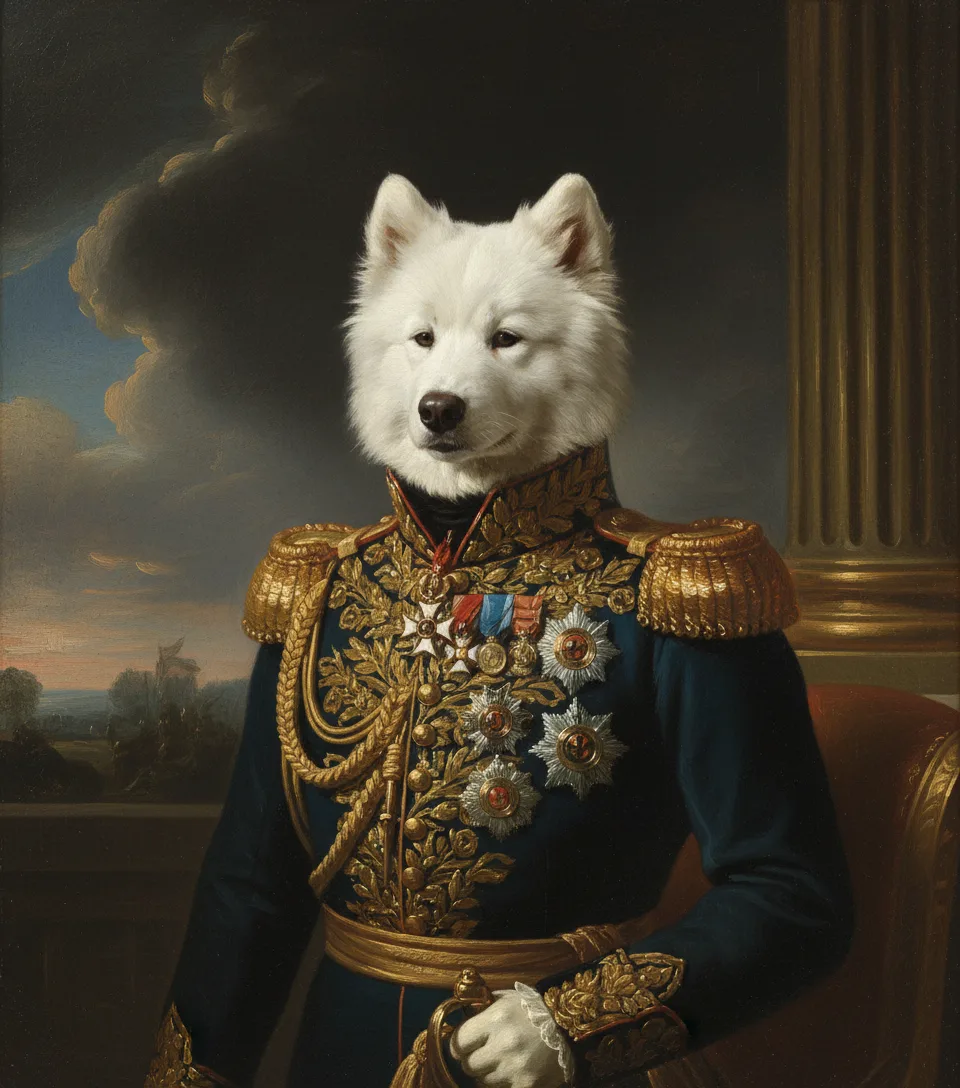
This page explains how to choose the height of a framed pet portrait and how to turn that height into a nail position on the wall. It starts with one number, the centre height, and shows how to choose it for the people who will look at the portrait: adults standing, people sitting, and people using a wheelchair. It then gives a formula for the nail, worked figures for the four Purrealism print sizes, and the checks to run above furniture, in hallways and on stairs. The hanging planner at the end of this page does the same sums for your own frame. The main framing and hanging guide shows where this step fits in the order of work.
Why measure to the centre
A frame has a top edge, a bottom edge and a centre. If you choose one height for the middle of the frame, every size shares that line, and a small 8 × 10 inch portrait and a large 24 × 36 inch portrait can hang side by side and still look level with each other.
Museums work the same way. The Smithsonian Institution's guidelines for accessible exhibition design give the height of small items measured to their centre line, and the height of wall labels measured to their centre line as well. The page on planning a gallery wall around a pet portrait uses a shared centre line to hang several frames as one group.
So the first decision is the centre height. The nail position comes from it later.
Whose eyes? Three reference points
There is no single right height, because eyes are at different heights. Measured data gives three useful reference points.
Adults standing
The Federal Aviation Administration (FAA) measured 1,244 of its technical operations staff at 25 sites around the United States, and publishes the results in its human factors design standard. Eye height standing was measured from the floor to the outer corner of the eye.
| Group | 5th percentile | Median (50th) | 95th percentile |
|---|---|---|---|
| Women | 55.6 in (141.2 cm) | 59.8 in (151.8 cm) | 63.8 in (162.1 cm) |
| Men | 60.4 in (153.5 cm) | 65.0 in (165.2 cm) | 69.1 in (175.6 cm) |
A percentile tells you how many people fall below a figure. The 5th percentile woman's eyes are lower than those of 95 women out of 100 in the survey. This is a survey of one workforce, so treat it as a guide to the spread of heights, and look at the people in your own home too.
Adults sitting
The same FAA survey measured eye height sitting upright, from the seat to the outer corner of the eye. The median was 31.9 inches for men and 29.7 inches for women. To find where a seated person's eyes are in your room, add the height of the chair or sofa seat. Measure the seat with a tape; the result tells you how far below a standing adult's eyes a seated guest's eyes will be.
People using a wheelchair
The Smithsonian's guidelines say an adult man who uses a wheelchair has an average eye level between 43 and 51 inches above the finished floor. They mount small items at a centre height no higher than 40 inches, and explain that objects placed above 40 inches will be seen only from below by most seated and short viewers. For wall labels, which people read up close, the guidelines give 48 to 67 inches as comfortable for both seated and standing people, and a centre line at 54 inches as the best height for everyone.
Choosing your centre height
Put those numbers together and a range appears. Seated eyes in a wheelchair sit at 43 to 51 inches. Median standing eyes in the FAA survey sit at 59.8 and 65.0 inches. A centre height between those ranges suits a room where some people stand and some sit.
The hanging planner below starts at 57 inches. That is a starting point you can change. It sits above the 43 to 51 inch range for seated wheelchair users and below the median standing eye height of both women and men in the FAA survey. The Purrspectives article on dog wall art ideas uses a centre height of 60 inches for its examples, which sits 3 inches higher.
Adjust the figure for the room:
- A hallway or landing where everyone stands. Move the centre up toward the standing figures.
- A dining room or a sitting room. Move it down toward seated eyes. Sit in the chair you use most and ask someone to mark your eye level on the wall.
- A home where someone uses a wheelchair, or a child's room. Move it down toward 43 to 51 inches, and measure the actual eye height of the person who will look at it most.
From centre height to nail
Once you have the centre height, the nail position follows from two measurements of the frame.
- Frame height. Measure the outside height of the finished frame, top edge to bottom edge. The page on how to measure a frame explains the outside size.
- Wire drop. Turn the frame over. Pull the hanging wire up tight toward the top edge, as the nail will, and measure from the wire to the top edge of the frame.
Then:
Nail height = centre height + half the frame height − wire drop
The frame's top edge sits at the centre height plus half the frame height. The wire, and so the nail, sits one wire drop below that edge.
If the frame hangs from two D-rings on two separate hooks instead of a wire, the drop is the distance from the top edge of the frame to the top of the inside of each ring. Put two nails or hooks at that height, spaced the same distance apart as the rings. The page on picture hanging hardware explains why two points of support are safer than one.
Worked figures for the four print sizes
These figures use the planner's starting values: a centre height of 57 inches, a frame and mat border of 2 inches on each side, a wire drop of 3 inches, and each print hung upright.
| Print size | Framed size | Top edge | Bottom edge | Nail height |
|---|---|---|---|---|
| 8 × 10 in | 12 × 14 in | 64 in | 50 in | 61 in |
| 12 × 16 in | 16 × 20 in | 67 in | 47 in | 64 in |
| 18 × 24 in | 22 × 28 in | 71 in | 43 in | 68 in |
| 24 × 36 in | 28 × 40 in | 77 in | 37 in | 74 in |
Every row shares the same centre, so all four frames line up through the middle. The top edge climbs and the bottom edge falls as the frame grows.
Above a sofa, a bed or a sideboard
Furniture sets a floor for the bottom edge. The planner shows the gap between the top of the furniture and the bottom of the frame, and the frame's width as a percentage of the furniture's width.
Take a sofa back 34 inches high and 84 inches wide, the planner's starting values. At a 57 inch centre, the four framed sizes above leave gaps of 16, 13, 9 and 3 inches. The framed widths are 14, 19, 26 and 33 percent of the sofa's width. A 3 inch gap is tight for the largest size, because heads rest against a sofa back. You can raise the centre height or choose the next size down.
The Canadian Conservation Institute adds a safety point in its guide to storage and display of paintings: do not hang a picture where it can come into contact with furniture, doors, curtains or blinds. Check that a headboard, a lamp shade or a door that swings open cannot touch the frame.
Hallways and stairs
A hallway brings a second rule into play. The Smithsonian's guidelines say objects mounted on a wall must stick out no more than 4 inches, unless their lower edge is below 27 inches or above 80 inches from the floor. People who use a cane find objects by touching low edges, so a deep frame at waist height in a walkway is hard for them to detect. Measure the depth of your frame, including the hardware on its back, before you hang it in a walkway.
The Canadian Conservation Institute also advises against hanging paintings where they might be brushed against or touched by passers-by, and names narrow corridors and stairwells as examples. It warns against hanging a picture at a height where feet, knees, handbags or hands can bump it. On a narrow stair, that points to a small frame hung high enough to clear shoulders, or to a wider wall elsewhere.
If you do hang a portrait beside stairs, measure the centre height from the step directly below the middle of the frame, so the frame sits at the same height above the stairs that it would above a floor.
Mark the wall in five steps
- Choose the centre height and write it down.
- Measure the frame height and the wire drop.
- Work out the nail height with the formula, or enter the numbers in the planner below.
- Measure the nail height up from the floor and mark it lightly in pencil, then find the horizontal middle of the space.
- Hang the frame, check it with a level, and step back to look from where people will stand or sit.
If you have not chosen a size yet, the four print sizes are listed on the pricing page, and the planner below draws each one to scale above your furniture.
Try it
Hanging planner
Work out where the nail goes, and see the four print sizes drawn to scale above your sofa, bed or sideboard.
The width the frame and any mat add on each side of the print.
Where the middle of the frame sits. The framing guide explains how to choose it.
Pull the hanging wire tight toward the top of the frame. Measure from the wire to the frame's top edge.
- Framed size
- 16 in (41 cm) wide × 20 in (51 cm) tall
- Put the nail at
- 64 in (163 cm)
- above the floor: centre height, plus half the frame height, minus the wire drop.
- Gap above the furniture
- 13 in (33 cm)
- Frame width compared with the furniture
- 19 percent
Questions and answers
What does centre height mean when hanging a picture?
Centre height is the distance from the floor to the middle of a framed picture. Measuring to the middle lets frames of different sizes line up along one height. The Smithsonian's guidelines for accessible exhibitions give heights for small items measured to their centre line, which is the same idea. The nail position is then worked out from the centre height.
How do you work out where to put the nail for a framed picture?
The nail for a framed picture goes at the centre height, plus half the frame height, minus the wire drop. For a frame 20 inches tall centred at 57 inches, with the wire pulled 3 inches below the top edge, the nail goes at 57 plus 10 minus 3, which is 64 inches above the floor. Measure the wire drop with the wire pulled tight.
What is the wire drop on a picture frame?
The wire drop on a picture frame is the distance from the top edge of the frame down to the hanging wire when the wire is pulled tight toward the top. It tells you how far below the nail the top of the frame will sit. With two D-rings hung directly on two hooks, the drop is the distance from the frame's top edge to the top of each ring.
How high are adults' eyes when standing?
Adults' standing eye height varies by several inches from person to person. In a Federal Aviation Administration survey of 1,244 technical staff at 25 sites, the median standing eye height was 65.0 inches for men and 59.8 inches for women. The 5th percentile woman's eyes were at 55.6 inches and the 95th percentile man's at 69.1 inches.
How high should art hang for a viewer in a wheelchair?
Art for a viewer in a wheelchair should hang lower than art for standing adults. The Smithsonian's guidelines for accessible exhibition design give the eye level of an adult man who uses a wheelchair as 43 to 51 inches above the floor. The guidelines mount small items at a centre height no higher than 40 inches, because higher objects are seen from below by seated viewers.
How high should art hang in a room where people sit?
Art in a room where people sit can hang lower, because seated eyes are lower. In a Federal Aviation Administration survey, the median eye height above the seat was 31.9 inches for men and 29.7 inches for women, sitting upright. Add the height of your own chair seat to those figures to find where a seated person's eyes actually are in your room.
What height do the Smithsonian guidelines give for wall labels?
The Smithsonian's accessibility guidelines place wall labels between 48 and 67 inches above the floor, a range they call comfortable for people who are seated and people who are standing. The same guidelines say a label with its centre line at 54 inches is at the best height for everyone. These figures are for text labels, which people read up close.
How far can a picture frame stick out from a hallway wall?
A picture frame in a hallway should stick out no more than 4 inches from the wall. The Smithsonian's accessibility guidelines set that limit for wall-mounted objects, because deeper objects are hard to detect for people who use a cane. The limit does not apply when the lower edge is below 27 inches or above 80 inches from the floor.
How much space is left above a sofa under a 24 × 36 portrait?
A 24 × 36 inch portrait with a 2 inch frame and mat border, centred at 57 inches, has its lower edge at 37 inches. Above furniture 34 inches tall, that leaves a 3 inch gap. The framed portrait is 28 inches wide, which is 33 percent of an 84 inch sofa. Raising the centre height to 60 inches would widen the gap to 6 inches.
Why does the hanging planner start at 57 inches?
The hanging planner on the Purrealism framing guide starts at a centre height of 57 inches, which you can change. That figure sits between two measured ranges: the 43 to 51 inch eye level of seated wheelchair users in the Smithsonian's guidelines, and the median standing eye heights of 59.8 and 65.0 inches in a Federal Aviation Administration survey of women and men.
Sources
- Smithsonian Guidelines for Accessible Exhibition Design, Smithsonian Accessibility Program. Accessed September 28, 2026.
- Appendix B: Anthropometric Data of Federal Aviation Administration Technical Operations Personnel, Federal Aviation Administration. Accessed September 28, 2026.
- Storage and Display Guidelines for Paintings, Canadian Conservation Institute. Accessed September 28, 2026.
Short reads on this topic
Articles from Purrspectives that answer one question each.

Cat wall art ideas: choosing a cat portrait for every room
Cat wall art for each room: the print size for a hall, living room, bedroom or small flat, the cat portrait that suits its colours, and where to keep it safe.

Dog wall art ideas: how to choose and hang a portrait of your dog
Good dog wall art fits its wall: pick a print size for the furniture below, hang it with its centre at eye level, and keep it out of direct sun.

How big is an 8 × 10 print? Pet portrait print sizes explained
An 8 × 10 print is 20.32 × 25.4 cm, with a 4:5 shape. See all four portrait print sizes in cm, plus the pixels, frames and mats each one needs.