Dachshund history: the German badger dog at royal courts and in wartime
Dachshunds were bred in Germany to hunt badgers underground. The breed's name, its sizes and coats, Queen Victoria's dachshunds and the World War I years.
By Purrealism
The dachshund was bred in Germany to go underground after badgers, and its long body and short legs come from that job. From the forests it moved into palaces. Queen Victoria kept dachshunds for decades, and a German emperor had two of his own. In World War I the breed's German name caused it trouble in the United States. This guide follows that history, the breed's sizes and coats, and ends with how to photograph a dachshund for a royal portrait.
A hunting dog from German forests
People in Europe hunted badgers with dogs long before the dachshund existed. The American Kennel Club (AKC) says Europeans had used dogs for this since at least the Middle Ages, and that France and other countries had badger dogs of their own. The AKC's breed page dates badger dogs to the 1400s and the dachshund as a specific breed to the 1600s. Its history article says German foresters and hunters were breeding the type consistently by the 1700s.
The Dachshund Club of America, the breed's club in the United States, gives the early dates. It says the first description of a dog that looks like a dachshund appeared in 1700: a low dog with a long, slender body, bent front feet and a smooth coat. In 1719 a German book called The Complete German Hunter showed two dogs of this kind.
A badger is a hard animal to hunt. The AKC says an adult weighs 25 to 40 pounds and has sharp teeth and claws. Every part of the dachshund was shaped for the fight:
- Short legs, so the dog could fit into the badger's hole.
- Compact feet to push soil back while it dug.
- A long, deep ribcage with room for the heart and lungs, so it could work underground for hours.
- A loud bark, so the hunter above ground could tell where the dog was.
The dog also had to act alone in the dark, with no room to turn around. The AKC says the breed standard, the written description of the ideal dog, calls the dachshund "courageous to the point of rashness".
What the name means
Dachshund is a German word. Dachs means badger and Hund means dog, so the name means badger dog. The Royal Kennel Club in the United Kingdom says the breed has a second name in Germany, Teckel, and that German hunters still use it to track wounded deer and to go underground after badgers or rabbits.
Two sizes and three coats
The AKC says the smooth coat is believed to be the original. Longhaired dachshunds came from breeding smooth dogs that had longer coats. Wirehaired dachshunds came later, in the 1800s, from crosses with rough-coated terriers. The AKC's breed page says the wire coat suited work in thorny bushes and the long coat suited cold weather.
Size changed with the work. The AKC says a boom in Germany's rabbit population in the 1800s led to the miniature dachshund. The Dachshund Club of America says the first miniatures were registered in Germany in 1902.
| American Kennel Club | Royal Kennel Club (UK) | |
|---|---|---|
| Sizes | Standard and miniature | Standard and miniature |
| Standard | 16 to 32 pounds, 8 to 9 inches tall | No weight given |
| Miniature | 11 pounds and under, 5 to 6 inches tall | Ideal 4.5 kg, at most 5 kg |
| Coats | Smooth, longhaired, wirehaired | Smooth, long haired, wire haired |
Germany has a third size. The Royal Kennel Club says German breeders recognize the standard, the miniature and the Kaninchen, or rabbit dachshund, and measure all three around the chest. In the UK the two sizes and three coats make six varieties that share one breed standard.
German breeders began to fix these types in the late 1800s. The Dachshund Club of America says a list of desired traits was set in 1879, and the first German breed club, the Teckel Club, was formed in 1888 with its own record of pedigrees.
Dachshunds at royal courts
Queen Victoria brought the breed into the British royal family. The Royal Collection Trust, which cares for the royal art collection, says she was the first British monarch to be fond of dachshunds. From the 1840s onwards she brought many of them over from Coburg, the small German state where her husband, Prince Albert, was born. Several became her favourite pets.
Three objects in the Royal Collection show these dogs:
- A silver gilt centrepiece, a large ornament for the dining table, designed by Prince Albert and commissioned by the Queen in 1842. Four of the couple's dogs stand around its base. The dachshund, looking at a rat in a cage, is Waldmann. The Trust says he was one of several dogs of that name.
- A photograph of Deckel, a print made in 1868 from an 1855 photograph, credited to William Bambridge. Its caption calls Deckel the Queen's favourite dachshund, and it comes from an album of photographs that Prince Albert collected.
- A dachshund carved in brown agate with diamond eyes, made by Fabergé. The Trust says the kennels of King Edward VII and Queen Alexandra at Sandringham held many dachshunds.
The Dachshund Club of America adds that Prince Albert hunted woodcock with a pair of dachshunds. The breed stayed in the royal family after Victoria. Our guide to royal dogs in history covers the dorgis of Queen Elizabeth II, crosses between her corgis and dachshunds. The Queen's other breeds are in Queen Victoria and her dogs.
Germany's own ruler kept them too. The AKC says Kaiser Wilhelm II, the last German emperor, owned two dachshunds named Wadl and Hexl. On a visit to the country home of Archduke Franz Ferdinand of Austria-Hungary, the pair killed one of the archduke's golden pheasants.
Britain and the United States
In Britain the dachshund became a family pet. The Dachshund Club of America says the first dachshund appeared at a British dog show in 1870, and that royalty often showed the breed in the years after. The Dachshund Club in Britain was formed in 1881, seven years before the German club. The early British standard asked for a large, heavy dog. As more German dogs reached British kennels, the German standard replaced it.
In the United States, the AKC admitted the dachshund to its Stud Book, its official register of pedigrees, in 1885. The Dachshund Club of America was founded in 1895 and is the eighth oldest club in the AKC.
The World War I years
The Dachshund Club of America says the war that began in 1914 turned many Americans against anything German. The AKC calls the dachshund a national symbol of Germany. The AKC says American owners began to call their dogs liberty hounds to avoid anti-German feeling. The club says many kennels stopped breeding, and that owners who took their dogs out in public called them Badger Dogs. The name Dachshund was officially restored in 1923. Only 23 dachshunds were registered with the AKC that year.
We found no museum or kennel club source on how British owners treated their dachshunds during the war, so this guide leaves that part out.
The breed recovered fast. The Dachshund Club of America says registrations passed 3,000 a year by the end of the 1930s, and many soldiers brought dachshunds home from Germany. The AKC says the breed rose from 28th to sixth among American registrations between 1930 and 1940. In the AKC's ranking for 2025, the dachshund moved from sixth to fifth.
Caring for a long back
The long back that suited a badger's tunnel needs care. The AKC tells owners to keep a dachshund lean, because extra weight strains the back and can lead to slipped or ruptured discs, the cushions between the bones of the spine. It gives a life expectancy of 12 to 16 years. The Royal Kennel Club asks breeders to screen their dogs' spines before breeding. Since 1 January 2010 it has refused to register puppies from two dapple parents (dapple is a spotted coat pattern), because that pairing carries a risk to the puppies' sight and hearing.
Photographing a dachshund for a royal portrait
A dachshund's shape is its history, so the photo should show all of it.
- Get down to the dog's level. A dachshund stands 5 to 9 inches tall, according to the AKC. Lie on the floor or put the dog on a low sofa. A photo from standing height makes the body look short and the head large.
- Show the whole length. Take one photo from the side with the nose, the back and the tail all inside the frame, and leave space at both ends.
- Light the coat to match its type. A smooth coat shines, so soft window light from one side works better than a flash. A wirehaired dog's beard and eyebrows need light on the face. A longhaired coat needs brushing first, so the long hair on the ears and chest shows.
- Take a face photo as well. Many royal portraits show the head and shoulders, and the long ears frame a dachshund's face well.
The guide on how to photograph your pet for a portrait has more tips that work with a phone.
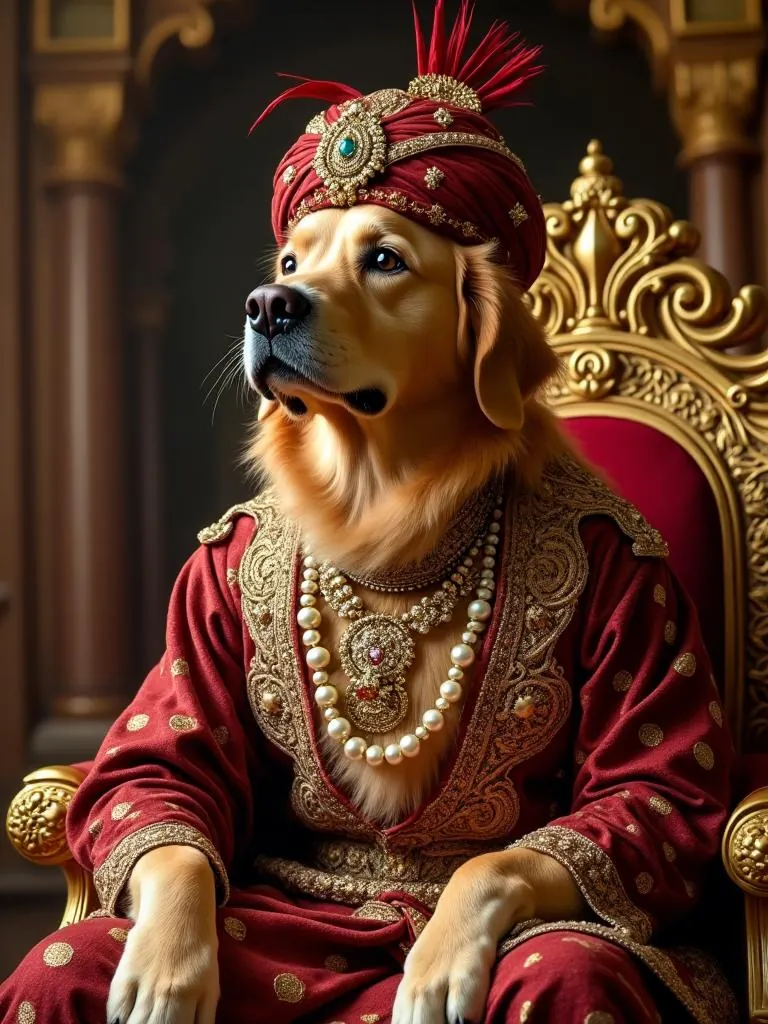
For the style, the breed's own history points to Europe. Purrealism has 15 royal styles. The Victorian Noble style matches the decades when Queen Victoria kept her dachshunds from Coburg. The other European styles are Renaissance Royal, Military General, Medieval Knight, Baroque Aristocrat and Regency Era. The Indian court styles work too: the portrait at the top of this page is a golden retriever as a Maharaja in a red jewelled turban on a gold throne, and a black and tan or cream dachshund would stand out against the same red and gold. The guide on how to choose a royal portrait style for your pet compares all 15, and the gallery shows finished portraits.
When you have a sharp photo of your dachshund, the portrait studio takes one image of up to 5 MB and lets you try any of the 15 styles.
Questions and answers
What were dachshunds originally bred for?
Dachshunds were originally bred to hunt badgers by digging into their dens. The American Kennel Club says the short legs let the dog fit into a badger hole, and its loud bark told the hunter above ground where the dog was. The AKC adds that dachshunds of different sizes were bred for different animals, and that packs of dachshunds were often used on wild boar.
Are dachshunds originally from Germany?
Dachshunds come from Germany. The Royal Kennel Club in the United Kingdom says the breed originated there, where it is called the Teckel, and that it is still used to track wounded deer and to go underground after badgers or rabbits. The American Kennel Club says France and other countries had their own badger dogs, but German foresters were breeding the dachshund type consistently by the 1700s.
What does the name dachshund mean?
The name dachshund means badger dog in German. The American Kennel Club explains that Dachs is the German word for badger and Hund is the word for dog. In Germany the breed also has a second name, Teckel, which the Royal Kennel Club gives in its breed profile. The Dachshund Club of America says some American owners used the English words Badger Dog during World War I.
How long have dachshunds been around?
Dachshunds have existed as a breed since the 1600s or 1700s, and badger dogs are older. The American Kennel Club's breed page says badger dogs go back to the 1400s and the dachshund as a specific breed to the 1600s. The Dachshund Club of America dates the first description of a dog like a dachshund to 1700, and a German hunting book of 1719 illustrated two of them.
What did the first dachshund look like?
The first dachshunds were low dogs with long, slender bodies and a smooth coat. The Dachshund Club of America says the first description of such a dog appeared in 1700, with bent front feet. The same club says portraits from 1836 show smooth, longhaired and wirehaired dogs with both straight and crooked legs, in yellow, brown, black, dapple and brindle.
How many sizes of dachshund are there?
Dachshunds come in two sizes in the United States and the United Kingdom, and three in Germany. The American Kennel Club recognizes the standard, at 16 to 32 pounds, and the miniature, at 11 pounds and under. The Royal Kennel Club says Germany adds a third size, the Kaninchen or rabbit dachshund, and defines all three by measuring around the chest.
What are the three dachshund coat types?
The three dachshund coat types are smooth, longhaired and wirehaired. The American Kennel Club says the smooth coat is believed to be the original, that longhairs came from breeding smooth dogs with longer coats, and that crosses with rough-coated terriers in the 1800s produced the wirehairs. The Royal Kennel Club says both sizes come in all three coats, which gives six varieties under one breed standard.
Why are dachshunds long?
Dachshunds are long because they were built to work inside a badger's tunnel. The American Kennel Club says the breed needed short legs to fit into the hole, and a long, deep ribcage with room for the heart and lungs, so the dog could keep working underground for hours. The same long back is why the AKC tells owners to keep a dachshund lean.
Did Queen Victoria have dachshunds?
Queen Victoria kept dachshunds for most of her reign. The Royal Collection Trust says she was the first British monarch to be fond of the breed, and that from the 1840s she brought many dachshunds from Coburg, Prince Albert's home in Germany. The Trust holds a photograph of Deckel, described in its caption as her favourite dachshund, and a silver gilt centrepiece, commissioned in 1842, that shows a dachshund named Waldmann.
Why were dachshunds called liberty hounds?
Dachshunds were called liberty hounds in the United States during World War I because the breed was linked with Germany. The American Kennel Club says American owners used the name to avoid the anti-German feeling of the time. The Dachshund Club of America says many kennels stopped breeding, some owners called their dogs Badger Dogs, and the breed's name was officially restored as Dachshund in 1923.
Sources
- Dachshund Dog Breed Information, American Kennel Club
- Dachshund History: The Badger Dog's Fascinating Past, American Kennel Club
- The Most Popular Dog Breeds of 2025, American Kennel Club
- Dachshund Breed History, Dachshund Club of America
- Dachshund (Smooth Haired), The Royal Kennel Club
- Dachshund (Min. Smooth Haired), The Royal Kennel Club
- Fabergé, Dachshund (RCIN 40392), Royal Collection Trust
- Prince Albert, Centrepiece, hallmarks 1842/3 (RCIN 1570), Royal Collection Trust
- William Bambridge, 'Deckel' (RCIN 2800733), Royal Collection Trust
Share this guide
The button copies a ready-written post, then opens LinkedIn. Paste the text into the post box.
Go deeper
The full guides on this topic, each a set of pages with sources: