How to light a framed pet portrait at home
How much light a framed print needs, which bulbs show red and gold truly, why LED suits art, and where to aim a lamp so it does not reflect in the glass.
By Purrealism. Part of Framing and hanging a royal pet portrait: frames, glass, walls and light.
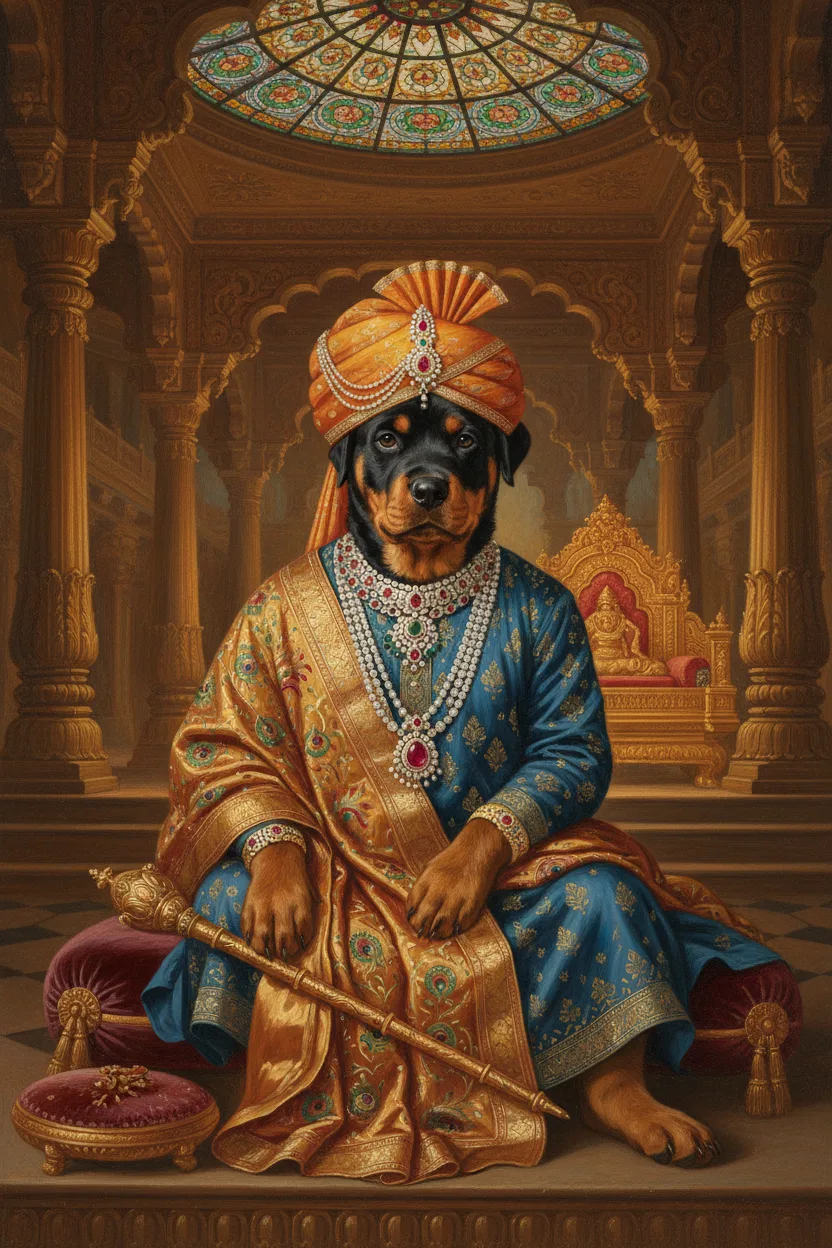
This page explains how to light a framed royal pet portrait in a home so that people can see its colours clearly while the print keeps them as long as possible. It covers how light damage adds up, how much light people actually need, which bulbs show reds and golds correctly, why LED lamps suit art, and where to aim a lamp so it does not bounce off the glass into someone's eyes. The advice comes mostly from the Canadian Conservation Institute, which publishes lighting guidance for museums, and it works for a single portrait over a sofa. The main framing and hanging guide covers the frame and the wall.
Light damage is a dose
Every hour of light adds to the damage. The Institute measures the amount of light falling on a surface in lux, and defines the total exposure, or dose, as the light level in lux multiplied by the time in hours. A dim wall for many hours can give a print the same dose as a bright wall for a few hours.
The Institute's fading tests make the scale clear. One day of sunlight gives the same dose as one year of display at 50 lux. Eight months of sunlight equals 400 years at 50 lux. And the Institute says there is no true recovery from faded colours: restoring them means replacing the original material with new material.
Here are the light levels the Institute gives for common situations:
| Situation | Light level |
|---|---|
| Museum benchmark for works on paper | 50 lux |
| Museum level for oil and acrylic paintings | 150 lux |
| Office lighting | 500 lux |
| A window or a study lamp | 5,000 lux |
| Average daylight | 30,000 lux |
| Direct noon sunlight | almost 100,000 lux |
Two ways to lower the dose follow from the definition. You can lower the light level, with a dimmer or a weaker lamp. Or you can shorten the hours, by switching the lamp off when nobody is in the room. Both count equally.
How much light people need to see
The Institute says 50 lux became the museum benchmark because colour science showed it was enough for the eye to work in full colour vision. Research in the 1980s found that a 25-year-old looking at a light-coloured object of moderate detail sees almost as well at 50 lux as in full sunshine.
That changes with the viewer and the picture. The Institute's visibility table allows up to 3 times the light for each of four harder cases: a dark surface, low-contrast details, fine details, and an older viewer. It says a person aged 65 needs several times as much light as a 25-year-old to see as well, even with glasses. The factors multiply, so an older person looking for fine detail in a dark object could need 3 × 3 × 3 × 3 × 50, or 4,050 lux.
For a pet portrait, two of those cases are common. A black labrador, a black cat or a dark background is a dark surface. A grandparent looking at the portrait is an older viewer. So a dark portrait in a room used by older family members may need more light than 50 lux to be seen well, and it pays to choose a lamp that gives good colour at a modest level instead of a bright one.
Which lamp: halogen, fluorescent or LED
The Institute's bulletin on LED lighting compares the lamps directly. A 60 watt traditional incandescent lamp, a 35 watt halogen lamp and a 9 watt LED lamp all give about the same amount of light. The rest of the power is lost as heat and infrared: 58, 33 and 7 watts. The Institute says there is no infrared radiation from LED lamps, so the light beam is "cold". Its guide to temperature adds that incandescent lamps, including halogen, can heat surfaces because of their high infrared content.
The bulletin also compares lamp life. It gives halogen lamps 2,000 to 2,500 hours and white LED lamps 20,000 to 50,000 hours. At 12 hours a day, that is 5.5 to 6.8 months for halogen and 4.6 to 11.4 years for LED. The Institute sums it up: halogens need replacing twice a year, while LED lamps need changing once a decade.
On damage, the bulletin is careful. It says LED lamps that give good or excellent light cause no extra damage to objects. It also reports that some early consumer LED lamps with a strong blue spike faded some dyes up to twice as fast as a museum-grade lamp. The answer is to buy a good LED lamp, and the next section explains how to recognise one. On ultraviolet, the bulletin says the output of the common blue-pump LED lamps falls by a factor of 1,000 between their blue peak and the ultraviolet boundary at 400 nanometres, and keeps falling beyond it.
Colour: CRI, R9 and colour temperature
CRI
The colour rendering index, or CRI, measures how correctly colours look under a lamp compared with ideal white light. The maximum score is 100. The Institute used to recommend a minimum of 85 for fluorescent lamps and now recommends 90 or above for LED lamps. It says the Energy Star 2017 standard, the most widely used standard for general LED lamps in Canada and the United States, asks only for a CRI of 80, which the Institute does not consider adequate for museums and art galleries.
R9, the red score
CRI is an average over eight pale colours. The Institute says an additional saturated red, labelled R9, is the hardest colour for most LED and fluorescent lamps to show well, even when their CRI is high. It defines two grades:
- Good light: CRI of at least 90 and R9 of at least 50.
- Excellent light: CRI of at least 90 and R9 of at least 90.
R9 matters for royal portraits because so many of them are red. In the gallery, the Maharaja golden retriever wears a red jewelled turban, the Patiala Pomeranian sits on a red throne, and the Regal Feline wears a red and gold robe. The Institute describes lamps with an R9 below zero as completely lacking in red output, and such a lamp cannot show a red turban as it was painted. Look for the CRI and R9 figures on the lamp box or the maker's website before you buy.
Colour temperature
Colour temperature describes whether white light looks warm (yellowish) or cool (bluish), measured in kelvin (K). The Institute says it is a matter of preference, and that the old belief that viewers always prefer warm light at museum levels has been shown to be false. Its one recommendation is to use the same colour temperature for all lamps in one space. It adds that 3000 K, the colour of a halogen lamp, is still the target for many makers of good LED lamps, and calls it a pleasant all-purpose choice for anyone who does not want to experiment.
Where to aim the lamp
Glazing acts like a mirror. Florida State University's guide to reflection explains that a smooth surface reflects light at a definite angle, and that light striking a mirror at an angle is reflected at an equal angle. So a lamp that shines at the glass from the same height as your eyes bounces straight back into them.
Use that rule to place the lamp:
- Put the lamp above the portrait and in front of it. Ceiling track lights, or a wall light fixed above head height, do this. The light hits the glass from above, so its reflection heads downward toward the floor, below the eyes of people standing or sitting.
- Keep the lamp off to the side of the main seat. If the portrait faces a sofa, a lamp placed to one side sends its reflection to the other side, away from the sofa.
- Check from where people sit. Sit in the usual chair and look for a bright spot on the glass. If you see one, move the lamp until it disappears.
Glare also comes from the room. The Institute says any bright lamp or window shining in a viewer's eyes reduces what they can see, and suggests louvers or extension tubes (small tubes that fit over a spotlight to narrow its beam) on lamps, and curtains or blinds on windows. It adds that current LED lamps tend to produce more glare than older lamps because of where the LEDs sit in the lamp, so a fitting that hides the bare lamp from view helps. The page on glass or acrylic for a framed print covers coated glass, which cuts reflections that lamp placement cannot.
Avoid lights fixed to the frame
Some frames carry a small lamp fixed to the top edge. The Institute advises against these. Its guide to framing works on paper says not to attach light fixtures to frames, because they produce excessive light levels, create a hot spot on the picture and add to fading. Its guide for paintings says picture lamps attached to frames are rarely successful, give uneven light and can overheat a painting. Light the portrait from a fixture set back from the wall instead.
Dimmers and timers
A dimmer lowers the light level, and a timer or a habit of switching off lowers the hours. Both lower the dose. The Institute says most LED lamps need special dimmers, because dimmers from old lighting systems may not work properly, and that the right dimmer for each lamp is listed on lamp packages and online.
A short checklist
- Choose a wall that direct sun does not reach. The page on safe places to hang a framed print explains why.
- Buy LED lamps with a CRI of 90 or more and an R9 of 50 or more.
- Use one colour temperature for every lamp in the room.
- Light from above and in front, and check for reflections from every seat.
- Turn the lamp off when the room is empty.
The lamp decides how the colours of the portrait look in your room. If you are still choosing a style, the article on how to choose a royal portrait style for your pet helps you pick colours that suit your pet's coat and your room.
Questions and answers
How much light should fall on a framed print?
A framed print should get as little light as lets people see it well. The Canadian Conservation Institute says museums adopted 50 lux as the benchmark for works on paper, because 50 lux is enough for the eye to see full colour. It lists 500 lux for office lighting and 5,000 lux for a window or study lamp, so a print lit at window level gets 100 times the benchmark.
How does museum lighting compare with sunlight for fading?
Museum lighting fades a print more slowly than sunlight. The Canadian Conservation Institute's fading tests show that one day of sunlight gives the same light dose as one year of display at 50 lux, and that 8 months of sunlight equals 400 years at 50 lux. The Institute defines the dose as light level in lux multiplied by hours of exposure.
Are LED bulbs safe for lighting art prints?
Good LED bulbs are safe for lighting art prints. The Canadian Conservation Institute says LED lamps that give good or excellent light cause no extra damage to objects, and that LED lamps put no infrared heat into the light beam. It warns that some poor LED lamps with a strong blue spike can fade some dyes up to twice as fast as a filtered halogen lamp.
What CRI should a bulb have for lighting art?
A bulb for lighting art should have a colour rendering index (CRI) of 90 or more. The Canadian Conservation Institute recommends this figure for LED lamps. CRI measures how correctly colours look under a lamp compared with ideal white light, on a scale with a maximum of 100. The Institute calls the Energy Star minimum of 80 inadequate for art.
What is R9 on a light bulb?
R9 on a light bulb is the score for how correctly a deep red looks under that lamp. The Canadian Conservation Institute says red is the hardest colour for most LED and fluorescent lamps to show well, even with a high overall CRI. It defines good light as CRI 90 with R9 of at least 50, and excellent light as CRI 90 with R9 of at least 90.
Should art be lit with warm or cool light?
Warm or cool light for art is a matter of taste. The Canadian Conservation Institute says colour temperature, measured in kelvin, is a question of preference, and that the old belief that viewers always prefer warm light at museum levels is false. Its one rule is to use the same colour temperature for every lamp in a room. It calls 3000 K a pleasant all-purpose choice.
Do halogen bulbs heat a framed picture?
Halogen bulbs do heat a framed picture more than LED bulbs. The Canadian Conservation Institute says a 60 watt incandescent lamp, a 35 watt halogen lamp and a 9 watt LED lamp give about the same light, but lose 58, 33 and 7 watts as heat. The light beam of an LED lamp carries no infrared, while incandescent lamps have a high infrared content.
How do you stop a lamp reflecting in a framed picture?
To stop a lamp reflecting in a framed picture, move the lamp so its reflection points away from the viewer's eyes. Florida State University's guide to reflection explains that a smooth surface, such as glass, reflects light at the same angle at which it arrives. A lamp placed high and in front of the picture sends its reflection down toward the floor.
Why do older people need more light to see a picture?
Older people need more light to see the same detail in a picture. The Canadian Conservation Institute says a person aged 65 needs several times as much light as a person aged 25 to see details equally well, even with glasses. Its visibility table allows up to 3 times the 50 lux benchmark for older viewers, and up to 3 times again for dark surfaces.
Do LED bulbs need a special dimmer?
Most LED bulbs need a dimmer made for LED lamps. The Canadian Conservation Institute says dimmers from older lighting systems may not work properly with LEDs, and that information on the right dimmer for each LED lamp is printed on lamp packages and available online. A dimmer lets you lower the light level, which lowers the light dose on the print.
Sources
- Agent of Deterioration: Light, Ultraviolet and Infrared, Canadian Conservation Institute. Accessed September 28, 2026.
- LED Lighting in Museums and Art Galleries (Technical Bulletin 36), Canadian Conservation Institute. Accessed September 28, 2026.
- Agent of Deterioration: Incorrect Temperature, Canadian Conservation Institute. Accessed September 28, 2026.
- Environmental Guidelines for Paintings, Canadian Conservation Institute. Accessed September 28, 2026.
- Framing Works of Art on Paper, Canadian Conservation Institute. Accessed September 28, 2026.
- Specular and Diffuse Reflection, Molecular Expressions, Florida State University. Accessed September 28, 2026.
Short reads on this topic
Articles from Purrspectives that answer one question each.
Cat wall art ideas: choosing a cat portrait for every room
Cat wall art for each room: the print size for a hall, living room, bedroom or small flat, the cat portrait that suits its colours, and where to keep it safe.

Dog wall art ideas: how to choose and hang a portrait of your dog
Good dog wall art fits its wall: pick a print size for the furniture below, hang it with its centre at eye level, and keep it out of direct sun.
How big is an 8 × 10 print? Pet portrait print sizes explained
An 8 × 10 print is 20.32 × 25.4 cm, with a 4:5 shape. See all four portrait print sizes in cm, plus the pixels, frames and mats each one needs.