Matte vs glossy paper: how print surfaces differ
Glossy paper reflects light in one direction and matte paper scatters it. Here is how each inkjet surface is made, measured and cared for, in plain words.
By Purrealism. Part of Art prints and paper: how a portrait print is made, sized and kept.
Matte and glossy papers differ in their top surface, and that surface changes how the print looks, how it reflects the room and how it must be handled. This page explains what gloss is, how it is measured, how inkjet paper makers build matte and glossy surfaces, and what each surface needs in care. It belongs to the guide to art prints and paper. For a short comparison with room advice, the article how big is an 8 × 10 print has a section on the two finishes.
What gloss is
Gloss is the shine of a surface. It comes from how the surface sends light back. Florida State University's guide to light, part of its Molecular Expressions microscopy primer, describes two kinds of reflection. Specular reflection comes from a smooth surface and leaves at one definite angle, the way a mirror reflects. Diffuse reflection comes from a rough surface and spreads in all directions. The guide adds that most things we see around us reflect light diffusely.
A glossy print is close to the smooth case. From most places in a room you see the picture, and from one angle you also see a bright reflection of a lamp or window. A matte print is close to the rough case. It spreads that light around, so no single bright reflection forms.
How gloss is measured
Gloss has a standard test. ASTM International's D523, the standard test method for specular gloss, measures it with a glossmeter at one of three angles: 20, 60 or 85 degrees. The instrument compares the light reflected by the sample at the mirror angle with the light reflected by a black glass standard.
The standard's summary says gloss is linked to a surface's ability to reflect more light close to the mirror direction than in other directions, and that its readings match what people see as shininess at the same angles. It also names other parts of how a surface looks that people use when they judge gloss: how sharply a reflected image appears, reflection haze and texture. So two papers with the same gloss number can still look different.
How inkjet papers get their surface
Plain paper soaks up inkjet ink and dulls it, so photo and art papers carry a coating on top. The Image Permanence Institute at Rochester Institute of Technology calls it an image receiver layer and describes how the main kinds developed.
Porous coatings on art paper
The first coatings went onto art papers such as watercolour paper. They were made of mineral particles in a starch or plastic binder, and the ink soaked into the spaces between the particles. The Institute says the early particles were too large to form a smooth, glossy surface, so these papers were always matte or kept the texture of the sheet underneath. The Historic New Orleans Collection says cotton rag "watercolour" paper has a more textured surface and gives a softer image.
Resin-coated photo papers
Later, makers copied traditional photo paper. They used resin-coated paper, called RC paper: a sheet laminated on both sides with a thin layer of polyethylene, a plastic. The Institute says the front layer is coloured white so the image looks bright. There are two kinds of inkjet RC paper:
- Polymer-coated, also called swellable: a plastic layer swells and takes the ink inside it. The Institute says these papers can be made glossier than porous papers, and the ink inside the layer resists scuffs and air pollution. They are used with dye inks, because many pigment particles are too large to enter the layer. They can take from several minutes to several hours to dry.
- Porous-coated: mineral particles on an RC base, smaller and more tightly packed than on art paper, which makes the surface glossier. These work with dye and pigment inks. The Institute says they are often sold as glossy but reach less gloss than polymer papers or traditional glossy photos.
Baryta papers
Photographers who liked traditional fibre-based darkroom prints asked for something similar. The Institute says baryta inkjet papers may or may not actually contain baryta, but all have a smoothing layer between the paper and the porous ink coating. The back is left uncoated to keep a fibrous paper feel. The Historic New Orleans Collection says baryta paper gives rich black tones.
Canvas
Canvas is a third choice with its own surface. The Image Permanence Institute describes inkjet canvas as a woven fabric with a porous coating, made to copy the texture and look of painting canvas. It says canvas has been popular for inkjet printing in both decorative art and photography, and that canvas for inkjet always carries a porous coating. Its woven texture scatters light in the same way a matte paper does.
Plain paper
For comparison, the University of Illinois guide says uncoated office paper gives images that are neither bright nor sharp, because the paper absorbs the ink directly, and that the amount of ink in a picture usually makes the paper cockle, which means it wrinkles and waves.
| Surface | Coating | Inks it takes | Main strength | Main weak point |
|---|---|---|---|---|
| Matte art paper | Porous, on an uncoated sheet | Dye or pigment | Texture of the sheet | Open pores leave ink exposed to air |
| Glossy polymer RC | Swelling plastic | Dye | Highest gloss, resists scuffs | Slow to dry, can bleed in damp air |
| Glossy porous RC | Porous, on an RC base | Dye or pigment | Dries at once | Less gloss than polymer, open pores |
| Baryta | Porous, over a smoothing layer | Dye or pigment | Look of a darkroom print | Surface can scuff |
Reading the label
The University of Illinois Library's preservation guide says paper makers rarely state whether a paper is porous or swellable. It gives clues. A paper labelled "instant dry" is porous. A swellable paper may be labelled "fast drying", and may say "high gloss" instead of "glossy". Its guide adds that swellable papers can take up to 24 hours to dry fully, while porous papers dry at once. Many papers also carry the maker's name printed on the back.
Uneven shine with pigment ink
Pigment ink is made of tiny solid particles, and the University of Illinois guide says they leave shallow deposits on the paper. The same guide says a pigment print on glossy coated paper can show differential gloss: the heavily inked areas and the areas with little or no ink shine differently, and the difference is easiest to see under direct light.
Caring for each surface
Each surface has its own risk when prints touch each other or a sleeve.
- Blocking and ferrotyping. The Image Permanence Institute defines blocking as materials sticking together by accident, and ferrotyping as a change in surface shine caused by contact with another surface under humidity or pressure. In its tests, reported by the American Institute for Conservation, matte colour photos in photo books blocked less than glossy ones, and swelling polymer inkjet papers were also at risk.
- Scuffing. The University of Illinois guide says prints on porous paper scuff more easily than prints on swellable paper. The Institute's tests found pigment inkjet more sensitive to smearing than any other print process.
- Drying. The Institute says handling polymer-coated prints while they are still wet can smudge the ink, and that all prints should dry fully before they are stacked or interleaved.
The page on storing unframed prints turns these points into steps, and the page on lightfastness and fading explains why open porous coatings matter for fading.
Choosing a surface for a portrait
Three questions help. First, where will the light come from? A window or lamp facing a glossy print will show as a bright patch from some places in the room. Second, how much fine detail does the portrait have? A smooth surface keeps fine lines crisp, while a textured art paper gives a softer image. Third, who will handle it? A print that will be passed around before framing is safer on a surface that resists scuffs.
What this means for a royal pet portrait
Purrealism art prints come in two paper finishes, matte and glossy, in four sizes from 8 × 10 to 24 × 36 inches. You choose the finish in the portrait studio. If you plan to frame the print behind glass, the guide to framing and hanging covers glazing and reflections.
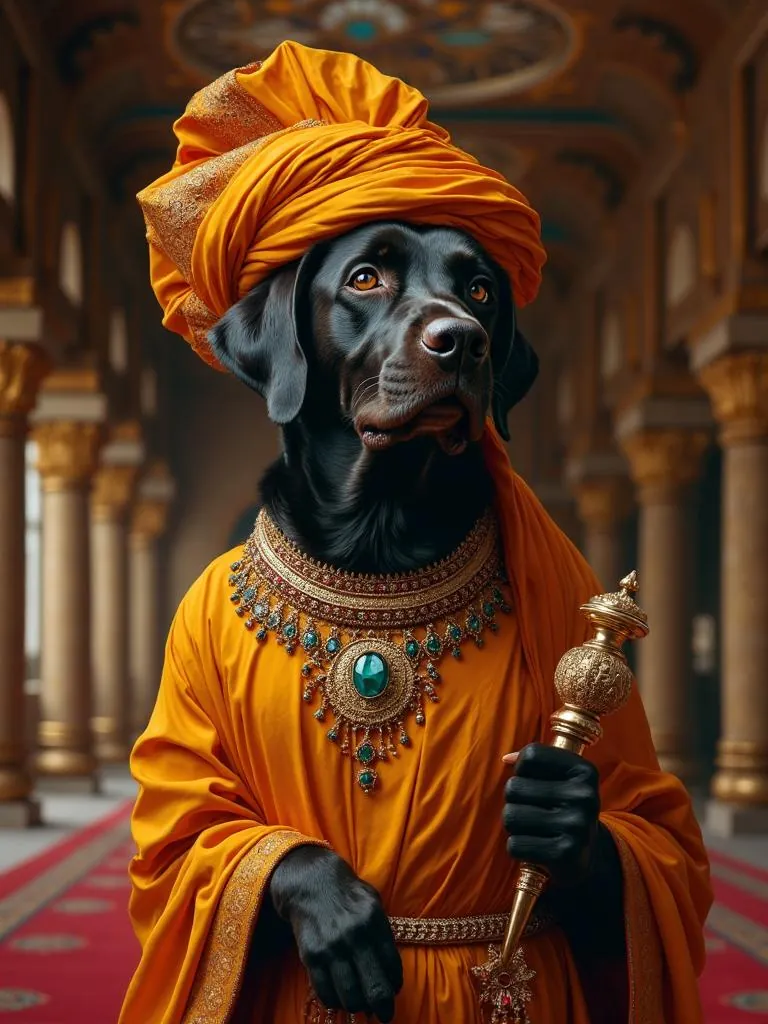
In the Mysore Royal portrait in the gallery, a black labrador in a saffron turban holds a gold sceptre, and the dog's black coat fills a large part of the picture. Dark areas carry the most ink, and the University of Illinois guide says differential gloss shows between areas of high and low ink density. On glossy paper, look at such a print under the light where it will hang. The page on paper weight covers the other number you will see on a paper packet.
Questions and answers
Which inkjet paper surface is the glossiest?
The glossiest inkjet paper surface is a swelling polymer coating on a resin-coated base. The Image Permanence Institute says these papers can be made glossier than porous-coated papers, and that porous photo papers sold as glossy reach less gloss than polymer papers or traditional glossy photographs. Polymer papers take dye inks only and can need hours to dry.
What is the difference between matte and glossy photo paper?
The difference between matte and glossy photo paper is the smoothness of the top surface. Florida State University's guide to light explains that a smooth surface reflects light at one definite angle, while a rough surface reflects it in all directions. ASTM D523, the standard test for gloss, measures how much light a surface sends back at a set angle compared with black glass.
Does matte or glossy last longer?
How long a matte or glossy print lasts depends on its coating and its ink. The Image Permanence Institute says swelling polymer coatings, used for high gloss papers, protect the ink from scuffs and air pollution, while porous coatings leave their pores open after drying, so colours are more exposed to pollution. Pigment ink has tended to resist light and moisture better than dye ink.
What is baryta paper?
Baryta paper is an inkjet paper made to look like traditional fibre-based black and white photo paper. The Image Permanence Institute says baryta inkjet papers may or may not actually contain baryta, but all have a smoothing layer under the porous ink coating and an uncoated back. The Historic New Orleans Collection says baryta paper gives rich black tones.
What is resin-coated photo paper?
Resin-coated photo paper, called RC paper, is paper laminated on both sides with a thin layer of polyethylene plastic. The Image Permanence Institute says the layer adds stiffness and resists water, and that the front layer is coloured white to make the image look bright. Inkjet RC papers come in two types: polymer-coated, which swells to take in ink, and porous-coated.
How is paper gloss measured?
Paper gloss is measured with a glossmeter, which shines light at a set angle and reads how much reflects at the mirror angle. ASTM D523 describes the method for angles of 20, 60 and 85 degrees and compares each reading with a black glass standard. The standard says its readings match what people see as shininess at the same angles.
What does instant dry mean on inkjet photo paper?
Instant dry on an inkjet photo paper label means the paper has a porous coating. The University of Illinois Library says papers labelled instant dry are porous, because mineral particles form tiny pores that take in the ink at once. Swelling polymer papers may be labelled fast drying or high gloss instead, and can take up to 24 hours to dry fully.
Why does a pigment print look patchy on glossy paper?
A pigment print can look patchy on glossy paper because inked areas and blank areas shine differently. The University of Illinois Library calls this differential gloss and says it shows most under direct light, between areas of high and low ink density. The library uses this uneven shine as one way to recognise a print made with pigment inks.
Why do glossy prints stick together?
Glossy prints can stick together when their faces touch under humidity or pressure, a fault called blocking. In Image Permanence Institute tests reported by the American Institute for Conservation, matte colour photos in photo books blocked less than glossy ones, and swelling polymer inkjet papers were also at risk. The researchers advised against storing such prints face to face without interleaving sheets.
Is glossy photo paper easier to scratch?
Scratch risk on photo paper depends on the coating and the ink. The University of Illinois Library says inkjet prints on porous paper are more likely to be scuffed than prints on swelling polymer paper, because the ink in a polymer coating sits inside the layer. The Image Permanence Institute adds that pigment ink prints are the most sensitive to abrasion.
Sources
- IPI's Guide to Preservation of Digitally-Printed Images, Image Permanence Institute, Rochester Institute of Technology. Accessed September 28, 2026.
- Digital Prints, Preservation Self-Assessment Program, University of Illinois Library. Accessed September 28, 2026.
- D523 Standard Test Method for Specular Gloss, ASTM International. Accessed September 28, 2026.
- Specular and Diffuse Reflection, Molecular Expressions, Florida State University. Accessed September 28, 2026.
- Inkjet/Giclée Print Process, The Historic New Orleans Collection. Accessed September 28, 2026.
- Lessons in Digital Print Preservation: The DP3 Project, American Institute for Conservation, Topics in Photographic Preservation, Volume 14. Accessed September 28, 2026.
Short reads on this topic
Articles from Purrspectives that answer one question each.
Cat wall art ideas: choosing a cat portrait for every room
Cat wall art for each room: the print size for a hall, living room, bedroom or small flat, the cat portrait that suits its colours, and where to keep it safe.
Dog wall art ideas: how to choose and hang a portrait of your dog
Good dog wall art fits its wall: pick a print size for the furniture below, hang it with its centre at eye level, and keep it out of direct sun.
How big is an 8 × 10 print? Pet portrait print sizes explained
An 8 × 10 print is 20.32 × 25.4 cm, with a 4:5 shape. See all four portrait print sizes in cm, plus the pixels, frames and mats each one needs.