The smartest dog breeds, and how dog intelligence is measured
In Stanley Coren's ranking, the smartest canine breed is the Border Collie, then the Poodle and the German Shepherd Dog. How the list was made, and its limits.
By Purrealism

The smartest canine breed in the best-known ranking is the Border Collie. That ranking comes from Stanley Coren, a professor emeritus of psychology at the University of British Columbia, in his book The Intelligence of Dogs. This guide lists the smartest dog breeds in his order, explains how the list was made, and then looks at what scientists have learned by testing dogs directly.
Which is the smartest dog breed?
The American Kennel Club publishes the top of Coren's ranking. These are the first ten breeds, in his order:
- Border Collie
- Poodle
- German Shepherd Dog
- Golden Retriever
- Doberman Pinscher
- Shetland Sheepdog
- Labrador Retriever
- Papillon
- Rottweiler
- Australian Cattle Dog
The full list covers more than 100 breeds. The American Kennel Club calls the book controversial.
How the ranking was made
Coren's book was first published in the early 1990s. His university lists a revised edition from 2006.
Coren describes three types of dog intelligence. In a 2009 release from the American Psychological Association, he named them:
- Instinctive intelligence: what the dog was bred to do, such as herding sheep.
- Adaptive intelligence: how well the dog learns from its surroundings to solve problems on its own.
- Working and obedience intelligence: how well the dog learns what people teach it. Coren compared this to "school learning".
The ranking measures the third type. The APA release says it used data from 208 dog obedience judges in the United States and Canada. So the list ranks breeds by how well they learn from people and obey, as those judges rated them. Coren also told the APA that a dog's breed decides some of the differences in intelligence between dogs.
In the same talk, Coren said that by several measures a dog's mental ability is close to that of a human child aged 2 to 2.5 years. He said the average dog can learn 165 words, including signals, and can count up to four or five.
What the top breeds were bred to do
The kennel clubs describe what six of the top breeds were bred to do.
The Royal Kennel Club says the Border Collie takes its name from the border regions of England, Scotland and Wales, where it worked sheep in the hills. The club says its intelligence, speed and range of skills have brought it success in obedience, agility and as a sniffer dog that finds explosives and drugs.
The Poodle comes from Germany, according to the Royal Kennel Club, where it was bred as a water retriever for duck hunters. The club recognises three sizes that share one breed standard.
The Royal Kennel Club says Max von Stephanitz developed the German Shepherd Dog as a herding dog. Police and armed forces later used it, and it also works as a guide dog for the blind and a tracking dog.
The American Kennel Club calls the Golden Retriever a Scottish gundog. It says the breed works in hunting, as a guide for the blind and in search and rescue.
The Doberman Pinscher, which the Royal Kennel Club calls the Dobermann, takes its name from Louis Dobermann, a tax collector in Apolda, Germany, who wanted a dog to protect him at work. The Royal Kennel Club says armed forces and police have used the breed's intelligence and trainability.
The Labrador Retriever comes from Newfoundland, according to the Royal Kennel Club. Dogs there helped fishermen retrieve nets and lost lines.
The rest of the top ten
The Royal Kennel Club describes what the last four breeds in Coren's top ten were bred to do.
The Shetland Sheepdog comes from the Isles of Shetland, off the northeast coast of Scotland, according to the Royal Kennel Club. The club says the breed descends from Scottish sheepdogs, the same ancestry that also produced the Collie and the Bearded Collie, and that it was shaped to herd on the islands' small farms. Today the breed competes in obedience and agility as well as the show ring.
The Papillon comes from France and Belgium, where the Royal Kennel Club says it was bred as a lap dog and companion for European aristocratic society, kept by figures including Madame de Pompadour and Queen Marie Antoinette. The club calls it a "dwarf spaniel" in Europe. Despite a companion breeding history rather than a working one, the Papillon now competes in obedience and agility.
The Rottweiler comes from Rottweil in southwest Germany, according to the Royal Kennel Club, where cattle dealers and farmers bred it to drive cattle to market and guard against robbers. The club traces its ancestry to mastiff-type dogs left behind by Roman armies, crossed with local sheepdogs. Farmers trusted the breed enough to hang money bags from its collar on the way home from market.
The Australian Cattle Dog was developed in Australia to herd cattle on large stations, the Royal Kennel Club says, by crossing dingoes with the drovers' dogs colonial settlers brought with them. The club notes that its exact ancestry is not fully known. It works by crouching low and nipping at the heels of cattle to move them, which is also why it is called a Blue Heeler or Red Heeler.
How many words can a dog learn?
Word learning is one skill that scientists have tested in single dogs. The two best-known cases are both Border Collies.
In 2004, researchers at the Max Planck Institute for Evolutionary Anthropology in Leipzig reported in Science that a Border Collie named Rico knew the names of over 200 items, mostly toys and balls. When he heard a new name, Rico picked out the one toy he did not know, and he still remembered it four weeks later. Scientists call this "fast mapping". Young children use it to learn new words after hearing them once.
In 2011, John Pilley and Alliston Reid of Wofford College reported in Behavioural Processes that a Border Collie named Chaser had learned the names of 1,022 objects over three years of intensive training.
Researchers at the Family Dog Project, at Eötvös Loránd University in Budapest, have studied how rare this skill is. In a 2021 study in Scientific Reports, they gave three months of training on two new toy names to 34 ordinary family dogs and to 6 dogs that already knew many toy names. All 6 of the dogs with a vocabulary passed the tests, and only 1 of the ordinary dogs did. Eighteen of the ordinary dogs were Border Collies, and only one of those 18 passed.
The group now calls these rare dogs Gifted Word Learners. In a 2023 study of 41 of them, 23 were Border Collies. The others included Labradors, Pomeranians, a German Shepherd and a Toy Poodle. The American Kennel Club reports that most Border Collies lack this skill, even after extensive training.
Does intelligence vary by breed?
Scientists now test dogs directly. The Duke Canine Cognition Center, founded in 2009, says it was the first centre of its kind on a university campus in the United States.
A 2019 study in Animal Cognition, with Duke's Brian Hare among its authors, used data on more than 7,000 purebred dogs from 74 breeds. Breeds with larger brains did better on short-term memory and self-control. For other skills, the results varied widely.
A 2022 study led from the University of Helsinki tested 1,002 dogs of 13 breeds with the same tasks. Breeds differed in understanding human gestures, in solving a detour problem, and in self-control. Border Collies and Australian Shepherds scored among the highest on self-control. The study found no significant breed differences in memory or logical reasoning.
A 2022 study in Science, described by the Broad Institute of MIT and Harvard, looked at 18,385 dogs through owner surveys and 2,155 through their DNA. Breed explained 9 percent of the differences in behaviour between dogs. A breed ranking gives a general picture, and each dog can differ from its breed.
Your clever dog in a royal portrait
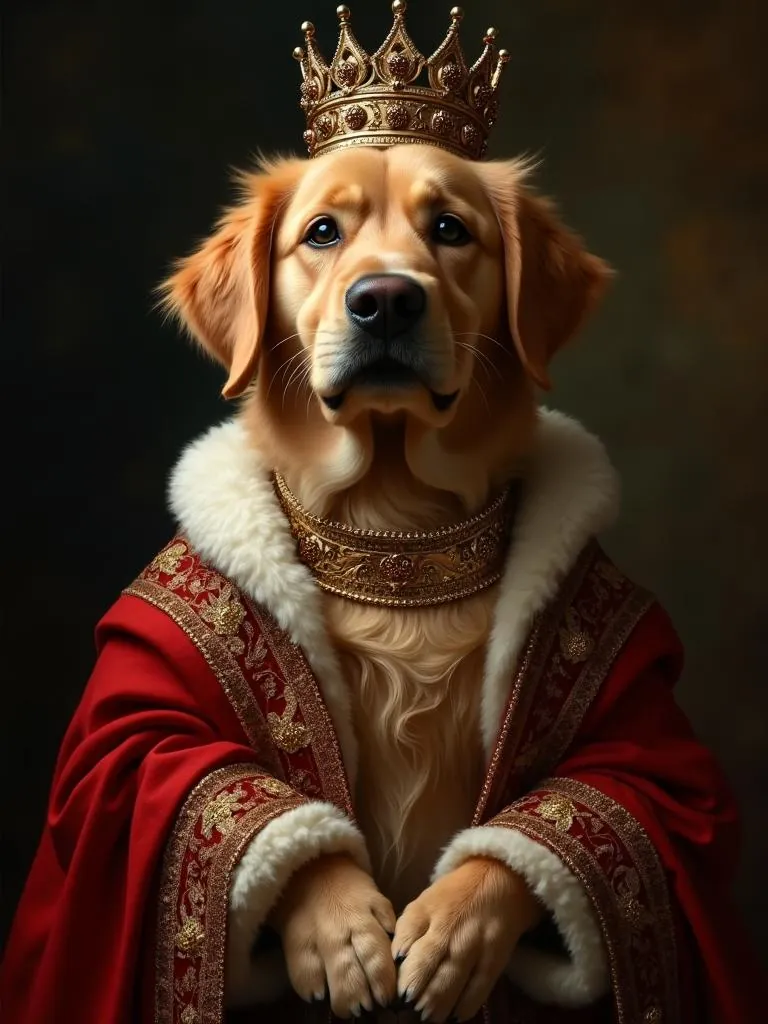
Two breeds from the top ten already appear in the Purrealism gallery. A golden retriever sits as a Maharaja in a red jewelled turban on a gold throne. A black labrador stands as Mysore royalty in a saffron turban, holding a gold sceptre.
If your dog is better known for its face than its brain, the guide to the cutest dog breeds is the one to read. For dogs that lived with kings and queens, see royal dogs in history. When you are ready, add a clear photo of your dog in the portrait studio and pick one of the 15 royal styles.
Questions and answers
What is the smartest dog breed?
The Border Collie is the smartest dog breed in the best-known ranking, made by psychologist Stanley Coren of the University of British Columbia. According to the American Psychological Association, Coren built the list from data given by 208 dog obedience judges in the United States and Canada. The Poodle came second and the German Shepherd Dog third. The list measures how well a breed learns from people and obeys.
What are the most intelligent dogs in order?
The most intelligent dogs in order, in Stanley Coren's ranking as the American Kennel Club publishes it, are the Border Collie, Poodle, German Shepherd Dog, Golden Retriever, Doberman Pinscher, Shetland Sheepdog, Labrador Retriever, Papillon, Rottweiler and Australian Cattle Dog. Coren is a professor emeritus of psychology at the University of British Columbia. The order comes from his book The Intelligence of Dogs.
How is dog intelligence measured?
Dog intelligence is measured by expert ratings and by direct tests. Stanley Coren used data from 208 dog obedience judges to rank breeds, according to the American Psychological Association, so his ranking rests on expert opinion about obedience. Scientists also test the dogs themselves with set tasks. A University of Helsinki study in Scientific Reports gave 1,002 dogs of 13 breeds the same tests of problem solving, self-control, memory and reading human gestures.
Does dog intelligence vary by breed?
Dog intelligence varies by breed for some skills and not for others. A 2022 University of Helsinki study of 13 breeds, published in Scientific Reports, found breed differences in understanding human gestures, solving a detour problem and self-control. It found no significant breed differences in tasks that measured memory or logical reasoning. Border Collies and Australian Shepherds were among the highest scorers on self-control.
Is dog intelligence genetic?
Genes play a part in dog intelligence and behaviour, but a dog's breed explains only a small share. A 2022 study in Science by UMass Chan Medical School and the Broad Institute of MIT and Harvard used 2,155 dog genomes and 18,385 owner surveys, and found that breed explained 9 percent of behaviour differences between dogs. Researchers at Eötvös Loránd University say the many Border Collies among word-learning dogs suggest a genetic influence.
How many words can the most intelligent dog understand?
A Border Collie named Chaser learned and remembered the names of 1,022 objects, according to a 2011 study in the journal Behavioural Processes. John Pilley and Alliston Reid of Wofford College report that she learned the names over three years of intensive training. Chaser also learned three common nouns, which are words that name a whole group of objects. Rico, another Border Collie, knew the names of over 200 items.
What is a dog's intelligence level compared to humans?
A dog's intelligence level is close to that of a human child aged 2 to 2.5 years, according to Stanley Coren of the University of British Columbia. The American Psychological Association reported his view in 2009. Coren said the average dog can learn 165 words, including signals, and can count up to four or five. He based this on several behavioural measures from studies he reviewed.
Does dog brain size affect intelligence?
Dog brain size affects some kinds of intelligence. A 2019 study in Animal Cognition, with Brian Hare of Duke University among its authors, used data on more than 7,000 purebred dogs from 74 breeds. Breeds with larger brains did better on tests of short-term memory and self-control. For other thinking skills, the link between brain size and results varied widely.
Are poodles the most intelligent dog?
Poodles are the second most intelligent dog breed in Stanley Coren's ranking, after the Border Collie. The ranking, reported by the American Psychological Association, rates how well a breed learns from people and obeys. The Royal Kennel Club says the Poodle comes from Germany, where it was bred as a water retriever for duck hunters, and that it has three sizes.
Are labradors the most intelligent dogs?
Labradors are the seventh most intelligent dog breed in Stanley Coren's ranking of obedience and working intelligence. The Royal Kennel Club says the breed comes from Newfoundland, where dogs helped fishermen retrieve nets and lost lines, and that Labradors now work as service dogs, guide dogs and gundogs. The Purrealism gallery shows a black labrador as Mysore royalty in a saffron turban.
Sources
- Stanley Coren, University of British Columbia, Department of Psychology
- Canine researcher puts dogs' intelligence on par with 2-year-old human, American Psychological Association
- Measuring Canine Intelligence: Ranking the Smartest Dog Breeds, American Kennel Club
- So You Think You Can Live With the World's Smartest Dog?, American Kennel Club
- Word learning in a domestic dog: evidence for fast mapping, Science (Max Planck Institute for Evolutionary Anthropology)
- Border collie comprehends object names as verbal referents, Behavioural Processes (PubMed)
- Word learning dogs (Canis familiaris) provide an animal model for studying exceptional performance, Scientific Reports
- A citizen science model turns anecdotes into evidence by revealing similar characteristics among Gifted Word Learner dogs, Scientific Reports
- Genius Dog Challenge and the Genius Dog Research Group, Eötvös Loránd University, Department of Ethology
- What Is a Gifted Word Learner Dog, and Do You Have One?, American Kennel Club
- Duke Canine Cognition Center, Duke University, Department of Evolutionary Anthropology
- Absolute brain size predicts dog breed differences in executive function, Animal Cognition (Scholars@Duke)
- Breed differences in social cognition, inhibitory control, and spatial problem-solving ability in the domestic dog (Canis familiaris), Scientific Reports
- Dog genetics suggest that behavior is more than just breed, Broad Institute of MIT and Harvard
- Border Collie, The Royal Kennel Club
- Poodle (Standard), The Royal Kennel Club
- German Shepherd Dog, The Royal Kennel Club
- Golden Retriever, American Kennel Club
- Dobermann, The Royal Kennel Club
- Retriever (Labrador), The Royal Kennel Club
- Shetland Sheepdog, The Royal Kennel Club
- Papillon, The Royal Kennel Club
- Rottweiler, The Royal Kennel Club
- Australian Cattle Dog, The Royal Kennel Club
Go deeper
The full guides on this topic, each a set of pages with sources: