French Bulldog history: from Nottingham lace makers to Paris and America
The French Bulldog began as a toy Bulldog kept by lace makers in Nottingham, England. How it reached Paris, got its bat ears in America and became No. 1.
By Purrealism
The French Bulldog is the most registered dog breed in the United States, and its story starts in England. It began as a small Bulldog kept by lace makers in Nottingham. The dogs moved with their owners to France, became fashionable in Paris, and got their famous ears from American owners. This guide follows that path, explains the breed's health problems, and ends with how to photograph a Frenchie for a royal portrait.
Toy Bulldogs in England
The French Bulldog comes from the Bulldog, Britain's native breed. According to the American Kennel Club (AKC), bull-baiting and other animal fights were banned in England in the 1830s. After that, Bulldogs went into the show ring. Shows divided them into classes by size, and the smallest had a class of their own: the English Toy Bulldog.
The AKC's breed page says a toy-size Bulldog became popular in some English cities in the mid-1800s, including Nottingham. Nottingham was then a centre of lace making, and the toy Bulldog became a kind of mascot for the city's lace makers. The French Bull Dog Club of America, the breed's club in the United States, also places the little dogs with the artisans of the lace trade around Nottingham, in the English Midlands.
From Nottingham to northern France
The move to France came with the Industrial Revolution. The AKC says lace making by hand, done in homes and small workshops, was under threat in this period, and many people in the lace trade moved to northern France. They brought their toy Bulldogs with them. The AKC's history article names the area as Normandy.
The small dogs became popular in the French countryside where the lace makers settled. Over several decades, the AKC says, the toy Bulldogs were crossed with other breeds, possibly terriers and Pugs. Along the way they developed their upright ears, and they were given the name Bouledogue Français, which is French for French Bulldog.
Paris in the 1890s
From the countryside the breed reached Paris. The AKC says the Frenchie came to be linked with Paris cafe life and with the dancehalls of the city at night. Two painters of that world, Edgar Degas and Henri de Toulouse-Lautrec, showed the dog in their pictures. The AKC's history article describes the dogs seen in Montmartre in the 1890s as compact and snub-nosed, sometimes with round, upright ears, and with a large personality.
The breed also reached royal homes. The same article says Grand Duchess Tatiana Nikolaevna, a daughter of Tsar Nicholas II of Russia, had a French Bulldog named Ortipo. It also records a French Bulldog on the Titanic.
England was slower to accept the new breed. The AKC explains that the Bulldog was a national symbol, and many English people were unhappy that the French had adapted it.
American owners and the bat ear
By the end of the 1800s the breed had spread across Europe and to America. The French Bull Dog Club of America says wealthy Americans saw the little dogs in Paris and began to bring them home. Society women first showed French Bulldogs at the Westminster dog show in New York in 1896, and a Frenchie appeared on the cover of the 1897 Westminster catalogue.
The ears became the subject of a disagreement. French breeders preferred the rose ear, a small ear that folds back. American owners preferred ears that stood up straight. The French Bull Dog Club of America, founded in 1897, calls itself the first club in the world for this breed, and it wrote a breed standard that allowed only the bat ear. The AKC says American owners of the early 1900s insisted that the bat ear was the correct type, and that this feature makes a Frenchie easy to recognize anywhere.
The AKC recognized the French Bulldog as a breed in 1898, according to its breed page.
The most popular breed in the United States
The AKC ranks breeds each year by the number of dogs registered with it. In its ranking for 2025, published in 2026, the French Bulldog came first for the fourth year in a row. The Labrador Retriever, Golden Retriever, German Shepherd Dog and Dachshund completed the top five.
The AKC's breed page describes the French Bulldog as playful, alert and adaptable. It stands 11 to 13 inches tall and weighs under 28 pounds. It has a large square head, heavy wrinkles above a short nose, and a smooth coat over a compact, muscular body. The AKC says Frenchies do not bark much, get on well with other animals, and need only a short walk or play session each day. The AKC calls it one of the world's most popular small breeds, above all with people who live in cities.
The short face and the Frenchie's health
The French Bulldog is brachycephalic, a word that means short-skulled. The AKC explains that the short face makes breathing less efficient than in long-nosed breeds. Frenchies therefore cope poorly with heat, exercise and stress, because all three make a dog breathe harder. The AKC advises owners to see a vet if the dog overheats easily or breathes noisily, and to choose a vet with experience of short-faced breeds before any anaesthetic.
The AKC lists other concerns too. Frenchies cannot swim, because of their front-heavy build, and should never be left alone near a pool or a bath. They gain weight easily. Some develop eye conditions, skin allergies or back problems. The AKC gives a life expectancy of 10 to 12 years.
A study by researchers at the Royal Veterinary College in London, published in 2021, measured these risks. Its authors compared the vet records of 2,781 French Bulldogs with those of 21,850 other dogs in the UK. Of 43 common disorders, French Bulldogs had higher odds of 20 and lower odds of 11. The largest differences were in the airway. French Bulldogs had 42.14 times the odds of narrowed nostrils, and 30.89 times the odds of brachycephalic obstructive airway syndrome, a group of breathing problems caused by the short skull. The authors conclude that the health of French Bulldogs has moved far from the health of other dogs, and link many of the differences to the extreme body shape that defines the breed.
For an owner, the lesson is practical. Keep walks short on hot or humid days, watch the dog's weight, and learn how your own dog sounds when it breathes normally.
Portraying a French Bulldog in a royal style
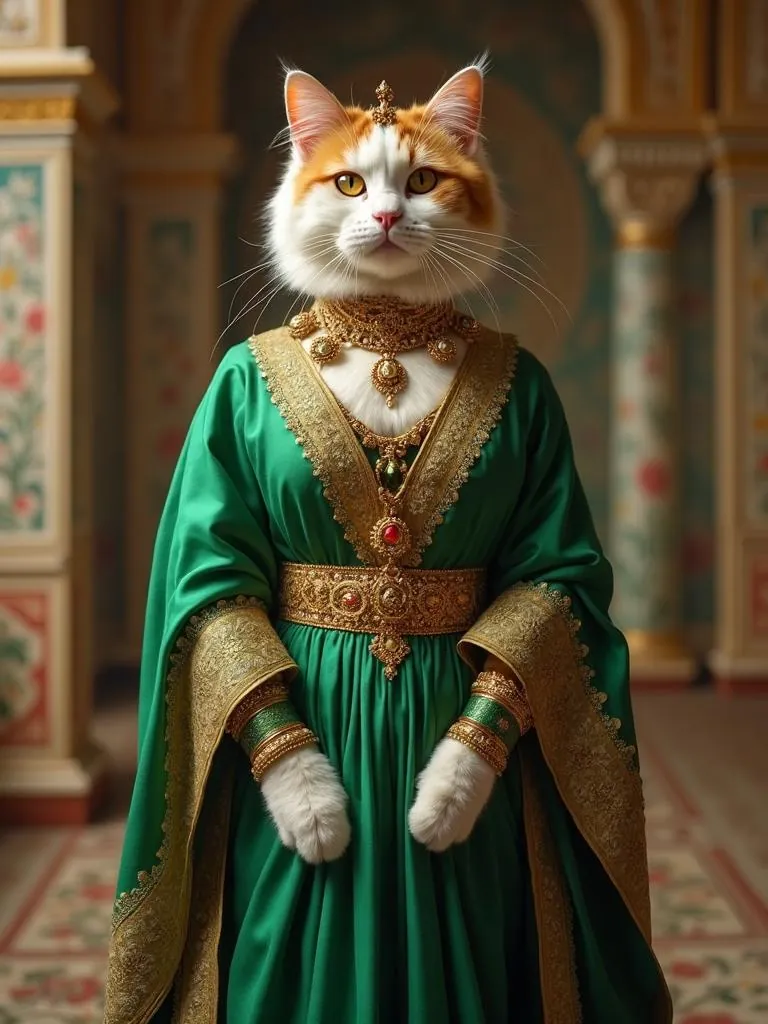
A Frenchie brings three strong features to a portrait: the square head, the bat ears and the wrinkles above the short nose. A royal portrait works best when all three stay clear. A turban or a crown should sit between or behind the ears, so their shape still shows.
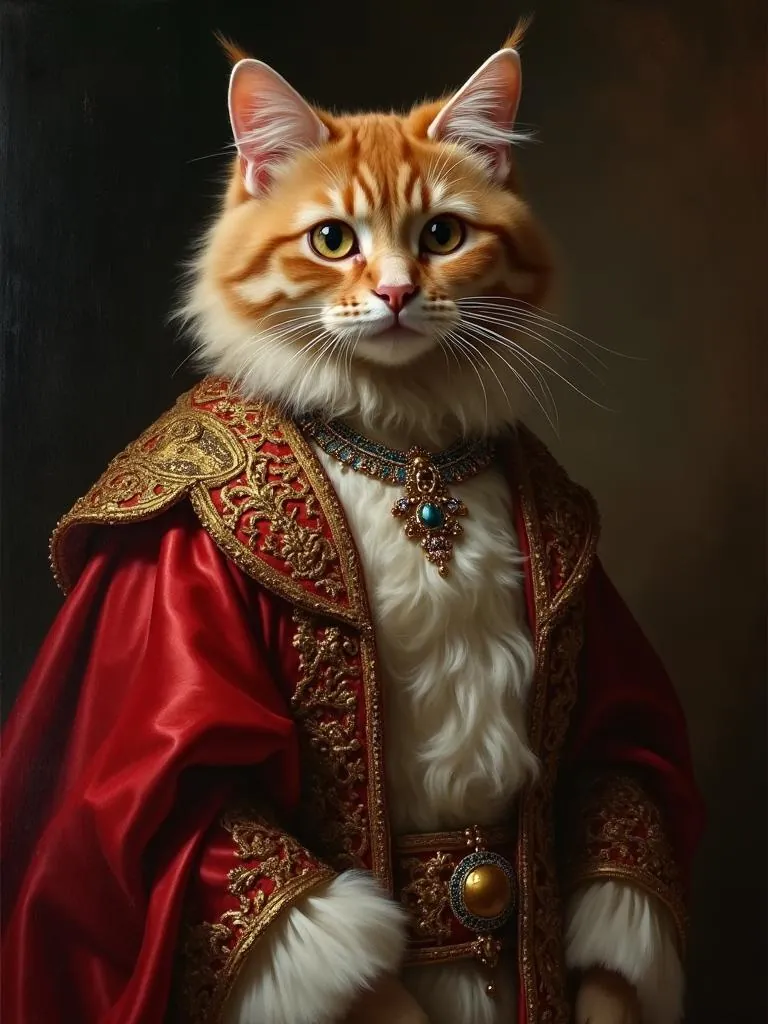
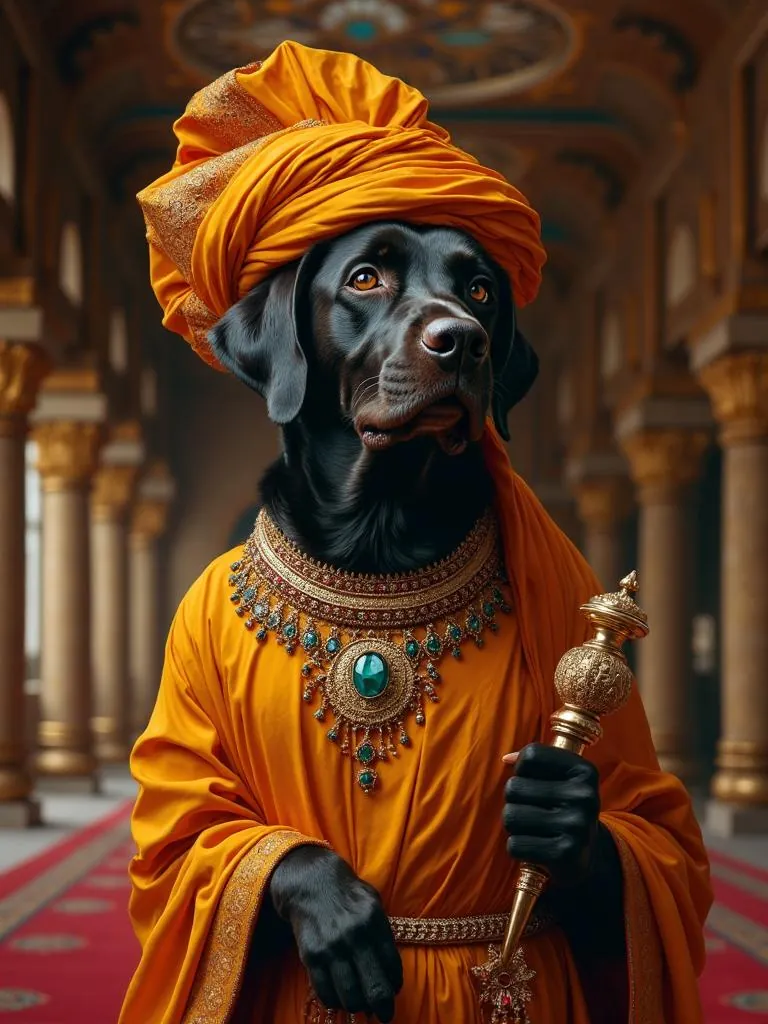
Coat colour guides the choice of clothes. The AKC lists brindle, cream, fawn, fawn brindle and white as standard colours, with combinations such as fawn and white. A fawn or cream Frenchie stands out against deep colours. The Maharaja portrait in the gallery, a golden retriever in a red jewelled turban on a gold throne, shows how a warm coat reads against red and gold. A brindle coat has dark stripes, so it suits lighter clothes. A dark Frenchie suits saffron and gold, like the black labrador in the Mysore Royal portrait at the top of this page, which wears a saffron turban and holds a gold sceptre. The history of that style is in the guide to Mysore painting.
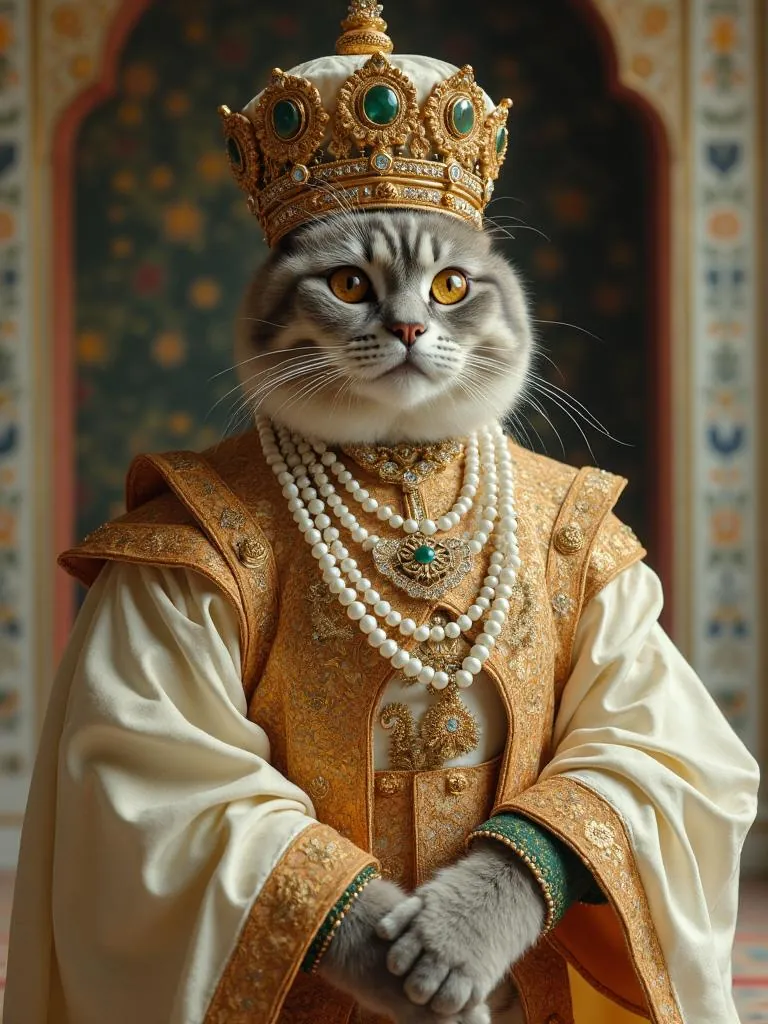
For history, the breed's own period is the late 1800s. Purrealism has a Victorian Noble style, one of 15 royal styles, and its years match the decades when the Frenchie moved from Nottingham to Paris and New York. The guide on how to choose a royal portrait style for your pet compares all 15 by coat colour and character.
Photographing a Frenchie for a portrait
The photo matters more than the style. For a short-faced dog, a few points help:
- Keep the session cool and short. The AKC warns that heat and exertion are hard on Frenchies. Take photos indoors or in the cool part of the day, and stop when your dog starts to pant hard.
- Hold the camera at eye level. The face is flat, so a photo from above hides the nose and makes the head look smaller.
- Show both ears in full. The bat ears are the breed's signature, and a portrait built from a photo with one ear cut off will lose it.
- Light the wrinkles from the side. Soft window light from one side shows the folds of the face. Light from straight in front makes them flat.
The guide on how to photograph your pet for a portrait has ten more tips, all of which work with a phone. When you have a clear, sharp photo of your Frenchie's face, the portrait studio takes one image file of up to 5 MB and lets you choose from all 15 styles.
Questions and answers
Are French bulldogs from France?
French Bulldogs began in England and were developed in France. The American Kennel Club says a toy-size Bulldog was popular in Nottingham in the mid-1800s, where it became a mascot for the city's lace makers. Many lace workers moved to northern France and took their dogs with them. In France the little dogs were crossed with other breeds and given the name Bouledogue Français.
What were French bulldogs originally bred for?
French Bulldogs were bred as small companion dogs. The American Kennel Club says the breed comes from the Bulldog, which went into the show ring after bull-baiting and other animal fights were banned in England in the 1830s. Shows had classes by size, including one for the smallest dogs, the English Toy Bulldog. Lace makers in Nottingham kept these toy Bulldogs as lapdogs and later took them to France.
When did French bulldogs originate?
The French Bulldog took shape in the second half of the 1800s. The American Kennel Club dates the toy Bulldogs of Nottingham to the mid-1800s and says the breed was linked with Paris cafe life by the 1890s. The French Bull Dog Club of America was founded in 1897, and the American Kennel Club recognized the French Bulldog as a breed in 1898.
Why do French Bulldogs have bat ears?
French Bulldogs have bat ears because American breeders chose them as the correct type. The French Bull Dog Club of America says French breeders preferred the folded rose ear, and Americans preferred ears that stood up. The American club then wrote a breed standard that allowed only the bat ear. The American Kennel Club calls the large, upright bat ears the breed's trademark feature.
Why are French bulldogs so popular?
French Bulldogs are popular because they are small, quiet and easy to exercise, and they are the most registered breed with the American Kennel Club. The AKC ranked the French Bulldog first in the United States for 2025, the fourth year in a row, based on its registration numbers. The AKC describes the breed as playful, alert and adaptable, and says Frenchies do not bark much and need only a short walk or play session each day.
What French bulldog colors are recognized by AKC?
The American Kennel Club lists brindle, cream, fawn, fawn brindle and white as standard French Bulldog colours, and also accepts combinations such as brindle and white, fawn and white, and white and fawn. The AKC lists black, blue, chocolate, black and fawn, and blue fawn as alternate colours, marked separately from the standard list on its breed page.
Do French bulldogs have breathing problems?
French Bulldogs often have breathing problems because of their short face. The American Kennel Club says their breathing is less efficient than that of long-nosed breeds, so they handle heat, exercise and stress poorly. A 2021 Royal Veterinary College study of 2,781 French Bulldogs in the UK found 30.89 times the odds of brachycephalic obstructive airway syndrome, a set of airway problems caused by the short skull.
How long do French bulldogs live?
French Bulldogs live 10 to 12 years, according to the American Kennel Club. The AKC lists a height of 11 to 13 inches and a weight under 28 pounds. It advises owners to watch the dog's weight, because Frenchies gain weight easily and extra weight raises the risk of some of the breed's health problems. It also says Frenchies cannot swim and should never be left alone near water.
Which royal portrait style suits a French Bulldog?
A French Bulldog suits a royal portrait style whose clothes contrast with its coat. The American Kennel Club lists fawn, cream, brindle and white among the breed's colours. A fawn or cream Frenchie stands out against the red jewelled turban of the Maharaja style, and a brindle Frenchie against lighter clothes. Purrealism offers 15 styles, including the Victorian Noble style for the Frenchie's own century.
Sources
- French Bulldog Dog Breed Information, American Kennel Club
- French Bulldog History: A Complicated Past From Brothels to Royals, American Kennel Club
- The Most Popular Dog Breeds of 2025: French Bulldog Holds Top Spot, American Kennel Club
- History of the French Bulldog Breed, French Bull Dog Club of America
- French Bulldogs differ to other dogs in the UK in propensity for many common disorders: a VetCompass study, Canine Medicine and Genetics (Royal Veterinary College authors), 2021
Share this guide
The button copies a ready-written post, then opens LinkedIn. Paste the text into the post box.
Go deeper
The full guides on this topic, each a set of pages with sources: