A pet portrait as a Diwali gift: the festival, the styles and the pets
Giving a royal pet portrait for Diwali: the five days of the festival, finding the date each year, the nine Indian court styles, and pets and fireworks.
By Purrealism. Part of Pet portrait gifts: choosing a royal portrait for every occasion.
Diwali, the festival of lights, is a time when families exchange gifts and sweets, and a royal portrait of the family's dog or cat can be one of those gifts. This page explains what the five days of Diwali celebrate, why the date moves each year and how to find it, how to choose among the nine Indian court styles for a Diwali portrait, which day of the festival suits the gift, and how to keep pets safe from fireworks, lamps and sweets. For the steps every portrait gift shares, start with the guide to pet portrait gifts.
What Diwali celebrates
India's Ministry of Tourism, on its Incredible India website, describes Diwali (also called Deepavali) as a celebration of the triumph of light over darkness and good over evil. For many Hindus it marks the return of Lord Rama after 14 years of exile and his victory over the demon king Ravana. The ministry adds that customs differ by region. In the south, the festival is linked to Naraka Chaturdasi and Lord Krishna's victory over the demon Narakasura. In the west, it recalls Lord Vishnu sending the demon king Bali to rule the underworld.
Diwali is also a time of light for other faiths. Statistics Canada says Sikhs commemorate Bandi Chhor Divas at the same time, and Jains observe Mahavira Nirvana Diwas, with the following day marking the start of the Jain new year. The Incredible India website says Bandi Chhor Divas honours the liberation of Guru Hargobind, the sixth Sikh Guru, and that in Amritsar the festival is marked with devotional hymns.
The five days
The ministry describes Diwali as a five-day festival. Its outline of the days:
| Day | What happens, as the Ministry of Tourism describes it |
|---|---|
| 1 | Families clean their homes, and Dhanteras is a day for auspicious purchases |
| 2 | Homes are lit with diyas (clay oil lamps), and rangoli designs are drawn at doorsteps |
| 3 | Families gather for Lakshmi puja, a prayer to the goddess Lakshmi for good fortune |
| 4 | Families exchange gifts and sweets with loved ones |
| 5 | Bhai Dooj, a day for the bond between brothers and sisters |
Families follow their own traditions, and some mark fewer days or different ones. Both descriptions used on this page, from India's Ministry of Tourism and from Statistics Canada, include lamps, sweets and the exchange of gifts.
Diwali in Canada
Diwali is a large festival in Canada. Statistics Canada says 828,195 people reported Hindu as their religion in the 2021 Census, making Hinduism the second most reported non-Christian religion in the country after Islam. It says 69.3 percent of Hindus in Canada lived in Ontario, and that the Toronto census metropolitan area was home to 55.3 percent of the country's Hindu population. British Columbia, Alberta and Quebec also had large Hindu communities.
The same article counts 771,790 Sikhs, with 76.6 percent living in Ontario or British Columbia, and 8,275 Jains. If you live in one of these communities, a Diwali gift for a neighbour, a colleague or a partner's family is a warm gesture, and a portrait of their pet is a gift about their household.
Finding the date each year
Diwali has no fixed date on the everyday calendar. It follows the Hindu lunar calendar, in which each month runs from one moon to the next. The Incredible India website says the Persian scholar Al Biruni recorded in the 11th century that Hindus celebrated Diwali on the new moon day of the month of Kartika. Because lunar months do not line up with the months of the everyday calendar, the date moves from year to year. Different regions and families may also count the festival's days in different ways.
The simplest way to find the date is to ask the family you are giving to, or to check the calendar of their temple or gurdwara. Once you know it, the gift countdown on the main gift guide page has an "another date" choice: enter the day, and it counts down to it and lists what to prepare.
Which day to give the portrait
The ministry's outline gives three natural moments.
Day 4, the day of gifts. The ministry says families exchange gifts and sweets with loved ones on this day. A portrait given with a box of sweets fits the custom.
Day 5, Bhai Dooj. This day is for brothers and sisters. The ministry says siblings reaffirm their love and commitment to each other. A portrait of your brother's or sister's pet is a gift about their home and their daily life, and it shows you know the animal they care for.
Day 1, Dhanteras. The ministry calls it a day for auspicious purchases that bring prosperity for the year ahead. If you are giving a portrait to your own household, Dhanteras is a fitting day to unveil it.
Ask the family which days they mark and when they exchange gifts. Customs vary, and the right day is the one they keep.
Choosing among the nine Indian court styles
Purrealism offers 15 portrait styles. Nine of them come from Indian royal courts: Indian Royalty, Maharaja, Maharani, Patiala Royalty, Chola Warrior, Mysore Royal, Mughal Emperor, Rajput Warrior and Maratha King. For a Diwali portrait, these styles connect the gift to the royal courts of India.
The gallery shows finished portraits in seven of the nine Indian styles:
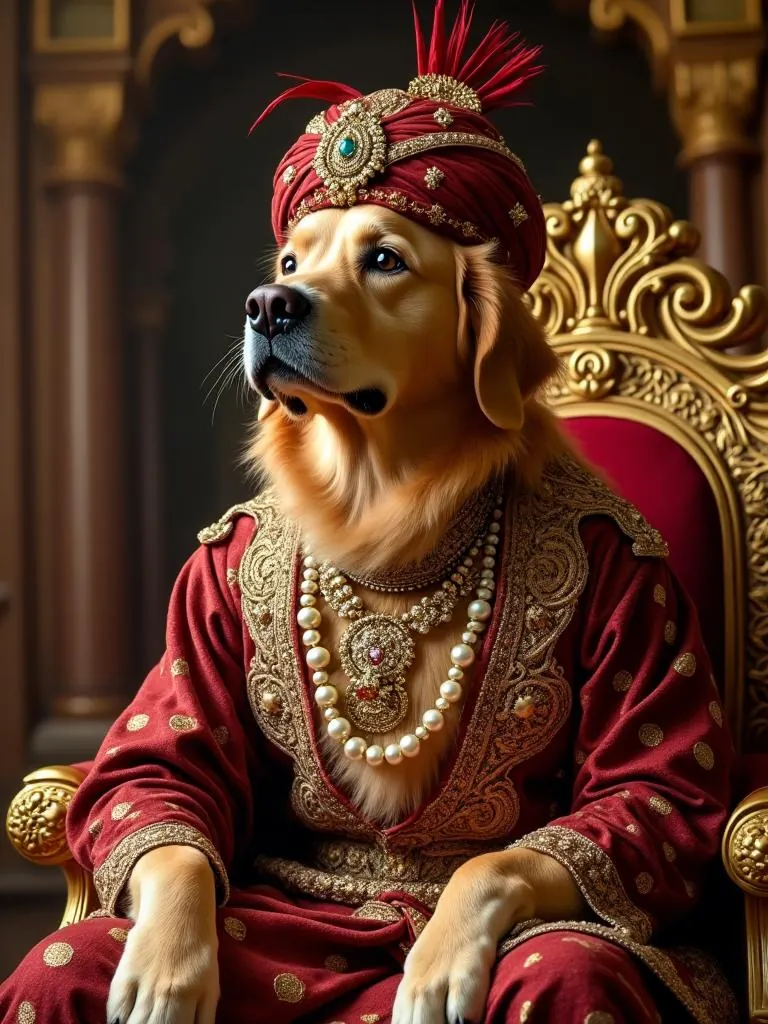
- Maharaja: a golden retriever in a red jewelled turban, seated on a gold throne.
- Maharani: a white and ginger cat in a green and gold gown.
- Mysore Royal: a black labrador in a saffron turban, holding a gold sceptre.
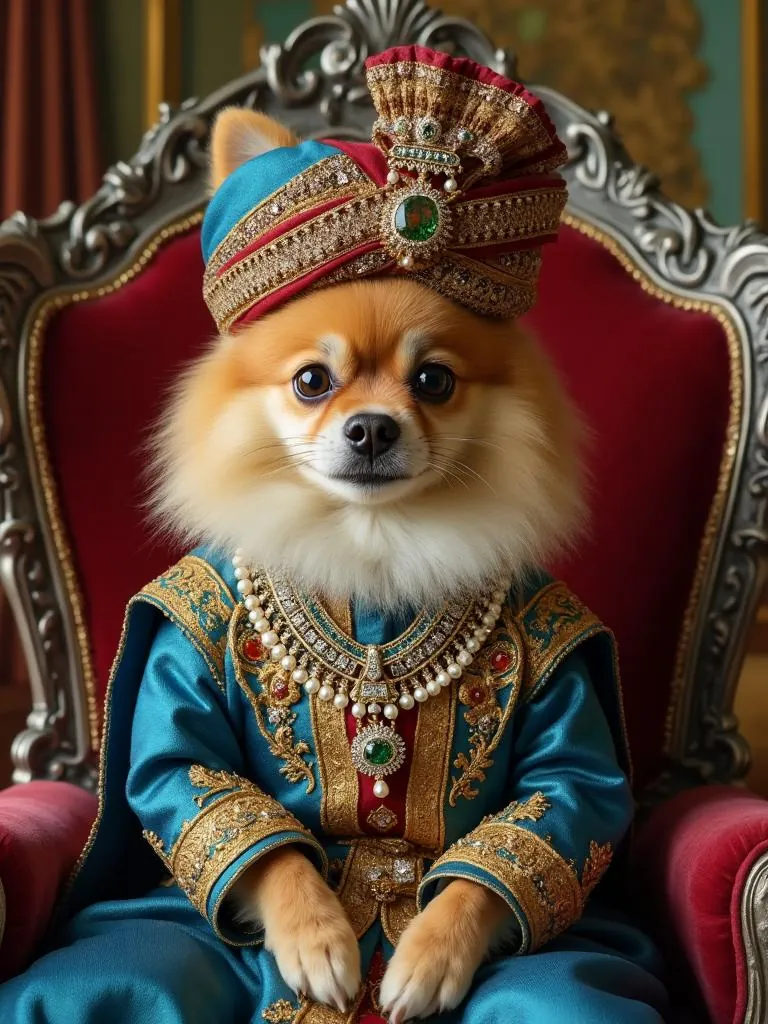
- Patiala Royalty: a Pomeranian in a blue coat and jewelled turban on a red throne.
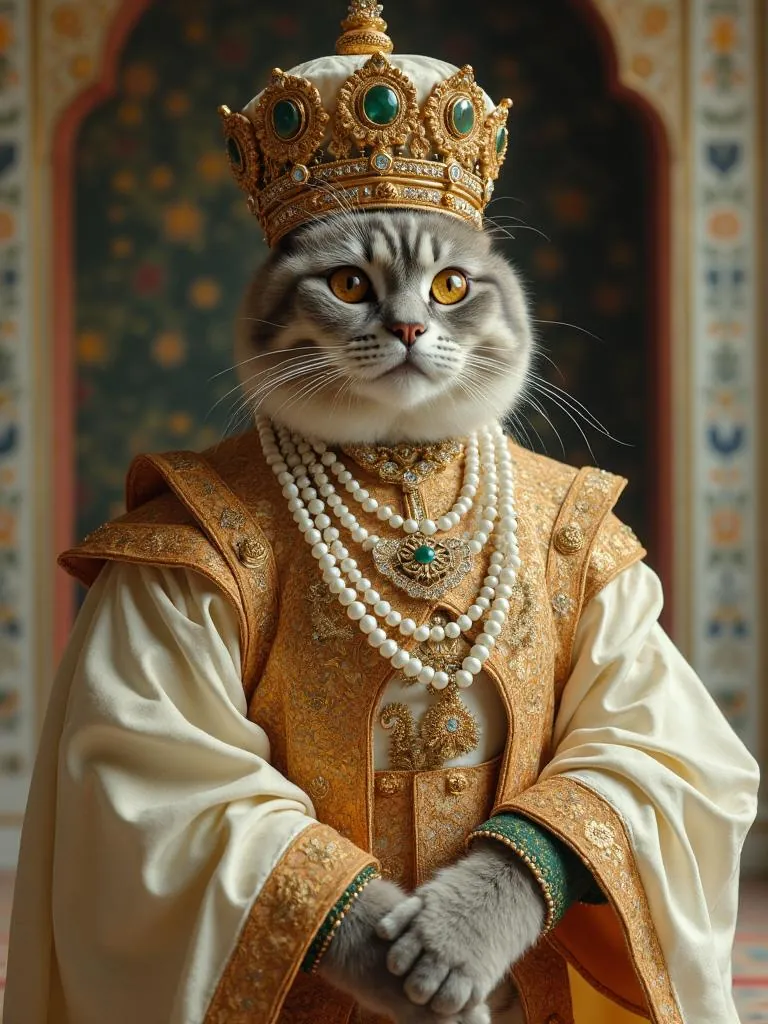
- Mughal Emperor: a grey cat wearing a jewelled crown and pearls.
- Rajput Warrior: a dog in armour, with a fort at sunset behind.
- Indian Royalty: a golden retriever in a royal crown and red robe, and a ginger cat in a red and gold robe.
Gold appears in several of these portraits, from the Maharaja's throne to the Mysore Royal's sceptre, which suits a festival of lamps. The Incredible India website lists Mysore Palace in Mysuru among the places where Diwali is celebrated, and the Mysore Royal style carries the name of that court.
For the history behind each court, the Indian court painting guide covers the Mughal, Rajput, Mysore and other traditions, and the Purrspectives article on Indian royal pet portraits explains each of the nine styles. Choose the court whose look fits the recipient's home and the pet's character. A calm, stately dog may suit the Maharaja on his throne. A cat that claims the best seat in the house may suit the Mughal Emperor.
Keeping the pet safe during Diwali
The festival's lamps, sweets and fireworks all reach the pet in the portrait.
Fireworks
The RSPCA, the UK animal welfare charity, says many animals find fireworks frightening, and that dogs can hear sounds four times further away than people can. On its fireworks campaign page, it says fireworks can reach 120 to 175 decibels, and that for people, sounds over 85 decibels can damage hearing. It gives this advice for dogs:
- Make a safe space filled with the dog's favourite things, and let the dog use it at all times.
- Move the dog there each evening before the fireworks begin, and stay nearby.
- Close windows and curtains, and black out the safe space if you can.
- Walk the dog in daylight, before fireworks are likely.
- Play music or television to mask the bangs.
- Make sure the dog is microchipped, in case it bolts.
The RSPCA also says never to punish a pet for being scared, and to ask a veterinarian for help if a pet's fear is severe.
Diyas and candles
An open flame at pet height is a risk. The ASPCA says kittens and dogs can burn themselves or start a fire by knocking over unattended candles, and the Oregon Veterinary Medical Association says never to leave holiday candles unattended, especially around puppies and kittens. Place diyas on high ledges or outside the door, and put them out before you leave the room.
Sweets and guests
The Oregon Veterinary Medical Association lists grapes and raisins, macadamia nuts, onions and garlic among foods that can harm pets. It warns that xylitol, a sweetener found in some sweets and baked goods, makes a dog's blood sugar drop fast and can damage the liver. The ASPCA says chocolate can cause vomiting, seizures and an abnormal heart rate. Keep sweet boxes closed and out of reach. With many visitors in the house, the association also advises giving pets a quiet room and watching the open door.
Presenting the portrait
A portrait fits among the lights and flowers of a Diwali home. Unveil it after the evening's prayers, or on the day your family exchanges gifts. The page on presenting a portrait gift covers wrapping and the card, and the page on getting a full-size photo for a surprise portrait explains how to get a good photo of someone else's pet without asking them.
Questions and answers
Why do people exchange gifts at Diwali?
People exchange gifts at Diwali to strengthen family bonds and mark new beginnings. India's Ministry of Tourism, on its Incredible India website, says families exchange gifts and sweets with loved ones during the five-day festival. Statistics Canada also lists exchanging gifts with family and friends, lighting diyas (oil lamps) or candles, and enjoying sweets as the ways Hindus celebrate Diwali.
How many days does Diwali last?
Diwali lasts five days, according to India's Ministry of Tourism. Its Incredible India website describes cleaning homes and making auspicious purchases on the first day, lighting diyas and drawing rangoli on the second, Lakshmi puja on the third, exchanging gifts and sweets on the fourth, and Bhai Dooj, a day for brothers and sisters, on the fifth. Customs vary between regions.
Why does the date of Diwali change every year?
The date of Diwali changes every year because the festival follows the Hindu lunar calendar. India's Ministry of Tourism says the Persian scholar Al Biruni recorded, in the 11th century, that Hindus celebrated Diwali on the new moon day of the month of Kartika. A lunar month does not line up with the everyday calendar, so the date moves from year to year.
Do Sikhs and Jains celebrate Diwali?
Sikhs and Jains both mark festivals at Diwali time. Statistics Canada says Sikhs commemorate Bandi Chhor Divas, which coincides with Diwali, and Jains observe Mahavira Nirvana Diwas, with the next day marking the start of the Jain new year. India's Ministry of Tourism says Bandi Chhor Divas honours the liberation of Guru Hargobind, the sixth Sikh Guru.
Where in Canada do the most people celebrate Diwali?
The Toronto area is home to the largest Diwali community in Canada. Statistics Canada says 55.3 percent of Canada's Hindus lived in the Toronto census metropolitan area at the 2021 Census, and 69.3 percent lived in Ontario. British Columbia, Alberta and Quebec also had large Hindu communities, and 76.6 percent of Canada's Sikhs lived in Ontario or British Columbia.
Which portrait style suits a Diwali gift?
One of the nine Indian court styles suits a Diwali gift, because they come from the royal courts of India. Purrealism's gallery shows a golden retriever as a Maharaja in a red jewelled turban on a gold throne, and a black labrador as Mysore royalty in a saffron turban. Choose the court whose look fits the recipient's home and the pet's character.
How can I keep my dog calm during Diwali fireworks?
A dog stays calmer during Diwali fireworks with a safe hiding place, closed curtains and daytime walks. The RSPCA advises filling a safe space with the dog's favourite things, moving the dog there before fireworks begin, closing windows and curtains, and playing music or television to mask the bangs. It says never to punish a frightened pet.
Are diyas dangerous for cats and dogs?
Diyas are dangerous for cats and dogs when they are left burning where a pet can reach them. The ASPCA says kittens and dogs can burn themselves or start a fire by knocking over unattended candles, and the Oregon Veterinary Medical Association says never to leave holiday candles unattended. Place diyas high or outside, and blow them out before leaving the room.
Can dogs eat Diwali sweets?
Dogs should not eat Diwali sweets, because some sweets contain ingredients that harm them. The Oregon Veterinary Medical Association lists raisins, grapes and macadamia nuts among harmful foods, and warns that xylitol, a sweetener, can make a dog's blood sugar drop fast. The ASPCA says chocolate can cause vomiting, seizures and a racing heart. Keep sweet boxes closed and high.
What is Bhai Dooj?
Bhai Dooj is the fifth and last day of Diwali, a day for brothers and sisters. India's Ministry of Tourism says siblings reaffirm their love and commitment to each other on that day. A portrait of a brother's or sister's pet makes a personal Bhai Dooj gift, because it shows you know the animal that shares their home.
Sources
- Diwali: A festival of lights and joy, Incredible India, Ministry of Tourism, Government of India. Accessed September 28, 2026.
- Diwali: Festival of lights, Statistics Canada. Accessed September 28, 2026.
- Keeping dogs, cats and other small pets safe during fireworks, RSPCA. Accessed September 28, 2026.
- Be a firework friendly neighbour to animals, RSPCA. Accessed September 28, 2026.
- Valentine's Day Safety Tips, ASPCA. Accessed September 28, 2026.
- Holiday Pet Care Tips, Oregon Veterinary Medical Association. Accessed September 28, 2026.
Short reads on this topic
Articles from Purrspectives that answer one question each.
Dog birthday ideas: how to celebrate your dog's birthday, plus gift ideas
Celebrate your dog's birthday with a favourite walk, a play date, a dog-safe treat and a yearly photo. Plus dog birthday gift ideas for the dog and the family.
Cat wall art ideas: choosing a cat portrait for every room
Cat wall art for each room: the print size for a hall, living room, bedroom or small flat, the cat portrait that suits its colours, and where to keep it safe.
Funny pet portraits: why a dog on a throne makes us smile, and 10 ideas to try
Funny pet portraits put a dog or cat in a serious human role. How Landseer and Wegman used the joke, and 10 royal portrait ideas matched to your pet's habits.