Maine Coon history: legends, early cat shows, size and winter coat
Maine Coon history from Maine farm fairs to Cosey's 1895 win in New York, the raccoon legends, the breed's return in the 1970s, its winter coat and big paws.
By Purrealism
The Maine Coon is a large, long-haired cat from the state of Maine, in the northeast of the United States. It began as a working farm cat, won the top prize at a famous New York cat show in 1895, nearly disappeared in the 20th century, and came back to become one of the ten breeds registered most often by the Cat Fanciers' Association. This guide follows that history, sorts the legends from the records, explains how the breed's body suits a Maine winter, and ends with how to photograph a Maine Coon for a royal portrait.
Where the Maine Coon came from
Nobody wrote down the first Maine Coon. The Maine Secretary of State's page on the state cat says the breed is regarded as a native of Maine, and that most breeders believe it began when local short-haired cats mated with long-haired cats from overseas. Those long-haired cats may have been Angora types brought home by New England sailors, the page says, or long-haired cats brought to America by the Vikings. The page presents both as beliefs.
The written record starts later. The Cat Fanciers' Association (CFA), a North American register of pedigree cats, says the breed's documented history goes back to the 1850s. The Maine page says the Maine Coon was well established more than a century ago as a hardy, handsome breed, well equipped to survive New England winters.
Legends about raccoons, a queen and a sea captain
The CFA's long article on the breed collects four origin stories. None has a record behind it.
- The raccoon. Brown tabby Maine Coons have bushy tails with rings of darker colour. People once took this as proof that cats had mated with raccoons, and the word Coon in the name comes from that belief. The CFA calls the combination genetically impossible. Some people told the same story with the American bobcat.
- Marie Antoinette's cats. In this legend, a sea captain named Samuel Clough joined a plot to take the French queen out of France and bring her to Wiscasset, Maine. He loaded his ship, the Sally, with her furniture, some of her belongings and six of her favourite cats. The queen was seized and later beheaded, and Clough sailed for Maine with her six long-haired cats still on board. The story says they mated with local cats. The CFA's breed page calls them Turkish Angoras released into the Maine woods.
- Captain Coon. Another legend tells of an English sea captain named Coon who sailed along the New England coast with a crowd of cats, most of them long-haired Persians and Angoras. His cats went ashore with him. When long-haired kittens appeared in local litters, people called them "one of Coon's cats". The CFA calls the captain's name improbable.
- The Vikings. The last story says the breed's ancestors were Norwegian forest cats, called Skogkatt, brought to North America by the Vikings.
These stories are fun to tell. As history, treat all four as legends.
Farm fairs and the first cat shows
The first Maine Coon contests were held on farms. The CFA article says that in the 1860s, farmers in Maine told stories about the strength and intelligence of their cats, and began holding their own cat show at the Skowhegan Fair. The winner took the title Maine State Champion Coon Cat.
The cats soon reached the city. The CFA says a show in Boston in 1878 included a dozen Maine Coons. Its history also names an early black and white Maine Coon with a long name: Captain Jenks of the Horse Marines, co-owned by Mrs. E. R. Pierce, who wrote down much of the breed's early history.
The best-known early show came in May 1895, at Madison Square Garden in New York. The CFA calls it the largest and most famous of the early American shows, and its breed page calls it the first U.S. cat show. A brown tabby female Maine Coon named Cosey won it. The CFA article lists her prizes: a silver medal marked "National Cat Show, 1895" with a cat face in the middle, and a silver collar engraved "National Cat Show, 1895, won by Cosey". The CFA Foundation says the collar, the medal and a photo of Cosey are now on display at the Feline Historical Museum in Alliance, Ohio.
The CFA says all cats at that show were sorted first by the length of their hair and then by sex, so Maine Coons competed as "longhairs" beside Persians and Angoras. For that reason, nobody knows how many Maine Coons were entered.
Decline and return in the 20th century
The CFA article says that soon after 1895, other long-haired cats with pedigrees came into greater favour, and Maine Coons slowly disappeared from the registers and the shows. For the next four decades the breed drew little attention.
In the late 1950s, the CFA says, the Maine Coon was declared extinct. The CFA says the report was exaggerated. People in Maine had already started work to keep the breed going:
- Early 1950s. Alta Smith and Ruby Dyer formed the Central Maine Cat Club. For 11 years it held a combined cat show and cat photo exhibition, kept breeding records, and wrote one of the first written standards for the breed. By 1963 its shows had outgrown every large hall nearby, and the club closed.
- 1960s and 1970s. Breeders worked for full recognition by the CFA, the breed page says. The Maine Coon Cat Club formed in 1973.
- 1 May 1975. The CFA gave the Maine Coon provisional status, the first step toward full recognition.
- 1 May 1976. The CFA gave the breed championship status, so Maine Coons could compete for its top titles.
- 1985. Maine made the Maine Coon its official state cat. The state law, Title 1, section 217, reads in full: "The state cat shall be the Maine coon cat."
The CFA's breed page says Maine Coons have been among the top ten breeds registered by the CFA for many years.
A body made for Maine winters
The Maine Coon's body suits a cold, snowy place. The Maine Secretary of State's page describes each part:
- The coat is glossy, heavy and water-resistant. It is longer on the ruff (the thick fur around the neck), the stomach and the back legs to protect against wet and snow, and shorter on the back and neck so it does not catch in bushes.
- The tail is long and bushy. The cat wraps it around itself when it curls up to sleep, which keeps it warm in winter.
- The ears carry more fur, inside and at the tips, than those of many breeds.
- The feet are big, round and tufted with fur, and the page says they serve as snowshoes.
Size is the other famous trait. The CFA calls the Maine Coon the largest of all pedigreed cats. Its longer article says males average 12 to 15 pounds (5.4 to 6.8 kg), with some reaching 20 pounds (9.1 kg) or more, and females 9 to 12 pounds (4.1 to 5.4 kg). The breed also grows slowly. The CFA says it can take up to three years to reach full growth, and the Maine page gives three to five years.
Some Maine Coons have extra toes. A 2020 study in the Journal of Feline Medicine and Surgery tested 75 Maine Coons from Europe, Canada and the United States. It found that one parent is enough to pass the trait on, that the number of extra toes varies from cat to cat, and that more than one gene change causes it in the breed.
Owners also mention the voice. The CFA says Maine Coons make chirps, trills and purrs, with an occasional meow. It calls them sociable and loyal cats that move from one lap to another instead of choosing a single favourite person.
Owners should also know one health fact. The Cornell Feline Health Center lists the Maine Coon among the breeds more likely to develop hypertrophic cardiomyopathy, a disease that thickens the walls of the heart. In 2005, researchers at UC Davis, Ohio State University and Baylor College of Medicine identified a gene change that causes the disease in Maine Coons. UC Davis says it was the first natural gene change found to cause any heart disease in a cat or a dog.
Photographing a Maine Coon for a royal portrait
A large cat with long fur and a long tail needs more planning than a small short-haired cat. These steps build on the general guide on how to photograph your pet for a portrait and the guide to photographing cats:
- Comb the coat first. The CFA recommends combing a Maine Coon two or three times a week. A combed coat shows the true length of the ruff and the fur on the back legs. Wait until the cat has relaxed again before you take photos.
- Get down to the cat's eye level. A photo taken from standing height makes a big cat look small and hides the chest. Sit or kneel on the floor.
- Leave room for the ears and the tail. Stand back far enough that the tufted ear tips and the whole tail fit in the frame. Crop later if you need to.
- Use soft light from the side. Window light from one side shows the layers of a long coat. Light from straight behind the camera flattens it.
- Show the paws. Big tufted feet, and extra toes if your cat has them, are part of what makes a Maine Coon look like one. A seated photo with the front paws in view gives the portrait your cat's real markings to follow.
- Focus on the eyes. Tap the screen on the nearest eye before you take the photo.
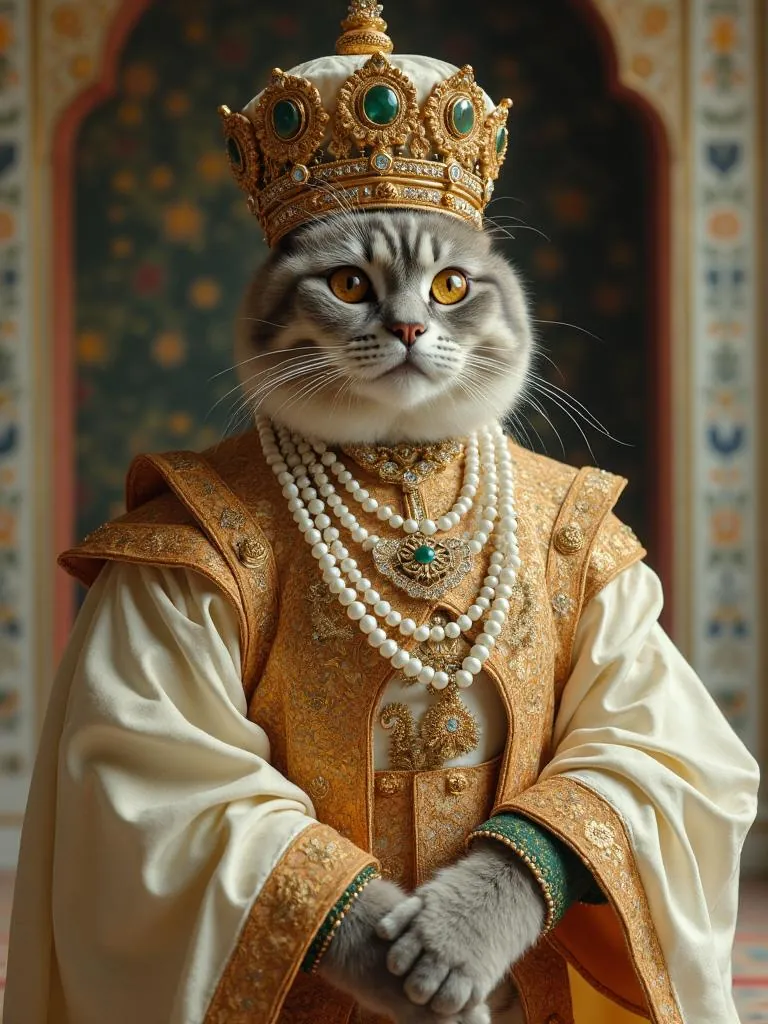
The gallery shows a grey cat as a Mughal emperor, wearing a jewelled crown and pearls. Royal cats have a long history of their own, told in the guide to royal cats in history. When your photo is ready, choose one of the 15 royal styles in the portrait studio and upload one clear photo of up to 5 MB.
Questions and answers
What is the history of the Maine Coon cat?
The Maine Coon is a long-haired farm cat from the state of Maine whose written history goes back to the 1850s, according to the Cat Fanciers' Association (CFA). Farmers showed their cats at the Skowhegan Fair in the 1860s, and a Maine Coon named Cosey won the big New York show of 1895. The breed then fell out of fashion, came back through breeders in the 1960s and 1970s, and gained CFA championship status in 1976.
Do Maine Coons come from Maine?
Maine Coons are regarded as natives of the state of Maine, says the Maine Secretary of State's page on the state cat. The same page says most breeders believe the breed began when local short-haired cats mated with long-haired cats from overseas, perhaps brought by New England sailors. Maine law has named the Maine Coon the official state cat since 1985, under Title 1, section 217 of the Maine Revised Statutes.
Are Maine Coons part raccoon?
Maine Coons have no raccoon in them. The Cat Fanciers' Association says the bushy, ringed tails of brown tabby Maine Coons once led people to believe that cats had mated with raccoons, which is where the word Coon in the name comes from. The CFA calls that combination genetically impossible, because a cat and a raccoon cannot produce young together. The story survives only as a legend.
Who won the first cat show in America?
A brown tabby female Maine Coon named Cosey won Best in Show at the National Cat Show at Madison Square Garden in New York in May 1895. The Cat Fanciers' Association calls it the first U.S. cat show, though its own history also records a smaller Boston show in 1878. The CFA Foundation says Cosey's silver collar, medal and photo are on display at the Feline Historical Museum in Alliance, Ohio.
Why are Maine Coon cats so big?
Maine Coon cats are big because the breed is tall, muscular and big-boned, and it keeps growing for years. The Maine Secretary of State's page on the state cat says males commonly weigh 13 to 18 pounds (5.9 to 8.2 kg) and females 9 to 12 pounds (4.1 to 5.4 kg). The Cat Fanciers' Association calls the Maine Coon the largest of all pedigreed cats, and says a mature male can reach 20 pounds (9.1 kg) or more.
When is a Maine Coon full grown?
A Maine Coon is full grown at three to five years old, later than most cats. The Cat Fanciers' Association calls it a slow-maturing breed that can take up to three years to reach full growth, and a longer CFA article says three to four years. The Maine Secretary of State's page on the state cat says Maine Coons reach their full size at three to five years old.
Do Maine Coons have 6 toes?
Some Maine Coons are born with extra toes, a trait called polydactyly. A 2020 study in the Journal of Feline Medicine and Surgery tested 75 Maine Coons from Europe, Canada and the United States. It found that one parent is enough to pass the trait on, that the number of extra toes varies from cat to cat, and that more than one gene change causes it in the breed.
Do Maine Coons meow?
Maine Coons meow now and then, but their best-known sound is a chirping trill. The Cat Fanciers' Association says Maine Coons make chirps, trills and purrs as well as an occasional meow, and that the breed is not considered talkative. The Maine Secretary of State's page on the state cat also says the breed's voice sets it apart from other cats, with a distinctive chirping trill.
Are Maine Coon cats friendly?
Maine Coon cats are described as friendly and sociable by the Cat Fanciers' Association. The CFA calls the breed sweet-tempered, loyal and easy to train, and says Maine Coons tend to go from one person's lap to another instead of choosing a single favourite. The CFA also calls the breed independent, needing a moderate amount of time with people. Each cat still has its own character.
Do Maine Coon cats have any health issues?
Maine Coon cats are one of the breeds more likely to develop hypertrophic cardiomyopathy (HCM), a disease that thickens the walls of the heart, says the Cornell Feline Health Center. In 2005, researchers at UC Davis, Ohio State and Baylor College of Medicine found a gene change in Maine Coons that causes HCM, the first found in any animal other than humans. Cornell says gene tests can show a raised risk, but results need a vet's advice, because not every cat with the change becomes ill.
Sources
- Maine Coon Cat, The Cat Fanciers' Association
- Maine Coon Cat Article, The Cat Fanciers' Association
- Cosey, The CFA Foundation (Feline Historical Museum)
- State Cat: Maine Coon Cat, Maine Secretary of State
- Maine Revised Statutes, Title 1, section 217: State cat, Maine State Legislature
- Genetic heterogeneity of polydactyly in Maine Coon cats (Hamelin and others, Journal of Feline Medicine and Surgery, 2020), National Library of Medicine (PubMed)
- Hypertrophic Cardiomyopathy, Cornell Feline Health Center, Cornell University College of Veterinary Medicine
- First gene mutation to cause heart disease in cats identified, University of California, Davis
Share this guide
The button copies a ready-written post, then opens LinkedIn. Paste the text into the post box.
Go deeper
The full guides on this topic, each a set of pages with sources: