Mughal Emperor portrait style: your pet in the imperial miniature tradition
The Mughal Emperor portrait style on Purrealism: the miniature tradition, the costume, which pets suit it, and how it compares with the Maharaja style.
By Purrealism. Part of Royal portrait styles: a guide to the 15 styles for your pet.
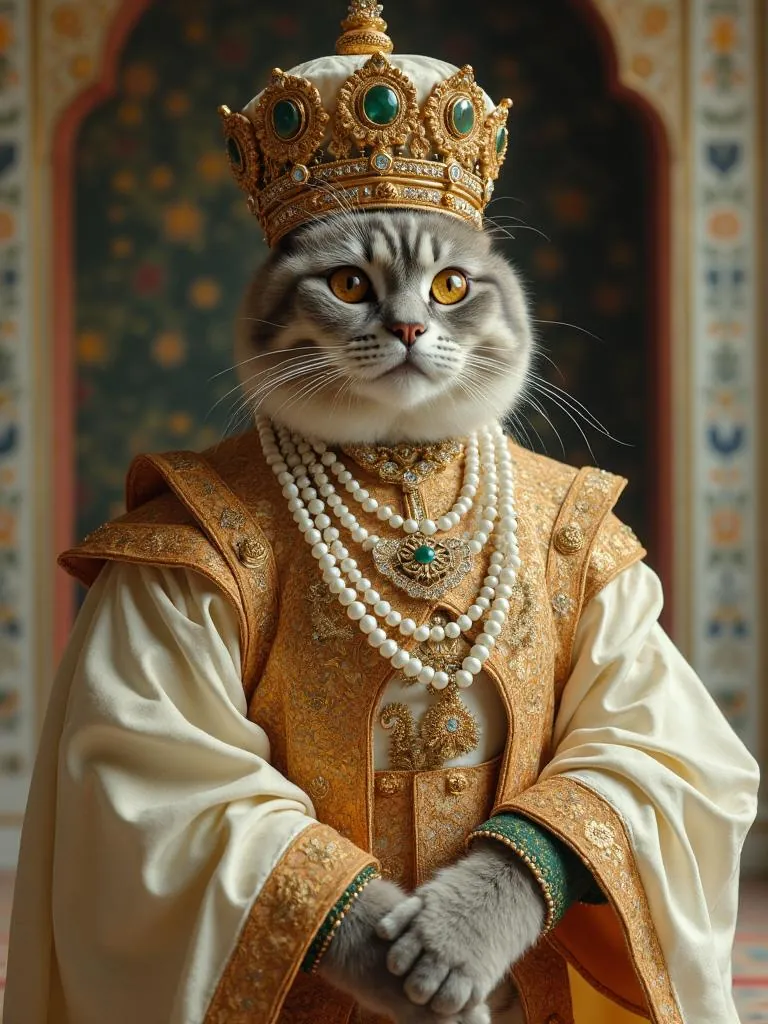
The Mughal Emperor portrait style is the most ornate of Purrealism's Indian looks. Your cat or dog appears in a jewelled crown and pearl strings, inside a painted portrait panel, mounted on a wide floral border in gold and green. The gallery example, a grey cat in the full Mughal layout, shows the style at its most detailed. This page covers the real court tradition behind it, what the costume looks like in detail, which pets suit it, and how it sits alongside the other Indian royal styles.
The courts behind the Mughal Emperor style
The Mughal dynasty ruled most of the Indian subcontinent from 1526, when Babur defeated the Delhi Sultanate at the First Battle of Panipat, until the last emperor, Bahadur Shah II, was exiled by the British in 1858 after the 1857 uprising. The peak of Mughal power and culture came under four emperors: Akbar, who reigned from 1556 to 1605; Jahangir, from 1605 to 1627; Shah Jahan, from 1628 to 1658; and Aurangzeb, from 1658 to 1707.
The Mughal imperial court produced one of the most developed traditions of portraiture in South Asian history. The portrait workshop, called a karkhana, employed trained painters who worked from observation of the emperor and his court. These painters used a miniature format: small, highly detailed paintings on paper or vellum, mounted on pages with wide decorated borders. The Victoria and Albert Museum in London holds a large collection of Mughal paintings, and its articles on the Mughal empire describe the painting workshop and its methods.
The Shah Jahan Album is the best-documented example of this tradition. The Metropolitan Museum of Art holds part of the album and describes it as one of the finest examples of Mughal imperial book arts. Each page in the album carries a portrait or a calligraphy panel at the centre, mounted on a painted border of flowers, birds and leaf scrolls in gold, blue, green and pink. These borders are the direct source for the wide floral frame in the Mughal Emperor style on Purrealism.
The portrait itself in the Mughal miniature tradition used a profile or three-quarter pose. The emperor stood or sat in a pale interior, dressed in a fitted robe with a sash and pearl strings, wearing a jewelled turban. The hands often held something: a flower, a cup, a book or a jewelled pendant. The Cleveland Museum of Art keeps a Portrait Jewel of Emperor Jahangir, a miniature portrait painted on vellum and set into a wearable ornament, which shows this format in a small, intimate form.
What the Mughal Emperor style looks like
A Purrealism Mughal Emperor portrait has two parts: the portrait panel and the border. The portrait panel takes up roughly the inner three-quarters of the image. Inside it, the pet appears against a pale ivory or white background, in the profile or three-quarter pose of the imperial miniature. The figure wears a jewelled turban with a sarpech at the front and pearl strings looped along the sides. Pearl strings also fall at the neck and chest in two or three rows.
One forepaw holds a flower: a lotus or a poppy, as in the Shah Jahan Album portraits. The robe is a fitted angarakha, a wrap-front coat, in white or pale gold silk with gold thread at the hem. The pose is upright, with the head held high and the gaze at a slight angle. Below the figure is a plain platform or a grass ground, in the same pale tones as the background.
Around the portrait panel runs the border. The border is painted in the manner of the Shah Jahan Album pages: a gold ground with painted flowers, each one detailed, in blue, pink, white and green. Small birds or insects sit between the flowers. The border is a full painted work in itself, in the same manner as the album borders at the Metropolitan Museum.
The colour palette of the portrait panel is pale: ivory, white and gold, with the pearl strings as the strongest white element. The sarpech jewel uses a green or red stone. The border introduces richer colours: the gold ground, the blue flowers and the green leaves. The result is a portrait that reads as contained and precise, very different from the broader throne-and-background format of the Maharaja style.
Which pets suit the Mughal Emperor style
The style suits a cat or a small to medium dog with a pale or grey coat. The pale portrait panel background lifts a light coat most clearly: a grey cat, a white Persian, a cream Ragdoll, a Siamese or a pale Birman all read well against the ivory ground. The gallery example is a grey cat, and the grey coat gives the portrait a clean contrast between the pale background and the jewelled costume.
A dark coat also works in the Mughal Emperor style. A black cat or a dark tabby reads as a strong silhouette against the pale background, and the pearl strings at the neck stand out. The contrast is sharper than in the Maharaja style, where the dark robe and the dark background reduce the contrast with a dark coat.
For dogs, the style suits smaller and medium breeds with a rounded or moderate muzzle. A Bichon Frise, a Maltese, a white Poodle, a Samoyed and a Cavalier King Charles spaniel all work well. A long-nosed sighthound such as a greyhound has a very long profile in the portrait, which can push the crown high above the frame. For those breeds, the Rajput Warrior style works better.
Cats with very flat faces, such as Persians or Exotic Shorthairs, also carry the style well. The crown sits above the head, not around it, so a flat face is not a disadvantage. The wide forehead of a flat-faced cat gives the crown a stable base.
Choosing Mughal Emperor against the other Indian styles
The Mughal Emperor style is distinct among the Indian royal styles because it is a miniature portrait inside a frame, rather than a full-scale state portrait. The table below shows the key differences.
| Style | Format | Border | Pose |
|---|---|---|---|
| Mughal Emperor | Portrait panel inside a floral border | Wide painted floral border | Profile or three-quarter |
| Maharaja | Full-scale portrait | Plain painted wall | Frontal, seated on throne |
| Maharani | Full-scale portrait | Plain warm background | Frontal, seated on cushion |
| Patiala Royalty | Full-scale portrait | European chair and plain ground | Frontal, seated |
| Rajput Warrior | Full-scale portrait | Desert fort and sunset sky | Three-quarter, standing |
The practical guide: choose Mughal Emperor when the buyer wants a portrait that looks like a museum piece, with the painted border and the miniature format. Choose Maharaja when the buyer wants a large, formal state portrait with a clear throne and turban. Choose Rajput Warrior when the pet has a strong forward pose and the buyer wants a landscape behind the figure.
Writing the room around a Mughal Emperor portrait
The Mughal Emperor portrait is contained and detailed. Its pale centre and gold border read against almost any wall colour. A warm cream wall, a sage green wall, or a soft terracotta wall all work. A cold white wall drains the warmth from the gold border. The portrait suits a smaller space, such as a study, a bedroom wall or a reading room, where the detail can be read from a normal viewing distance.
A gilt frame or a dark wood frame picks up the gold in the border. A plain white or black frame works less well because it introduces a new element that competes with the border. For the Mughal Emperor style in particular, a thin frame is better than a wide mat. The border is part of the image, and a wide mat between the portrait and the frame adds a visual gap where the border already performs that role. The framing and hanging guide at /guides/framing-and-hanging covers the options.
From photo to Mughal Emperor portrait
The studio needs to see the pet's face clearly to place the crown and the pearl strings. A photo taken at a slight angle, with the pet looking forward or just to one side, at eye level, in soft daylight, gives the most useful reference. The Mughal miniature pose is a profile or three-quarter view, so a photo taken from exactly in front can work, and the studio adjusts to the near-profile of the painted tradition.
Sharp eyes and a clear forehead matter most, because the crown sits above the eyes and the pearl strings fall from the chin. A blurred or shadowed face makes the placement of both harder. The photo should be under 5 MB and in good daylight. The pet photo guide at /guides/pet-photo-guide covers the full checklist.
Once the photo is uploaded at /create, the portrait is returned in the Mughal Emperor style. The art prints and paper guide at /guides/art-prints-and-paper covers the print options. For the Mughal Emperor style, a matte paper reads the flat painted quality of the miniature most faithfully. At a larger size, the detail in the border and the fine pearl strings both reward a matte surface.
The Royal portrait styles hub at /guides/royal-portrait-styles collects all 15 styles side by side for comparison, and the gallery at /gallery shows finished portraits.
Questions and answers
What is the Mughal Emperor style?
The Mughal Emperor style dresses your pet as an emperor of the Mughal dynasty, the Muslim rulers who governed most of the Indian subcontinent from 1526 to 1857. The style follows imperial portrait miniatures of that period, where the emperor stands in profile in a jewelled crown and pearl strings, often holding a flower, and the portrait is mounted on a wide illuminated floral border. The Shah Jahan Album at the Metropolitan Museum of Art is the primary source.
What does a Mughal Emperor portrait look like?
A Mughal Emperor portrait on Purrealism shows your pet in a jewelled crown called a jama, with two or three rows of pearl strings at the neck and chest, holding a flower in one paw. The portrait panel sits inside a wide border of painted flowers in gold and green, in the manner of imperial Mughal albums. The background behind the figure is plain white or pale blue. The gallery example is a grey cat in this layout.
Which pets suit the Mughal Emperor style?
The Mughal Emperor style suits a cat with a pale or grey coat whose face reads clearly against the white background of the portrait panel. A Siamese, a grey tabby, a white cat and a Russian Blue all carry the jewelled crown and the pearl strings well. A dog can also wear this style: a Bichon Frise, a Maltese, a white Poodle and a Samoyed all have pale coats that suit the pale interior of the miniature panel.
What is the Shah Jahan Album?
The Shah Jahan Album is a collection of imperial portraits and calligraphy assembled for Shah Jahan, the fifth Mughal emperor, in the 17th century. The Metropolitan Museum of Art holds part of it. Each page carries a portrait or a calligraphy panel at the centre, mounted on a painted border of flowers, birds and leaves in gold, blue and green. The Metropolitan Museum describes it as one of the finest examples of Mughal imperial book arts.
How does Mughal Emperor differ from Maharaja?
Mughal Emperor and Maharaja are both Indian royal styles but from different courts. Maharaja follows the Hindu rulers of India's 19th-century princely states, seated on a gold throne in a red turban, in a broad state portrait. Mughal Emperor follows the Muslim emperors of the 16th to 18th century, in a small portrait panel with a wide floral border, in profile, holding a flower. The Mughal style is more detailed and contained; the Maharaja style is broader and more formal.
What is a jama crown in Mughal portraiture?
In Mughal portraiture, the emperor's crown was a turban decorated with a central jewelled ornament called a sarpech and, in the later imperial period, a halo of light around the head called a nimbus. The crown in the Mughal Emperor style on Purrealism uses a jewelled turban with a sarpech at the centre and pearl strings looped along the sides. The Cleveland Museum of Art holds a portrait jewel of Emperor Jahangir, who had small portraits of himself set into wearable ornaments as gifts for his nobles.
What colour palette does the Mughal Emperor style use?
The Mughal Emperor style uses ivory, gold and green. The portrait panel background is pale ivory or white. The border around the panel is gold with green leaves and coloured flowers. The emperor's turban and robe use gold, white and blue in the same proportions as the album pages at the Metropolitan Museum. The pearl strings are white, and the sarpech jewel uses a green stone. These colours come directly from the Shah Jahan Album's borders and from imperial Mughal portraits in the British Museum.
What photo works best for a Mughal Emperor portrait?
A Mughal Emperor portrait starts best from a photo that shows your pet's face in a three-quarter or slight side angle, with the eyes clear and the ears visible above the crown. The Mughal miniature uses a profile or near-profile pose, so a photo of your pet at a slight angle gives the studio the best reference for placing the crown and the pearl strings. Soft daylight, sharp eyes and a file under 5 MB give the best result. The pet photo guide at /guides/pet-photo-guide covers the full checklist.
How big should a Mughal Emperor portrait be?
The Mughal Emperor portrait contains more fine detail than most other styles, because the wide floral border adds painted flowers and leaves around the portrait panel. On an 8 by 10 print the border and the crown read clearly. On a 12 by 16 or 16 by 20 the individual flowers in the border and the pearl strings become readable. The pricing page at /pricing lists the available sizes. A digital download keeps the full resolution for printing at any size later.
What room suits a Mughal Emperor portrait?
A Mughal Emperor portrait has a pale ivory centre and a gold and green border, so it reads well in any room without needing a specific wall colour. A cream, warm white or deep green wall all work. The portrait is more contained than the Maharaja or the Rajput Warrior, so it suits a smaller space or a room where a more complex portrait would feel heavy. A dark wood or gilt frame picks up the gold in the border. The framing and hanging guide at /guides/framing-and-hanging covers the placement.
Is the Mughal Emperor style suitable for a cat?
The Mughal Emperor style is one of the best Indian styles for a cat. The portrait panel keeps the focus on the face, and the pale background lifts a cat's coat, especially a pale or grey coat. The gallery example is a grey cat in the full Mughal layout. The crown sits above the head and the pearl strings fall against the chest, which suits a cat's long neck. A cat with a flat face also works because the crown sits above, not around, the head.
Sources
- The Shah Jahan Album, The Metropolitan Museum of Art. Accessed October 6, 2026.
- Portrait Jewel of Emperor Jahangir, The Cleveland Museum of Art. Accessed October 6, 2026.
- Mughal paintings in the British Museum collection, The British Museum. Accessed October 6, 2026.
- The arts of the Mughal Empire, Victoria and Albert Museum. Accessed October 6, 2026.