Rajput Warrior portrait style: your pet in armour and at the fort
The Rajput Warrior portrait style on Purrealism: Rajput painting schools, the costume, which pets suit it, and how it compares with Mughal Emperor.
By Purrealism. Part of Royal portrait styles: a guide to the 15 styles for your pet.
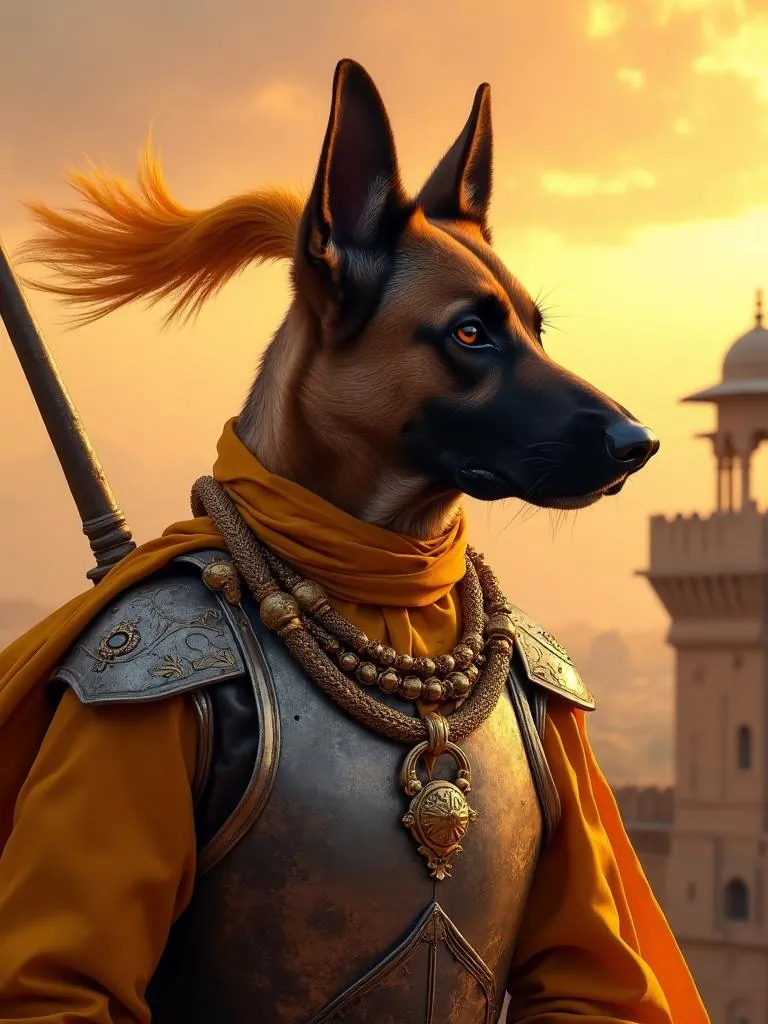
The Rajput Warrior portrait style is the most dramatic of Purrealism's Indian looks. Your dog or cat appears in bronze or gold armour, with a sword at the side, standing before a desert fort at sunset. The gallery cover for this style shows a mixed-breed dog in the full costume against an orange and red sky. This page covers the Rajput painting tradition behind the style, what the costume looks like, which pets it suits, and how it differs from the Mughal Emperor and the other Indian royal styles.
The courts behind the Rajput Warrior style
The Rajput kingdoms of Rajasthan were Hindu warrior states that governed the desert and semi-arid land of northwest India. The main Rajput clans included the Sisodia of Mewar, the Rathore of Marwar, the Hada of Hadoti and the Kachwaha of Amber and Jaipur. From the 16th century, many Rajput rulers became vassals of the Mughal emperors while keeping their own courts, their own temples and their own painting workshops.
Rajput painting developed in these courts from roughly 1600 onward. Each court had its own painting school with a distinctive style. The Mewar school at Udaipur used strong saturated colours and bold line work. The Marwar school at Jodhpur produced large-format paintings with detailed architectural backgrounds. The Bundi and Kota schools of the Hadoti region used a distinctive dark green landscape, with river scenes and hunt paintings. The Kishangarh school is known for the elongated faces with lotus-petal eyes in its portraits of the divine.
Google Arts and Culture, working with the Salar Jung Museum, has documented the Rajasthan painting tradition and its sub-schools, describing how each court's workshop developed a local style from a shared Mughal-influenced starting point. The Victoria and Albert Museum in London holds a large collection of Rajput paintings from these schools, including battle scenes, royal portraits and narrative paintings of Hindu epics. The Metropolitan Museum of Art also holds Rajput works from several schools.
The royal portrait in the Rajput tradition showed the ruler in armour, on horseback or on foot, against a landscape. The fort or palace behind the figure identified the ruler's seat and showed his power. The sunset sky was used in formal and martial portraits: the long orange light of late afternoon in the desert, with the fort silhouetted against it. This is the background in the Rajput Warrior style on Purrealism.
What the Rajput Warrior style looks like
A Purrealism Rajput Warrior portrait places the pet in armour in the foreground, with the fort and sky behind. The armour is bronze or dark gold, with a breastplate over the chest, shoulder plates, and engraved or riveted detail. A sword rests at the side or across one shoulder. The pet stands or sits in a three-quarter pose, body turned slightly left, face turned to look forward or at a slight angle.
The background behind the figure shows a sandstone fort or palace tower, in yellow and warm grey. The sky above the fort is orange and red at sunset, with the sun low at the horizon. A thin strip of desert or dry ground runs at the base of the portrait. The light falls from the right side of the portrait, matching the direction of the sunset, so the pet's near side is lit in warm orange and the far side is in cooler shadow.
The colour palette is strong throughout. The bronze of the armour, the orange of the sky, and the warm sandstone of the fort all reinforce each other. The pet's coat, whatever colour it is, reads against this warm background. A dark coat reads as a strong silhouette in the armour; a pale coat catches the warm sunset light and glows.
The painting style follows the Rajput tradition: flat perspective, precise line work, strong outlines, and the landscape treated as a backdrop rather than a fully three-dimensional space. The sky and the fort are painted in a simplified, direct manner. This is the visual language of the Mewar and Marwar schools, where the court painter's job was to show the ruler's rank and setting clearly, not to create the illusion of depth.
Which pets suit the Rajput Warrior style
The style suits a dog with a strong build and a pose that fills the frame. The armour is broad at the chest and the sword is long: a large or medium dog with a solid build reads best in both. A German Shepherd, a Rottweiler, a Belgian Malinois, a Dobermann, a Labrador, a Golden Retriever, a Siberian Husky and an Alaskan Malamute all carry the costume well. A Staffordshire Bull Terrier, a Boxer and a Bullmastiff also work, because their wide chests suit the breastplate.
A long-nosed sighthound also suits this style, for a different reason. A greyhound, a Borzoi, a Saluki or an Afghan Hound has a very long profile, and the wide desert landscape behind gives that profile room. The narrow head and the tall, lean body read as a distinctive silhouette against the broad sunset sky. These breeds do less well in the Maharaja or the Mughal Emperor styles, where the costume is centred on the crown rather than the body.
A cat can wear the Rajput Warrior style. A large, long-bodied cat with a confident expression, such as a Maine Coon, a Norwegian Forest cat or a large Tabby, carries the armour and the sword. A small or round-faced cat reads better in the Mughal Emperor or the Maharani styles, where the costume is scaled to a smaller figure and the portrait panel is more contained.
Choosing Rajput Warrior against the other Indian styles
The Rajput Warrior style is the only Indian style on Purrealism that uses an outdoor landscape as its main background. Every other Indian style uses a throne, a plain wall, a painted border or a cushioned seat. This makes the Rajput Warrior the right choice when a buyer wants the pet in a dramatic outdoor setting rather than an interior one.
| Style | Background | Scale | Dominant colour |
|---|---|---|---|
| Rajput Warrior | Desert fort and sunset sky | Full-scale outdoor portrait | Bronze and orange |
| Maharaja | Plain painted wall, gold throne | Full-scale indoor portrait | Red and gold |
| Mughal Emperor | Floral border, pale panel | Miniature panel | Ivory and gold |
| Maharani | Warm wash in rose and ochre | Full-scale indoor portrait | Green and rose |
| Patiala Royalty | European chair, plain ground | Full-scale indoor portrait | Blue and gold |
| Mysore Royal | Mysore palace columns | Full-scale indoor portrait | Saffron and gold |
The practical guide: choose Rajput Warrior when the buyer wants an outdoor, dramatic portrait and the pet has the build to fill the armour. Choose Maharaja or Maharani for an indoor formal look. Choose Mughal Emperor for a contained, detailed miniature.
Writing the room around a Rajput Warrior portrait
The Rajput Warrior portrait uses strong, warm colours: bronze, orange and deep red. A room with a bold or dark wall suits it best. Deep red, terracotta, dark teal, forest green and warm charcoal all work. A white or pale wall reduces the impact of the sunset and the armour. The portrait is a dominant piece in any room; it works best on its own, with no other large print nearby competing for attention.
A study, a hallway, a staircase landing or a room used as a home office all suit this style. It reads at a distance better than the Mughal Emperor portrait, which rewards close viewing. For a large wall, the Rajput Warrior style is a stronger choice than the Maharani or the Patiala Royalty, both of which are quieter in colour. The framing and hanging guide at /guides/framing-and-hanging covers the frame choice and placement.
From photo to Rajput Warrior portrait
The studio needs to see the pet's full body to place the armour correctly. A photo of the dog or cat standing upright, facing forward or at a slight angle, with all four legs visible and the tail not cut off, gives the most complete reference. The chest needs to be clear for the breastplate, and the head needs to be upright for the helmet or headpiece. A photo in good daylight, at eye level, with sharp eyes and a clear body outline, gives the best result.
A sitting pose also works, especially for a large dog whose full standing height would push the head to the top of the frame. The sword rests beside the body in a seated pose, and the armour reads just as clearly. The pet photo guide at /guides/pet-photo-guide covers the full checklist.
Once the photo is uploaded at /create, the studio returns the portrait in the Rajput Warrior style. The art prints and paper guide at /guides/art-prints-and-paper covers the print options. For the Rajput Warrior style, a matte paper reads the dry, painted surface of the Rajput court portrait most faithfully. A glossy paper lifts the bronze and the orange sky, which suits a room with strong natural light.
The Royal portrait styles hub at /guides/royal-portrait-styles collects all 15 styles for comparison. The gallery at /gallery shows finished portraits in each of the main styles.
Questions and answers
What is the Rajput Warrior style?
The Rajput Warrior style dresses your pet as a Rajput warrior-king, in armour with a sword, against a desert fort at sunset. The style draws from the royal portrait paintings of Rajasthan, produced by the painting schools of Mewar at Udaipur, Marwar at Jodhpur, and Hadoti at Bundi and Kota, between the 17th and 19th centuries. The Victoria and Albert Museum in London holds works from these schools, and the Metropolitan Museum of Art holds Rajput paintings from the same period.
What does a Rajput Warrior portrait look like?
A Rajput Warrior portrait on Purrealism shows your dog or cat in bronze or gold armour, with a sword held at the side or resting on the shoulder. The background shows a desert fort at sunset, with orange and red in the sky and a sandstone wall or tower behind the figure. The pet stands or sits in a three-quarter pose, facing slightly left, in the manner of Rajput royal portraits where the ruler stood before his fort or palace.
Which dog breeds suit the Rajput Warrior style?
The Rajput Warrior style suits large or medium dogs with a strong build and a forward-facing pose. A German Shepherd, a Dobermann, a Rottweiler, a Labrador, a Siberian Husky and a Belgian Malinois all fill the armour well. A long-nosed sighthound such as a greyhound or a Borzoi also suits this style, because the long profile reads clearly against the sunset landscape. The armour frame and the wide background reward a dog whose body fills the portrait.
Can my cat be a Rajput Warrior?
A cat can wear the Rajput Warrior style. A large, confident cat with a strong facial expression carries the armour and the sword well. A Maine Coon, a Norwegian Forest cat and a large tabby have the build to fill the costume. A small or delicate cat may read better in the Mughal Emperor style, where the portrait panel is smaller and the costume is lighter. The studio examples show cats in warrior styles alongside dogs.
What is Rajput painting?
Rajput painting is the royal portrait and narrative painting tradition of the Hindu Rajput kingdoms of Rajasthan and the Himalayan foothills, produced roughly between 1600 and 1850. The main schools are Mewar at Udaipur, Marwar at Jodhpur, Bikaner, Bundi, Kota, Kishangarh, Jaipur and Basohli. Google Arts and Culture, working with the Salar Jung Museum, describes the traditions of Rajasthan and their visual language of strong colours, flat backgrounds and precise line work. The Victoria and Albert Museum holds a large collection of works from these schools.
How does Rajput Warrior differ from Mughal Emperor?
Rajput Warrior and Mughal Emperor both come from Indian courts but look very different. Mughal Emperor is a contained miniature portrait inside a floral border, in pale tones, with a profile pose. Rajput Warrior is a full-scale portrait in strong colours, with an outdoor setting, the pet in armour against a sunset sky and a desert fort. Rajput courts and Mughal courts existed at the same time and influenced each other, but Rajput painting kept stronger local colour and outdoor settings.
What colour palette does the Rajput Warrior style use?
The Rajput Warrior style uses bronze, orange and deep red. The armour is bronze or dark gold, with riveted or engraved decoration. The sky behind the fort is orange and red at sunset. The fort walls are sandstone yellow or warm grey. The pet's face is lit from the side by the setting sun, with warm light on the near side and cool shadow on the far side. These colours follow the palette of Rajput battle and court paintings, where the sunset background was used for state and martial portraits.
What photo works best for a Rajput Warrior portrait?
A Rajput Warrior portrait starts best from a photo of your dog standing or sitting, looking forward or slightly to one side, with good light on the face. The style uses a three-quarter pose, so a photo at a slight angle from the front gives the studio the best reference for placing the armour and the sword. A tall, upright pose suits the style better than a crouched pose. The photo should be under 5 MB. The pet photo guide at /guides/pet-photo-guide covers the full checklist.
What room suits a Rajput Warrior portrait?
A Rajput Warrior portrait uses strong colours, so it suits a room with a bold wall. A deep red, a terracotta, a dark teal or a warm charcoal wall all work. A pale or white wall reduces the impact of the orange sunset and the bronze armour. The portrait works well in a study, a hallway or a staircase. A dark wood frame or a flat frame in dark metal suits the style. The framing and hanging guide at /guides/framing-and-hanging covers the placement options.
Is the Rajput Warrior style a good gift?
The Rajput Warrior style is a strong gift for a dog owner whose pet has a large, confident build. A German Shepherd, a Husky or a Labrador in armour reads as a celebration of the dog's character. The style also works for a cat owner whose cat is large or assertive in its manner. The gift guide at /guides/pet-portrait-gifts covers the occasions where this style fits: birthdays, Diwali and any celebration where a formal, dramatic portrait is welcome.
How big should a Rajput Warrior portrait be?
The Rajput Warrior portrait reads best at a large size, because the armour, the sword and the desert fort all carry detail that a small print would compress. On a 12 by 16 or 16 by 20 print the rivets on the armour, the sunset sky and the fort behind are all readable. On an 8 by 10 the layout still reads clearly, but some of the landscape detail behind the figure is lost. The pricing page at /pricing lists the available sizes. A digital download keeps the full resolution.
Sources
- Splendours of Rajasthan, Salar Jung Museum, on Google Arts and Culture. Accessed October 6, 2026.
- Rajput paintings at the Victoria and Albert Museum, Victoria and Albert Museum. Accessed October 6, 2026.
- Rajput paintings at the Metropolitan Museum of Art, The Metropolitan Museum of Art. Accessed October 6, 2026.
- Portrait of a Rajput king, Victoria and Albert Museum. Accessed October 6, 2026.