Maharani portrait style: your pet as an Indian queen
The Maharani portrait style on Purrealism: the real courts behind it, the costume details, which pets suit it, and how it compares with the other Indian styles.
By Purrealism. Part of Royal portrait styles: a guide to the 15 styles for your pet.
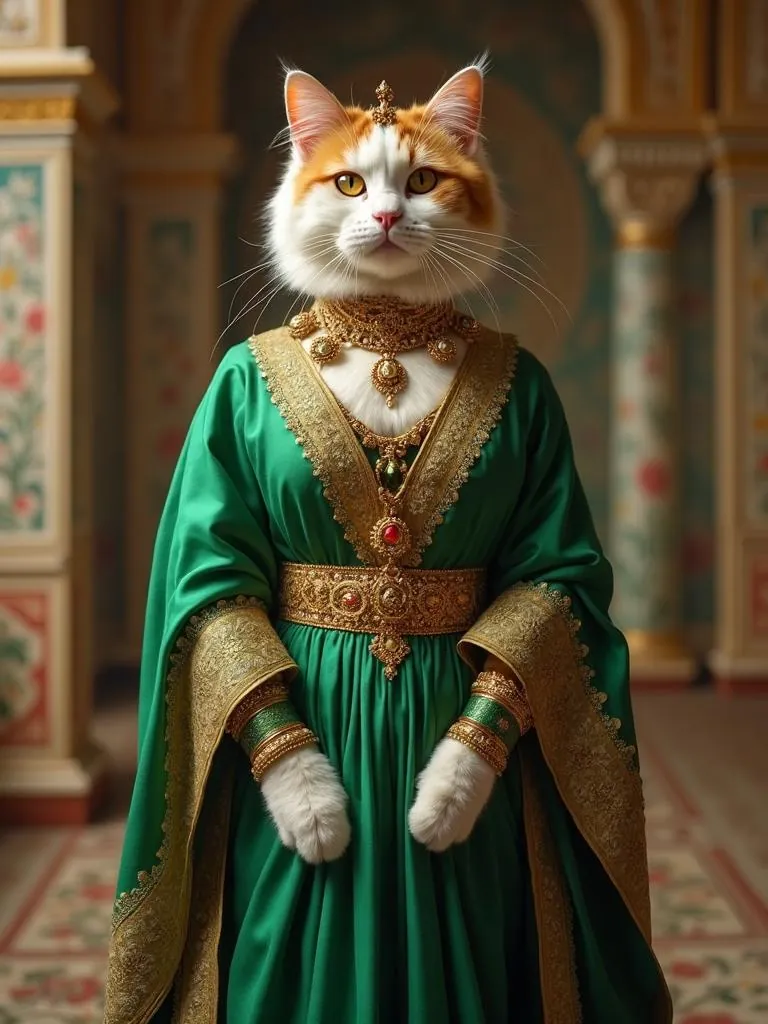
The Maharani portrait style is Purrealism's Indian queen look. Your cat or dog sits in a long green and gold anarkali dress, with an odhni draped over the head, a jewelled maang tikka at the forehead, and pearl strings at the neck. The gallery cover for this style, a white and ginger cat in the full costume, is the clearest example on the site. This page covers what the style borrows from real maharani portraits, which pets it suits, and how it differs from the Maharaja and the other Indian styles.
The courts behind the Maharani style
A maharani was the queen or chief consort of an Indian princely state. The title is Sanskrit, from maha meaning great and rani meaning queen. Encyclopaedia Britannica describes the maharani as the female counterpart of the maharaja, and the title was used across Hindu India. The maharani of a major princely state was a public figure. She appeared in formal portraits, she held her own court, and in some states she governed on behalf of a minor son.
The formal portrait of a maharani followed a different set of conventions from the portrait of her husband. A maharaja portrait centred on the regalia of rule: a sarpech on the turban, a scabbard across the lap, and a gold throne. A maharani portrait centred on the regalia of the court consort: a maang tikka at the forehead, pearl strings at the neck, an anarkali dress in silk, and an odhni, a long embroidered veil, draped over the head and across one shoulder. The throne or seat in a maharani portrait was often lower and softer than the maharaja's, cushioned in silk.
The Victoria and Albert Museum in London holds Indian court portraits from this period, including paintings and drawings of Rajput royal women. These paintings show the costume conventions that Purrealism draws from: the odhni in a fine silk or cotton with a woven gold border, the maang tikka in emerald and gold, and the background in warm painted tones. The museum also holds Indian court jewellery of the type worn in these portraits, including forehead ornaments from the 19th century.
The Rajput schools of painting, which reached their peak between the 17th and 19th centuries, produced both male and female court portraits. The women's portraits tended to use lighter colour palettes than the men's, with rose, pale green and ivory. The Mughal influence on Rajput courts also brought the use of pearl strings at the neck and the high-collared, fitted bodice. The Maharani costume on Purrealism draws from both conventions: the Rajput warmth of colour and the Mughal precision of jewellery.
What the Maharani style looks like
A Purrealism Maharani portrait keeps the elements of the court portrait and puts the pet in the queen's place. The costume reads from the head down. At the top is the odhni: a long veil in deep green silk, with a gold embroidered border, draped over the head so that the pet's ears remain visible on either side. A maang tikka sits at the forehead, pendant down, with a green stone at the centre.
At the neck are three rows of pearl strings, close to the chin, and a gold collar with a central emerald below them. The dress is an anarkali, a fitted long dress with a flared lower half, in deep green silk with gold thread work along the hem and the cuffs. The arms are bare from the elbow down, with gold bracelets at the wrist. The background is a soft warm wash in rose and ochre, painted in the flat manner of Rajput court portraits.
The light in the portrait falls from the sitter's left, with gentle shadows on the right side of the face. The painting is not photographic. The shadows are flat and the lines are clean, which is the manner of the court painters who worked for the Rajput and Mughal rulers of the 18th and 19th centuries. The palette is warm throughout: green silk, gold thread, rose background and pearl white.
The gallery cover portrait shows a white and ginger cat in this costume. The cat's face is framed by the odhni on either side, the ears point upward between the veil's folds, and the maang tikka rests at the centre of the forehead above the eyes. The pearl strings reach from under the chin to the collar. The seated pose uses both forepaws resting forward on a low cushioned platform.
Which pets suit the Maharani style
The style suits a cat or dog whose ears frame well under the odhni. The veil falls on either side of the head, so upright ears stay visible and add to the portrait. A cat with large, upright ears, such as a tabby, a Siamese, an Abyssinian or an Ocicat, carries the costume without losing the ears in the fabric. A white, cream or ginger coat sits well against the green and rose palette.
Long-haired cats also suit the style. The soft green and rose background does not compete with long fur the way a dark background would. A Persian, a Ragdoll, a Maine Coon or a Norwegian Forest cat all work in this style. The gallery example is a short-haired white and ginger cat, and its face is clean and clear at every print size.
A dog can wear the Maharani style as well. A golden retriever, a Cavalier King Charles spaniel, a shih tzu, a Bichon Frise and a Pomeranian all carry the odhni and the anarkali well. The round or broad-headed breeds work best because the veil falls more naturally around a wide head than a narrow one. A long-nosed sighthound such as a greyhound or a Borzoi reads better in the Rajput Warrior style, where the narrow head sits in an armoured frame against a landscape.
For a male dog, the Maharaja style is worth comparing. The Maharaja uses a tall red turban and a gold throne, which suits the same broad-headed breeds. The Maharani style may read better for a female dog or for an owner who prefers the warm green and rose over the formal red and gold.
Choosing Maharani against the other Indian styles
The Maharani is one of six Indian royal styles on Purrealism. The table below shows how it differs from the others.
| Style | Court | Costume centre | Palette |
|---|---|---|---|
| Maharani | Hindu princely state | Odhni, maang tikka, anarkali | Green, gold, rose |
| Maharaja | Hindu princely state | Red turban, sarpech, gold throne | Red, gold, deep blue |
| Mughal Emperor | Mughal dynasty | Jewelled crown, pearl strings, flower | Blue, white, floral border |
| Rajput Warrior | Rajput court | Armour and sword | Bronze, orange, desert sunset |
| Patiala Royalty | Sikh maharaja of Patiala | Blue coat, halo, jewelled turban | Blue, gold, saffron |
| Mysore Royal | Wodeyar dynasty of Mysore | Saffron turban, gold sceptre | Saffron, deep green, gold leaf |
The practical guide: choose Maharani when the pet is a cat with upright ears, when the owner prefers a warm green and rose palette over a red and gold one, or when the portrait is for a female pet. Choose Maharaja when the pet is a broad-headed dog and the room has a formal, dark-toned wall. Choose Mughal Emperor when the painting's flat miniature border is the main appeal.
Writing the room around a Maharani portrait
A Maharani portrait uses a warm palette, so it suits a room with a warm wall. Terracotta, sage green, deep cream and warm grey all work. A cold white wall flattens the rose and gold in the background. The framing and hanging guide at /guides/framing-and-hanging covers the frame choice. A dark wood frame or a thin gold frame reads well beside the green and gold in the costume. A white or silver frame reads too modern against the embroidered veil.
The portrait works in a sitting room, a bedroom, a hallway or a dining room. It is a quieter formal piece than the Maharaja, which uses stronger reds and a gold throne. In a bedroom, the rose background reads as a warm accent against most wall colours. In a hallway, the portrait gives a visitor something to read as they move past.
From photo to Maharani portrait
The photo gives the studio the pet's face, the shape of the ears and the direction of the eyes. A Maharani portrait needs to see the forehead clearly, because the maang tikka sits there. A photo of the cat or dog looking forward or at a slight angle, seated, at eye level, with good light on the face and no flash, gives the painter the most to work with. A photo in soft daylight from a window, with the camera held low, is the standard starting point. The pet photo guide at /guides/pet-photo-guide covers the full checklist.
Once the photo is uploaded at /create, the studio returns the portrait in the Maharani style. The result comes as a digital download or as an art print on matte or glossy paper. The art prints and paper guide at /guides/art-prints-and-paper covers the paper choice. For the Maharani style, a matte paper reads the flat painted quality of the court portrait most faithfully. A glossy paper lifts the green silk and the pearl strings, which suits a room with good natural light.
The Royal portrait styles hub at /guides/royal-portrait-styles collects the full list of styles side by side, and the gallery at /gallery shows finished portraits. The Maharani style also works as a gift for Diwali, a birthday, or for any occasion where a formal portrait in a warm Indian palette would be welcome. The gift guide at /guides/pet-portrait-gifts lists the occasions where this style fits best.
Questions and answers
What does Maharani mean?
Maharani means great queen in Sanskrit, from maha meaning great and rani meaning queen. The title was used for the chief consort of a maharaja in India's princely states, and also for a woman who ruled a state in her own right. Encyclopaedia Britannica describes the maharani as the female counterpart of the maharaja, the same title used by the wives of Hindu rulers from Rajasthan to Mysore during the 19th century.
What does the Maharani style look like?
The Maharani portrait style shows your pet in a long anarkali dress in green and gold silk, with an odhni, a long embroidered veil, draped over the head. A maang tikka sits at the centre parting of the forehead. Pearl strings loop at the neck and wrists, and the background uses warm tones of rose and saffron. The gallery portrait shows a white and ginger cat dressed this way, seated with both forepaws resting forward.
Which cat breeds suit the Maharani style?
The Maharani style suits a cat whose ears sit upright and frame well under the odhni. The veil falls on either side of the head rather than over it, so upright ears remain visible. A tabby, a Siamese, a ginger cat, a white Persian and a Ragdoll all carry the costume well. The gallery example is a white and ginger cat. Long-haired cats benefit from the soft warm tones in the background, which sit beside a pale or warm-coloured coat.
Can my dog be a Maharani?
A dog can wear the Maharani style. A golden retriever, a Cavalier King Charles spaniel, a shih tzu and a Pomeranian all suit the costume well. The odhni falls naturally around a round or broad head. A long-nosed sighthound such as a greyhound suits the Rajput Warrior style better, where the narrow head reads more clearly against an armoured costume. For a dog, the Maharaja style is also worth comparing, as it uses a similar seated pose.
What is the difference between Maharani and Maharaja?
Maharani and Maharaja are the queen and king of the same Indian princely court. The Maharaja costume uses a tall red turban, a sarpech ornament and a scabbard across the lap. The Maharani costume uses an odhni over the head, a maang tikka at the forehead, and a long anarkali dress. The Maharaja style suits a dog whose head carries a turban; the Maharani style suits a cat whose ears stay visible under a veil.
What is a maang tikka in the Maharani costume?
A maang tikka is a head ornament worn at the centre parting of the hair in Indian court dress. A pendant hangs on the forehead, suspended by a chain attached to a pin at the crown. In Maharani court portraits from the 19th century, the maang tikka was set with emeralds, rubies or diamonds. The Victoria and Albert Museum holds Indian jewellery from this period, including forehead ornaments of this type.
What colour palette does the Maharani style use?
The Maharani style uses green, gold and rose. The anarkali dress is deep green silk with gold embroidery along the hem. The odhni is a lighter green with a gold border. The background sits in rose and warm ochre, which complements both pale and ginger coats. The pearl strings at the neck are white, and the maang tikka uses a green stone at the centre. These colours follow Indian court paintings of the Rajput and Mughal period.
What photo works best for a Maharani portrait?
A Maharani portrait starts best from a photo of your cat or dog looking forward or at a slight angle, seated, at eye level. A clear view of the face, with the ears visible, lets the studio place the odhni and the maang tikka cleanly. Soft daylight from a window, with no flash, gives the best result. The photo should be sharp at the eyes and under 5 MB. The pet photo guide at /guides/pet-photo-guide covers the full checklist.
Is the Maharani style suitable as a gift for Diwali?
The Maharani style works well as a Diwali gift because its palette of green, gold and rose reads as a celebration print. Diwali is a festival of lights observed by Hindu, Jain and Sikh communities, and a royal portrait in an Indian court style fits the occasion. The gift guide at /guides/pet-portrait-gifts lists Diwali alongside birthdays, Christmas and other dates. A print in the Maharani style makes a gift that stands out from standard pet photos.
How big should a Maharani portrait be?
The Maharani portrait suits a medium to large print, because the odhni, the maang tikka and the embroidery on the gown carry detail that a small print would lose. On an 8 by 10 print the costume reads clearly, and on a 12 by 16 or 16 by 20 the pearl strings and the gold border on the veil become readable individually. The pricing page at /pricing lists the available sizes. A digital download keeps the full resolution for printing later.
What room suits a Maharani portrait?
A Maharani portrait works well in a room with a warm wall colour, such as terracotta, sage green or deep cream. The rose and gold in the background read warmly against those tones. A hallway, a sitting room or a bedroom all suit the style. A dark wood frame or a thin gold frame works better than a modern white frame. The framing and hanging guide at /guides/framing-and-hanging covers the frame choice and placement in more detail.
Sources
- Maharani, Encyclopaedia Britannica. Accessed October 6, 2026.
- Indian royal jewellery and court dress, Victoria and Albert Museum. Accessed October 6, 2026.
- Portraits of Rajput women at the V and A, Victoria and Albert Museum. Accessed October 6, 2026.
- Maharaja Karam Singh of Patiala and his son, Asian Art Museum, San Francisco. Accessed October 6, 2026.