Maharaja portrait style: your dog or cat as a Hindu royal
The Maharaja portrait style on Purrealism: the real courts behind it, the costume, which pets suit it, and how it differs from the other Indian styles.
By Purrealism. Part of Royal portrait styles: a guide to the 15 styles for your pet.
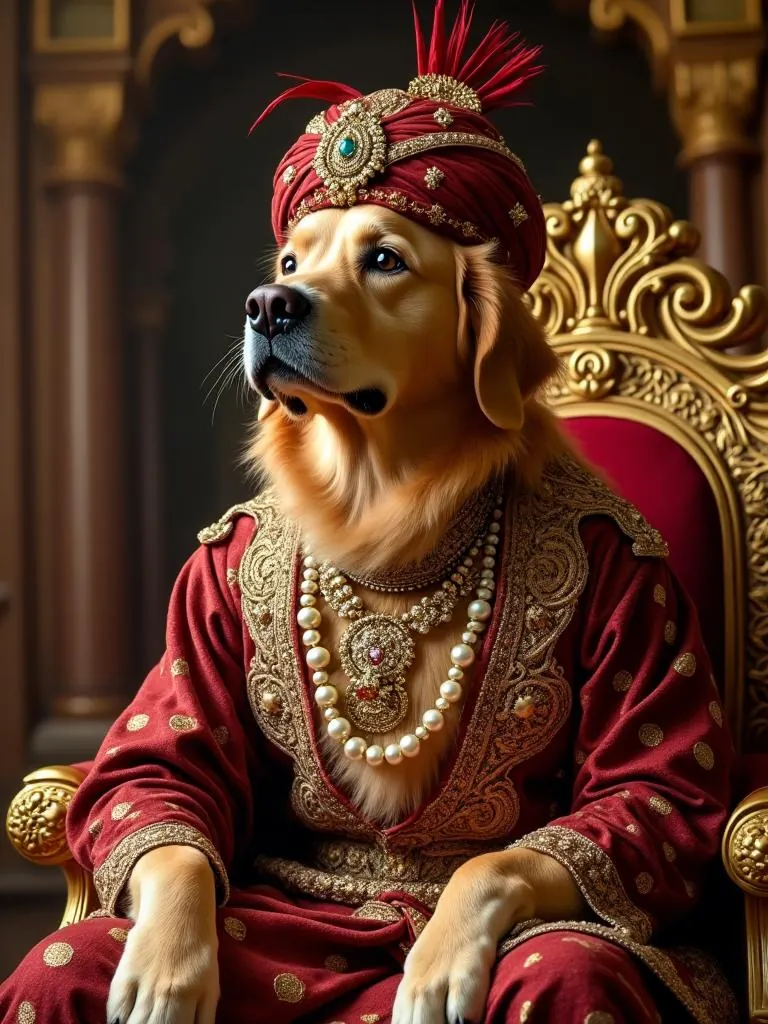
The Maharaja portrait style is Purrealism's most formal Indian royal look. Your dog or cat sits on a gold throne, in a red jewelled turban, with pearl strings at the neck and a scabbard across the lap. The gallery cover for this hub, a golden retriever in this style, is the clearest example on the site. This page covers what the style borrows from real maharaja portraits, which pets it suits, and how it differs from the other Indian royal styles.
The courts behind the Maharaja style
A maharaja was the ruler of an Indian princely state. The word is Sanskrit, from maha meaning great and raja meaning king. Encyclopaedia Britannica says the title was used across Hindu India and that British officials adopted it as a formal rank for the rulers of states that signed treaties with the British crown. By the 19th century the title was carried by rulers from Rajasthan to Mysore, including the maharajas of Patiala, Jodhpur, Udaipur, Jaipur, Mysore and Travancore.
A maharaja portrait was the state portrait of its day. It had to carry across a long hall, to be legible to a visitor at the back, and to show the ruler's rank without the need for a caption. The portraits that survive share a short list of features: a frontal or three-quarter pose, a jewelled sarpech on the turban, pearl strings at the neck, a scabbarded sword across the lap, and a seated frame on a throne or chair.
A late 19th-century example of this tradition sits at the Royal Ontario Museum: a miniature portrait of Maharaja Mahendra Singh of Patiala, painted on ivory. The Asian Art Museum in San Francisco keeps a group portrait of his great-grandfather, Maharaja Karam Singh of Patiala, with his son. Karam Singh was the first of the Patiala rulers to take the title of Maharaja. He kept Rajasthani painters at his court from 1814 to 1815, which blended Rajasthani and Punjabi conventions into the Patiala court style.
The Mughal courts, which came before, used a different format. The Mughal Emperor style, which has its own page, follows the imperial portraits in the Shah Jahan Album, held at the Metropolitan Museum of Art. Those portraits are small, mounted on wide floral borders, and painted in profile. The Maharaja style borrows the sarpech and the pearl strings from the Mughal tradition but keeps the broader seated frame of the 19th-century princely portrait.
What the Maharaja style looks like
A Purrealism Maharaja portrait keeps the elements of the state portrait and puts the pet in the ruler's place. The costume reads from top to bottom. At the top is the red jewelled turban, with a sarpech in the centre and strings of pearls looped along the sides. The sarpech holds a large coloured stone, usually an emerald, with gold filigree around it. Beneath the turban is a long face: in the gallery example, a golden retriever looks forward with ears framed by the turban cloth.
At the chest is a long robe in deep red or blue, embroidered along the hem with gold thread. Pearl strings loop at the neck, in two or three rows. A scabbarded sword rests across the lap, horizontally, with the hilt to the sitter's right. At the base is the throne: a gold frame with a red cushion, carved along the arms. Behind the throne, a plain painted wall sits in a muted red or green.
The light falls softly from the sitter's left. The painted shadows are flat, not deep, which is why the costume reads so clearly. This is close to what Karnataka Tourism describes for the Mysore tradition: delicate lines, muted colours and intricate brushwork, with the gold reserved for the jewellery.
Which pets suit the Maharaja style
The style suits a dog whose face sits well under a jewelled turban. A broad head carries the turban without hiding the ears, and a straight muzzle lets the pearl strings fall against a long jaw. The gallery example, a golden retriever, carries the look as well as any breed on the site. A labrador, a shepherd, a corgi, a pomeranian, a shih tzu, a cocker spaniel, a cavalier king charles spaniel and a border collie all share the same facial shape and work for the same reason.
A cat can wear the Maharaja style, but the Maharani style, which the next page covers, suits a cat better in most cases. The Maharaja turban is tall and the collar is high; a cat with upright ears and a confident expression can carry it, but a cat whose ears sit lower is more at ease in the Maharani costume. The studio examples show cats of several breeds in the broader Indian Royalty family, including Siamese, Persian and tabby cats in warrior and aristocrat looks.
A very long-nosed sighthound, such as a borzoi, a whippet or a greyhound, works less well in Maharaja because the long nose stretches past the turban's natural fall and competes with the sarpech. For those breeds, the Rajput Warrior style, with armour and a sunset fort behind, pairs the long head with a long landscape and reads more cleanly.
Choosing a Maharaja portrait against the other Indian styles
Six Indian royal styles share the same vocabulary of turbans, thrones and jewels. The quick comparison below shows what makes Maharaja different.
| Style | Court | Costume centre | Background |
|---|---|---|---|
| Maharaja | Hindu princely state | Red turban with sarpech, gold throne | Plain painted wall |
| Mughal Emperor | Mughal dynasty | Jewelled crown, pearl strings, flower in hand | Wide floral border |
| Rajput Warrior | Rajput court | Armour and sword | Sunset over a desert fort |
| Patiala Royalty | Sikh maharaja of Patiala | Blue coat, jewelled turban, halo | European-style chair |
| Mysore Royal | Wodeyar dynasty of Mysore | Saffron turban, gold sceptre | Mysore palace columns |
| Chola Warrior | Chola dynasty | Bronze-coloured armour | Temple architecture |
The practical shortcut: pick Maharaja when a buyer wants the simplest, most legible Indian royal look. The costume reads from across a room, and the gold throne and red turban make the portrait recognisable as a maharaja painting without further caption.
Writing the room around a Maharaja portrait
A Maharaja portrait is a formal piece. The gold throne and deep red robe work best in a room that has a dark wall or a muted wall colour. A cream, warm grey or forest green wall sets off the red and gold. The framing and hanging guide covers the frame choice. A dark wood frame or a gilt frame suits the style; a thin matt frame reads too modern against the jewelled turban.
The style is a strong presence. A Maharaja portrait tends to sit well on its own, with no other large picture nearby, so the eye can read the full costume. Over a mantelpiece, in a dining room, or above a reading chair are the three places where this style is most at home. For a hallway or a staircase, a quieter style such as Victorian Noble or Regency Era reads better in passing.
From photo to Maharaja portrait
The photo matters more than the style. A clear, well-lit photo of your pet, in soft daylight, at eye level, with sharp eyes, lets the painter place the sarpech and the pearl strings cleanly. The pet photo guide covers the full checklist: light from a window or open shade, no flash, the camera held low, and a plain background. A photo under 5 MB is accepted at /create.
Once the photo is uploaded, the studio returns a painted portrait in the Maharaja style within the project's standard turnaround. The result comes as a digital download or an art print. The art prints and paper guide covers the paper choice. For a Maharaja portrait, a matte paper reads the painted costume as it is; a glossy paper lifts the pearls and the gold more.
Once the portrait is ready, the Royal portrait styles hub at /guides/royal-portrait-styles collects the full list of styles, and the gallery at /gallery shows finished portraits in each one. For the Maharaja style in particular, the cover portrait is the clearest reference: a golden retriever on a gold throne, in a red jewelled turban, in the pose that the 19th-century maharajas of Patiala and Jodhpur sat for.
The Maharaja portrait can also be a gift. A dog owner who keeps a large retriever, a poodle or a bernese mountain dog will read the costume at once. The gift page at /purrspectives/dog-mom-gifts lists occasions where a royal pet portrait works, and the gift occasion guide at /guides/pet-portrait-gifts covers birthdays, Diwali, Christmas and other seasonal dates.
Questions and answers
What does Maharaja mean?
Maharaja means great king in Sanskrit, from maha meaning great and raja meaning king. The title was given to the Hindu rulers of India's princely states, from Rajasthan to Mysore. Encyclopaedia Britannica says British officials used it as a formal title during the Raj and that the Maharaja of Patiala was the first ruler of Patiala to take the title, succeeding his grandfather Sahib Singh.
What does the Maharaja portrait style look like?
The Maharaja portrait style on Purrealism shows your pet seated on a gold throne, in a red jewelled turban, with a scabbard across the lap and heavy pearl strings at the neck. The cover of the Royal portrait styles hub shows a golden retriever in this style. The costume follows the 19th-century maharaja portraits of Rajasthan and Punjab, which paired a jewelled turban with a European-style chair.
Which dog breeds suit the Maharaja style?
The Maharaja style suits a dog whose face sits well under a jewelled turban. A golden retriever is the gallery example, and its broad head carries the turban comfortably. A labrador, a shepherd, a corgi, a pomeranian, a shih tzu and a cocker spaniel all work for the same reason. A long-nosed sighthound such as a borzoi or a greyhound suits the Rajput Warrior style better.
Can my cat be a Maharaja?
A cat can wear the Maharaja style, but the Maharani style suits a cat better in most cases. The Maharaja costume centres on a tall turban, which can hide a cat's ears. The Maharani costume keeps the cat's ears visible under a long veil. If a cat has large upright ears and a confident expression, the Maharaja style still works, as the studio examples show.
Is Maharaja the same as Mughal Emperor?
Maharaja and Mughal Emperor are different Indian styles. Maharaja is a Hindu ruler of a princely state, usually painted in the 19th century, in a jewelled turban and a European chair. Mughal Emperor is a Muslim emperor of the Mughal dynasty from the 16th to 18th century, painted in a Mughal miniature with a wide floral border, as in the Shah Jahan Album at the Metropolitan Museum of Art.
What colour palette does the Maharaja style use?
The Maharaja style uses red, gold and deep blue. The red appears in the turban and the throne cushion, the gold in the throne frame and the turban ornaments, and the deep blue in the robe and the background. These colours follow the 19th-century portraits of Patiala, Jodhpur and Udaipur, which used strong reds and golds for a formal state portrait.
What does the jewelled turban in the Maharaja style mean?
The jewelled turban in the Maharaja style is a sarpech, the forehead ornament worn by Indian rulers. The sarpech held an emerald or ruby at the centre, with pearl strings along the sides. Emperor Jahangir of the Mughal court had tiny portraits of himself made as gifts to his nobles, and the Cleveland Museum of Art keeps one such Portrait Jewel of Emperor Jahangir, which the sarpech descended from.
What size works for a Maharaja pet portrait?
The Maharaja portrait suits a large print, because the costume carries detail that a small print would lose. On an 8 by 10 print the throne and the sarpech sit clearly, and on an 11 by 14 or 16 by 20 print the pearls and jewels become readable. The pricing page at /pricing shows the available sizes. A digital download keeps every detail at full resolution.
How is the Maharaja style different from Patiala Royalty?
The Maharaja style follows a broad Hindu princely tradition, with a red turban, a gold throne and a scabbard. Patiala Royalty follows the Sikh maharajas of Patiala, with a blue coat, a halo around the head and a European chair, as in the portrait of Maharaja Karam Singh of Patiala held at the Asian Art Museum. Both are formal state styles, but Patiala Royalty carries Sikh and British influence.
What photo works best for a Maharaja portrait?
A Maharaja portrait starts best from a photo of your pet looking straight at the camera, sitting still, at eye level. The 19th-century maharaja portraits use a frontal or three-quarter pose, which the studio follows. A photo in soft daylight with sharp eyes, under 5 MB, gives the painter the detail to carry the turban and the pearls. The pet photo guide at /guides/pet-photo-guide covers the full checklist.
Sources
- Maharaja, Encyclopaedia Britannica. Accessed October 6, 2026.
- Miniature portrait painting of Maharaja Mahendra Singh of Patiala, Royal Ontario Museum. Accessed October 6, 2026.
- Portrait Jewel of Emperor Jahangir, The Cleveland Museum of Art. Accessed October 6, 2026.
- Maharaja Karam Singh of Patiala and his son, Asian Art Museum, San Francisco. Accessed October 6, 2026.