Poodle history: Germany, the French court and the distinctive clip
Poodle history from German duck retrievers and the French royal court to the three sizes, the distinctive clip and photographing a poodle for a portrait.
By Purrealism
The Poodle began as a working dog in the water, hunting ducks for German and French hunters, and ended up in the baskets of French kings and the courts of European nobility. Its distinctive clip started as a practical grooming style and became a fashion statement. This guide follows the Poodle from its origins in Germany to the French royal court, explains the three sizes and the clip, and ends with how to photograph one for a royal portrait.
German duck retriever
The Poodle most likely began in Germany, where it was bred as a water retriever. The American Kennel Club says the breed's name comes from the German word pudeln, meaning to splash in water, which describes its original work: retrieving waterfowl from lakes and rivers for hunters. The breed's curly, water-resistant coat kept it warm in cold water, and its strong swimming ability made it effective in the field.
In France, the breed was called the Caniche, from the French word for duck. France, Germany and Russia have all been connected to the breed's early history, but the AKC says Germany is the most likely origin. The Standard Poodle was the original working retriever, and the same intelligence and trainability that made it suited to fieldwork later made it a natural performer in circuses and a skilled truffle hunter in France.
The distinctive clip
The Poodle's grooming style is one of the most recognisable in the dog world. It began as a practical trim for a water-working dog. The American Kennel Club says hunters trimmed the legs, neck and tail to reduce water resistance when the dog swam. The puffs of fur left around the joints and chest protected the dog's vital organs and joints in cold water. The feet and face were kept short to give the dog better movement.
The decorative elements came later, in the French court. Rosettes on the hips, pompoms on the tail and puffs on the legs reflected the fashions of powdered wigs and ruffles popular in the French court of the 1700s. The practical trim and the fashion trim became one style that has stayed with the breed ever since.
The French royal court
Poodles became closely associated with French royalty and nobility. The American Kennel Club says King Henri III of France, who reigned from 1574 to 1589, was known for carrying small poodle-type dogs in a basket around his neck. Louis XVI favoured Toy Poodles, and the breed became a fixture in the courts of the French nobility. The poodle became so closely identified with France that it is often called the French national dog, despite having German origins.
Three sizes
The Poodle comes in three sizes. The American Kennel Club says the Standard stands over 15 inches at the shoulder, the Miniature stands 15 inches or under, and the Toy stands no more than 10 inches. All three sizes maintain the same proportional body structure and the same low-allergen curly coat.
The AKC recognised the Standard and Miniature as separate varieties in 1887. The Poodle Club of America, founded in 1931, recognised the Toy Poodle as a third variety in 1943. The AKC places the Standard and Miniature in the Non-Sporting Group and the Toy Poodle in the Toy Group. Despite the separate groupings, the three are regarded as varieties of one breed.
Photographing a Poodle for a royal portrait
A Poodle's most recognisable features are its textured, curly coat and its upright, alert posture. Getting both in one photo calls for the right light and patience. These steps add to the full guide on photographing dogs:
- Sit at the dog's eye level. An upright poodle looks best when the camera is level with its face, not looking down. This shows the full head and the upright ears.
- Use window light from the side. Side light shows the depth and texture of the curly coat. Light from behind the camera flattens the coat and loses the texture.
- Wait for the upright posture. A Poodle's posture is part of its character. Wait until the dog is standing or sitting straight before you focus.
- Choose a plain background. The curly coat and the distinctive clip are detailed enough. A plain background keeps the focus on the dog.
- Show the full head and ears. The long, low ears and the rounded skull are part of the breed's shape. Leave enough room in the frame for both ears.
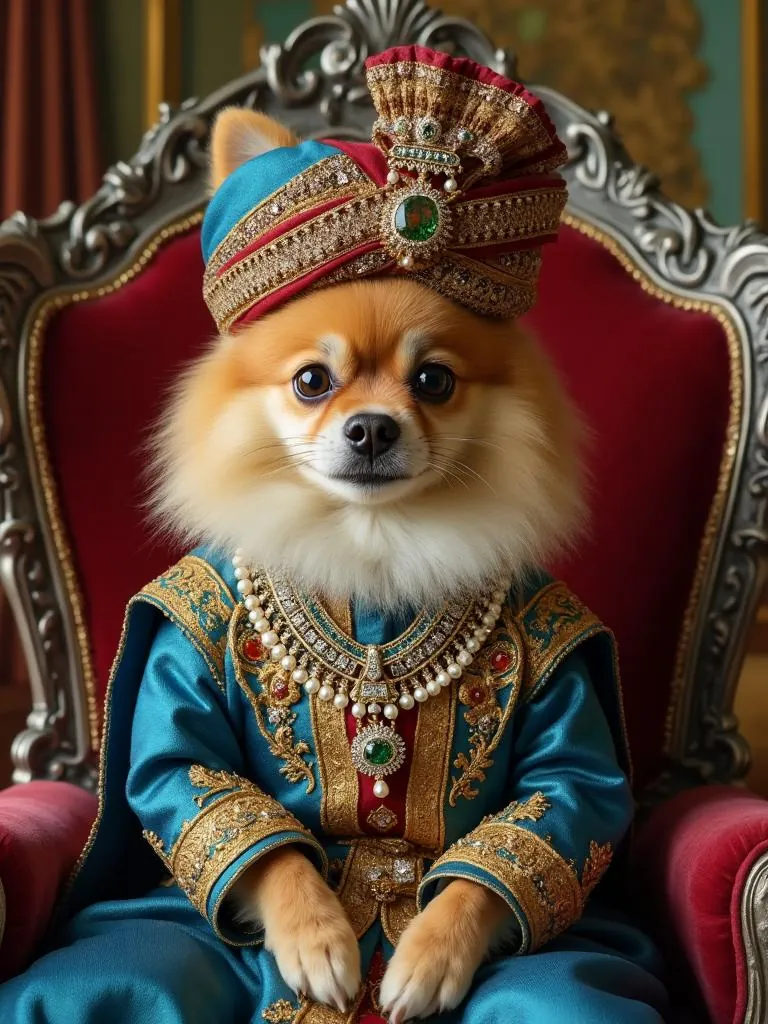
The gallery shows dogs in Maharaja and Mysore royal styles. When your photo is ready, the portrait studio lets you choose from 15 royal styles and upload a photo of up to 5 MB.
Questions and answers
Where do Poodles originally come from?
Poodles most likely originated in Germany, though France and Russia have also been connected to the breed's early history. The American Kennel Club says the Poodle's name comes from the German word pudeln, meaning to splash in water, which reflects the breed's original role as a water retriever and duck hunter. Despite the German origins, the breed became closely associated with France, where it was developed into a court dog over several centuries.
What does the word poodle mean?
The word poodle comes from the German word pudeln, meaning to splash in water, according to the American Kennel Club. The name reflects the breed's original purpose as a water retriever used by hunters to collect ducks from lakes and rivers. In France, the breed was called the Caniche, from the French word for duck, canard, also referring to the dog's work in water.
Why do poodles have that distinctive haircut?
The Poodle's distinctive clip began as a practical grooming style for water retrievers. The American Kennel Club says hunters trimmed the legs, neck and tail to reduce water resistance when the dog swam after ducks. The puffs of fur left around the joints and chest protected the dog's vital organs and joints in cold water. The decorative elements, rosettes on the hips and pompoms on the tail, were added later and reflected the fashions of the French court.
What are the three sizes of poodle?
There are three sizes of poodle: the Standard, the Miniature and the Toy. The American Kennel Club says the Standard stands over 15 inches at the shoulder, the Miniature stands 15 inches or under, and the Toy stands no more than 10 inches. All three sizes maintain the same proportional body structure and the same low-allergen curly coat. The Poodle Club of America, founded in 1931, recognised the Toy as a third variety in 1943.
Did French royalty keep poodles?
French royalty had a strong connection with poodles. The American Kennel Club says King Henri III of France, who reigned from 1574 to 1589, was known for carrying small poodle-type dogs in a basket around his neck. Louis XVI also favoured Toy Poodles among the French nobility. The breed became so closely identified with France that it is often called the French national dog, despite having German origins.
When did the AKC recognise the poodle?
The American Kennel Club recognised the Standard and Miniature Poodle as separate varieties in 1887. The Poodle Club of America was founded in 1931. The Toy Poodle was recognised as a third variety by the Poodle Club of America in 1943. The AKC places the Standard and Miniature in the Non-Sporting Group and the Toy Poodle in the Toy Group.
What were poodles originally used for?
Poodles were originally used as water retrievers to collect waterfowl for hunters. The American Kennel Club says the breed's curly, water-resistant coat and its strong swimming ability made it suited to this role. The Standard Poodle was the original working retriever, and the breed's intelligence and trainability made it easy to direct in the field. It later moved into performing, circus acts and truffle hunting in France.
What colour are poodles?
Poodles come in a range of solid colours, with black, white and apricot among the most common. The American Kennel Club says all three sizes of poodle share the same low-allergen curly coat, and that the coat can also be silver, brown, cream and blue. Parti-coloured poodles, with patches of two colours, exist but are not recognised in the AKC show ring. The coat does not shed in the way a typical dog coat does.
How do I photograph a poodle for a royal portrait?
A poodle's most recognisable features are its textured, curly coat and its upright, alert posture. Sit at the dog's eye level and use window light from the side to show the depth of the coat. Wait for the dog to hold its posture upright before you tap the nearest eye to focus. Leave enough room in the frame to show the full head and ears. The guide to [photographing dogs](/guides/pet-photo-guide/photographing-dogs) has more steps on angles and lighting.
Sources
- Poodle History, American Kennel Club
- Standard Poodle, American Kennel Club
Share this guide
The button copies a ready-written post, then opens LinkedIn. Paste the text into the post box.
Go deeper
The full guides on this topic, each a set of pages with sources: