Corgi history: Wales, the spitz family and the royal kennels
Corgi history from medieval Wales to the 1934 breed split, Susan the birthday corgi, Queen Elizabeth II and photographing a corgi for a royal portrait.
By Purrealism
The Pembroke Welsh Corgi is a small dog with a long history. It began as a working farm dog in Wales, drove cattle across fields for centuries, and reached the royal kennels of Buckingham Palace in the 1930s. This guide follows the corgi from the Welsh farms where it worked to the dog that went on a royal honeymoon, and ends with how to photograph one for a portrait.
A working dog from Wales
The Pembroke Welsh Corgi started as an all-purpose farmyard dog in Wales. The American Kennel Club says the breed herded cattle to grazing lands, helped guard livestock, controlled rodents and offered family protection. Its method was to drive cattle by nipping at their heels and quickly dropping below the line of a kick. The low, long body was practical: a dog that works at the heels of a herd needs to be close to the ground.
The word corgi likely comes from Welsh. The American Kennel Club gives two possible origins: the Welsh words for dwarf and dog combined, or the word curgi, meaning to watch over. The Pembroke belongs to the spitz family, with related breeds that include the Swedish Vallhund, the Norwegian Buhund and the Schipperke. The AKC dates the breed to at least the tenth century in Wales.
Two breeds, one name
The Pembroke is not the only corgi. The Cardigan Welsh Corgi shares the name and the country but belongs to a different family. The American Kennel Club says the Pembroke, found in southern Wales, belongs to the spitz group, while the Cardigan, found in northern Wales, belongs to the teckel group, the same family as the dachshund. The two breeds look similar but are distinct.
The most obvious difference is the tail. The Pembroke is naturally short-tailed, while the Cardigan has a long, fox-like tail. For many years the two were shown together as one breed. In the 1920s, the Kennel Club in England recognised the corgi. In 1934, the Kennel Club officially separated the two into distinct breeds, and that same year the first two Pembrokes were registered with the American Kennel Club. The first American champion, Little Madam, took her title in 1935.
From Welsh farms to royal kennels
The royal connection with corgis began in 1933, when breeder Thelma Gray brought a litter of Pembroke Welsh Corgis to show the Duke of York, the future King George VI, and his family. The American Kennel Club says the family chose a puppy and named him Dookie. A few years later, Gray gave the family another Pembroke called Jane. The princesses Elizabeth and Margaret grew up with these dogs.
The corgi that defined the breed in the public mind was Susan. For her eighteenth birthday in 1944, the then Princess Elizabeth was given Susan, registered with the Kennel Club as Hickathrift Pippa. The AKC says Susan went everywhere with the Princess, including on the honeymoon, hidden under blankets in the royal carriage. Queen Elizabeth II bred from Susan for the rest of her life, and the AKC records that all subsequent royal corgis were descended from her, across more than 30 dogs and at least 14 generations.
The Pembroke Welsh Corgi Club of America was founded on 12 February 1936. By 2023, the AKC ranked the breed eleventh in the United States by registration.
Photographing a corgi for a royal portrait
A corgi has three features worth showing: the long, low body, the large upright ears and the thick double coat. These steps add to the full guide on photographing dogs:
- Sit on the floor at eye level. A corgi is low to the ground, so the camera needs to be low too. A photo taken from above makes the dog look shorter and hides the chest.
- Use window light from the side. Side light shows the texture of the double coat and brings out the colour of the markings.
- Wait for the ears. A corgi with drooping or sideways ears gives a different impression than one with upright, alert ears. Wait for stillness, then shoot.
- Leave room for the full length. The long body is part of the breed character. Step back enough to fit the whole dog in the frame before you crop.
- Show the face straight on. The wide, fox-like face with its large ears and dark eyes is the most distinctive part of a corgi.
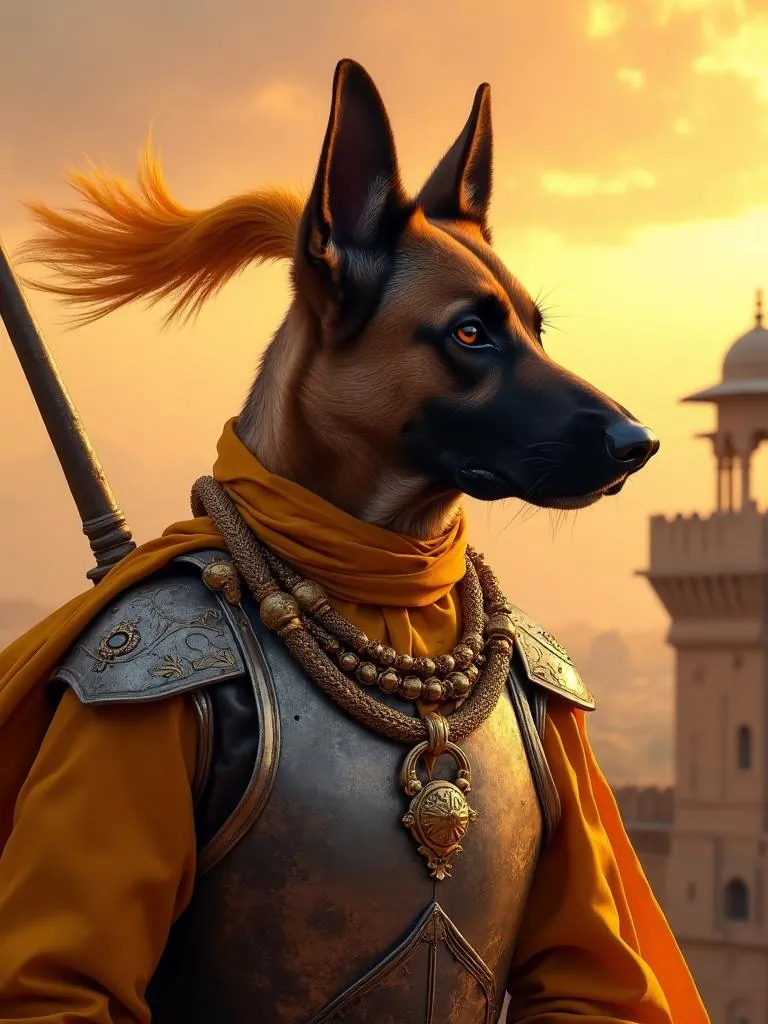
The gallery shows dogs in Rajput and Maharaja styles. When your photo is ready, the portrait studio lets you choose from 15 royal styles and upload a photo of up to 5 MB.
Questions and answers
What were corgis originally bred for?
Corgis were originally bred in Wales as working farm dogs. The American Kennel Club says the Pembroke Welsh Corgi was an all-purpose farmyard dog that herded cattle to grazing lands, controlled rodents and helped guard livestock. The breed drove cattle by nipping at their heels and darting away, using its low body to avoid kicks. This same low shape, long and close to the ground, defines the breed today.
What does the word corgi mean?
The word corgi likely comes from Welsh words meaning dwarf dog, according to the American Kennel Club. The AKC gives two possible origins: the Welsh words for dwarf and dog combined, or the word curgi, meaning to watch over. Both interpretations fit the breed, which is small in size and was used to watch over cattle and farm property in Wales for centuries.
What is the difference between a Pembroke and Cardigan Welsh Corgi?
The Pembroke and Cardigan Welsh Corgi are two separate breeds. The American Kennel Club says the Pembroke belongs to the spitz family and was found in southern Wales, while the Cardigan is older and belongs to the teckel group, found in northern Wales. The most visible difference is the tail: the Pembroke is naturally short-tailed, while the Cardigan has a long, fox-like tail. They were officially recognised as separate breeds in 1934.
When was the corgi recognised as a breed?
The Kennel Club in England recognised the corgi as a breed in the 1920s, according to the American Kennel Club. In 1934, the Kennel Club officially recognised the Pembroke and Cardigan as two separate breeds. That same year, the first two Pembroke Welsh Corgis were registered with the American Kennel Club. The first American champion, a dog called Little Madam, took her title in 1935.
Who brought the first corgi to the royal family?
Breeder Thelma Gray brought a litter of Pembroke Welsh Corgis to show the Duke of York, the future King George VI, and his family in 1933. According to the American Kennel Club, the family chose a puppy and named him Dookie. A few years later, Gray gave the royal family another Pembroke called Jane. These were the corgis that the young princesses Elizabeth and Margaret grew up with.
Who was Susan the corgi?
Susan was a Pembroke Welsh Corgi given to Princess Elizabeth as an eighteenth birthday gift in 1944. The American Kennel Club says Susan, registered as Hickathrift Pippa, became so close to the Princess that she accompanied Elizabeth on her honeymoon, hidden under blankets in the royal carriage. Queen Elizabeth II bred from Susan, and the AKC says all subsequent royal corgis descended from her across more than 30 dogs and at least 14 generations.
How did corgis get such short legs?
The Pembroke Welsh Corgi has short legs because the breed was built to herd cattle. The American Kennel Club explains that a low body suited the herding work: the dog could nip at cattle heels and then drop below the level of a kick. The Pembroke belongs to the spitz family, whose relatives include the Swedish Vallhund, and the stocky, low body shape has been part of the breed for centuries.
Are corgis good at herding?
Corgis are still recognised as herding dogs. The American Kennel Club classes the Pembroke Welsh Corgi in its herding group, alongside breeds such as the Border Collie and German Shepherd. The AKC says the Pembroke drives cattle by nipping at their heels and quickly moving out of the way. Modern Pembrokes still compete in herding trials, and by 2023 the AKC ranked the breed the eleventh most popular in the United States.
When was the Pembroke Welsh Corgi Club of America founded?
The Pembroke Welsh Corgi Club of America was founded on 12 February 1936, according to the American Kennel Club. The club was established two years after the breed was first registered with the AKC in 1934, and its first meeting took place at the Westminster Kennel Club show. By 2023, the AKC ranked the Pembroke Welsh Corgi as the eleventh most popular breed in the United States by registration.
How do I photograph a corgi for a portrait?
A corgi has three features worth showing: the long, low body, the large upright ears and the thick double coat. Sit on the floor at the dog body level and use window light from the side to bring out the texture of the coat. Wait until the ears are upright and the dog is still before shooting. The guide to [photographing dogs](/guides/pet-photo-guide/photographing-dogs) has more steps on angles and focus for small dogs.
Sources
- Pembroke Welsh Corgi, American Kennel Club
- Pembroke Welsh Corgi History, American Kennel Club
- Queen Elizabeth II Royal Pembroke Welsh Corgis, American Kennel Club
Share this guide
The button copies a ready-written post, then opens LinkedIn. Paste the text into the post box.
Go deeper
The full guides on this topic, each a set of pages with sources: