Boxer dog history: Bullenbeissers, Munich 1895 and two World Wars
Boxer dog history from the German Bullenbeisser hunting dog and the 1895 Munich club to World War II service, the Westminster show and portrait tips.
By Purrealism
The Boxer is a German breed with a long ancestry and a 20th century rise to popularity. Its roots trace back to the Bullenbeisser, a medieval German hunting dog, and its modern form was developed in Munich at the end of the 1800s. The breed served in two World Wars and produced some of the most decorated show dogs in American history. This guide follows that history and ends with how to photograph a Boxer for a royal portrait.
The Bullenbeisser: a hunting dog of the German nobility
The Boxer's most direct ancestor was the Bullenbeisser, a large German hunting dog whose name means bull biter. The American Kennel Club says German noblemen bred the Bullenbeisser from Molosser descendants, a group of large, powerful dogs with ancient origins in the Middle East and Asia. The dog was used to hunt boar, bear and other large game on noble estates.
The Bullenbeisser's undershot jaw, where the lower teeth extend past the upper teeth, let the dog hold a large animal by the nose while still breathing through the gap at the sides of its mouth. This feature, present in modern Boxers, was practical before it became a physical standard. After the Napoleonic Wars, as large German estates were divided up, the dog's job changed. Bullenbeissers moved into work for butchers and cattle dealers, and smaller individuals were crossed with English Mastiff-type dogs to produce what would become the modern Boxer.
Munich 1895 and the breed standard
The modern Boxer breed was formalised in Munich. The American Kennel Club says the first Boxer club was founded there in 1895. The founding dogs included a brindle female called Alt's Flora, imported from France, whose descendants produced Muhlbauer's Flock, the first Boxer to be registered when the stud book opened in 1904.
The breed's name comes from the way it uses its front legs. The AKC says a Boxer raises and uses its front paws in play and defence in a way that resembles a human boxer in a ring. An earlier German name for the Bullenbeisser, Boxl, may also have contributed to the name.
Boxers reached the United States in 1904, the same year they were first registered with the American Kennel Club. The American Boxer Club was established in 1935, placing the breed in the AKC's Working Group alongside breeds such as the Doberman Pinscher and the Great Dane.
Two World Wars
Boxers served in military roles in both World Wars. The American Kennel Club says the breed served across all branches of the armed forces during World War II alongside German Shepherds, Doberman Pinschers and Belgian Malinois. Their roles included messenger work, guard duty and search tasks. A well-known photograph shows a Boxer parachuting behind enemy lines.
Bang Away and the show ring
The Boxer's most celebrated moment in American show history came in 1951, when CH Bang Away of Sirrah Crest won Best in Show at the Westminster Kennel Club show. The American Kennel Club says Bang Away went on to win 121 Best in Show titles and appeared in national magazines. His record stood for nearly 70 years, until 2020, when another Boxer, GCHP2 CinniBon's Bedrock Bombshell, known as Wilma, won her 133rd Best in Show title.
Temperament and growth
The American Kennel Club describes Boxers as bright, alert and sometimes silly, and says the breed is always courageous. The AKC adds that Boxers take four to five years to reach full maturity, longer than most dogs of similar size. This slow maturity means young Boxers often keep the boisterous energy of a puppy well into their second and third years. The breed craves human companionship and does well in active households.
Photographing a Boxer for a royal portrait
A Boxer has a broad, flat face and an alert, upright expression, and both features show best at eye level. These steps add to the full guide on photographing dogs:
- Sit on the floor at eye level. A photo taken from above shortens the face and makes the dog look smaller. Get down to the dog's level to show the full face.
- Use window light from the side. Side light shows the musculature of the chest and the texture of the short coat. Light from behind the camera flattens both.
- Choose a plain or dark background. A Boxer's fawn or brindle coat shows well against a plain dark or neutral surface. A busy background competes with the dog's markings.
- Capture the alert expression. A Boxer's most recognisable look is ears up, eyes forward, posture straight. Wait for that moment before you tap the screen to focus.
- Show the full head. The broad, flat skull and the deep muzzle are the breed's signature. Leave enough space in the frame for the whole head.
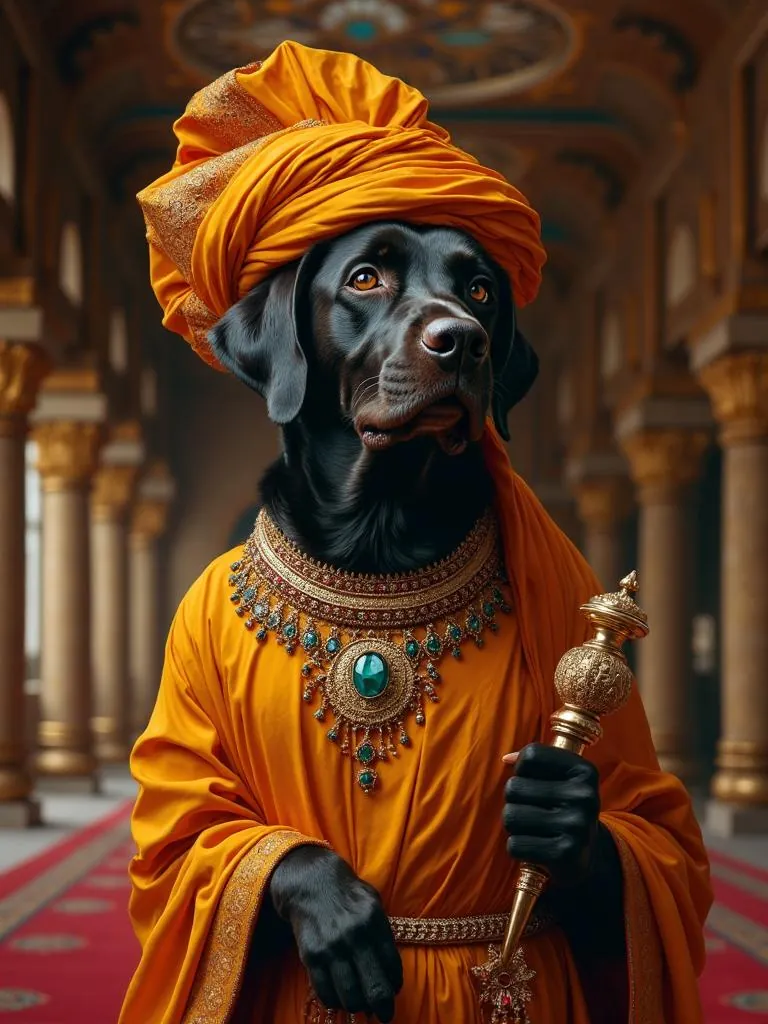
The gallery shows dogs in Mysore and Maharaja royal styles. When your photo is ready, the portrait studio lets you choose from 15 royal styles and upload a photo of up to 5 MB.
Questions and answers
Where do Boxer dogs come from?
Boxer dogs come from Germany, where the breed developed in Munich in the late 1800s. The American Kennel Club says the modern Boxer descended from the Bullenbeisser, a German hunting dog bred from ancient Molosser dogs. After the Napoleonic Wars, as German noble estates broke up, Bullenbeissers moved from hunting estates into work for butchers and cattle dealers. Smaller Bullenbeissers were then crossed with English Mastiff-type dogs to produce the modern Boxer.
What is a Bullenbeisser?
A Bullenbeisser was a large German hunting dog, whose name means bull biter in German. The American Kennel Club says German noblemen bred the Bullenbeisser from Molosser descendants during medieval times. The dog was used to hunt large game such as boar and bear. Its undershot bite let it hold an animal by the nose while still breathing. The Bullenbeisser is the main ancestor of the modern Boxer dog.
When was the first Boxer club founded?
The first Boxer club was founded in Munich, Germany, in 1895. The American Kennel Club says a Boxer called Muhlbauer's Flock, whose ancestry traced back to a brindle female called Alt's Flora imported from France, became the first registered Boxer when the stud book opened in 1904. The American Boxer Club was established in 1935, placing the breed in the American Kennel Club's Working Group.
Why are Boxers called Boxers?
The American Kennel Club says the Boxer uses its front legs in a distinctive way, raising them when it plays or defends itself, in a manner that resembles a human boxer in a ring. This trait, combined with the German word Boxl or Boxl, an earlier German name for the Bullenbeisser, is likely where the breed name comes from. The breed's powerful front legs and upright posture reinforce the name.
When did Boxers come to the United States?
Boxers reached the United States in 1904, the same year they were first registered with the American Kennel Club. The American Boxer Club began operations in 1935. The AKC says the breed has been among the most popular in America for a long time, rising steadily through the registration rankings over the 20th century.
Did Boxers serve in World War II?
Boxers served in military roles in World War II. The American Kennel Club says the breed served across all branches of the armed forces alongside German Shepherds, Doberman Pinschers and Belgian Malinois. A well-known photograph shows a Boxer parachuting behind enemy lines. The breed's intelligence, strength and trainability made it suited to wartime roles including messenger work, guard duty and search tasks.
What is the most famous Boxer dog in show history?
The most famous Boxer in American show history is CH Bang Away of Sirrah Crest, who won Best in Show at the Westminster Kennel Club show in 1951. The American Kennel Club says Bang Away won 121 Best in Show awards and received wide coverage in national magazines. His record was surpassed in 2020 by another Boxer, GCHP2 CinniBon's Bedrock Bombshell, known as Wilma, who won 133 Best in Show titles.
How long do Boxer dogs take to mature?
Boxer dogs take four to five years to reach full maturity, according to the American Kennel Club. The AKC describes the breed as boisterous and sometimes silly, and says the breed's slow maturity means puppies often keep their playful behaviour well into adulthood. Owners describe young Boxers as energetic and affectionate dogs that need steady training and regular exercise while they are growing.
What group do Boxers belong to?
Boxers belong to the Working Group of the American Kennel Club, the same group that includes breeds such as the Doberman Pinscher, the Great Dane and the Rottweiler. The American Boxer Club placed the breed in this group when it joined the AKC in 1935. Working Group breeds were historically bred to perform tasks such as guarding, pulling sleds or carrying out military and police work.
How do I photograph a Boxer for a royal portrait?
A Boxer has a broad, flat face and an alert, upright expression, and both show best when the camera is at the dog's eye level. Sit on the floor and use window light from the side to bring out the musculature of the chest and the texture of the short coat. A dark or plain background helps the face stand out. The guide to [photographing dogs](/guides/pet-photo-guide/photographing-dogs) has more steps on angles and focus.
Sources
- Boxer History: The Boisterous Breed That Has Been a Fan Favorite for Decades, American Kennel Club
- Boxer, American Kennel Club
Share this guide
The button copies a ready-written post, then opens LinkedIn. Paste the text into the post box.
Go deeper
The full guides on this topic, each a set of pages with sources: